Skeptical criticism on Buddhist beliefs and observances.

What about taking up a monk's life in a Buddhist community, what's that, a sangha? maybe in Thailand. At least to be logical in your committal to what, Theravada Buddhism? Because from reading in the web I understand that Theravadans are expected to assume sangha life in a community as their ideal, the fastest and surest way to attain Nirvana.


Yrreg

That is my plan, I just need to earn enough money for the flight there and back. And since I'm currently unemployed, that's not easy.
 
Ken, most of the practical application of zen practice to martial arts is to get your thinking out of the way of your training. So you don't tie yourself up in fancy schemes 4 moves ahead but react to what's actually happening. The degree of practically of this is open to debate and it's yet another area of martial arts that acts as a b*llsh*t magnet.
I read an interesting description of zen as understood in normal japanese life in a translation of a Book of 5 Rings "the real art of Japanese management" by some Shorinji Kempo practitioners. This has its own branch of Buddhism (diamond zen) which is as questionable as SK's links to Shaolin temple. As I recall it tied in with the quotes from Victoria's book (which I must buy) that it's seen as an attitude of focusing on what you're doing.
Yrreg - thanks for the pointer to the book. However, why do you continue on about things that have been explained? The title "resident buddhist" is a whimsy, that's all. There are no rules restricting titles.
 
That's always confused me, because there was a guy named Kung Fu Tsu (or some approximation) almost a millennium earlier, who wrote a lot of good stuff. Was the one named after the other, or what?
No. Kung Fu Tse is Master Kung, Kung being his family name. Kung fu means something like "skill acquired through hard work" and can apply to cooking or hairdressing as much as martial arts.
 
Maybe if you trained in something that had to do with fighting, you'd think different. My training doesn't consist of practicing choreographed motions and teaching choreography.

I suggest that you have a bigoted view of aikido. The practise of certain moves is like learning a language, the moves are the alphabet, once one is proficient with the letters , one can learn the words and concepts.

In many practises the forms are not used in the sense of practise. In free practise the thrower is approached by the others and varios attacks are employed, it is up to the thrower to respond or hopefully move prior to the initiation of the attack, the movements in that case are not coregraphed. But hey , if you like to think of things the way you do that is cool.

I could recomend that you practise aikido, but sounds as though you are close minded about it. I do agree that there is a lot of mystical garbage that is taught in aikido, but the practise itself is the key, not the words. My sensei Tohei Akira was not particularly mystical, very practical.


So do you practise punches to learn to do them with reacting?
No, I strive to be a better fighter, and thus, better at defending myself.

Different roads.

My instructors claimed that by learning to read the bodies of eople in the moment you could somehow determine the attack at the moment it was lauched and therefore counter it.

The main goal of aikido is different from most martial arts, in that the training is to learn to avoid fights.
 
"...for they are non-violent people..."

No, Buddhism is not so massively and chronically associated with violence and atrocity, but given a chance and smug with power, Buddhists can also fall prey and relish inflicting agony and death on fellow humans, all in the name of their noble religious philosophy.

Here are excerpts from an article I found in the web of a Westerner who took up Buddhism, Zen, as the religion of peace unlike faiths originating from the Middle East. Please read the whole article.


However, Brian Victoria is still not disillusioned with Buddhism, he has adopted the NARB (not a real Buddhist) defense.


According to Christopher Stevens, the author of the article:


I would earnestly recommend to Brian Victoria to instead take up with the Greenpeace activists for a lifetime advocacy, or with the folks at Amnesty International. One need not have to adopt any esoteric metaphysics to experience the impulse to adopt a noble existence.

So, what else is new?


Yrreg

I have been sceptical of the claim myself, and did start a thread about it two years ago.

The irony exists in many buddhist culture where the eating of meat is not approved, but butchering is done by a sperate caste.

I am not sure that the modern japanese military was totaly buddhist but it is a very telling point.

I will point out that the Dalai lama has not used violence to return to Tibet.

Also many Xians seem to feel that the teachings of christ allow for warfare!
 
Here are excerpts from an article I found in the web of a Westerner who took up Buddhism, Zen, as the religion of peace unlike faiths originating from the Middle East. Please read the whole article.

Yes, I've read the 'Zen Holy War' article before, many years ago. I've seen the article on many Buddhist sites.

But remember that while Zen Buddhism is one of Japan's religions, it's quite minor compared to the number one Japanese religion, Shinto. And it was mainly Shinto that was the religious driving force behind Japanese aggressions at the beginning to mid 20th century. It was Shinto that viewed the Emperor as a god.

I'm not saying that Japanese Buddhists are blameless, though. The two biggest Japanese Zen schools, Soto and Rinsai, were loyal to the emperor.

But I've never claimed that Buddhists are perfect, anyway.
 
yrreg - Go bother Randi if you feel you must. I'm sure he as better things to do than tone down the appropriate response, but I'm sure you've just got to scratch that itch.

username - Welcome.
 
Kid crying, "Wolf, wolf."

(Wudang #182) Yrreg - thanks for the pointer to the book [Zen at War]. However, why do you continue on about things that have been explained? The title "resident buddhist" is a whimsy, that's all. There are no rules restricting titles.​
​

Yes, like the kid calling out wolf wolf when he knew there was no wolf lurking about; but remember, a wolf was around when he last called wolf wolf.

Please bear with me, everyone here, I have this habit from way back in youthful childhood, of pestering my elders with questions which they thought had been explained –- to themselves satisfactorily.

Actually I am not talking about rules here, but more of what I might call the ideology of the JREF on no patronage in any hint even of any philosophico-religious system. Am I correct about this ideology of JREF?

What am I after? To change things? Too ambitious, just to change thinking.

No, I am still not happy with Ryokan sporting the label of Resident Buddhist, though I must confess that if Buddhism makes him the guy he is here in this thread, a softspoken mild character (can't say the same about myself), that's enough merit for others to sign up with Buddhism, even without as I said all the esoteric or mystical metaphysics.

Just out of curiosity and to continue my experiment I might just try to contact James Randi, and see whether he can agree with my less accommodating sentiment, objecting to Ryokan’s self-designated title of Resident Buddhist, for the same reasons I entertain on this score.

-----------

Allow me to give notice again that I am here just to enjoy exercising what I have learned about scientific skepticism as applied to paranormal phenomena, pseudoscience, and supernaturalism; and no offense to Buddhist comrades here, I feel that Buddhism is a good subject to apply skeptical criticism to.

attachment.php


I think I should adopt the logo above for my own, if James Randi does not mind.


Yrreg
 

Attachments

  • JREF logo.gif
    JREF logo.gif
    3.8 KB · Views: 19
Incidentally, I need help!

See that material below, and know how I did that? And that will appear also below, here in the present message.

attachment.php


No, I don't want that thing to appear, but the way I am going about putting a graphic in a message here in this forum always leads to that "Attached Thumbnails".

And how did I come to know about that procedure? By looking around for instructions here and experimenting and so far that is the way I have arrived at.

People here more knowledgeable and skillful, please tell me of better ways to put a graphic in a message, without that attached thumbnail appearing at the bottom of the message when it gets published.


Thanks -- I am really a dummy.


Yrreg
 

Attachments

  • thumbnail.jpg
    thumbnail.jpg
    6.1 KB · Views: 21
What is mystical metaphysics for Yrreg.

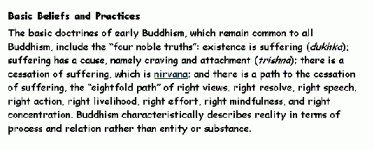
I picked up that phrase, mystical metaphysics, from reading in the web. And I thought I have a good idea of what it means. So I applied it to Buddhism because the four noble truths of Buddhism make up what I think is a mystical metaphysics.

Here, I will reproduce a word-picture from Columbia Encyclopedia on the four noble truths of Buddhism.

attachment.php

(I should have just done a copy and paste routine instead of my multi-steps print-copy, MS Word, MS Paintbrush, etc., but it's enjoyable fun in a way...)

That word picture tells me what I understand to be a mystical metaphysics and the mystical metaphysics that is Buddhism.

I read in the web that Buddha does not go for metaphysics, so I guess that is the nearest he gets to metaphysics -- unless our good Buddhist experts here can give me the authentic Buddhist metaphysics.

I have not read Pirsig's "Zen and the Art of Motorcycle Maintenance," something like that, but I understand it has to do with his metaphysics of quality. I have read some reviews in the web of this book, and the impression I get is that he is also into some mystical metaphysics.

I have a strong suspicion that all metaphysics in the light of our knowledge today of science and technology is mystical metaphysics, with the exception of the metaphysics of first principles of knowledge, like that one about the law of contradiction, a thing cannot be and not be at the same time and under the same aspect, and that one about Occam's principle of thought economy, as someone here reproduces it under his every message: "Entia non sunt multiplicanda praeter necessitatem" -- something like that.

Well, I hope I have hit the idea about mystical metaphysics which skeptics would understand by that phrase.

Please correct me for mistakes in my meanings of words and phrases.

Yrreg
 

Attachments

  • buds beliefs.gif
    buds beliefs.gif
    6.8 KB · Views: 23
so that we may all understand what you are saying more accurately please define mystical and metaphysical as you are using them.

Also, what do you consider buddhism to be? Or, what aspect or teaching are you finding objectionable or woo-woo?

I ask you to define these terms only so that I , and others, may better understand your thoughts.

As I look for the definition of metaphysical I find at least a dozen very distinct definitions for the term. When it comes to buddhism I understand there are a few/several main schools, but in total there are a couple thousand individual schools of thought.

I don't even know where to begin unless you clarify what these terms mean to you.

As far as the 4 noble truths that you pasted, I don't see that they fit any definition of mystical or metaphysical that I know of, so in order to continue a beneficial conversation on the topic I would need to understand why you regard them as such.

Thank you in advance for your thoughts.
 
Two observations, or three...

Observation 1.

Buddhists seem to make much of nothingness, and one here gives the example of nothingness being great for doors and windows. That is what I see time and again with some Buddhists, making play on words.

The only message in such plays on words is to my evaluation, that the human mind cannot see into the intricacies of reality. So? so better just to accept the teachings of Buddhist masters: about self or no-self, rebirth, Nirvana, and depend on meditation to see light at the end of the tunnel?

On the contrary in fact there are innumerable minds who do see into the intricacies of reality, starting with those plays on words from Buddhist masters of quibble.


Observation 2.

Do all Buddhists believe in recurring rebirths? or only religious Buddhists, but not philosophic Buddhists? Anyway, unlike in Hinduism its mother religion and philosophy (or step-mother or mother-in-law), where there is some soul that is being 'rebirthed' again and again, Buddhism is novel in this regard that it rejects the existence of the soul or self.

And this is where honest Buddhists confess to difficulties in explaining how nothing is the identically same intermediary thing (pun not intended) between rebirths.

When you read their attempts at explanation you will realize that they are trying to drown you in a tsunami of words, hoping that you will accept the no-self for an intermediary nothingness between rebirths, or be amenable to sweep all the difficulties under the rug.

--------------

Observation 3.

There is now here in this thread noticeably more volume of words in the direction of my kind of skeptical criticism in regard to Buddhism; so, this thread is picking up, getting more enjoyable to read and to write for, and thereby more educational as intended by the founder of this foundation called James Randi Educational Foundation, understanding education as learning to be scientifically skeptical.

So, that is new.


Yrreg
 
username - You seem to be something of a kindred spirit. Make no mistake, I'm not trying to associate with you all of the negativities that I've been accumulating. You just remind me of me, but nicer.

yrreg - I think that one book that might help make some sense of things is The Spirit of Zen by Alan W. Watts. I've been rereading it since this I tripped across this thread. I'd be interested in your thoughts and questions on Buddhism after reading this book.

Also, you mentioned Pirsig's Zen and the Art of Motorcycle Maintenance. This has been a favorite of mine for decades (I can't believe I just said 'decades') and I try to reread it every year or so. Someone once observed that it doesn't have that much to do with Zen and even less to do with motorcycle maintenance, but I have found the book to be very thought provoking, wise, and personally scary.

It is an autobiographical / biographical account of a man with a history of mental illness discovering who he was earlier in his life, trying to reconcile that with who he is now, and concerned about signs that his son may be troubled. It takes the form of a motorcycle trip that the father and son take westward, interspersed with flashbacks and discussions.

It is a great book. The author does have touches of woo, especially evident in an afterward to the book that was written several years later, but I can only embrace him for that - it comes out when he talks about the death of his son, the one that accompanied him on that journey.

Pirsig's Zen is largely a book about Quality, and I have incorporated a lot of what I understand from that book. One of the people in this book is Phaedrus - I've been far to close to him for comfort - that is what scares me. It is a haunting book for me.

Pirsig wrote a second book, Lila, that is in many ways a sequel to Zen. It also is autobiographical, fascinating, and has made me think off and on for years. I think I'll start to reread Lila tonight.
 
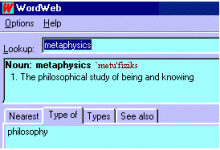
Mystical and metaphysics from WordWeb.

I think I can accept the definitions of mystical and metaphysics from WordWeb online dictionary.

Here, I am going to reproduce the snapshots of the definitions, because I enjoy doing this routine, even though it takes time and perseverance, like joining dots to draw a figure.

Mystical:
attachment.php

I believe meaning #3 is my idea of the mystical.

Metaphysics:
attachment.php

The philosophical study of being and knowing,
that is a genius of a definition by WordWeb.

Yes, I believe that Buddhism from my citation of Columbian Encyclopedia is a mystical metaphysics, understanding the words as defined by WordWeb.

I must confess that I really do not have the chromosomes to appreciate all kinds of mystical things like others here with a mystical slant enjoy dwelling in, for example, Buddhist enthusiasts.

And I guess people with mystical leanings just have to live with people like myself with almost nothing of mysticism -- perhaps except a feeling of wonder in looking at a terrific landscape like of forests and mountains and skies, all clean and sparkling without the filth of man scattered debris -- as usual with my sense organ this time of sight, nothing by meditation or flashes of enlightenment.


Yrreg
 

Attachments

  • myst inwweb.gif
    myst inwweb.gif
    6.3 KB · Views: 20
  • met in wweb.gif
    met in wweb.gif
    3.7 KB · Views: 23
Observation 1.

Buddhists seem to make much of nothingness, and one here gives the example of nothingness being great for doors and windows. That is what I see time and again with some Buddhists, making play on words.

The only message in such plays on words is to my evaluation, that the human mind cannot see into the intricacies of reality. So? so better just to accept the teachings of Buddhist masters: about self or no-self, rebirth, Nirvana, and depend on meditation to see light at the end of the tunnel?

On the contrary in fact there are innumerable minds who do see into the intricacies of reality, starting with those plays on words from Buddhist masters of quibble.

I don't think you understand the concept of nothingness in buddhism. I suspect, but don't yet know with any certainty, that one of the difficulties with buddhism for those raised in a western culture is that buddhist teachings were originally penned in eastern languages. When translating things are lost. Words are used which unfortunately mean something to those who use the language natively that is different than what those translating wish to convey. As I undertand it nothingness means everythingness.

You may consider this a clever play on words, but I don't think it is, rather I think it is more likely a difficulty in translation. An honest difficulty in conveying meaning rather than an intentional deception.

It is a release from suffering, desire and the finite state of self. It arises from the understanding that everything is interconnected (everythingness).

Believing in the self results in viewing ourselves as seperate, disconnected from everything else. Nothingness is viewing our 'self' as a fictional construct which impedes our ability to realize how we are interconnected to everything else.

Since I am just beginning to investigate buddhism I cannot offer you anything more. All I can offer you is I do not believe you correctly understand what you are criticising. I have not read it yet, but I understand from the opinions of others that you might enjoy 'buddhism without beliefs' which is a book on buddhism that divorces the practice/essence from the various beliefs and cultural trappings of the various sects/denominations.

For the remainder of your inquiry I leave to to those who actually know what they are talking about. I hope that nothing I have said has been factually incorrect, but prefer the posts of those who better understand than I do.
 
For the remainder of your inquiry I leave to to those who actually know what they are talking about. I hope that nothing I have said has been factually incorrect, but prefer the posts of those who better understand than I do.

Seems to me you understand pretty well :)
 
Observation 1.

Buddhists seem to make much of nothingness, and one here gives the example of nothingness being great for doors and windows. That is what I see time and again with some Buddhists, making play on words.

The nothingness quote is attributted to Lao Tzu in the Dao De Ching. The play on words is just irrascable human nature. It is the nothingness of the door that makes a house useful. And there is in the buddhist tradition, the symbol of the empty house to represent the five skanhas as the dwelling of non-self.

The only message in such plays on words is to my evaluation, that the human mind cannot see into the intricacies of reality. So? so better just to accept the teachings of Buddhist masters: about self or no-self, rebirth, Nirvana, and depend on meditation to see light at the end of the tunnel?

Again, the buddha did not teach this, although there are schools which teach faith as the path to enlightenment.

Tye buddha taught that the student should criticaly examine the teaching of the buddha, but there are those who stray from the path that the buddha taught and use faith as a tool/crutch.

There is another buddhist image of the old man who is blind with a stick.

On the contrary in fact there are innumerable minds who do see into the intricacies of reality, starting with those plays on words from Buddhist masters of quibble.

I have heard that the koans of Chan and zen are meant to teach the student that words and concepts are fetters that need to be evaluated as a carpenter does thier tools.

Observation 2.

Do all Buddhists believe in recurring rebirths? or only religious Buddhists, but not philosophic Buddhists? Anyway, unlike in Hinduism its mother religion and philosophy (or step-mother or mother-in-law), where there is some soul that is being 'rebirthed' again and again, Buddhism is novel in this regard that it rejects the existence of the soul or self.
The issue of reincarnation is really tough one for buddhists, in the Mahayan traditions there are teachings that the soulkd is re-ncarnated multiple times often just like the progenitor of hindus. So there are buddhist schools which hold to some very metaphysical beliefs, in tibet there is the belief in the reincarnation of former master, who should have attained nibbanna, and is therefore a paradox.
And this is where honest Buddhists confess to difficulties in explaining how nothing is the identically same intermediary thing (pun not intended) between rebirths.

This is an essential teaching of the buddha, he often made reference to lamps.
And then would ask then student to ponder if the flame on the lamp was the same flame after it had been extinguished and then relit.
Or if the room was the same or not when lit by a different lamp. As a modern interpretation I take it to mean that the continuity of consciousness is n illusion of memory habits.

When you read their attempts at explanation you will realize that they are trying to drown you in a tsunami of words, hoping that you will accept the no-self for an intermediary nothingness between rebirths, or be amenable to sweep all the difficulties under the rug.

I agree, that is why I interpret the teachings in a non-metaphysical sense, I am a materialist in many ways.

There is not continutiy between the events of the perception of the self. Can a person who reads the words of Plato truely relive Plato?

In the wuote that I gave by Thich Naht Hahn, he states clearly the the vehicles which provide form are transformed and that the nature of being changes. I could be wrong, but I do not feel that he means the form of the cloud continues into the rain in some sort of rebirth, I take it to mean that the stuff of being changes and that we should accept it.

--------------

Observation 3.

There is now here in this thread noticeably more volume of words in the direction of my kind of skeptical criticism in regard to Buddhism; so, this thread is picking up, getting more enjoyable to read and to write for, and thereby more educational as intended by the founder of this foundation called James Randi Educational Foundation, understanding education as learning to be scientifically skeptical.

So, that is new.


Yrreg

If you offer beliefs that you are sceptical of then we can agree or diagree.

Here is a great big one that may interest you,

I worked for three years in a domestic violence shelter for women and thier children. Domestic violence is a huge issue around the world and quite an evil in all societies. I haven't studied amnesty internationals reprots to determine if the rates of domestic violence are lower in buddhist societies, because the reports state that womens rights are an issue in all nations and places.

It does bother me that societies that are grown in the precense of the teachings of the buddha are as rife with domestic violence as those that are not.

As I stated earlier, I do not believe that the buddha was a modern elgaltarian, his mother and wife had to browbeat him into allowing women into the sangha, from the tales.

 
met·a·phys·ics
NOUN:
(used with a sing. verb) Philosophy The branch of philosophy that examines the nature of reality, including the relationship between mind and matter, substance and attribute, fact and value.
(used with a pl. verb) The theoretical or first principles of a particular discipline: the metaphysics of law.
(used with a sing. verb) A priori speculation upon questions that are unanswerable to scientific observation, analysis, or experiment.
(used with a sing. verb) Excessively subtle or recondite reasoning.

ETYMOLOGY:
From pl. of Middle English methaphisik, from Medieval Latin metaphysica, from Medieval Greek (ta) metaphusika, from Greek (Ta) meta (ta) phusika, (the works) after the Physics, the title of Aristotle's treatise on first principles (so called because it followed his work on physics) : meta, after ; see meta- + phusika, physics ; see physics

http://education.yahoo.com/reference/dictionary/entry/metaphysics;_ylt=AoxGTgiUMuu1olioHv4Am0WsgMMF

mys·ti·cal

ADJECTIVE:
Of or having a spiritual reality or import not apparent to the intelligence or senses.
Of, relating to, or stemming from direct communion with ultimate reality or God: a mystical religion.
Enigmatic; obscure: mystical theories about the securities market.
Of or relating to mystic rites or practices.
Unintelligible; cryptic
 
I think I can accept the definitions of mystical and metaphysics from WordWeb online dictionary.

I cited the american heritage dictionary because culturaly the use of the words metaphysics and mystical in american usage tends more to be

'A priori speculation upon questions that are unanswerable to scientific observation, analysis, or experiment. '

and

'Of or having a spiritual reality or import not apparent to the intelligence or senses.'

although the definitions you cited are very valid and quite right.
Yes, I believe that Buddhism from my citation of Columbian Encyclopedia is a mystical metaphysics, understanding the words as defined by WordWeb.

I must confess that I really do not have the chromosomes to appreciate all kinds of mystical things like others here with a mystical slant enjoy dwelling in, for example, Buddhist enthusiasts.

And I guess people with mystical leanings just have to live with people like myself with almost nothing of mysticism -- perhaps except a feeling of wonder in looking at a terrific landscape like of forests and mountains and skies, all clean and sparkling without the filth of man scattered debris -- as usual with my sense organ this time of sight, nothing by meditation or flashes of enlightenment.


Yrreg
And again, the buddhist meditation is merely to learn to relax and be mindful, it is not the induction of a trance state, and enlightenment is the loss of the fetters that bind the mind from perception.
 

ISF - Join now!

Every member here is approved by hand. No bots, no spam, just people who care about evidence and honest debate.

Membership is free!

Create your free account

Back
Top Bottom