Merged DDWFTTW in a “Real” Wind

Status
Not open for further replies.
quote=llyricist
Again, that is NOT "Javaprop data"

If you use the geometry spork posted, it gives totally different results at 120 rpm and 8.04 m/s of: 2890 W, and 277.07 Newtons Thrust.

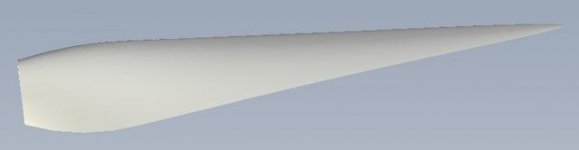
If you let Javaprop design the prop using 4.876m diameter, .304m spinner, 8.04 m/s, and 120 rpm, using the density and SoS provided by spork, it designs a prop that looks nothing like the actual prop, but gives the results that he posted.
 
I had noticed that the prop efficiency was beginning to drop for the higher powers.
If you kept the size constant, that makes sense. Highly loaded props are less efficient.

It would be nice to be able to calculate exactly what the power inputs were for the various cart speeds.

I don't have data for sporks prop but for a similar one that was automatically found by an JavaProp based optimization:

attachment.php


For simulation results above windspeed see attached PDF. The pitch is automatically set to maximize acceleration at each speed.

With increasing speed, shaft power and prop efficiency are both increasing. The theoretical efficiency for the design given by JavaProp was 93%, but with the resistance parameters I chose the max speed of above 3WS was achieved while working at only 79%.

In other words: The prop could be more efficient, but probably only at some much lower power input, that would not produce enough thrust to counter drag at 3WS.
 

Attachments

If you use the geometry spork posted, it gives totally different results at 120 rpm and 8.04 m/s of: 2890 W, and 277.07 Newtons Thrust.

If you let Javaprop design the prop using 4.876m diameter, .304m spinner, 8.04 m/s, and 120 rpm, using the density and SoS provided by spork, it designs a prop that looks nothing like the actual prop, but gives the results that he posted.

Gee, that's fascinating. Too bad the power, thrust and torque are also there...amd it does look the prop.....

vc=18*1.467 !vo (f/s) (this is 18 mph airspeed)
omega=120 !RPM
rho=.00226 !Density (slug/ft^3)1500 ft MSL
vsnd=1116.5 ! Speed of sound (f/s)
rt=8.0 !Tip radius (ft)
rh=0.5 !Hub radius (ft)
nblade=2 !Blade number
ao=5.73 !Lift curve slope of 2-d section
apzl= -5.0 !zero lift angle of attack (deg)
ld=67 !Section max L/D (6412 @350000 Re)
cl=0.9 !CL at max L/D
pflag=1 !1=fixed thrust 2 = fixed power
qdes=50. !design thrust (lb) or power (hp)

Design point:

Thrust= 49.9167099(lbs)
Torque= 124.131477(ft-lb)
Power= 2.83614945 (HP)
etap= 0.845000148

http://www.propdesigner.co.uk/html/about_the_author.html
Not a PhD, like Hepperle?

And you are an amateur musician?
 
Last edited:
Oh, you need to edit for that.

The idea still fails using Thrust = power/V as in the submission.
Unless you think you can do better than 100% ideal?

No, but you have yet to disprove my calculation showing that the cart works with 90% transmission efficiency, and will accelerate if the efficiency is higher than this.

Still waiting for your calculation of rolling resistance, by the way.

And details of where you explained how the cart accelerates.

I don't need to explain one thing to you.

After all, you deny the test data supplied by those rouges at Continental Tyres. They are in on it too you know. A great number of text books have been written to deny that cart. It is scandalous.

Oddly, there seems to be only one thing that employs any of the cart's claims. No boats, planes or machines of any sort, just one ddw cart.
Nobody has tried tying two ice-boats together.

I have yet to see any data from Continental: if their BMX tyres have a Crr of 0.0055, that's fine, 'cos that's what I used when I calculated the rolling resistance. Your turn now to calculate, with or without Continental's data.

You don't have to explain anything to me personally; I thought you might want to explain to the forum in general. If that is not the case, can I ask exactly why you are posting here?
 
Not a PhD like Mike Drela?

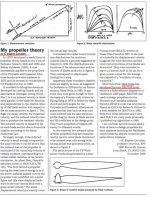
Larrabee is a reference, and used by Dr Drela and Javaprop's Dr Hepperle

attachment.php


From Drela's DDW paper:

"From the definition of turbine and propeller efficiencies:"
V boat speed ( in this case cart speed)
W =,wind speed
Fp = thrust force on air prop
Pp = shaft power of air prop
ηp = air prop total efficiency

Pp = Fp (V −W)/ηp

Idealised prop:

np =1
Fp = Thrust
Pp = Power
( V- W) = 28mph - 10mph) = 8.046m/s

Thrust = Power/Velocity
V = 8.046m/s
Thrust = 220.04N
Power = 8.046*220.04N = 1770W

Prop Torque = Power/w
w= 12.566 rad/sec.
=1770W/12.566
= 140.85N-m.

Transmission:
Gearing = 2.8:1
omega=120 RPM (groundspeed =28mph)
Wheel rate = 120*2.8
= 336rpm
= 5.6revs/sec
= 35.185 radians/sec

Groundspeed = 12.516m/s (28mph)
Wheel circumference = 12.516/5.6 = 2.235m
Radius = 2.235/2pi =0.3552m


Wheel Power:
Wheel Power (100% efficiency)
Wheel shaft torque = Prop Torque/2.8 =
140.85N-m/2.8 =
50.30N-m

P= T*w = 50.30*35.185 = 1769.80W

Wheel Drag:
F =T/r
50.30-m/0.3552 = 141.61N

Net force (100% efficiency idealized machine)
Aero drag = 21N
Rolling Resistance = 57N
Thrust = 220.040N
Wheel_drag = 169.217N

Net ~ 220N - 141 - 57 -21 = 1N (Not to be confused with Wayne Newton, or over the border Juan Newton)

Power:
Power Prop
Power= 2.83614945 (HP)
= 1770WW
Power Wheel
= 1769.80W

Net power =0

Aero drag Power = 21N*8.046m/s = 168W (air )
Aero drag Power = 21N**12.51m/s = 262.836W (wheel)
Wheel power = 57N*12.51m/s = 713W

Wheel power = 1769.80W
Prop Shaft power = 1770W
Drag Losses = 262.83W + 713W = 975.83W

Net loss 975.83W

Still to go, actual prop efficiency, tyre power losses other then due to Frr, and transmission losses.


No matter what wheel size of gearing used, there will be no energy
to add KE to the cart's mass so that it may accelerate. A barefoot use of the lever, that confuses force and work.

If the losses were all zero, and the prop 100% efficient, then the cart could be towed above WS, and maintain that speed, but not accelerate.
But if that were possible, then so would a cart without a prop, or a sliding friction-free brick.
If perfected, the cart would be a type 3 perpetual motion machine.

 

Attachments

  • larrabee.jpg
    larrabee.jpg
    49.7 KB · Views: 60
Last edited:
I have yet to see any data from Continental: if their BMX tyres have a Crr of 0.0055, that's fine, 'cos that's what I used when I calculated the rolling resistance. Your turn now to calculate, with or without Continental's data.

You don't have to explain anything to me personally; I thought you might want to explain to the forum in general. If that is not the case, can I ask exactly why you are posting here?

As near as I can figure it, humber is here to claim expertise while demonstrating ignorance in a variety of topics. He has delusions of competence.
 
Easy peasy, Humber.
Just keep using that 57 N rolling resistance, instead of working out what it should be, and using a Cd of 0.3 (worse than an Audi) when 0.2 is more likely, and ....Hey Presto! it doesn't work!:rolleyes:

ETA: Air drag seems to have been included twice- what is the 12.51 m/sec about? It ain't the airspeed the cart is experiencing.
Tyre losses are included in the rolling resistance calculation. The Javaprop/ Prop.Designer propellor thrust result includes an efficiency calculation- nothing more to deduct here.
Not very good with figures, sir; a fail, I'm afraid.

You have thrilled me long enough- I'm off to bed.
 
Last edited:
I have yet to see any data from Continental: if their BMX tyres have a Crr of 0.0055, that's fine, 'cos that's what I used when I calculated the rolling resistance. Your turn now to calculate, with or without Continental's data.

You don't have to explain anything to me personally; I thought you might want to explain to the forum in general. If that is not the case, can I ask exactly why you are posting here?

To show that the cart is bogus, and the submitted theory is wrong.

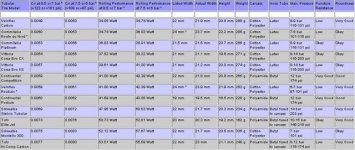
attachment.php


"Protocol: The Coefficient of Rolling Resistance (Crr), was aquired by testing all tires on a 120 cm (47.244") drum at 30 km/h (18.64 mph). Loading was similated with a 44/56% balance of front and rear tire. Total bike including rider weight was 85 kg (187.39 lbs)."

Take the top one:

V = 30kph = 8.3m/s
m = 47.6kg
Crr = .005
Frr = m*g*Crr
=47.6*9.81*.005
2.33N

Power = 2.33N*8.3 = 19.37W
Chart measures 34.7W

That difference is due to internal tyre loss and that is load, velocity and acceleration dependent

Cart is 295kg. What is the load over the rear wheels?
Keep the same ratio ?
so .56*295kg = 82.5 kg per wheel.

On dirt, at 28mph, and accelerating, while sustaining all the forces needed to drive the prop. etc etc...

57N*12.5m/s = 712W, due to Frr alone.
 

Attachments

  • tyres_2.jpg
    tyres_2.jpg
    44.8 KB · Views: 58
Last edited:
Easy peasy, Humber.
Just keep using that 57 N rolling resistance, instead of working out what it should be, and using a Cd of 0.3 (worse than an Audi) when 0.2 is more likely, and ....Hey Presto! it doesn't work!:rolleyes:

ETA: Air drag seems to have been included twice- what is the 12.51 m/sec about? It ain't the airspeed the cart is experiencing.
Tyre losses are included in the rolling resistance calculation. The Javaprop/ Prop.Designer propellor thrust result includes an efficiency calculation- nothing more to deduct here.
Not very good with figures; a fail, I'm afraid.

That is the power lost to the air, the wheel supplies the cart
Idealised as it is, all of the wheel power goes to the prop
To power the losses add them to that, and the wheel drag rises, net force = misery.

That is a crude outline. Three engineers, their math, data, and references are not going to be defeated by innumerate hand-waving talk
 
Last edited:
Easy peasy, Humber.
Just keep using that 57 N rolling resistance, instead of working out what it should be, and using a Cd of 0.3 (worse than an Audi) when 0.2 is more likely, and ....Hey Presto! it doesn't work!:rolleyes:

ETA: Air drag seems to have been included twice- what is the 12.51 m/sec about? It ain't the airspeed the cart is experiencing.
Tyre losses are included in the rolling resistance calculation. The Javaprop/ Prop.Designer propellor thrust result includes an efficiency calculation- nothing more to deduct here.
Not very good with figures, sir; a fail, I'm afraid.

You have thrilled me long enough- I'm off to bed.

It's been mentioned before, but may be worth repeating, that if you can only "prove" that ddwfttw is impossible by quibbling about drag and rolling friction and other losses, you have actually conceded that it is possible.

There is also all that pesky experimental data that says it works. Humber has made some pathetically feeble attempts to refute that, but we are still waiting for his detailed analysis.
 
Yes, the data speaks for itself, and, to everyone but the 1-3 deniers, it says the cart works.

The wind data shows 100degree changes and many errors of calculation and logic. It too gets a drubbing.
 
It's been mentioned before, but may be worth repeating, that if you can only "prove" that ddwfttw is impossible by quibbling about drag and rolling friction and other losses, you have actually conceded that it is possible.

There is also all that pesky experimental data that says it works. Humber has made some pathetically feeble attempts to refute that, but we are still waiting for his detailed analysis.

The cart fails all power and force analysis.
The submitted analysis is nonsense, so the cart's operation is due to something else.
 
To show that the cart is bogus, and the submitted theory is wrong.

[qimg]http://www.internationalskeptics.com/forums/attachment.php?attachmentid=22298&stc=1&d=1306100611[/qimg]

"Protocol: The Coefficient of Rolling Resistance (Crr), was aquired by testing all tires on a 120 cm (47.244") drum at 30 km/h (18.64 mph). Loading was similated with a 44/56% balance of front and rear tire. Total bike including rider weight was 85 kg (187.39 lbs)."

Take the top one:

V = 30kph = 8.3m/s
m = 47.6kg
Crr = .005
Frr = m*g*Crr
=47.6*9.81*.005
2.33N

Power = 2.33N*8.3 = 19.37W
Chart measures 34.7W

That difference is due to internal tyre loss and that is load, velocity and acceleration dependent

Cart is 295kg. What is the load over the rear wheels?
Keep the same ratio ?
so .56*295kg = 82.5 kg per wheel.

On dirt, at 28mph, and accelerating, while sustaining all the forces needed to drive the prop. etc etc...

57N*12.5m/s = 712W, due to Frr alone.

Great! Humber yet again demonstrates his incomprehension. You have calculated for one wheel only, and used 47.6 kg- no wonder the chart is different!
Now try for the total load- the rolling resistance is in practical terms independant of the number of wheels, so:
RR = 85 kg x 9.81 x .005 = 4.169 N, or multiply by 8.3 = 34.6 W.
No need for flannel about internal tyre loss, etc. etc.- it matches the chart!

Now for the cart.
295 kg x 9.81 x .0055 (slightly higher Crr for the BMX tyres); Rolling resistance = 15.91 N.

See- we got there eventually!

Now I really am off to bed. goodnight.
 
Last edited:
The wind data shows 100degree changes and many errors of calculation and logic. It too gets a drubbing.

We're still waiting for that analysis. Hint: Wind shifts that didn't happen during actual test runs are irrelevant. Get cracking. We're waiting for it. In the unlikely event that it's ever produced, it's certain to by hilarious.

ETA: Errors in calculation and logic: Now there's something humber knows a lot about. He makes 'em in just about every post.
 
Last edited:
We're still waiting for that analysis. Hint: Wind shifts that didn't happen during actual test runs are irrelevant. Get cracking. We're waiting for it. In the unlikely event that it's ever produced, it's certain to by hilarious.
Commenced man to cook of last meal "You are late"
Oh, I am worried by the razor-sharp opposition.
Heard of the Laffer Curve?
The cart's theory, and the attempts to better the cart by lowering the efficiency produce a Laugher Curve. That is hilarious.
 
Last edited:
Commenced man to cook of last meal "You are late"
Oh, I am worried by the razor-sharp opposition.
Heard of the Laffer Curve?
The cart's theory, and the attempts to better the cart by lowering the efficiency produce a Laugher Curve. That is hilarious.

It works on the treadmill, and it works in the real wind. No matter how much stuff that you don't actually understand you copy and paste, you can't explain that away.

BTW, have you gotten that propless treadmill cart to work yet when it isn't "towing" a ddwfttw cart?
 
Status
Not open for further replies.

ISF - Join now!

Every member here is approved by hand. No bots, no spam, just people who care about evidence and honest debate.

Membership is free!

Create your free account

Back
Top Bottom