Merged DDWFTTW in a “Real” Wind

Status
Not open for further replies.
What you will find is that, by reducing the power input, the cart becomes less and less viable, as the air drag and rolling resistance remain constant for the given set up. Increase the power requirements, and we need less transmission efficiency.

Up to a certain point. If you increase the power even more, the difference between the thrust and drag starts to drop again.
 
Up to a certain point. If you increase the power even more, the difference between the thrust and drag starts to drop again.

I had noticed that the prop efficiency was beginning to drop for the higher powers.

It would be nice to be able to calculate exactly what the power inputs were for the various cart speeds.
 
Tyres are well studied, and there is an abundance of theory and measurement by automotive engineers and cyclists alike.
Even with an idealised Thrust = P/V prop, there is no energy to add to the cart's KE, so it can never accelerate. The ultimate but unachievable result, would be a type 3 PM machine.
The wind data says how that fate has been avoided.

But the cart DID accelerate. Unquestionably. Even on Humber's graphs.
We are still waiting for you to explain how and why.
 
I had noticed that the prop efficiency was beginning to drop for the higher powers.

It would be nice to be able to calculate exactly what the power inputs were for the various cart speeds.

You do that using a program like prop designer with the appropriate prop, feed it the rpm and airspeed, and it will tell you the power demand and thrust, you can even see the results of changing pitch.
 
Here's the chord data spork provided earlier converted to meters. You can copy it from here and paste it into a text file that you can import into Prop designer, and set the cl to a constant .9. And get the close results to spork's design.

r(m) chord(m)
0.175251448 0.057857361
0.220969217 0.096671746
0.266686986 0.140478513
0.312404755 0.186686986
0.358122524 0.233014325
0.403840293 0.27758915
0.449558062 0.319018592
0.495275831 0.356360866
0.5409936 0.38906431
0.586711368 0.416912527
0.632429137 0.439926852
0.678146906 0.458314538
0.723864675 0.472380372
0.769582444 0.482511429
0.815300213 0.48910698
0.861017982 0.49258153
0.906735751 0.493325206
0.95245352 0.491709845
0.998171289 0.488067662
1.043889058 0.482697348
1.089606827 0.475870162
1.135324596 0.467817738
1.181042365 0.458741237
1.226760134 0.448811338
1.272477903 0.438177385
1.318195672 0.426967388
1.363913441 0.415281926
1.40963121 0.403209387
1.455348979 0.390819872
1.501066748 0.378171289
1.546784517 0.365309357
1.592502286 0.352267601
1.638220055 0.339070405
1.683937824 0.325739104
1.729655593 0.312273697
1.775373362 0.29868028
1.821091131 0.284946663
1.8668089 0.271057604
1.912526669 0.256991771
1.958244438 0.242706492
2.003962207 0.228153002
2.049679976 0.213270344
2.095397745 0.197960988
2.141115514 0.182103017
2.186833283 0.165513563
2.232551052 0.147921365
2.27826882 0.12889363
2.323986589 0.107625724
2.369704358 0.082362085
2.415422127 0.046979579
2.323986589 0.107625724
2.369704358 0.082362085
2.415422127 0.046979579
 
Last edited:
Here's the chord data spork provided earlier converted to meters. You can copy it from here and paste it into a text file that you can import into Prop designer, and set the cl to a constant .9. And get the close results to spork's design.

And now you are saying that does represent the prop. It too fails.
No power can from the wind can be gained by a propeller. That is that.
And BTW, Spork has already said he stands by the submission, well, because that is what was submitted.
 
Last edited:
Average does not equal constant.

Acceleration is constant at 0.1ms-2. Mass is constant so force is constant.
If you want to play averages, then the average speed of the cart is 8.5mph
It there anything you won't say? Post that.
 
Acceleration is constant at 0.1ms-2. Mass is constant so force is constant.
If you want to play averages, then the average speed of the cart is 8.5mph
It there anything you won't say? Post that.

You keep saying you have explained how the cart accelerates. As I have obviously missed this, is it possible for you to post a link, or say where this is, please?
 
I never claimed otherwise


I have no idea what significance you think this has, except that you are having deep trouble following along.

My, what a coincidence. Javaprop accepts random data, and produces this?

attachment.php
 

Attachments

  • javaprop.png
    javaprop.png
    78.5 KB · Views: 37
Acceleration is constant at 0.1ms-2. Mass is constant so force is constant.
If you want to play averages, then the average speed of the cart is 8.5mph
It there anything you won't say? Post that.

No, you calculated the acceleration based on the total change in speed divided by time, that yields average acceleration for that time. I posted the data from the record run a few weeks ago that included acceleration, and it was not constant.
 
And who keyed in 'flat plate' for the airfoil? One way to reduce the efficiency!
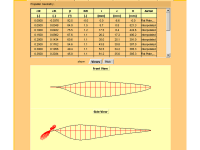
Oh, you need to edit for that.

The idea still fails using Thrust = power/V as in the submission.
Unless you think you can do better than 100% ideal?
 
Last edited:
Status
Not open for further replies.

ISF - Join now!

Every member here is approved by hand. No bots, no spam, just people who care about evidence and honest debate.

Membership is free!

Create your free account

Back
Top Bottom
