Merged DDWFTTW in a “Real” Wind

Status
Not open for further replies.
It works on the treadmill, and it works in the real wind. No matter how much stuff that you don't actually understand you copy and paste, you can't explain that away.
It must be that I am incredibly lucky, but it looks to me like someone else is getting pasted.

BTW, have you gotten that propless treadmill cart to work yet when it isn't "towing" a ddwfttw cart?

That's for desert. Ice-cold.
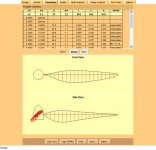
 
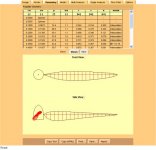
Gee, that's fascinating. Too bad the power, thrust and torque are also there...amd it does look the prop.....

vc=18*1.467 !vo (f/s) (this is 18 mph airspeed)
omega=120 !RPM
rho=.00226 !Density (slug/ft^3)1500 ft MSL
vsnd=1116.5 ! Speed of sound (f/s)
rt=8.0 !Tip radius (ft)
rh=0.5 !Hub radius (ft)
nblade=2 !Blade number
ao=5.73 !Lift curve slope of 2-d section
apzl= -5.0 !zero lift angle of attack (deg)
ld=67 !Section max L/D (6412 @350000 Re)
cl=0.9 !CL at max L/D
pflag=1 !1=fixed thrust 2 = fixed power
qdes=50. !design thrust (lb) or power (hp)

Design point:

Thrust= 49.9167099(lbs)
Torque= 124.131477(ft-lb)
Power= 2.83614945 (HP)
etap= 0.845000148

http://www.propdesigner.co.uk/html/about_the_author.html
Not a PhD, like Hepperle?

And you are an amateur musician?

Humber, for the 10,000,000th time, those numbers are not from Javaprop.
 
The wind data shows 100degree changes and many errors of calculation and logic. It too gets a drubbing.
What errors in calculation? Just because you are unable to do it, does not mean there are any errors, and you have yet to show any.
 
Here's Javaprop with the actual geometry (note SI Units):

Diameter D 4.876 m
Spinner Dia. Dsp .3048 m
Speed of Rotation n 120 1/min
Velocity v 8.04672 m/s
Number of Blades B 2
Solidity sigma 0.0793
Propeller
v/(nD) 0.825 v/(ΩR) 0.263
Efficiency η 77.015 % loading medium
Thrust T 291.39 N Ct 0.1052
Power P 3.04 kW Cp 0.1127
β at 75%R 25.8° Pitch H 5.57 m

attachment.php


Here is Javaprop's Design:

Diameter D 4.876 m
Spinner Dia. Dsp .3048 m
Speed of Rotation n 120 1/min
Velocity v 8.04672 m/s
Number of Blades B 2
Solidity sigma 0.0659
Propeller
v/(nD) 0.825 v/(ΩR) 0.263
Efficiency η 80.09 % loading medium
Thrust T 211.01 N Ct 0.0801
Power P 2.12 kW Cp 0.0825
β at 75%R 24.7° Pitch H 5.27 m

attachment.php
 

Attachments

  • JavaProp Real Geometry.jpg
    JavaProp Real Geometry.jpg
    37.5 KB · Views: 61
  • JavaProp Design.jpg
    JavaProp Design.jpg
    40.3 KB · Views: 61
The argument that the carteers are making is the cart is rolling and so the propeller is spinning, therefore the rotating airfoil can feel a force from the wind. In other words, the rotating propeller is producing thrust force. I don't agree with this as the cart, if it reached wind speed would only feel reistance forces acting on it to slow it down. The propeller will spin only with a residual thrust (same as a fan that has been unpowered) and that residual thrust cannot exert enough force on the wind to slow any appreciable air mass down.

The propeller works the same when the cart is travelling slower, the same as, and faster than wind speed.

A simple explanation is that the propeller is like a swimmer who reaches forward in the water then pulls his hand backwards. The propeller, because of its shape, does the same thing. It's always reaching "downwind" then pulling backwards.

You're once again, even if you don't realize it, claiming that a propeller-driven aircraft couldn't take off in still air. That's ridiculous.

-- Roger
 
Last edited:
Humber, for the 10,000,000th time, those numbers are not from Javaprop.

Makes not difference to the facts. I really don't care how they were generated, but do you think that there are different types of propeller according to the time of day or programme?
 
What errors in calculation? Just because you are unable to do it, does not mean there are any errors, and you have yet to show any.

Again, the problem is that you are incapable of telling the truth.
You assume that because you can do simple vector additions that makes you "clever", but have not seen the countless errors that produces.
 
Last edited:
Here's Javaprop with the actual geometry (note SI Units):

Diameter D 4.876 m
Spinner Dia. Dsp .3048 m
Speed of Rotation n 120 1/min
Velocity v 8.04672 m/s
Number of Blades B 2
Solidity sigma 0.0793
Propeller
v/(nD) 0.825 v/(ΩR) 0.263
Efficiency η 77.015 % loading medium
Thrust T 291.39 N Ct 0.1052
Power P 3.04 kW Cp 0.1127
β at 75%R 25.8° Pitch H 5.57 m

[qimg]http://www.internationalskeptics.com/forums/attachment.php?attachmentid=22301&stc=1&d=1306112564[/qimg]

Here is Javaprop's Design:

Diameter D 4.876 m
Spinner Dia. Dsp .3048 m
Speed of Rotation n 120 1/min
Velocity v 8.04672 m/s
Number of Blades B 2
Solidity sigma 0.0659
Propeller
v/(nD) 0.825 v/(ΩR) 0.263
Efficiency η 80.09 % loading medium
Thrust T 211.01 N Ct 0.0801
Power P 2.12 kW Cp 0.0825
β at 75%R 24.7° Pitch H 5.27 m

[qimg]http://www.internationalskeptics.com/forums/attachment.php?attachmentid=22302&stc=1&d=1306112564[/qimg]

The prop chord data is given as a ratio. Widths relative to stations along the length. The scaling to actual size is done when the dimension is set in the design window. No need to have wasted time converting to metric.
The power, thrust and torque are also scalable, because there are fixed conversion factors between metric and US Standard Units, and the same physics applies. So, that one is closed to Spork as a means of derision.
It takes an extraordinary level of obtuseness not to see that there is no prop design that can improve on an ideal transducer.
 
Last edited:
Here's Javaprop with the actual geometry (note SI Units):

Diameter D 4.876 m
Spinner Dia. Dsp .3048 m
Speed of Rotation n 120 1/min
Velocity v 8.04672 m/s
Number of Blades B 2
Solidity sigma 0.0793
Propeller
v/(nD) 0.825 v/(ΩR) 0.263
Efficiency η 77.015 % loading medium
Thrust T 291.39 N Ct 0.1052
Power P 3.04 kW Cp 0.1127
β at 75%R 25.8° Pitch H 5.57 m

[qimg]http://www.internationalskeptics.com/forums/attachment.php?attachmentid=22301&stc=1&d=1306112564[/qimg]

Here is Javaprop's Design:

Diameter D 4.876 m
Spinner Dia. Dsp .3048 m
Speed of Rotation n 120 1/min
Velocity v 8.04672 m/s
Number of Blades B 2
Solidity sigma 0.0659
Propeller
v/(nD) 0.825 v/(ΩR) 0.263
Efficiency η 80.09 % loading medium
Thrust T 211.01 N Ct 0.0801
Power P 2.12 kW Cp 0.0825
β at 75%R 24.7° Pitch H 5.27 m

[qimg]http://www.internationalskeptics.com/forums/attachment.php?attachmentid=22302&stc=1&d=1306112564[/qimg]

Which one looks like the BB? What do you know the first one or is that the way the images are differently scaled? Never mind. Did you try to enter the parameters for a 4.786m/120rpm stick?

3.04kW/291N = 2.12kW/211N
 
Last edited:
Commenced man to cook of last meal "You are late"
Oh, I am worried by the razor-sharp opposition.
Heard of the Laffer Curve?
The cart's theory, and the attempts to better the cart by lowering the efficiency produce a Laugher Curve. That is hilarious.

Showing that the cart still works with only 90% transmission efficiency may be hilarious to you, dear chap; your efforts to show that it doesn't provide the chuckles for the rest of us.

Your "commenced man" raised a chuckle too.

How are your rolling resistance calculations coming on? or are you envisaging a one-wheeled cart?

That it fails with a 100% efficient system, and then the Carteers use the 10% loss as a gain in the hope of rescuing Little Nell is funnier still, Tobermoryphil. But then again, Continental Tyres are part of the conspiracy.
They even went as far as to denigrate their own products. That's commitment.
 
Last edited:
That it fails with a 100% efficient system, and then the Carteers use the 10% loss as a gain in the hope of rescuing Little Nell is funnier still, Tobermoryphil. But then again, Continental Tyres are part of the conspiracy.
They even went as far as to denigrate their own products. That's commitment.

It only fails with your fiddled "100%" system.
Perhaps you could try again, this time with a realistic rolling resistance figure, (you can of course calculate this?), a realistic Cd value (only deducting air drag once), and a decent run with Javaprop, or better, Prop.Designer.

We are still waiting for you to point out exactly how the cart accelerates, by the way. You say you have explained this in the past; a link would be most appreciated.
 
Last edited:
To show that the cart is bogus, and the submitted theory is wrong.

[qimg]http://www.internationalskeptics.com/forums/attachment.php?attachmentid=22298&stc=1&d=1306100611[/qimg]

"Protocol: The Coefficient of Rolling Resistance (Crr), was aquired by testing all tires on a 120 cm (47.244") drum at 30 km/h (18.64 mph). Loading was similated with a 44/56% balance of front and rear tire. Total bike including rider weight was 85 kg (187.39 lbs)."

Take the top one:

V = 30kph = 8.3m/s
m = 47.6kg
Crr = .005
Frr = m*g*Crr
=47.6*9.81*.005
2.33N

Power = 2.33N*8.3 = 19.37W
Chart measures 34.7W

That difference is due to internal tyre loss and that is load, velocity and acceleration dependent

Cart is 295kg. What is the load over the rear wheels?
Keep the same ratio ?
so .56*295kg = 82.5 kg per wheel.

On dirt, at 28mph, and accelerating, while sustaining all the forces needed to drive the prop. etc etc...

57N*12.5m/s = 712W, due to Frr alone.

I was following the above (even the mistakes) right up until the highlighed figure was plucked out of thin air.

Humber, why didn't you just do the last little bit and actually calculate the force for the cart using the equation in your own post? As tobermoryphil pointed out, the chart figures appear quite sensibly to be for the total of both bike wheels and you can do the same calculation for the cart.

Frr = m*g*Crr

Frr = 295 * 9.81 * 0.005

Frr = 14.5N

Desperate. 57N comes from the submission (13lb = 57N)
That won't be anywhere near enough to allow a 295kg cart to be driven by the wheels.

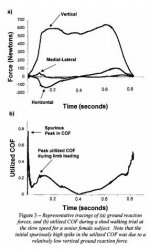
Metrology of Pedestrian Locomotion and Slip Resistance, M Marpet

attachment.php
 

Attachments

  • walking.jpg
    walking.jpg
    21.6 KB · Views: 48
Status
Not open for further replies.

ISF - Join now!

Every member here is approved by hand. No bots, no spam, just people who care about evidence and honest debate.

Membership is free!

Create your free account

Back
Top Bottom