Merged DDWFTTW in a “Real” Wind

Status
Not open for further replies.
For example with the cart going dw at windspeed, the cart's body will not affect the wind, but the prop will create a breeze blowing back - which means the passage of cart has slowed the wind. That energy must go somewhere, and it can only go into resistive losses and accelerating the cart. Therefore if friction is not too high, the cart will accelerate from windspeed.

It really just that simple.

humber doesn't even think it could go downwind at windspeed though, humber doesn't think a balloon floating in the wind goes downwind at windspeed, so nothing could ever reach windspeed.
 
There is no energy from the ground, and the ground is not necessary to extraction of energy from the wind, and is a source of friction.

In the rest frame of the ground, that's correct.

It's correct that in the rest frame of the ground, the ground cannot supply energy. The presence of the ground is however necessary to the extraction of energy from the wind.
 
It's correct that in the rest frame of the ground, the ground cannot supply energy. The presence of the ground is however necessary to the extraction of energy from the wind.

Yes, that's more or less correct. Or one can simply note that "wind" has no meaning without the ground as a reference, and then the second part becomes tautological.
 
Last edited:
Dear old Humber; in a twist as usual. Rolling resistance by definition includes for tyre deformation, etc. How about biting the bullet and actually working it out for yourself?

And why exactly is a drag coefficient of 0.25 too high?

You now claim sidewinds will increase the air drag. Strange- not so long ago, you claimed they provided the propulsive force!

What you will find is that, by reducing the power input, the cart becomes less and less viable, as the air drag and rolling resistance remain constant for the given set up. Increase the power requirements, and we need less transmission efficiency.

For example, if I put 2.5KW input for the prop, Javaprop gives a thrust of255.36 N.
( 5 m prop, 300mm spinner, 120 rpm, MH 116 airfoil, 8.046 m/sec airspeed)
Now we try out only 90% transmission efficiency. We therefore need 2.7777KW from the wheels: over the 12.516 m covered in 1 sec, this gives a retarding force of 221.94 N,
Add rolling resistance, 15.9, and air drag, 17.5, we get 255.34 N.

So, we maintain speed with only 90% transmission efficiency; if our transmission is more efficient than 90%, we obviously accelerate.
 
In the rest frame of the ground, that's correct.

It is true from all frames. The ground does not supply energy to the cart.
The Earth is massive. Common motion of cart and ground or wind and ground etc, will not change the energy transfer.

From an earlier post:
If a car moves relative to the Earth, and so relative to the center of masses of each, then momentum moves from the ground to the car.

The energy exchange is tiny, because the Earth is massive, so all of the energy from the engine does work on the car ( efficiency aside) and adds to the car's KE.

The car gains momentum p and gains kinetic energy p^2/2m1, the earth gains momentum −p and gains kinetic energy p^2/2m2

All of the energy (p^2/2m1+ p^2/2m2 comes from the engine. (1)

An "observer" moving with velocity u relative to the center of mass, sees the car change by −u·p and the earth by +u·p.

(To save the subscript clutter m1 = car, m2 = Earth. )

m1
ΔKE(car)= (−m u − p)^2/2m − (−m u)^2/2m

=(m^2 u^2 −2m u·p + p^2)/2m - (m^2 u^2)/2m (quadratic expansion)

= −u·p + (p^2)/ 2m

m2
ΔKE(earth)= (−mu + p)^2/2m − (−m u)^2/2m

=(m^2 u^2 + 2m u·p + p^2)/2m - (m^2 u^2)/2m

= u·p + (p^2)/ 2m

Add then and you are back to (1)

You can work it using KE = 1/2mv^2
KE = p^2/2m
p=mv
KE = (mv)^2/2m
=1/2mv^2

...and get the same result.

The same goes for the wind, which is moving relative to the cart and the ground. Only the difference of air and cart counts. The Earth is just a massive surface as far as the cart is concerned.

That's patently false. For example with the cart going dw at windspeed, the cart's body will not affect the wind, but the prop will create a breeze blowing back - which means the passage of cart has slowed the wind. That energy must go somewhere, and it can only go into resistive losses and accelerating the cart. Therefore if friction is not too high, the cart will accelerate from windspeed.
It really just that simple.

The cart is facing a headwind that opposes motion. That wind is a result of the cart's motion, and not an independent source of energy.

The attempt to turn water into wine by "extraction" fails, because of the physical differences of turbine and prop tube streams, and the limited effects that wind (or moving air mass) may have on the rotor's AV.

If the wind opposes the rotor, it opposes the wheel. Torque will rise, but so will the opposing drag force. Strain is an indicator of torque and so transmitted power.

If the wind aids the rotor, the torque will fall, and less strain will appear in the shaft, indicating falling the power transmission from the "wheel generator", so no overall benefit will be accrued.

 
Yes, that's more or less correct. Or one can simply note that "wind" has no meaning without the ground as a reference, and then the second part becomes tautological.

Right: "wind" is the relative motion of the air and something else (in this case the something else is the ground). If we remove the something else, we can't talk about wind. The important point, which the Hs refuse to see, is that the ground is not just a source of friction that slows down the cart: in the ground frame, the reactive force from the ground is essential in extracting the kinetic energy from the air. Without that reactive force, the vehicle can never go faster than the wind.
 
Humber: our land yacht travelling at 1.41 times wind speed, on its 45 degree off DDW course, is also meeting a headwind. 45 degrees off the bow, and with an apparent velocity equal to the actual wind speed. So how then can it accelerate to 4 times wind speed- the apparent wind direction gets more and more towards the bow the faster it goes, too!
 
humber, you have been told this countless times, the cart does not run off of the headwind that it creates. It runs off of the difference between the speed of the wind over the ground and the speed of the ground. That difference is there regardless of how fast the cart is moving or even regardless of frame of reference.
 
Dear old Humber; in a twist as usual. Rolling resistance by definition includes for tyre deformation, etc. How about biting the bullet and actually working it out for yourself?

And why exactly is a drag coefficient of 0.25 too high?

You now claim sidewinds will increase the air drag. Strange- not so long ago, you claimed they provided the propulsive force!
Not what I said, and I don't need to convince you.

What you will find is that, by reducing the power input, the cart becomes less and less viable, as the air drag and rolling resistance remain constant for the given set up. Increase the power requirements, and we need less transmission efficiency.
For example, if I put 2.5KW input for the prop, Javaprop gives a thrust of255.36 N.
( 5 m prop, 300mm spinner, 120 rpm, MH 116 airfoil, 8.046 m/sec airspeed)
Now we try out only 90% transmission efficiency. We therefore need 2.7777KW from the wheels: over the 12.516 m covered in 1 sec, this gives a retarding force of 221.94 N,
Add rolling resistance, 15.9, and air drag, 17.5, we get 255.34 N.

Wrong way around, trying to gain by making the cart less efficient? Funny. The formerly unlimited power potential, is now in the reject basket savaging for bargains.

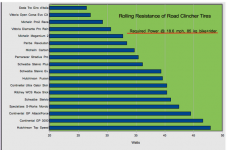
It is not possible to scale a car tyre as you hope to do by 10 seconds of a wiki read. At that rate, a PhD will be yours tomorrow.

Differences abound in the construction and loading. Car tyres have a near square footprint, whereas the near round section of a bike tyre produces an elliptical pattern. Perhaps you can use data from this one.

attachment.php


The tyre will slide. It does, and that is why there is so much scrubbing, and the video data does not match the calculated RPM.

Talk to the data, and every text on tyres.


There is no power gain for add KE to the chassis.
KE = work
Power =work/time.

Aero drag rises quadratically, so the power rises as the cube of velocity.
P = 21N*(12.5m/s) ( groundspeed) = 262W

Power = force*velocity for the linear rolling losses.
Rolling Power = 57N*12.5m/s = 712W

Tyre distortion to create the additional traction to support 170N depends upon construction. Cheap tyres are lossy, but even the kevlar types consume a lot of power. We can ask TAD for the tyre type, the wheel loading, the tyre pressure, and plug into my MATLAB model.
 

Attachments

  • truck.jpg
    truck.jpg
    34 KB · Views: 45
Humber:
You obviously have not looked at your favourite Wiki site for long enough- if you did, you would not be mentioning car tyres. All sorts of bike tyres are mentioned, including BMX tyres with their Crr of .0055.
So, now go and work out the rolling resistance, PLEASE!
Surely you can do this simple calculation?

ETA:You say you do not need to convince me- surely you are trying to convince all of us?
 
Last edited:
Right: "wind" is the relative motion of the air and something else (in this case the something else is the ground). If we remove the something else, we can't talk about wind. The important point, which the Hs refuse to see, is that the ground is not just a source of friction that slows down the cart: in the ground frame, the reactive force from the ground is essential in extracting the kinetic energy from the air. Without that reactive force, the vehicle can never go faster than the wind.

Did Terry tell you that? He is a wag, isn't he?
 
Humber:
You obviously have not looked at your favourite Wiki site for long enough- if you did, you would not be mentioning car tyres. All sorts of bike tyres are mentioned, including BMX tyres with their Crr of .0055.
So, now go and work out the rolling resistance, PLEASE!
Surely you can do this simple calculation?

ETA:You say you do not need to convince me- surely you are trying to convince all of us?

attachment.php
 

Attachments

  • tyrepower.png
    tyrepower.png
    78 KB · Views: 45
IOW: Humber has no idea. Who'da thunkit?

Tyres are well studied, and there is an abundance of theory and measurement by automotive engineers and cyclists alike.
Even with an idealised Thrust = P/V prop, there is no energy to add to the cart's KE, so it can never accelerate. The ultimate but unachievable result, would be a type 3 PM machine.
The wind data says how that fate has been avoided.
 
Status
Not open for further replies.

ISF - Join now!

Every member here is approved by hand. No bots, no spam, just people who care about evidence and honest debate.

Membership is free!

Create your free account

Back
Top Bottom