WTC Dust Study Feb 29, 2012 by Dr. James Millette

thanks mm
cool, i did not know he sent a sample out. take note millette and chris mohr.
jones-
"A separate sample was sent to a scientist, Mark Basile working in New England and he also sees the same active red/gray material. I have to say one thing while I am discussing the efforts by Mark Basile. He was the first one to ignite a red/gray chip and observe the spheres, the tiny iron-rich spheres in the residue after the red/gray chip is ignited."

i remember basile talking about getting a sample from a museum.

I am glad you bring Mark Basile up, because you say:
i think ill listen to someone that actually did some research on these chips.
I'll give you a chance to actually listen to someone that actually did some research on these chips now:

First: Your last sentence is wrong. mark Basile got his sample not from a museum but from Janette MacKinlay, who also gave Jones one of the samples 1-4 that was used in the Bentham study. So Basile's sample has the same source as one of Jones's. Source: 9/11 Free Fall, 27 December 2012, at 22:09: "[Steven Jones ] followed up a couple weeks later and got me in touch with a woman by the name of Janette MacKinlay, which is one of the four samples of dust that was were used in the article that he and the others that he worked with published back around, shortly after that time frame I think it was around 2009 or so, or early 2009 they published. So really, that's kind of when I first started really getting involved in the dust itself. I mean I was doing some reading and learning up to that point, but the actual hands-on began basically around January of 2008."
(He talks about a meeting with Jones in December 2007).

Later in the same interview, at 27:26, he sais: "There are a lot of paint chips in the dust! You should make that perfectly clear! Just when you, if anybody in the audience, let's say, would get out there and get a World Trade Center dust sample, and they pull out red chips from this, I'm not telling anybody in the world that every red chip you're gonna pull out of there is one of these nano-thermite chips. The vast majority of them actually are primer paint, from what I'm finding, but that doesn't mean they all are. And they are not all, because […?...] pulled out ones where I've seen the reaction, I've seen the product, so I know they're in there. But there is also a lot of primer paint chips in there, too." and then, az 28:28: "I think some of the chips that, you know, Jones and all looked at were definitely, you know, primer paint chips, too, so not everything in there was necessarily nanothermite chips."

So Mark Basile makes it perfectly clear that in his expert opinion, he, who studied the red-gray chips, thhinks that some of the chips you pull out with a magnet, and even some of those that Jones studied, are NOT thermite, while he thinks some are. So Mark Basile unambiguously testifies that the red-gray chips that Jones pulled from his dust samples with a magnet represent different materials.


With this in mind, and not forgetting that YOU said you would "listen to someone that actually did some research on these chips", please answer my original question:

Are all red-gray chips that you pull from WTC dust with a magnet the same material, or is there a possibility that this method (magnetic attraction plus visual identification as "red-gray chips") yields two or more different materials?
 
Last edited:
Originally Posted by Mark Basile - Chemical Engineer
"If you take these chips and section them, and look at them before you ignite them, there are no iron micro-spheres, there are no iron particles, there are no iron films contained in these chips. It is only after you bring them up to their ignition point and they go through their thermitic reaction, that liquid iron is produced and the energy is released. These chips are not naturally occurring."
MM - this is the reason why Basile and others are so easily discredited. They simply have absolutely no idea what they are observing.

Even though their own data shows that the gray layer is steel they simply don't recognise that fact.

A36 Steel - Chemical composition.

Carbon, C 0.25 - 0.290 %
Copper, Cu 0.20 %
Iron, Fe 98.0 %
Manganese, Mn 1.03 %
Phosphorous, P 0.040 %
Silicon, Si 0.280 %
Sulfur, S 0.050 %

So for Basile to say there isn't any Fe films or particles present when 98% of the gray layer is iron is laughable. The man simply has no understanding in regards to what he's looking at.

Further proof can be seen in the Harrit et al paper in which he is co-author.

8. What Future Studies are Contemplated?

In addition, the gray-layer material demands further study. What is its purpose?
Page 28.

So they had no clue what the gray layer was. It has no purpose, it's simply the oxidised layer of steel the paint was applied to! They are all so wrapped up in their thermite hypothesis that they didn't actually understand that they were looking at rust and paint.


Originally Posted by Dr. Steven Jones
"We found that the spheroids that are rich in iron produced by the DSC test, that is, by the ignition of the red material in the DSC, these have a signature that is rich in iron but not enough oxygen to make even FeO. So that indicates to us that the iron has been reduced which again is a signature for the thermite reaction. So the formation of the spheres which implies a very high temperature, over 1400 C and the reduction of the iron oxide to an iron-rich phase indicates that a thermitic reaction has occurred and therefore we are able to call this material, an active thermitic material."
Again here we see the lack of basic understanding from Jones. he claims the red layer produces iron spheres when ignited. This simply isn't true. Once again Jones completely fails to recognise that there are two materials present in the chips. They even state it in the paper - a red layer and a gray layer.

I have already shown why Jones is wrong here using the data in his own paper! The iron spheres are produced from the gray oxidised steel layer (most likely via a direct iron reduction method which does not require melting of iron).

These photos prove that.

If the red layer was producing the spheres through the process of Fe2O3 + Al = Al2O3 + Fe

then why does the red layer remain? Remember that the red layer is red because of the Fe2O3 particles contained in that layer. If all the Fe2O3 particles had reacted in the thermite process then there wouldn't be a red layer observed after ignition would there? It's simple to see, look:

picture.php


Now you'll say, "ah but there was more Fe2O3 than needed so that's why some remains", which of course is hilarious. You won't know why it's hilarious, but if you understood chemistry and the word "stoichiometry" then you'd know why.

We can also see that Jones' claim of 1400°C temperatures are nonsense too. Have a look at the DSC residue under SEM:

picture.php


As I have pointed out before, yet had no reply from any truther rebutting the observation; it's clear that there are still hexagonal platelets (kaolin) and whitish rhomboids (Fe2O3) present AFTER DSC.

What temperature does Aluminium melt at?
What was the maximum temperature the DSC was performed at?
What is the temperature that Jones is claiming was present?

The claim from truthers including yourself and Basile/Harrit/Jones/Farrer etc is that these hexagonal platelets contain pure unbound Al. If that were true then even if some of this Al had not reacted in the thermite reaction then this remainder would have melted at 660°C (and produced a sharp endotherm on the DSC curve) when the DSC reached that temperature, thereby destroying the hexagonal platelets.

The fact that there are hexagonal platelets clearly present in the residue after heating above the melting point of Al proves that there is no pure (free) Al present in those platelets. No pure Al = no thermite.

Dr Millette's data tallies with this observation. He observes the exact same hexagonal platelet particles as seen in Harrit et al in all characteristics, however, unlike the incompetent truthers he actually uses two recognised materials characterisation techniques to determine what the material is. He concludes that the material is kaolin and that there is no pure Al present.

Igniting a material and observing the residue is not a technique for materials characterisation no matter the number of times a truther with zero scientific education or training says so. Any competent and knowledgeable peer reviewer or for that matter any lab technician would have looked at all of the particles post DSC instead of getting hung up on "iron rich microspheres". Harrit et al simply believed in thermite before any of their testing and that belief prevented them from any rational analysis of the data in their tests.

You and Senenmut will ignore this of course and Senenmut will write one illiterate sentence containing the words "ignite" and "silicon rich microspheres", but it won't change the fact that Millette has comprehensively destroyed Harrit et al's pseudo-paper. Hell their own data destroys their own paper!

Any self respecting analyst could have produced a paper with the correct conclusion using SEM and FTIR in under 5 pages.
 
Last edited:
thanks mm
cool, i did not know he sent a sample out. take note millette and chris mohr.
jones-
"A separate sample was sent to a scientist, Mark Basile working in New England and he also sees the same active red/gray material. I have to say one thing while I am discussing the efforts by Mark Basile. He was the first one to ignite a red/gray chip and observe the spheres, the tiny iron-rich spheres in the residue after the red/gray chip is ignited."

i remember basile talking about getting a sample from a museum.
Hi Senenmut, I know Basile got a sample from Jones et al and that he found iron-rich spheres. I challenge the assumption that iron-rich spheres can be produced ONLY by temperatures higher than the melating point of steel/iron. RJ Lee certainly doesn't think so. Dave Thomas created iron-rich spheres with steel wool and a Bic lighter. That wasn't proof enough for you all, so now I am hoping to see an experiment done where known primer paint on steel gets cooked to sub-melting temperatures. Will we see iron-rich spheres? And if so, will that experiment also be written off due to the fact that it wasn't the same kind of paint we saw at WTC? Also, Beachnut keeps telling you over and over again the most obvious things, like "No aluminum oxide". Beachnut keeps hammering away at the obvious and no one ever seems to respond to him.
 
Dr. Millette must have observed a large number of red/gray chips in his pile after using the basic chip isolation method described in the 2009 Bentham paper.

At the very least, he would have realized that if he further isolated his chips of interest by utilizing the resistivity test, he would strengthen his claim that he was matching the test methods published by Dr. Harrit et al.
The paper reports only one chip with that unusual resistivity, with characteristics that don't match those visible for chips a-d, thus an unknown chip.

Millette did the right thing: to not rely on one single datapoint to draw conclusions, and instead rely on more efficient methods of identification.
 
Hi Senenmut, I know Basile got a sample from Jones et al and that he found iron-rich spheres. I challenge the assumption that iron-rich spheres can be produced ONLY by temperatures higher than the melating point of steel/iron. RJ Lee certainly doesn't think so. Dave Thomas created iron-rich spheres with steel wool and a Bic lighter. That wasn't proof enough for you all, so now I am hoping to see an experiment done where known primer paint on steel gets cooked to sub-melting temperatures. Will we see iron-rich spheres? And if so, will that experiment also be written off due to the fact that it wasn't the same kind of paint we saw at WTC? Also, Beachnut keeps telling you over and over again the most obvious things, like "No aluminum oxide". Beachnut keeps hammering away at the obvious and no one ever seems to respond to him.

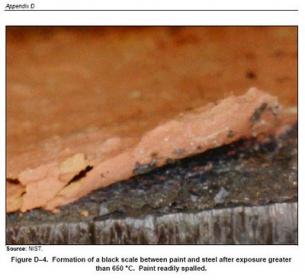
i guess the primer (tnemec) on the wtc steel heat to 650C (if i remember right) didnt count?


Today, I added the following paragraphs on the talk page in Wiki entry regarding nanothermite:

"Hi, as regards the "nanothermite paper" of Harrit et al, I would like to add info you have perhaps missed. In autumn 2011, debaters on a skeptical web JREF (including me) arranged a new study, conducted by an American forensic expert James Millette, in which new analyses of these red/gray chips from WTC dust were performed. And in February 2012, the most of the results were published here:

In short: in his samples of WTC dust, James Millette found (among others) the same kind of bilayered red/gray chips as chips (a) to (d) described in the paper of Harrit et al. He analyzed them by several methods including SEM-EDS, TEM, FTIR and others and found that stacking hexagonal platelets ca 1 micron in size, which were declared to be elemental aluminum by Harrit et al, are particles of kaolinite (as was expected in JREF already four years ago).

The main conclusion of James Millette was: "The red/gray chips found in the WTC dust at four sites in New York City are consistent with a carbon steel coated with an epoxy resin that contains primarily iron oxide and kaolin clay pigments. There is no evidence of individual elemental aluminum particles of any size in the red/gray chips, therefore the red layer of the red/gray chips is not thermite or nano-thermite."

These chips are simply layers of WTC red epoxy primer paint, containing iron oxide and kaolinite, which are attached to rusted steel flakes. More specifically, we in JREF are pretty sure that they are particles of red primer employed on WTC1/WTC2 floor trusses, since its composition, found in NIST report NCSTAR 1-6b, Appendix B, p. 155, corresponds very well to the analyses both of Harrit et al and Millette. But, this is just my remark, since James Millette himself did not mention this very plausible hypothesis in his report. Ivan Kminek"

If you wish, you can add some more info there, or correct/edit me or whatever:o)
 
Last edited:
I am glad you bring Mark Basile up, because you say:


Later in the same interview, at 27:26, he sais: "There are a lot of paint chips in the dust! You should make that perfectly clear! Just when you, if anybody in the audience, let's say, would get out there and get a World Trade Center dust sample, and they pull out red chips from this, I'm not telling anybody in the world that every red chip you're gonna pull out of there is one of these nano-thermite chips. The vast majority of them actually are primer paint, from what I'm finding, but that doesn't mean they all are. And they are not all, because […?...] pulled out ones where I've seen the reaction, I've seen the product, so I know they're in there. But there is also a lot of primer paint chips in there, too." and then, az 28:28: "I think some of the chips that, you know, Jones and all looked at were definitely, you know, primer paint chips, too, so not everything in there was necessarily nanothermite chips."

So Mark Basile makes it perfectly clear that in his expert opinion, he, who studied the red-gray chips, thhinks that some of the chips you pull out with a magnet, and even some of those that Jones studied, are NOT thermite, while he thinks some are. So Mark Basile unambiguously testifies that the red-gray chips that Jones pulled from his dust samples with a magnet represent different materials.

[/B]

he shouldnt speak for jones but that is excellent summary of what i said:

Are all red-gray chips from each sample that you pull from WTC dust with a magnet the same material, or is there a possibility that this method (magnetic attraction plus visual identification as "red-gray chips") yields the same material in some samples, altogether different material in some samples, or two or more different materials in some samples?

What a moronic cowardly way to hide from honesty!

But - what is your answer?

When you have one and the same sample of WTC dust, for example the very one sample collected by Janette MacKinlay, and you pull a number of red-gray chips from it with a magnet, are all those chips from that sample the same material, or could they be, as Basile has found when he studied that dust sample from Janette MacKinlay, different materials?


To remind you - from the Bentham paper, page 9:
"As soon as Ms. MacKinlay was allowed to re-enter her apartment, she did so and began cleaning up. There was a thick layer of dust on the floor. She collected some of it into a large sealable plastic bag for possible later use in an art piece. Ms. MacKinlay responded to the request in the 2006 paper by Dr. Jones by sending him a dust sample."​
(My bolding)
So you see, when Harrit and Jones pulled red-gray chips from their MacKinlay sample, those chips came from the exact same sample as Basile's chips: Janette MacKinlay had just one bigger bag of dust, one sample, from which she gave both Jones and Basile subsamples.

I hope you are not thinking that, while Basile found the red-gray chips in the MacKinlay dust sample to be different materials, you can be sure with certainty that the Jones/Harrit portion of the very same MacKinlay dust sample could only contain red-gray chips from exactly one material?

If you think such a moronic thing, please give very good reasons!

But I really want you to answer the follwing question, which I asked you several times - and not your cowardly perversion of it:


Are all red-gray chips that you pull from WTC dust with a magnet the same material, or is there a possibility that this method (magnetic attraction plus visual identification as "red-gray chips") yields two or more different materials?
 
Last edited:
Senenmut: yes, it is basically possible, since they were several/many red paints protecting steel used in WTC. And in some dust samples, the "concentration" of some paint can be higher than in others.

But who cares in this regard?

Chips (a) to (d) declared to be nanothermite by Harrit et al are clearly the same as the most of chips analyzed by James Millette, in which kaolinite was identified as those alleged "aluminum" stacking platelets! As simple as that:cool:
 
Last edited:
Hi Senenmut, I know Basile got a sample from Jones et al and that he found iron-rich spheres. I challenge the assumption that iron-rich spheres can be produced ONLY by temperatures higher than the melating point of steel/iron. RJ Lee certainly doesn't think so. Dave Thomas created iron-rich spheres with steel wool and a Bic lighter. That wasn't proof enough for you all, so now I am hoping to see an experiment done where known primer paint on steel gets cooked to sub-melting temperatures. Will we see iron-rich spheres? And if so, will that experiment also be written off due to the fact that it wasn't the same kind of paint we saw at WTC? Also, Beachnut keeps telling you over and over again the most obvious things, like "No aluminum oxide". Beachnut keeps hammering away at the obvious and no one ever seems to respond to him.

What I want to know is this.

If Harrit/Jones separated out paint chips using a resistivity test (or any other test) from the already extracted red/gray, magnetically attracted chips, then why on God's green earth did they not test those paint chips and publish the results?

Let me get this straight. According to what truthers think, Harrit and his group did the following sequence:

1. Extracted chips of interest using a magnet.
2. Took those chips and further extracted ones that had red/gray layers.
3. Then they further separate those chips into low and high resistivity via resistivity tests.
4. They then went to tabulated data from an outside source regarding paint coatings, http://www.emeraldinsight.com/journals.htm?articleid=876638&show=html, and compared that data to their resistivity results.
5. Based on the comparisons in number 4 above, they determined that those chips with high resistivity were paint and those with low resistivty were "chips of interest".
6. They then performed the rest of the tests in the Bentham paper on the low resistance, "chips of interest".

Can anyone answer the following questions? Senenmut? MM? Harrit and Jones won't clarify a thing to me when I ask them. They answered the first couple emails with vague explanations, but when pressed, they clammed up. I sent them two more emails yesterday. We'll see what happens.

1. If they did number 3 above, how come, according to the Bentham paper, did they only test ONE chip for resistivity? See the red word below in the quote. "Chip". One. Singular.
Bentham paper said:
Given the small size of the red chip, about 0.5 mm x 0.5 mm, we used two probes and obtained a rough value of approximately 10 ohm-m.

2. They supposedly determined that they had red/gray, magnetically attracted PAINT chips. Why didn't they heat those to see if they produced microspheres?

3. Why didn't they run tests on those paints chips separated out and publish the composition when compared to the composition of the supposed thermitic chips?

4. How did they determine they had paint chips? The resitivity test, according to truthers, was used to separate out low and high resistance chips only.

The Bentham paper proposes a different sequence which is listed below:

1. Extracted chips of interest using a magnet.
2. Took those chips and further extracted ones that had red/gray layers.
3. Ran the tests in the paper and random chips from the extracted samples above.
4. Someone brought up the fact that the chips were probably paint.
5. Harrit and his group took ONE chip and did a resistvity test on it and came up with low resistivity
4. They then went to tabulated data from an outside source regarding paint coatings, http://www.emeraldinsight.com/journals.htm?articleid=876638&show=html, and compared that data to their single resistivity result.
5. Based on their findings in number 4 above, they conclude that the chip they tested was NOT paint, as it had low resistivity and their source above for paint coatings says that paints have a high resistivity.
6. They then assumed that ALL the red/gray chips that they extracted with a magnet were not paint.
 
At the very least, he would have realized that if he further isolated his chips of interest by utilizing the resistivity test, he would strengthen his claim that he was matching the test methods published by Dr. Harrit et al.

Really?

Explain how Harrit "strengthened" his own position by testing ONE chip, but goes on to publish data on four chips?

You want Millette to "further" isolate his chips using the resistivity test after using the two separation criteria listed in the Bentham paper, yet have no objections/complaints to Harrit not following that same protocol?

:rolleyes:

If you are so sure that Harrit and his group did separate chips into high and low resistance chips to make sure they tested the right ones, how was Harrit sure the other three chips (since he only tested one per the paper) weren't paint?

Again.

They tested one chip per the paper, yet published data on four chips.
 
he shouldnt speak for jones but that is excellent summary of what i said:

Are all red-gray chips from each sample that you pull from WTC dust with a magnet the same material, or is there a possibility that this method (magnetic attraction plus visual identification as "red-gray chips") yields the same material in some samples, altogether different material in some samples, or two or more different materials in some samples?

According to the Bentham paper, all red/gray chips, extracted with a magnet from a WTC dust pile, are supposedly all thermitic.
 
What a moronic cowardly way to hide from honesty!

But - what is your answer?

When you have one and the same sample of WTC dust, for example the very one sample collected by Janette MacKinlay, and you pull a number of red-gray chips from it with a magnet, are all those chips from that sample the same material, or could they be, as Basile has found when he studied that dust sample from Janette MacKinlay, different materials?
one has to be skeptical since it cost the world over a trillion dollars. alot is riding on the offical version.
did it get from jones to basile in the mail? did jones hand deliver the sample? remember what henryco said:

henryco:
"So my conviction is that my samples were falsified: the material of interest was removed and a kind of paint that can mimic efficiently the red/gray chips was put in place (many such chips) but the real ones were not removed with 100% efficiency since i was able to find at least a single one a few monthes ago.

I believe the control, manipulation and substitution must take place at the level of our post offices here in France. I noticed very suspect and systematic abnormal delays at my own post office."


To remind you - from the Bentham paper, page 9:
"As soon as Ms. MacKinlay was allowed to re-enter her apartment, she did so and began cleaning up. There was a thick layer of dust on the floor. She collected some of it into a large sealable plastic bag for possible later use in an art piece. Ms. MacKinlay responded to the request in the 2006 paper by Dr. Jones by sending him a dust sample."​
(My bolding)
So you see, when Harrit and Jones pulled red-gray chips from their MacKinlay sample, those chips came from the exact same sample as Basile's chips: Janette MacKinlay had just one bigger bag of dust, one sample, from which she gave both Jones and Basile subsamples.
should be.....but...

I hope you are not thinking that, while Basile found the red-gray chips in the MacKinlay dust sample to be different materials, you can be sure with certainty that the Jones/Harrit portion of the very same MacKinlay dust sample could only contain red-gray chips from exactly one material?

If you think such a moronic thing, please give very good reasons!

But I really want you to answer the follwing question, which I asked you several times - and not your cowardly perversion of it:


Are all red-gray chips that you pull from WTC dust with a magnet the same material, or is there a possibility that this method (magnetic attraction plus visual identification as "red-gray chips") yields two or more different materials?

my version is better:
Are all red-gray chips from each sample that you pull from WTC dust with a magnet the same material, or is there a possibility that this method (magnetic attraction plus visual identification as "red-gray chips") yields the same material in some samples, altogether different material in some samples, or two or more different materials in some samples?


it can weed out what henryco has described "manipulation and substitution" above. if jones found some red red's like henryco found, i bet he would have done XEDS on them and found them "similar" to the compostion of the red gray chips. did he? the paper does not state he did. are those red reds just in henryco's samples. are the multilayers just in jones and basiles samples. there is still alot to research here.
 
my version is better:
Are all red-gray chips from each sample that you pull from WTC dust with a magnet the same material, or is there a possibility that this method (magnetic attraction plus visual identification as "red-gray chips") yields the same material in some samples, altogether different material in some samples, or two or more different materials in some samples?

You have your answer.

Harrit's paper concludes that any red/gray, magnetically attracted chip extracted from a pile of WTC dust is supposedly thermitic.
 
one has to be skeptical since it cost the world over a trillion dollars. alot is riding on the offical version.
did it get from jones to basile in the mail? did jones hand deliver the sample? remember what henryco said:

henryco:
"So my conviction is that my samples were falsified: the material of interest was removed and a kind of paint that can mimic efficiently the red/gray chips was put in place (many such chips) but the real ones were not removed with 100% efficiency since i was able to find at least a single one a few monthes ago.

I believe the control, manipulation and substitution must take place at the level of our post offices here in France. I noticed very suspect and systematic abnormal delays at my own post office."
Strange that you should suddenly suspect that Basile's subsample may be somehow manipulated! This apparently didn't bother you earlier when YOU first brought up Basile and his results from his subsample!

You are wrong of course on the details: Basile didn't get his subsample from Jones, he got it from Janette MacKinley.

Henryco suspects his French post office. Basile's subsample didn't go through a French post office.


But you are resorting to the last straw of all truthers: To declare any evidence that refutes you manipulated or fake. Shame on you! Your excuse it pathetic, paranoid, moronic, cowardly and dishonest. by the same logic, you should entertain the possibility that Jones and Harrit fabricated samples and/or data. Note that we do not sink to this shameful level of yours by making up such accusations out of nothing at all.

should be.....but...

my version is better:
Are all red-gray chips from each sample that you pull from WTC dust with a magnet the same material, or is there a possibility that this method (magnetic attraction plus visual identification as "red-gray chips") yields the same material in some samples, altogether different material in some samples, or two or more different materials in some samples?


it can weed out what henryco has described "manipulation and substitution" above. if jones found some red red's like henryco found, i bet he would have done XEDS on them and found them "similar" to the compostion of the red gray chips. did he? the paper does not state he did. are those red reds just in henryco's samples. are the multilayers just in jones and basiles samples. there is still alot to research here.
Your version is cowardly crap, but: You don't even answer your own question! Please answer your own question!

The last paragraph talks about henryco - henryco and his sample is not the topic here. It talks about red-only chips - red-only chips are not the topic here. What a moronic, cowardly and dishonest attempt at moving goal posts! Shame on you!! That is no answer to even your answer! Did you think I would not notice your latest dishonest cowardice?


Then answer MY question - I know, it is very very hard for you, since it requires you to be honest and courageous - two traits you are working to avoid at all costs:

Are all red-gray chips that you pull from WTC dust (e.g. Janette MacKinley's single sample) with a magnet the same material, or is there a possibility that this method (magnetic attraction plus visual identification as "red-gray chips") yields two or more different materials?
 
Strange that you should suddenly suspect that Basile's subsample may be somehow manipulated! This apparently didn't bother you earlier when YOU first brought up Basile and his results from his subsample!

You are wrong of course on the details: Basile didn't get his subsample from Jones, he got it from Janette MacKinley.

Henryco suspects his French post office. Basile's subsample didn't go through a French post office.
thanks for clearing that up. it sounded like jones sent him the sample.


But you are resorting to the last straw of all truthers: To declare any evidence that refutes you manipulated or fake. Shame on you! Your excuse it pathetic, paranoid, moronic, cowardly and dishonest. by the same logic, you should entertain the possibility that Jones and Harrit fabricated samples and/or data. Note that we do not sink to this shameful level of yours by making up such accusations out of nothing at all.
no its not a last straw. millette never did replicate the experiments to see if his react to produce iron and silicon rich microspheres. once he does that, then we can speculate.


Your version is cowardly crap, but: You don't even answer your own question! Please answer your own question!
it takes into account of manipulation. yours is crap b/c you assume all the wtc dust SHOULD represent the same dust. that is a big assumption especially if manipulation and substitution is going on.

The last paragraph talks about henryco - henryco and his sample is not the topic here. It talks about red-only chips - red-only chips are not the topic here. What a moronic, cowardly and dishonest attempt at moving goal posts! Shame on you!! That is no answer to even your answer! Did you think I would not notice your latest dishonest cowardice?
its part of the topic b/c it is supposedly wtc dust. he said he only found 1 red gray chip and i believe he said he "lost" that one. so it would be interesting if jones found any red red's with similar xeds or if millette found red red with similar xeds or if millette or henryco found any multi layered red gray chips? those are the things you need to think about.


Then answer MY question - I know, it is very very hard for you, since it requires you to be honest and courageous - two traits you are working to avoid at all costs:

Are all red-gray chips that you pull from WTC dust (e.g. Janette MacKinley's single sample) with a magnet the same material, or is there a possibility that this method (magnetic attraction plus visual identification as "red-gray chips") yields two or more different materials?

did it go through a post office? if one would really wanted to find out, jones and basile would have to get together and analyze their janette mackinley's samples they both have.

so my statement would work better than yours still:
Are all red-gray chips from each sample that you pull from WTC dust with a magnet the same material, or is there a possibility that this method (magnetic attraction plus visual identification as "red-gray chips") yields the same material in some samples, altogether different material in some samples, or two or more different materials in some samples?

So you're not sure about the Bentham paper's conclusion? That all red/gray chips magnetically extracted from a pile of WTC dust are supposedly thermitic?
 
And you've read the 2009 Bentham paper which used the term "iron-rich".

Have YOU read the paper?

In order to better understand these features of the destruction, the authors initiated an examination of this dust. In June 2007, Dr. Steven Jones observed distinctive bi-layered chips, with both a red and a gray layer, in a sample of the WTC dust. Initially, it was suspected these might be dried paint chips, but after closer inspection and testing, it was shown that this was not the case. Further testing was then performed on the red/gray chips in an attempt to ascertain their composition and properties.

So, according to the quote from the paper above, they found that none of the red/gray layered, magnetically attracted chips were paint.

NONE.

No mention that SOME of the chips were found to be thermitic. No mention that SOME of the chips were found to be paint. It is implied that ALL the red/gray chips were thermitic.
 
That wasn't proof enough for you all, so now I am hoping to see an experiment done where known primer paint on steel gets cooked to sub-melting temperatures. Will we see iron-rich spheres? And if so, will that experiment also be written off due to the fact that it wasn't the same kind of paint we saw at WTC? Also, Beachnut keeps telling you over and over again the most obvious things, like "No aluminum oxide". Beachnut keeps hammering away at the obvious and no one ever seems to respond to him.

the laclede primer was supposedly electrocoated using the anodic technique. i hope ivan kminet has come up with a solution using the anodic technique to produce the epoxy paint electrocoated onto steel.

as with the al2o3, i also have called for them to find some. you would think after it reacts, just let the smoke settle and test it. i dont know why they didnt do it????
 

ISF - Join now!

Every member here is approved by hand. No bots, no spam, just people who care about evidence and honest debate.

Membership is free!

Create your free account

Back
Top Bottom