WTC Dust Study Feb 29, 2012 by Dr. James Millette

Is it Really a Bridge Too Far?

Dr. Millette must have read the section of the 2009 Bentham paper describing the results of a simple resistivity test which provided an easy method for further isolating useful low-resistance red/gray chips and eliminating high-resistance red/gray chips like primer paint.

Dr. Millette must have observed a large number of red/gray chips in his pile after using the basic chip isolation method described in the 2009 Bentham paper.

At the very least, he would have realized that if he further isolated his chips of interest by utilizing the resistivity test, he would strengthen his claim that he was matching the test methods published by Dr. Harrit et al.

From reading the 2009 Bentham paper, Dr. Millette knew that Dr. Harrit et al found great significance in the behaviour of certain red/gray chips that were isolated from the 9/11 WTC dust and heated to approximately 430C.

Dr. Millette could easily have heated some of his "chips of interest" higher than the 400C 'cap' he used for his still unpublished paper.

He could then have easily performed a preliminary examination of the residue.

The results of this little extra work, would have given his paper some real punch.

He might shoot down that infamous peer-reviewed paper that claimed a major life-altering discovery about the 9/11 WTC dust.

Or, he could have considered that apparent easy road to be one fraught with danger, in the nature of a Pandora's Box.

Instead he chose to claim his chips quacked just like Dr. Harrit et al's chips and that in his expert opinion they were innocuous.

He makes no comment on the fact that even if Dr. Harrit et al were totally out to lunch, and that if the red chips did not contain a nanothermitic substance, why did these scientists all observe selected red/gray chips from 9/11 WTC dust samples igniting at ~430C transforming from a compound containing no iron-rich microspheres to a residue containing iron-rich microspheres?

A discovered material in the 9/11 WTC dust that ignites around 430C and produces a heat spike hot enough to melt iron.

Dr. Millette read all this and very strangely ignores it.

He has read that this material, whatever it is, permeates all of the 9/11 WTC dust, and must represent what must be a large amount of un-ignited substance, left over from an even larger amount of the substance. That this substance had the capacity to melt steel if it was ignited by a temperature of 430C.

And Dr. Millette chose not to investigate. Not even take an easy peek. Supposedly very interested, but surprisingly not curious.

MM
 
Now, consider this analogy: X takes samples of chips from dust and does several tests relevant to identification of composition. He reports the results of those tests. He also reports that he sprinkled some of the chips on a ham sandwich and that they made the sandwich taste like mint. X also reports that he pressed his hand into a pile of the chips, then lifted his hand and the chips stuck there for 4 - 33 seconds.

Now, Y wants to do a further study of the chips, but cannot get chips directly from X. To make sure he has the right stuff, he finds chips that match the data from the identification methods used in the paper. He finds chips that match all criteria. Can we conclude they are the same substance at this point, or must Y also do the ham sandwich test and the sticky hand test before reaching any conclusions? After all, if the results were different, that would show they had different stuff! The next test could prove the identification wrong, so we must withhold judgment until those tests are done. In a case like this, this kind of reasoning is clearly bad. Presumably, we do not care if those tests are performed or not. The reliable, sane methods are enough.

As far as I can tell, this parallels a significant part of Millette and others' reasoning. Millette found red-grey chips attracted to a magnet, with the same appearance in micrographs, same SEM appearance, same XEDS. Since the DSC is not particularly useful in making a positive ID of what a material is made of (though it can rule things out), and we know nothing else about the DSC chips, this is not so great a test to use to match chips. Also, the resistivity test has a lot of problems due to the double layers and small size of chips. Thus DSC and resistivity are like ham sandwich tests. Millette could do them, but there is no reason to demand that he do them, and the results are fine without them. Analogy complete.

In addition, if you look back at Harrit et al paper, you find that what many here say is true: Harrit et al do not say which chips they did DSC or the resistivity test on. There is nothing to suggest that any other data about those chips is reported in the paper, which seems confirmed by Harrit's statement that they did resistivity tests on random chips. This makes replication of these tests more dubious.

Given the above, the best response I can think of is to claim that the DSC tests are interesting in their own right, because of the spheres. Even if everything else points to paint, and data about the DSC chips are lacking, it is worth trying to reproduce the results.

This could be further turned into a desperate attempt to defend Harrit et al. Just claim chips a-d are paint, but the DSC chips are different. They just happened to be superthermite, unlike a-d and the MEK chip. This is why they make spheres. To rule this possibility out, Millette needs to show that paint can make the spheres in the DSC.

Then we have what appears to be the defense favored by MM and senenmut. They appear to claim that there are all kinds of things in the dust that are red-grey bi-layered of the same thickness with the same appearance under a microscope, same appearance under SEM, same elemental composition and same XEDS spectrum. Millette happened to get a bunch that were all paint, and Harrit et al got several that were thermite. Only the DSC tests can tell us whether or not this happened.

At this point, I would side with many here and say that all taken together the two papers show that burning paint can make the spheres.
 
number one, it makes sense and number two, i believe farrer did do it. why would he lie about such a simple experiment.
To cover his arse, perhaps? He was the actual lead author of the Bentham paper and chiefly responsible for the bad science and false conclusions in it. Why would he NOT lie about it?

You are still gullible. You are not sceptic.

haha!! who is the real gullible one here. that would be you trying to associate millette chips to jones chips when millette did not replicate the experiments and produce iron and silicon rich microspheres!!
Stop moving the goal post.

Harrit et al say that chips a-d are thermite.
Did Harrit et al "produce iron and silicon rich microspheres" from chip a, chip b, chip c, or chip d?

You are dodging the point that, if you accept that chips a-d are the same, for a set of reasons, then you must also accept that the chips that Millette proved to NOT contain any elemental Al and thus NO thermite are also that same material, for the exact same reasons.

So, Senemut, do you agree that chips a-d are all the same material? Give reasons: What data do you base your opinion on!


all i/we can say are they are similar but they are not conclusively the same material until he starts to replicate, replicate, replicate!
Again: Did Harrit et al heat chips a? Chip b? Chip c? Or chip d? Senemut, yes, no, or you don't know?
Of course you know that answer: There is no indication that any of chips a-d were tested in the DSC or otherwise heated.

You agree that there are different kinds of materials among the magnetically attracted red-gray chips, righ? So: Which of these kinds produce microspheres? You know the answer: It's "we don't know, because the data is insufficient".

You see, Jones is responsible for a crap paper; the DSC test merits no replication, as he forgot to tell us which if the several kinds of red-gray chips they used there.

very broad? just like tillstson very broad curve.
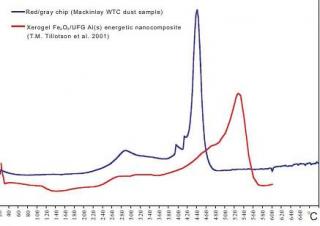
You gullibly fell for a simple, sneaky trick: That graph (which, by the way, clearly shows that that chips behaves significantly DIFFERENTLY from the nanothermite reference and hence is NO evidemce for thermite) shows only one of the four traces. The blue curve. Which, although being very much different from the reference, is still the least different.

But you quoted me: I wrote:

"In Figure 19, the black and green curves are "very broad thermal traces" and not spiked. Also, they prove an energy release far beyond that which thermite can possibly do (>4 kJ/g), which proves unambiguously that something other than thermite burned and contributed significantly to the height and width of those traces. Which is it? What do Harrit et al say on this matter?"

Then you went ahead and showed NOT the black and green curves. Why, Senemut? Was that deliberate? Was that consciously dishonest? Were you hoping to fool me, or are you yourself so profoundly fooled by Harrit et al?

You see, if you knew how to read DSC traces, you'd realize that they put at least two different kinds of red-gray chips in the DSC. In all of them, something that is NOT thermite burned on air and was responsible for the most part of the DSC traces. Unfortunately, Harrit et al, in the incompetence or dishonesty, forgot to give us hints which of the several different kinds of materials they wasted in this utterly stupid experiment.


So let's get back on track.

Please concentrate on the question:

Are chips a-d all from the same material?
By what objective criteria (data) do you decide whether or not they are the same? List all objective criteria that you use to determine whether chips a-d are the same material, or from different materials!
 
This could be further turned into a desperate attempt to defend Harrit et al. Just claim chips a-d are paint, but the DSC chips are different. They just happened to be superthermite, unlike a-d and the MEK chip. This is why they make spheres. To rule this possibility out, Millette needs to show that paint can make the spheres in the DSC.

This is a clear contradiction to the conclusion of their paper:

Based on this observations, we conclude that the red layer of the red/gray chips we have discovered in the WTC dust is active, unreacted thermitic material, incorporating nanotechnology, and is a highly energetic pyrotechnic or explosive material.
 
not right. they look similar via xeds but until ya heat it up in a dsc and look at the curve and check for iron and silicon rich microspheres, then maybe we can say they are the "same."

Those that Harrit et al heated up in a dsc and look at the curve and checked for iron and silicon rich microspheres - did those "look similar via xeds" to chips a-d? Did they "look similar via xeds" to the MEK-soaked chip?

You will admit, I hope, that you have no *********** clue.
 
Dr. Millette must have read the section of the 2009 Bentham paper describing the results of a simple resistivity test which provided an easy method for further isolating useful low-resistance red/gray chips and eliminating high-resistance red/gray chips like primer paint. ...

Stop that dirty rotten lie. It's getting old.


Please answer:

Are chips a-d the same material, yes or no?
Please list ALL the objective criteria that use to make that determination.
Do you have any resistivity data on chip a, b, c, or d? Of you course you DON'T. Nor does Jones claim that they did this test on chips a, b, c or d.

So, MM: Are chips a-d the same material? Yes, no, or don't know?

Only an answer to this question will get you any further. Please answer it honestly.
 
From reading the 2009 Bentham paper, Dr. Millette knew that Dr. Harrit et al found great significance in the behaviour of certain red/gray chips that were isolated from the 9/11 WTC dust and heated to approximately 430C.

Dr. Millette could easily have heated some of his "chips of interest" higher than the 400C 'cap' he used for his still unpublished paper.


MM

millette said he followed astm standards yet astm D 4451 - 02 that mentions how to do a muffle furnace test on paint state the muffle furnace should be 450C.

it states the 450C +/- 25C so 450C is the average to where it needs to be heated to ash and get the pigments.

did millette even do that? NOPE! was he scarred to do that (pandoras box), or maybe the jref members here relayed what they wanted the muffle furnace to be heated to or maybe its his lab protocol (not astm standard). i tried emailing his lab to find out the protocol for that particular test but no answer.
 
Harrit et al say that chips a-d are thermite.
Did Harrit et al "produce iron and silicon rich microspheres" from chip a, chip b, chip c, or chip d?
and maybe they are in his samples. did he once say that his dsc produced chips that had no iron and silicon rich microspheres.

do you not believe in the scientific method? do you think you and millette are better than the scientic method or somehow "higher up" so you dont have to worry about such things and whatever you say goes? millettes samples need to be able to do what jones and crews do...ie produce iron and silicon rich microspheres. once again if you dont know about the scientic method:
wiki-
"Reproducibility is the ability of an entire experiment or study to be reproduced, or by someone else working independently."


You are dodging the point that, if you accept that chips a-d are the same, for a set of reasons, then you must also accept that the chips that Millette proved to NOT contain any elemental Al and thus NO thermite are also that same material, for the exact same reasons.
its not a doge, its a fact. there are multiple sources of these red gray chips in jones' paper. he did not state that some of the red gray chips did not react in the dsc. millette has anohter lot of the wtc dust. he has not shown that his are the same material...once again...reproducibility.

So, Senemut, do you agree that chips a-d are all the same material? Give reasons: What data do you base your opinion on!
yep...from jones' samples and from what his paper says about his samples.


Again: Did Harrit et al heat chips a? Chip b? Chip c? Or chip d? Senemut, yes, no, or you don't know?
Of course you know that answer: There is no indication that any of chips a-d were tested in the DSC or otherwise heated.
they worked with this stuff, not you.

You agree that there are different kinds of materials among the magnetically attracted red-gray chips, righ? So: Which of these kinds produce microspheres? You know the answer: It's "we don't know, because the data is insufficient".
do you mean like henryco's red red chips and the one lone red gray chip he lost! i bet jones would have seen those if they were attracted by the magnet b/c they look similar to the red grays. and they have similar xeds. but jones makes no mention of these red red's. millette makes no mention of multi layer chips that are attracted by the magnet and neither does henryco.


You see, Jones is responsible for a crap paper; the DSC test merits no replication, as he forgot to tell us which if the several kinds of red-gray chips they used there.
he makes NO mention that one or two or three did not react. all reacted from what the paper tells to produce iron and silicon rich microspheres.

but i am glad that you admit that you are against the scientific method!! take note chris moyer.


"In Figure 19, the black and green curves are "very broad thermal traces" and not spiked. Also, they prove an energy release far beyond that which thermite can possibly do (>4 kJ/g), which proves unambiguously that something other than thermite burned and contributed significantly to the height and width of those traces. Which is it? What do Harrit et al say on this matter?"
we already went over that and i think even the paper states there may have been more than one reaction.

Then you went ahead and showed NOT the black and green curves. Why, Senemut? Was that deliberate? Was that consciously dishonest? Were you hoping to fool me, or are you yourself so profoundly fooled by Harrit et al?
to show you that "wide" dsc curve from tillotson. thats all.

You see, if you knew how to read DSC traces, you'd realize that they put at least two different kinds of red-gray chips in the DSC. In all of them, something that is NOT thermite burned on air and was responsible for the most part of the DSC traces. Unfortunately, Harrit et al, in the incompetence or dishonesty, forgot to give us hints which of the several different kinds of materials they wasted in this utterly stupid experiment.
whose expert opinion is that they put in 2 different types of red gray chips?
also we know that when farrer burned epoxy "it gave a very broad thermal trace, NOT at all like the spiked exothermic DSC peak in our Fig 19."
 
Last edited:
Those that Harrit et al heated up in a dsc and look at the curve and checked for iron and silicon rich microspheres - did those "look similar via xeds" to chips a-d? Did they "look similar via xeds" to the MEK-soaked chip?

You will admit, I hope, that you have no *********** clue.

ill take harrit's word for it when he speaks of the MEK soaked chip since he actually worked with these red gray chips.

http://www.ae911truth.org/downloads/documents/primer_paint_Niels_Harrit.pdf
 
Last edited:
Originally Posted by Senenmut
?
wrong?
replication of experiments.....thats science ya know.
did millette get iron and silicon rich microspheres?

please tell how one would get iron and silicon rich microspheres from millettes chips?


Originally Posted by Redwood

Try burning the organic resin matrix in an oxygen-containing atmosphere, as Harrit and Jones did with their paint chips.

Oh wait, they're really thermite cleverly disguised at paint, down to the metallic aluminum and silicon platelets made to resemble common aluminum silicate (kaolinite).

In which case, they will ignite under an inert atmosphere. Get back to us when Harrit & Jones do this.


Originally Posted by Senenmut

they did:

"When Dr Farrer burned epoxy paint in the DSC, it gave a very broad thermal trace, NOT at all like the spiked exothermic DSC peak in our Fig 19. This is one of the many tests he did to check things."
http://911blogger.com/news/2012-09-08/letter-regarding-redgray-chip-analyses

I'm sorry, but your reply is non-responsive to my reply. You asked how to get iron & silica rich microspheres from burning paint samples.

Try to stay focussed. If you wish to discuss DSC tests, you could start by responding to my remarks about the importance of running DSCs under an inert atmosphere, if one wishes to verify the hypothesis of thermite.


Originally Posted by Senenmut
show us a paint product on steel that produces iron and silicon rich microspheres around 430C.

Originally Posted by Redwood
Harrit and Jones's chips would be one. You can duplicate this yourself by igniting any red primer with a combustible base that also contains kaolinite. You'll have no problem finding them, guaranteed.


Originally Posted by Senenmut

please tell us how this would work?

Gladly! At the simplest possible level of experiment, you should collect multiple samples of red paint flaking off of steel or iron. This should be no problem in any environment, they are that common. Most will have a silicate in the matrix of the paint along with the hematite pigment. A few may instead have something else such as titanium dioxide or silica.

If you wish, you can separate out the samples containing the silicate materials by identifying the platelet structures of silicates such as kaolin. (You'll need access to an electron microscope or a high-power optical microscope.) The platelets may not be kaolin, but another micaceous material, but this is of no importance. Did you know that iron oxide mixed with silicates has been in use for centuries in rust-inhibiting paints? It's known generically as "micaceous iron oxide".

Now ignite them with a torch. If you have microscope access, you can personally verify the existence of microspheres in the ash. If you want to know their precise nature, you'll need to send them off to an analytical laboratory.

If you have no microscope access, just send all of your paint samples to an analytical laboratory, ask them to separate the samples containing mica-like platelets, and ignite those samples, and check for microspheres found in the ash, and ask to have them analyzed if you're willing to pay for the analysis.

If you want to do more sophisticated tests, I can send you some suggestions.


Originally Posted by Redwood
You could also inform us as to purpose of silicon or silicon compounds in H&J's purported thermite, other than to reduce energy yield per unit weight. Maybe you can ask H&J and pass it on.


Originally Posted by Senenmut
i think basile said it might provide fluidity.

Please ask Dr. Basile to explain the importance of fluidity in military-grade demolition nano-thermite, unless you can do it yourself. Are you sure that it isn't supercalifragilisicexpialidociousness?:rolleyes:
 
Dr. Millette must have read the section of the 2009 Bentham paper describing the results of a simple resistivity test which provided an easy method for further isolating useful low-resistance red/gray chips and eliminating high-resistance red/gray chips like primer paint.

Dr. Millette must have observed a large number of red/gray chips in his pile after using the basic chip isolation method described in the 2009 Bentham paper.

Pure crap!

Harrit and his group didn't even do what you are claiming. Per the paper, they performed the resistivity test on ONE CHIP. You keep saying CHIPS, which is incorrect.

Given the small size of the red chip, about 0.5 mm x 0.5 mm, we used two probes and obtained a rough value of approximately 10 ohm-m. This is several orders of magnitude less than paint coatings we found tabulated which are typically over 1010 ohm-m [31].

Red chip. One. Singular.

Which chip of the four in the paper did they do the resistivity test on? Why weren't the other three tested if it was so simple?
 
ill take harrit's word for it when he speaks of the MEK soaked chip since he actually worked with these red gray chips.

http://www.ae911truth.org/downloads/documents/primer_paint_Niels_Harrit.pdf

Why wasn't the "simple" resistivity test mentioned in this paper?

Also, why didn't they actually study the paint chips they separated out using the resistivity test? Why do they keep going to what NIST reports in their study other outside data regarding paints?

They had paint chips right in their hands correct?
 
you still dont get it. from the bolded above, they might of had all thermitic chips. im glad you recognize jones had thermitic chips!! now that you understand that, you can see that millette had a different type of red gray chip.

Nope.

Millette extracted the the chips exactly the way Harrit and his group did. Making sure the chips had a red/gray layer and that they were attracted to a magnet. Harrit and his group conclude in their paper that all chips extracted using the above two criteria are thermitic.

Millette got different results using the same extraction method proposed by Harrit and his group. This proves that the conclusion in Harrit's paper, that all red/gray chips extracted by a magnet will be thermitic, is completely incorrect.

Also, how come they didn't perform resistivity tests on the other three chips in their paper?
 
Dust does not match thermite, no need for further DSC

Millette does not have to do a DSC. No truther has a clue what DSC is used for anyway.
However, Jones and Harrit already proved the dust does not match thermite.
111JonesDelusion.jpg


911 truth believers in thermite make these graphs as small as possible since they show Jones did not find thermite.
If 911 truth thermite believers had any skill in research, they would find the dust is closer to burn wood DSC, or soil DSC. They can't find much.
The biggest sign of failure is when they bring up iron rich spheres. Big failure.

Millette can rest his case - there was no steel damage on 911 by thermite. A fact left out of the endless quest for the thermite fantasy.

What does resistivity have to do with anything? Sources other than the insane nuts, Jones and Harrit.
Where is the aluminum oxide Jones? lol, what a fraud.
 
Bad Boy,

Niels Harrit has in fact said in interviews in the past that he thinks that there must have been thousands of tons of this nano-thermite in the buildings, since so much was left over! This from their observation or estimation that about 0.1% of the dust samples were, by weight, red-gray chips. If they suppose that total mass of the debris was, say, 1 million tons, and a good proportion of that was turned to dust - say, 100,000 tons, then 0.1% of that is 100 tons. BUT what they find in the dust is merely the unburned left-overs of the hypothetical thermite, so originally there should have been ... well, let's boldly speculate ... a hundred times as much, or 10,000 tons.

Tackling this from a different angle: That infamous "6 wt-% of the dust are iron microspheres, says RJ Lee" translates to ... 6,000 tons of iron microspheres total, and if these are the product of thermite, this means 12,000 tons of thermite total.
Of course this begs the question: Why isn't there about as much aluminium oxide, or 3% by weight Al in the dust?


As for the much more reasonable "it's paint" hypothesis: A while ago, BasqueArch calculated an estimate for the total surface of structural steel in both towers:
http://www.internationalskeptics.com/forums/showpost.php?p=8058454&postcount=2109
I took his work and estimates that this amounts to roughly 75 tons of paint on structural steel, both of tje twin towers combined. If 1% of that surface flakes off during the collapse and enters the dust (0.75 tons of paint), taking an equal, but heavier layer of oxidized steel with it (gray layer), then we would expect to find "some" (single-digit number of) tons of red-gray chips in the dust.

It is difficult to estimate the amount of dust that was created and settled outside the immediate debris pile. I usually go with an assumption of very roughly 50,000 tons. A few tons of paint chips would be 0.01% of this, so what Harrit et al. reported is one order of magnitude above my expectation. Then again, my inputs have considerable margin of error, and I have yet not accounted for paints other than which was applied to the structural steel of the twins.

This might help narrow the margin.
From Bazant calculation of entire TTowers mass shed in the dust clouds ~ 20%

“κout= mass shedding fraction = fraction of mass that escapes outside
tower perimeter before the end of crush-down (not afterwards).
Based on video and seismic records,κout≈0.2”
http://www.absolutenetsolutions.com/psych/images2/00 WTC Collapse - Wha#558C6.pdf
 
Calculating SF (square feet ) of thermite paint over all steel for both towers

Ok. ~12,000 tons of thermite painted onto WTC1,2 steel structure to melt it. How much surface area of steel would this be?

[my bold]
From email correspondence between chemical engineer T. Mark Hightower and Niels Harrit:
On July 27, 2011, Niels Harrit (chief author of the 2009 nanothermite paper) presented a calculation for how much thermitic material would have been necessary to explain the presence of the many tiny iron-rich spheres in the dust (assuming that a thermite reaction was the source of the spheres).
He gave a range of numbers, based on lower and higher concentrations of the thermite formulation. His lowest figure amounted to 29,000 metric tons of thermitic explosive per tower – a value hundreds of times greater than the calculation for conventional explosives. His “conservative” estimate (based on 10% iron-oxide in the thermitic material) was 143,000 metric tons of thermitic material that would have been placed in each tower. http://www.veteranstoday.com/2011/08/27/nanothermite-if-it-doesnt-fit-you-must-acquit/
[note: thermitic material is red layer only per Bentham paper]
Oystein 12,000 tons x 2000 lbs = 24,000,000 lbs. of thermite paint.
From “That infamous ‘6 wt-% of the dust are iron microspheres, says RJ Lee’ “translates to ... 6,000 tons of iron microspheres total, and if these are the product of thermite, this means 12,000 tons of thermite total.”-Oystein.

Harrit low 29,000 metric tonnes x 2204 lbs = 63,916,000 lbs x 2 towers =127,832,000 lbs. of thermite paint.
Harrit high 143,000 metric tonnes x 2204 lbs = 315,172,000 lbs x 2 towers = 630,344,000 lbs. of thermite paint.

We may ignore for the moment the unnoticed transportation, distribution and application difficulties of this amount of thermitic material applied to the steel structure as well as the steel melting or explosive energy deficit of a 100 micron layer, and solely calculate the amount of steel surface area that these amounts of painted thermite would cover.
--------------------------------------------------------------------------

From TNEMEC Series 104-1211 Epoxy red steel primer, similar to that used in the original towers.
http://www.tnemec.com/resources/product/PDS/104.pdf
Total steel surface area of both towers combined= 14,340,000 SF
http://www.internationalskeptics.com/forums/showpost.php?p=8058454&postcount=2109

From Bentham paper - chips thickness; 10-100 microns gray layer, 10-100 microns red layer.
At 100 microns (average width of human hair) dry film paint thickness for the “active” red layer, one gallon of the primer paint covers 329 SF and weighs 14.7 lbs/gallon -2.4 lbs / gal. for evaporative loss of VOCs (volatile organic compounds) and HAPs (hazardous air pollutants) = 12.3 lbs/ gal. net.
--------------------------------------------------------------------------
Oystein -from 6% iron microspheres 24,000,000 lbs / 12.3 lbs per gal = 1,951,220 gal x 329 SF/gal. = 641,951,380 SF of painted steel coverage /14,340,000 SF of steel surface area both towers =
45 times more surface area than the actual total for all of the steel surface areas of the two towers.

Harrit low 127,832,000 lbs / 12.3 lbs per gal = 10,393,000 gal x 329 SF/gal. = 3,419,297,000 SF of painted steel coverage /14,340,000 SF of steel surface area both towers =
238 times more surface area than the actual total for all of the steel surface areas of the two towers.

Harrit high 630,344,000 lbs / 12.3 lbs per gal = 51,247,000 gal x 329 SF/gal. = 16,860,263,000 SF of painted steel coverage /14,340,000 SF of steel surface area both towers =
1,176 times more surface area than the actual total for all of the steel surface areas of the two towers.

These SF calculations based on the thermite claims show that the amount of iron microspheres found in the dust could not have been produced solely, or even predominantly, by the “thermitic” red layer of the chips.
 
Last edited:

ISF - Join now!

Every member here is approved by hand. No bots, no spam, just people who care about evidence and honest debate.

Membership is free!

Create your free account

Back
Top Bottom
