WTC Dust Study Feb 29, 2012 by Dr. James Millette

MM: What we see in Fig. 19 is this:

[qimg]http://www.internationalskeptics.com/forums/picture.php?albumid=1016&pictureid=7419[/qimg]

Apparently, exothemic reactions (burning) started at about 330-370 degrees C in the case of two "bigger" exotherms. You do not see that?

It is in very good agreement e.g. with this calorimetric curve for epoxy resins/composites:

[qimg]http://www.internationalskeptics.com/forums/picture.php?albumid=986&pictureid=7252[/qimg]

Because of this typical behavior of polymers (e.g. binder in paints), temperature for ashing set to about 400 degrees C is ideal, since all polymer is burned after some time (1 h in Millette's study), but the effect of heat on pigments and other uncombustible components is minimal.

I printed this figure out and tried to determine the onset temperature of the peaks graphically. My results for the Intermont and White sample are:

Intermont: 373°C
White: 386°C

I think that these results are not very exact due to the graphical determination method and that a margin of error of +/-10°C should be assumed.
 
The only "lying" there are actually Harrit et al.
Well, perhaps not lying - being the bloody amateurs they are, they may simply be unqualified to read DSC curves.

Look - here is the DSC curve from the Tillotson and Gash paper:

[qimg]http://i1088.photobucket.com/albums/i328/MikeAlfaromeo/ActiveThermiticMaterial/TG_Fig3_colored.png[/qimg]

As you can see, it is endotherm below ca. 380 °C, but exotherm above that.
Power increases to ca. 2 W/g at 490 °C, and then the power increase rate increases (curve gets steeper), till it peaks at just under 5 W/g and at ca. 525 °C.

Would you say that this sample ignited at 380 °C, at 490 °C, at 525 °C, or did not ignite at all?
Give reasons for your answer!

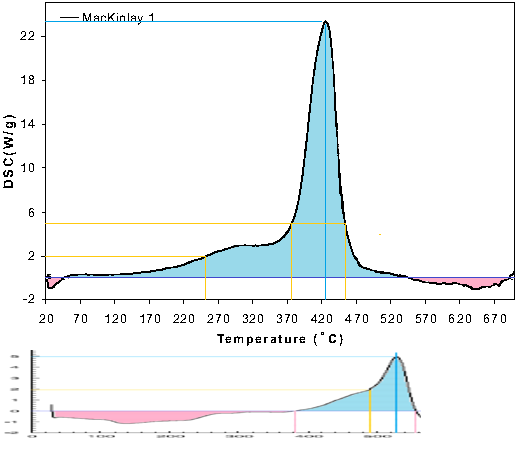
Now look at the DSC curve for ono of Harrit's chips - the MacKinlay 1 sample:

[qimg]http://i1088.photobucket.com/albums/i328/MikeAlfaromeo/ActiveThermiticMaterial/HarritFig19-1_vs_TG_Fig3.png[/qimg]

It goes into exotherm territory at 45 °C - does it ignite then?
It surpasses 2 W/g at ca. 250 °C - does it ignite then?
It surpasses 5 W/g (the peak power of Tillotson's nano-thermite) at ca. 380 °C - does it ignite then?

If you think that Tillotson's sample ignited at all AND Harrit's sample did NOT ignite at 380 °C or below, you've got some 'splainin' to do :D

They say "ignorance is bliss" and that "a little bit of knowledge is a dangerous thing".

Your exhaustive use of the work others does not change the fact that you are an anonymous amateur falsely accusing true professionals of being "bloody amateurs".

Professionals with long histories of peer-reviewed papers.

Regarding your use of curves, without plot points and a displayed timeline, your observations are out of context.

HarritFig19-1_vs_TG_Fig3.png


For every increase in 10°C on the x-axis, 1 minute has occurred. From 370 °C to 470 °C, 600 seconds have passed.

We know from the Harrit et al Paper and the Basile video, "that the red/gray chips from different WTC samples all ignited in the range 415-435 ˚C" and that the exothermic duration was only 1/15 - 2/15 second!

Unlike in the DSC, the video shows the ignition of a sample placed an electrically heated ribbon where the critical temperature was reached more quickly. Each frame represents 1/30 of a second.

wtccipignitioncomp2ar1.jpg


It can be seen in the video that prior to ignition the red shows a rapid darkening and expansion which likely accounts for some of the pre-ignition data points.

MM
 
We know from the Harrit et al Paper and the Basile video, "that the red/gray chips from different WTC samples all ignited in the range 415-435 ˚C" and that the exothermic duration was only 1/15 - 2/15 second!
Unfortunately you don't realise what an exotherm is. The exotherm is any positive energy release. Anything above zero on the DSC curve.

In the Harrit paper the exotherm starts at around 50°C. The exotherm continues until approximately 530°C.

530-50/10=48 minutes. The exotherm lasted 48 minutes.

Secondly you are calculating from a video of a chip being heated by a resistance wire and not DSC with a known and controlled heating rate. What is the heating rate in the video? How is the exotherm being measured in the video? Hint: it's not.

Fail again MM. lol.
 
It is correct that Millette wrote this.

What is not correct is the implied assumption that there was a single "the formula for the primer paint used on iron column members in the World Trade Center towers (Table 1)".
Table 1 shows the composition of one of the primers (plural!) that are known to have been applied to WTC steel, namely Tnemec Red 99, specified to be applied to the WTC perimeter columns. That formula contains, among other, ingredients, Zinc Chromate. Even though Millette, citing Harrit, gives a too high number for the expected Zinc content (it is Harrit who committed three to five rather stupid mistakes in the reference), the conclusion is correct that the chips that Harrit concentrated on can't be this Tnemec primer from the perimeter columns, because they contain no, or too little, Zinc.

However, there was at least one other primer paint, applied by the LaClede Steel Company to the floor joists. Their composition is Zinc-free. Some of the chips that Millette studied, and the Chips a-d in the Harrit study, have elemental spectra that are an excellent match for the LaClede primer.

Millette apparantly wasn't aware of the existence of the LaClede primer at the time he released this preliminary report, but he is now, and will account for it in the final report.

Thank you for your help, I appreciate it. It makes sense now. I'm afraid I was a humanities major and I'm not well versed in the sciences.
 
Oystein: Regarding auto-phase mapping, I am really not strong in this matter, so I can hardly contribute.

I am looking now at Millette's "MEK chip" (swollen in MEK, then dried and subjected to this mapping):

picture.php


I am not actually sure what I see. But it seems to me that this red layer is partially covered with some other, irregular layer (?). Jim Millette should explain this. Or, perhaps I simply do not understand what is depicted here... If there is really some other layer, it could/should have different composition, but nothing like this is seen in the mapping itself. Therefore this "different layer" is probably just a part of red layer which was swollen to such an irregular "shape".

MM: Congratulation! After several years even you finally acknowledge what we have repeated here perhaps hundred times: that DSC curves in Bentham paper must be seen with the necessary "timeline", therefore "from 370 °C to 470 °C, 600 seconds have passed"!!! Great. Thanks for this substantial progress in your mind:cool:

Otherwise, as even your confused fellow jtl understands and you seem to admit now, heating in DSC is not comparable with the Basile's heating on quickly heated strip (and even much less is comparable to the heating with oxyacetylene torch, which can have a temperature over 3000 degrees C!).

You wrote: "We know from the Harrit et al Paper and the Basile video, "that the red/gray chips from different WTC samples all ignited in the range 415-435 ˚C" and that the exothermic duration was only 1/15 - 2/15 second!"
Only your part regarding Basile's video is acceptable in sense that this chip apparently ignited even with some flame.
As for Harrit's paper, there is no DSC curve showing that chips slowly heated in DSC really ignited (which basically means "self-sustaining" burning without additional application of external heat) at any temperature. All we actually see (I repeat) are slow exothermic processes starting below 400 degrees and lasting up to 530 degrees C;)
 
Last edited:
Kminek: This is indeed a plain, undeniable truth, which cannot be changed by your words about peculiarity of DSC. What we see are slow exothermic processes starting at ca 330-370 degrees C and with maximum rates at ca 430 degrees C, lasting several minutes.

Oystein :being the bloody amateurs they are, they(Harrit et al) may simply be unqualified to read DSC curves.

Sunstealer: Unfortunately you don't realise what an exotherm is. The exotherm is any positive energy release. Anything above zero on the DSC curve.

My goodness the level of ignorance you guys display is incredible. Maybe I should be kind to Oystein and Kminek because their first language is not English, but I don´t think Sunstealer has that excuse. An "exotherm" can show all kinds of things, it can be be something simple as phase transition of the sample, having absolutely NOTHING to do with ignition point and burning. But, this is what I, MM, Basile and Harrit et al are talking about, we are talking about the point at which the chips IGNITE:

MM: samples all ignited in the range 415-435 ˚C

jtl: First of all the ignition point is the center of the peak, not start of exotherm, as this is a peculiarity of the DSC.

Harrit et al know the difference between ignition point and the general exotherm, but you Sunstealer et al so not understand, possible because of language difficulties, possible because you are simply unqualified. But hey you guys, just keep relying on your old defense, calling Harrit et al names, it makes you look so incredible cool:p
 
Sunstealer: This is a classic indication that the authors are frauds and peddling woo-woo.

The classic indication of a fraud is actually that the author is incapable of publishing a reviewed paper, but prefers instead to troll internet forum while posing as an anonymous expert, like you Sunstealer.

Another indication that an author is a fraud is that this author has documented charges of fraud against himself, like Millette.

Another classic indication that someone is a fraud or a pseudoscientist is that this person ignores data that counters his argument, refuses to admit mistakes and keeps peddling his woo no matter what:

Sunstealer:
Chips a-d contain no aluminates.
MEK chip does contain aluminates.

jtl: No matter the lack of Zn after MEK wash of fig 14, and everything else, you all continue the old MEK-Tnemec hand-wave like you never heard of an objection. The only aluminate in Tnemec is bound up with Calcium, but figure 17 in the Bentham paper does show aluminum rich area without Calcium. This means no Calcium Aluminates, and therefore figure 14 cannot be Tnemec.
 
Mohr: I have decided there is no further point in our discussions. I wish you well in your research, but our conversations have become fruitless. Your condescension and putdowns of my memory at every opportunity, your insistence that I haven't done any experiments when I organized a major experiment, and my reactions to you, calling you irritating etc., are taking the conversation nowhere. It is always my goal to try to retain civility and respect and I am getting too irritated with you personally to live up to my own personal ideals. I continue to be open to working with anyone to find a mutually-agreed-upon protocol for testing the chips with a lab both sides can agree is independent, assuming someone else has the funds to pay for such a study (around $6,000-$10000!). I continue to hope Steven Jones will release samples of his red-grey chips and the unpublished data he claims to have.

If anyone else wants to try to carry on a conversation with JTL they are welcome to try. JTL I wish you well and apologize for anything I may have said that was offensive or hurtful to you or others.

You are such a victim Mohr, you got angry at Ryan for quoting a document about Millette fraud charges, you misquote me and call me names but blame me for "fruitless conversations". Maybe you should start talking to that chemist and start to learn about the topic at hand before you accuse others of being the cause of "fruitless conversations"? Maybe you should have done that before you started making your debunking video for the chips, buddy? What does your "training" as journalist tell you about that?

And again you think you are a victim of someone being mean to you because I tell you outright, and repeat again here, the fact that you organized a study does not mean you have done any experiments.

Edited by kmortis: 
Removed personal comment


I accept your apology and I tell you I have no hard feelings, but I also ask you to consider if perhaps you are a bit out of your element in these discussions?

I share your wish for more studies and do hope your effort results in Millette publishing a paper. In fact I hope this happens asap.
 
Last edited by a moderator:
My goodness the level of ignorance you guys display is incredible. Maybe I should be kind to Oystein and Kminek because their first language is not English, but I don´t think Sunstealer has that excuse. An "exotherm" can show all kinds of things, it can be be something simple as phase transition of the sample, having absolutely NOTHING to do with ignition point and burning. But, this is what I, MM, Basile and Harrit et al are talking about, we are talking about the point at which the chips IGNITE:

Harrit et al know the difference between ignition point and the general exotherm, but you Sunstealer et al so not understand, possible because of language difficulties, possible because you are simply unqualified. But hey you guys, just keep relying on your old defense, calling Harrit et al names, it makes you look so incredible cool:p

Hehe:D
The ignition point is defined in this way: The minimum temperature at which a substance will continue to burn without additional application of external heat. Also called kindling point.
We do not know if Bentham chips behaved in this way, but since exothermic processes in these tiny objects weighing less than one milligram were very slow, lasting several minutes (as recorded by the device), we have no proof of ignition in the sense of the definition.

Indeed, we fully agree with Harrit that chips can be ignited (and Basile showed that at least this one chip "Lucky 13" really ignited). We are only in the strong contradiction as regards the source/fuel of this possible ignition. According to us, the fuel/the source of exotherms is just gradually pyrolyzed and burning organic polymer binder and nothing else, since kaolinite and iron oxide do not burn at all:cool:
 
Last edited:
Ivan, for the time being, I can't help you much with with the interpretation of the EM-omage of Millette's MEK/EDS-map chip.
It seems, that the outcropping of "irregular" top layer is most closely associated with Phase 3 which is "Primary: High Si" - in other words silica.

On a German board, Africanus mentioned the other day that Diatomaceous Silica, a common filler in paints and I think about 10% of the Tnemec pigments, can soak up liquids and swell in the process. Not sure if that would explain the outcropping. Now I don't think this chip is Tnemec (no Zinc, and too much of the Al=Si phases). It would rather be some third kind of paint, with both Al-silicate and amorphous silica.
 
Oystein : Well, you are right, whereas phases 1, 4, 5 and 6 are distributed evenly on the chip, this is not so much the case of phase 3 (and also phase 2):

picture.php


I agree that phase 3 rich in Si basically coincide with this strange "additional layer" (and even with its little pieces visible e.g. on the right edge of red layer).

And I think that also phase 2 tells us something, since "carbon dots" are not so abundant again in the area where this irregular layer is visible. This could mean that carbon-based binder (its signals) is partially "shielded" by some inorganic stuff rich in silicon in this "layer".

Anyway, if all this is true (some contaminating layer based e.g. on silica is present), Jim Millette did not chose really optimal chip for that EDS-mapping.

And it seems that only parts outside this irregular layer can be considered to be "reliable", as for the composition of red layer of the chip.
 
Last edited:
Not sure if this is going to come out ok because I did it very quickly, but here are all 6 phases together with SEM pic and sample plus phase table. You may have to zoom in with your browser.

picture.php


If you look at the corresponding EDX spectra for this sample there are 16 of them. Many of those don't fit into the Laclade or Tnemec EDX that we'd expect. Unfortunately there isn't any way of knowing which chip with which EDX spectrum we are observing in the phase mapping section. I presume that it's the same one on pages 41 and 42 of Millette's report that is a good match for Laclade, but it's impossible to tell.

There are some oddities. My initial thought was that there was some sort of swelling or additional material on this phase mapping chip. I'll have to take a closer look at this chip because there are some anomalies such as phase 4 and the strong green along 2 sides of the chip.
 
Thanks, Sunstealer, for this set of images.
Some months ago I pointed out that many Millette's chips seem to be contaminated with some whitish stuff, which is visible again here. I supposed it should be mostly calcium sulfate from drywalls, but perhaps it is silica or similar silicon-rich stuff in the case of some chips for some unknown reason (?)

Perhaps the "MEK chip" subjected to EDS mapping is among those we see on the left "set of chips"?
It could be basically revealed if some real enthusiast would "clip out" all these chips on the left, enlarge them and try to fit their shape to the shape of MEK chip using Photoshop or so.
If there is a good fit found, we can see if this chip was really contaminated with this whitish stuff, which could explain the strange "irregular layer".

In such a case, I do not understand why Jim Millette chose just such a contaminated chip. Or, why he did not wash this chip with water prior soaking in MEK, in order to remove whitish stuff. Perhaps because Harrit et al also did not wash their chip for "MEK soaking"? Yes, not "perhaps", but quite probably:cool:
 
Last edited:
Sunstealer,

the MEK-Chip, after MEK-soaking and drying, is ca. 0.45 mm across; the left-hand edge is ca. 0.37 mm, and the right-hand edge 0.30 mm. So we must look for a chip with similar size and shape.
Also, the corresponding overall EDS-spectrum should have Si>Al & Fe, and bits of Ca (only bits!), Na, Mg, Ti and Cr, all of which you find in all phases except the C phase; but no S.

I don't really see any chip that fits one or the other bill :(
 
You are such a victim Mohr, you got angry at Ryan for quoting a document about Millette fraud charges, you misquote me and call me names but blame me for "fruitless conversations"

Jtl, it has been shown over and again that nobody has ever accused Millette of fraud. This shows that Kevin Ryan is either dishonest, or suffers from a reading comprehension problem, or is a fool.

This also shows that if you continue to cite Ryan, you are either dishonest, or you suffer from reading comprehension problems, or you are a fool.

What do you think you are accomplishing here? Do you think that there is one person, in the entire world, whom you have persuaded?

From your writing, I'm guessing that you are roughly of high-school age. If you've graduated, and you're in college, enroll in some classes in freshman chemistry. If you aren't in college, enroll at your local community college.

At the very least, you'll get smarter. You might even find that you like it and are good at it. You might even get a degree, and bemusedly look back at what a young fool you were, once.
 
Based on Fig. 7, 10 and 11a:

Fig 7 shows that Al=Si overall in the red layers of these four chips
Fig. 10 shows that that Al and Si have identical spacial distribution, and both correlate with the platelets. In other words, there is no region, no particle in that image which contains Silica (Si, but no Al)
Fig. 11a shows that the platelets contain Al=Si

The platelets are kaolin clay - zero doubt about that.
Kaolin contains Al and Si in equal amounts. It is pervasive in these chips.
There would have to be some excess in Si in Fig. 7 if there were significant silica in addition to kaolin, but there isn't.


As far as I can see, Millette provides no EDS spectrum or BSE images for that chip shown in Appendix G, so I can't assess if it really has the same EDS characteristics and pigment morphology as chips a-d.
Correct me if I am wrong I spent little time on this.
Well, I've no time to dig into this now but it sounds to me like you're saying Millette's chips do not correspond to chips a-d, and that would have serious implications.

One objection that comes to mind is that figs. 10 and 11a are from chip a (or from another chip from dust sample 1), and that says nothing of chips b-d.
 
Another indication that an author is a fraud is that this author has documented charges of fraud against himself, like Millette.
You are a fraud.

Now you have a documented charge of fraud against yourself. Which is, according to your standards, an indication that you are a fraud.

Great! Now let's go on.

Documented charges of fraud against Jones, must mean Jones is a fraud.
Documented charges of fraud against Harrit, must mean Harrit is a fraud.

Or maybe it takes more than a charge of fraud for someone to be a fraud?

As I proved, Cate Jenkins' charges against the Lioy team in which Millette participated were unfounded. Her citations in support of her charges were all post-analyses. And later in her paper, she uses the same results obtained by the Lioy team that she previously criticized, to reveal another purported fraud by a different team.
 
Our efforts to find paint primer from a WTC truss is still being met with frustration... You may remember our attempts to get paint from the Red Knights, a motorcycle/firefighters' club who has a WTC memorial with the trusses. An FDNY first responder agreed to ask them personally for a small paint sample, giving us the maximum possible credibility for our request. Their response? "It's a no go. Their thinking is that they don't want to ligitimize any 911 truther arguments."
 

ISF - Join now!

Every member here is approved by hand. No bots, no spam, just people who care about evidence and honest debate.

Membership is free!

Create your free account

Back
Top Bottom