• Security incident: ISF was recently accessed by intruders. Please change your password, and change it anywhere else you used it. Read more

What did Democrats do wrong?

What did Democrats do wrong?

  • Didn't fight inflation enough.

    Votes: 13 14.9%
  • Didn't fight illegal immigration enough.

    Votes: 24 27.6%
  • Too much focus on abortion.

    Votes: 2 2.3%
  • Too much transgender stuff.

    Votes: 31 35.6%
  • America not ready for Progressive women leader.

    Votes: 31 35.6%
  • Should have kept Joe.

    Votes: 3 3.4%
  • Not enough focus on new jobs.

    Votes: 2 2.3%
  • Nothing, Trump cheated & played dirty!

    Votes: 16 18.4%
  • Didn't stop Gaza War.

    Votes: 9 10.3%
  • I can be Agent M.

    Votes: 6 6.9%

  • Total voters
    87
There's the salience thing of course. Inflation was an is very salient to most people, well unless you are rich. Vaccines, not so much. Almost nobody has died of the measles in living memory in the US thanks to vaccines, but everyone has felt inflation.

I know, folks have died of covid, a lot of folks but, we were basically lied to about the efficacy of those vaccines so, not all that much of a winning issue. Especially when it was dems that kept poor kids and kids of color out of school.
Seems relevant to the problem I'm pointing out.
 
see, look how salty you get. seeing more nazis then there actually are, which is still more fairly an uncomfortable amount of nazis or that trump is a terrible choice for president but you think probably not quite as terrible as they say is so offensive to you in a way that i don't understand or even care to.

your priorities are irrational, it's not my problem. guess i'm just not being nice enough. well too bad for both of us i guess, i'm not the one who's in the wrong here but i need to bear the consequences just the same. why should i be nice about it?
Why should you be nice about it, well, if you want folks to vote for your side, being nice is more effective. I mean, 90% of my posts on this forum are basically if you want folks to be on your side, start by being nice to them because being mean to them will just make them not listen to you. To be fair, I'm probably doing that to.
 
There's the salience thing of course. Inflation was an is very salient to most people, well unless you are rich. Vaccines, not so much. Almost nobody has died of the measles in living memory in the US thanks to vaccines, but everyone has felt inflation.

I know, folks have died of covid, a lot of folks but, we were basically lied to about the efficacy of those vaccines so, not all that much of a winning issue. Especially when it was dems that kept poor kids and kids of color out of school.
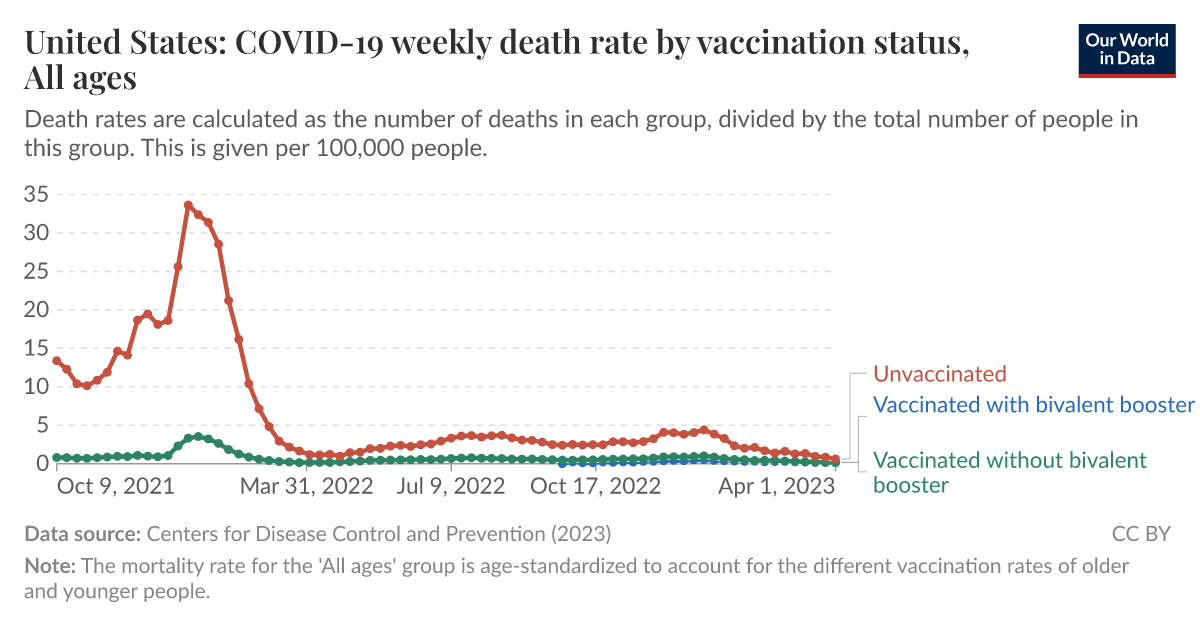
Mmmmmm... the COVID vaccines were pretty useful.
 
Why should you be nice about it, well, if you want folks to vote for your side, being nice is more effective. I mean, 90% of my posts on this forum are basically if you want folks to be on your side, start by being nice to them because being mean to them will just make them not listen to you. To be fair, I'm probably doing that to.
i don't think so, i think they need to feel the consequences of their own decisions. that's what works.

anyway, i don't know what you're doing. you seem to be much more concerned with being nice to people who are never nice, and being as charitable as possible to people who are never charitable, insisting what works for them will never work. trump is awful to his allies and enemies alike, he's mean spirited and incoherent, he lies and cheats constantly.

why, when that works for him, is your advice to do the opposite? and why demand that of the left which the right never adheres to? it's this insane double standard, it doesn't make sense. and i'm sorry if that hurts your feelings, but i don't see how that's not how it is.
 
It abso-◊◊◊◊◊◊◊-lutely does. I have no idea what you're even talking about.

Rationality is a set of tools for understanding how the world works, it is emphatically not a set of values which tell you how the world ought to be.

Someone who wants nothing more than his next heroin dose can use his rational faculties to find it.

Someone who wants nothing more than to die soon can use rationality to find a relatively quick and painless way to do so.

Someone who wants nothing more than to cause other sentient beings to suffer can use rationality to cause as much suffering as possible.

If you think rationality has values built in, I challenge you to show me what definition you are using.
 
Rationality is a set of tools for understanding how the world works, it is emphatically not a set of values which tell you how the world ought to be.

Someone who wants nothing more than his next heroin dose can use his rational faculties to find it.

Someone who wants nothing more than to die soon can use rationality to find a relatively quick and painless way to do so.

Someone who wants nothing more than to cause other sentient beings to suffer can use rationality to cause as much suffering as possible.

If you think rationality has values built in, I challenge you to show me what definition you are using.
rationality is a factor in which values are important and which aren't. for example, whether or not to do heroin at all or whether or not they want to live or die, or whether or not suffering is good or bad or who should suffer and which sentient beings are worth it and so on and so forth. values aren't randomly pulled out of a hat.
 
The big problem I see is the idea that our lives are in the hands of government officials. If this is an incorrect assessment, it needs to be corrected. If it is correct, then we need to fundamentally change the situation so that our lives are NOT in the hands of government officials, be they "quacks" or not.
Can I ask why?
I mean, that's pretty much the whole point of government, as I see it. Large areas of our wellbeing are controlled or administered in one way or another by the government. Health, safety standards, defence, workers' rights, indeed, rights of any kind. All of these things involve creating some kind of centrally-enacted, universal standards or policies, so that everyone enjoys the same protections. These policies and standards are created by the legislature, which is democratically elected.
Note that I'm not saying that the actual practice of this is perfect, just that the principle seems to me to be sound. What, may I ask, are your reasons for opposing this?
 
Can I ask why?
My guess would be that government officials are insufficiently expert and/or have institutional bias which causes their standards to be more focused on protecting the government, increasing their (and/or their agency's) power and the requirement for national standards means that those standards may not be fit for local purposes.

OTOH experts from the private sector are absolutely expert and have no institutional bias. These experts will focus solely on the public good and will do so based on a much wider perspective.

For example a government expert tasked with ensuring the quality of the air and water may prevent the release of certain chemicals into the air or water system because they represent some kind of risk to public health. They may not have taken into account however the impact on public health of a company having to scale back operations because they're no longer able to release those chemicals.

Likewise, it may seem desirable to insist that employers provide a safe working environment but if the impact of having to provide that safe working environment is them closing down the plant and moving to a country where the loss of life or limb is simply part of the cost of doing business then maybe those standards don't need to be so high.

Of course standards that protect the life of the unborn, indemnify corporations from prosecution by overzealous government agencies and so on are fair and good.
 
rationality is a factor in which values are important and which aren't. for example, whether or not to do heroin at all or whether or not they want to live or die, or whether or not suffering is good or bad or who should suffer and which sentient beings are worth it and so on and so forth. values aren't randomly pulled out of a hat.
Everything in the above paragraph is wrong, aside from the bit about the hat.

Rationality is the art of adjusting your beliefs to reality and making decisions which maximize your expected value. It does not tell you which end goals to pursue, and this is part of why values alignment is such a hard problem in AGI research.
 
There's the salience thing of course. Inflation was an is very salient to most people, well unless you are rich. Vaccines, not so much. Almost nobody has died of the measles in living memory in the US thanks to vaccines, but everyone has felt inflation.
Oh, some people have died from measles. And guess who was in the middle of that.

And we have seen an increase in outbreaks in the mainland US.
I know, folks have died of covid, a lot of folks but, we were basically lied to about the efficacy of those vaccines so,
By folks yo uare carrying water for.
not all that much of a winning issue. Especially when it was dems that kept poor kids and kids of color out of school.
Yes, because people using your lines give a flying ◊◊◊◊ about poor kids.
 
Can I ask why?
Because government workers are often idiots and fools. This isn't peculiar to government workers, but they aren't better than the rest of us.
I mean, that's pretty much the whole point of government, as I see it. Large areas of our wellbeing are controlled or administered in one way or another by the government. Health, safety standards, defence, workers' rights, indeed, rights of any kind. All of these things involve creating some kind of centrally-enacted, universal standards or policies, so that everyone enjoys the same protections. These policies and standards are created by the legislature, which is democratically elected.
Note that I'm not saying that the actual practice of this is perfect, just that the principle seems to me to be sound. What, may I ask, are your reasons for opposing this?
Who said I opposed government doing any of these things? I didn't. You read that into what I actually said, but I didn't actually say any of these things.

What I said is that I don't want my survival to be dependent upon government. That doesn't mean I don't want government to try to help me survive, but I want to be able to survive even if government screws up. I think we should structure society such that when government does screw up (and it inevitably will), the vast majority of us can and will survive such screwups just fine.

I'm not sure why that position is generating such controversy and opposition. Seems like this should be everyone's default position.
 
Because government workers are often idiots and fools. This isn't peculiar to government workers, but they aren't better than the rest of us.
So who would you rather our lives be in the hands of - government workers whose job is to make things better for everyone, or capitalists who only care about themselves?

Idiots and fools can still do good work if they are properly trained. The vast majority of government workers are not doing jobs that require a great deal of intelligence or even common sense. They just need to do what they are told. But I suspect you are actually talking about the people in charge, not the grunt workers.

The problem is that unlike career government workers, who are trained by the system to do the job, the leaders are political appointees who often have no idea how to run a government department and didn't get where they are by being smarter than average. In the case of Trump appointees they are typically chosen for irrelevant reasons such as that they have been good to him or have antithetical values that Trump hopes will destroy the departments they head. Even the smartest government employees will struggle to do good work when headed by idiots who are working against them.

What I said is that I don't want my survival to be dependent upon government. That doesn't mean I don't want government to try to help me survive, but I want to be able to survive even if government screws up. I think we should structure society such that when government does screw up (and it inevitably will), the vast majority of us can and will survive such screwups just fine.
You aren't thinking it through. In practice - except for those of us who live on deserted islands - our lives are dependent on government. Without government your life would quickly get a lot worse. You might survive, but you probably wouldn't be liking it. Even with 'screwups', having government to rely on is better than not having it.

You say we should structure society so we can survive without government help if (when) it screws up. But a structured society needs government, otherwise it's anarchy. That might would be OK if people were all rational and moral when left to their own devices, but we all know many of them aren't. But even if they were, not having anyone looking at the 'big picture' to coordinate society is a bad thing, because it could go any way and individuals are powerless to prevent it. As soon as you have someone doing that coordination, you have 'government' - and of course the possibility that they 'screw up'.

That's why it's important to support people in the role of 'government' who are smart and have our best interests at heart. But that's also the problem. How do we do that when we ourselves are stupid and selfish, and don't recognize the need to choose leaders who aren't?

Seems like this should be everyone's default position.
That's how you see it. Others think differently. I don't think anarchy is a good idea. I want a government that I can depend on to do the stuff needed to keep society together and keep the country in good health, and I expect to be dependent on that. The idea of having to go it alone just because the government might (will) sometimes 'screw up' is frankly frightening. of course I want a certain amount of autonomy too, and I'm quite happy to do stuff on my own when it's not a job of government - but not when it is.

As an example, a few years ago the water supply in the local village here got contaminated with a 'bug'. In the week between water tests half the people in the village got sick. That wasn't a screwup, it was just one of those things that happens. The screwup was when the (conservative) mayor of our city panicked and threw chlorine into our water supply, which is an artesian source not connected in any way to the village supply. There was no need to do that. Within a short space of time, hundreds of hotwater cylinders in the area sprung leaks, as well other copper piping fixtures. This happened because the chrorine reacts with lime in the water to corrode copper. Mine was one of them.

What do you do in a situation like that? I told the council to shove it and got the water disconnected of course. I'll find my own damn water supply! Except I didn't of course. I got the cyclinder replaced with a vitrious enameled one (the only type plumbing suppliers will sell here now) and continued to enjoy nice hot water. Yes, I am dependant on government to supply me with potable water, and I still want it even after they screwed up. The alternative would be far worse (even just a week without water as I attempted to drain and remove the cyclinder myself was painful enough!).

 
My guess would be that government officials are insufficiently expert and/or have institutional bias which causes their standards to be more focused on protecting the government, increasing their (and/or their agency's) power and the requirement for national standards means that those standards may not be fit for local purposes.

OTOH experts from the private sector are absolutely expert and have no institutional bias. These experts will focus solely on the public good and will do so based on a much wider perspective.
This is quite astonishingly naive. It is also quite the departure from your stance in the UK Politics forum, where you appear to be fairly left-wing, opposed to privatisation and in favour of nationalisation.
Your naivety with regard to private versus public can be shown by a couple of examples. Thames Water, on our side of the pond, is the first one. Priavtised water company, massive wastage of water, huge amounts of pollutants released into the water, £14 billion of debts, all whilst paying out enormous dividends to its shareholders. That is the exact opposite of focusing on the public good.
On the US side, the opiates crisis. Pharmaceutical companies are responsible for a nation-wide public health crisis. They showed no sign of being aware of the public good at all: profits were paramount, and to hell with the families and communities devastated by the effects of mass drug addiction.
In both cases, the private sector focused on its own narrow interests , maximising profit at the expense of the public- and, in both cases, it has needed government intervention to bring them to heel.
For example a government expert tasked with ensuring the quality of the air and water may prevent the release of certain chemicals into the air or water system because they represent some kind of risk to public health. They may not have taken into account however the impact on public health of a company having to scale back operations because they're no longer able to release those chemicals.
Astonishing. You are arguing that companies should be allowed to release harmful chemicals freely and unfettered by oversight or legislation, in order to safeguard jobs and the profits of those companies.
Likewise, it may seem desirable to insist that employers provide a safe working environment but if the impact of having to provide that safe working environment is them closing down the plant and moving to a country where the loss of life or limb is simply part of the cost of doing business then maybe those standards don't need to be so high.

You now abandon the concept of a safe working environment too? Wow. Just wow.
Are you being serious, or have I missed the sarcasm in this post? I sincerely hope this is sarcasm, because the alternative is that you are a dyed-in-the-wool cutthroat capitalist, intent only on profit, and utterly unconcerned about harm to the environment and to people's health- and that is a truly disgusting attitude.
Of course standards that protect the life of the unborn, indemnify corporations from prosecution by overzealous government agencies and so on are fair and good.
Third choice: you are channeling your inner Ziggurat, and trying to express what you think is his viewpoint.
Do, please clarify. I have little time for the elitist cynicism you voice in the UK Politics forum, but this is a new low, if this is a serious post.
 

ISF - Join now!

Every member here is approved by hand. No bots, no spam, just people who care about evidence and honest debate.

Membership is free!

Create your free account

Back
Top Bottom