In his May 2009 letter titled
WHY THE RED/GRAY CHIPS ARE NOT PRIMER PAINT, Niels Harrit attempted to figure out the composition of the Tnemec primer that was specified for the perimeter columns, and specifically its Zinc- and Magnesium content. He committed a few serious errors, which I will now correct, to come up with a better estimate of what the composition MAY have been.
He references two tables with ingredients:
First, the Tnemec composittion as documents by NIST in NCSTAR 1-3C, Appendix D, Table D-1. This is actually two tables:
Pigment:
Iron Oxide|35.9%
Zinc Yellow|20.3%
Tnemec pigment (proprietary)
|33.7%
Diat. Silica|10.1%
SUM
|
100.0% Vehicle (grouped and summed by me)
Raw and bodied Linseed oil|41.5%
Resins and agent|26.3%
Thinners|32.3%
SUM
|
100.1%
Harrit's first mistake is to ignore that the (inorganic) pigments add up to 100%, and that the organic vehicle ingredients also add up to 100% (plus rounding error). He assumes in his discussion that, for example, Zinc Yellow is 20.3% of the wet paint, and that the (volatile) thinners are 32.3% of the wet paint.
He thinks that, when the 32.2% volatile thinners evaporate, and 67.8% solids are left, that then the Zinc Yellow would be (20.3/67.8)=29.9% of the dry paint.
This is of course WRONG. Pigments and vehicle are mixed in some proportion. If, for example, the pigments are 40% of the dry paint, and the vehicle then thus 60% of the dry paint, then Zinc Yellow would be (40% * 20.3%) = 8.1% of the dry paint. In this case, Harrit would have overestimated the Zinc-content by a factor of ca. 3.7
However, we do not know the proportion of pigment:vehicle in the wet or dry paint. As we will see, this can be estimated from further data.
The second table that Harrit uses comes from a
Material Safety Data Sheet for Series 010 Tnemec Primer Red, dated 04/11/2003.
A word of caution: This data is 36 years younger than the Tnemec composition documented for the WTC in 1967! It is extremely likely that the recipe has been changed since! It is still a "modified alkyd" based primer, though.
This table lists ingredients only roughly:
Ingredient|lower bound %|exact %|upper boud %
Zinc compounds||2.98|
Organic Cobalt comp.||.10|
Iron Oxide Fume|1||5
Iron Oxide Fume|6||10
Quartz||4.36|
Talc|21||30
Ca silicates and aluminates|6||10
Amorph. Silica|1||5
Mineral Spirits, as Stoddard solvent||22.71|
SUM
|
35
|
30,15
|
60 So the sum of all listed ingredients adds up to a value between 65.15% (lower bound) to 90.15% (upper bound). Not 100%! Where is the rest?
It is a bit strange that a pigment would include Stoddard solvent (white spirit) - if that is, as Harrit assumes, a pigment!
But looking at another, more contemporary MSDS from Tnemec, for example this for
Series 10 Tnemec Primer Red Modied Alkyd Paint, we see there that there is still 10-30% talc, 1-5% quartz, 10-30% Stoddard solvent, 5-10% Ca-aluminates and silicates, 6-15% iron oxide fume, 1-5% Zinc compounds etc - but this time it also lists Alkyd Resin (10-30%), which is in line with the old 1967 composition (while some of the pigments are not!).
So I conclude:
Harrit's second mistake is to assume that the MSDS is for the proprietary Tnemec
pigment, which makes up 33.7% of the pigment, when in fact it is the MDSD for the ready
wet paint, as sold.
This mistake has two major effects:
First, he adds the Stoddard solvent (or 33.7% of it) to the volatile thinner, which he deducts in addition to the thinner he deducts for the vehicle composition, further increasing the overestimation of Zinc Yellow
Secondly, it makes him underestimate the Ca, Mg and Al content derived from the MSDS data.
Harrit's third mistake isn't quite as bad: He assumes that the paint composition hasn't changed from 1967 to 2003. We have to keep this in mind.
Now, knowing that the MSDS actually shows ingredients of the wet paint, we can use it to estimate the vehicle

igment ratio! Here is how:
- The 1967 specification has 32.3% Thinners
- The 2003 MSDS has 22.71% Stoddard solvent
- I claim both are one and the same. I find it reasonable to assume that an alkyd based red primer formulated with thinner would in 2003 still have about the same ratio of thinner:resin+oil (volatile:non-volatile components). So if 22.71% of wet paint is 32.3% of vehicle, then vehicle is 22.71/32.3 = 70.3% of the wet paint, and pigments are 29.7% of the wet paint!
After the thinners evaporate, the composition of the dried paint is then
Iron Oxide|13.8%
Zinc Yellow|7.8%
Tnemec pigment|12.9%
Diat. Silica|3.9%
Vehicle|61.6%
Note that Harrit had a result of 34% Zinc Yellow in dry paint - wrong by a factor of more than 4.3!
(Actually, as linseed oil dries, it oxidizes, adding some mass of oxygen from air. On the other hand, I am not sure to what drying extent reactions also release some mass, so perhaps that cancels out to some extent)
I still have these pesky 12.9% of "Tnemec pigment (proprietary)", and I can only speculate what that is. The MSDSs list significant amounts of Talc (Mg3Si4O12H2), Calcium Silicates (Ca2SiO4) and Calcium Aluminates (Ca3Al2O6), so perhaps this Tnemec pigment is mostly mafde of these?
Assuming that the Tnemec pigment is 6 parts Talc, 1 part Ca-Silicates and 1 part Ca-Aluminates, and assuming that the sum formula of the vehicle is dominated by oxidized triglycerides from the linseed oil, averaging C9O4H16, I computed the following
first guess for the elemental composition of 1967 Tnemec Red:
H: 5.3%
C: 35.4%
O: 36.0%
Mg: 1.9%
Al: 0.3%
Si: 4.9%
Ca: 1.5%
Cr: 2.2%
Fe: 9.6%
Zn: 2.8%
Note that the entire content of Ca, Mg and Al is based on very uncertain assumptions for the Tnemec proprietary pigment, as are 2/3 of the Si.
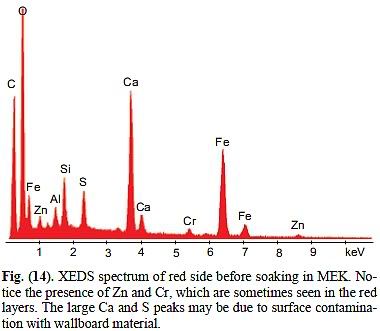
I ran this composition through a XEDS simulation - result and discussion in the next post.