Merged Thread to Discuss The Excellent Analysis of Jones latest paper

What's your point. The gray layer is oxidized steel that the paint (red layer) was once adhered to. Not exactly rocket science here. :rolleyes:
Senemut thinks wrongly that iron/steel has to ignite in order to form spheres. What can you do with someone who doesn't have the basic knowledge in chemistry that a 14 year old has? How can you explain reactions that don't involve ignition?
 
Sunstealer, Oystein: Mark Basile introduced himself in this way: "I have a bachelor of science in chemical engineering from Worcester Polytechnic Institute. I've worked for about 25 years in industry and the majority of what I do is analytical work and figuring out what materials are composed of, why they are what they are..." etc.

If his other analytical work has been of the similar quality as in the case of WTC chips (with the same insight, detachment and understanding)... God save these companies:boggled: (On the other hand, he could be still good in some specialized and routine analyses, why not.) Otherwise, I am quite sure that he will never arrange another analysis of WTC dust:cool:

Btw, just yesterday I posted some calculations based on Basile's own data. According to him, the heating element for burning the WTC chips had dimensions:

thickness: 0.002 in (ca 0.05 mm)
width: 0.1 in (ca 2.5 mm)
length: 0.25 in (ca 6 mm)


But looking at his video, the real length of the element is much, much higher than the width. It looks like that even basic data about his heating experiments may not be correct in his lecture, therefore no reliable calculations can be performed:(
 
Last edited:
That one sentence proves Basile has no idea what he is talking about. No one who knows anything about materials science would describe oxidised iron or steel in that way. You don't integrate carbon or manganese into iron or indeed treat these elements as a separate component of the material.

What Basile is doing is he's looking at the EDX spectrum and treating each element individually without understanding that for example whenever oxygen is present you are highly likely to have oxides in the sample. He doesn't seem to understand that if iron and carbon are present then there is a very high likelyhood that the material will contain iron carbon phases such as those found in steels.

He's embarrassing. If you know what you are on about you can see that he doesn't have any idea what he is saying just by looking at his delivery. He's fooling the uneducated.


With someone who has such a poor grasp and who uses completely inappropriate words and phrases to describe phenomena that he's observed then it's almost impossible to garner much useful information from him.

He uses the word ignite but we have little idea if he understands the difference between "ignite" and "banana". Yes the oxidised steel may not ignite but that doesn't mean it's not part of a reaction such as reduction due to carbon released from the burning of an organic material namely paint.

Yes he can speculate but that's utterly pointless. Twoofers will still lap it up though. /shakes head.

looks like you missed the part where the gray layer does not produce spheres or anything.

basile-
"But the gray layer basically seems to be largely iron, although there's some other stuff that's integrated into it too, it seems to have a fairly high carbon and oxygen content as well. But it doesn't ignite, it's just the red layer that ignites. I think if you had a big enough chunk of this, uh.. that I can envision that the gray layer would probably wind up getting consumed into this molten mass of iron that might be produced, but with these small chips you don't get the progression of the event to that level... But I can only speculate."
 
Last edited:
looks like you missed the part where the gray layer does not produce spheres or anything.

basile-
"But the gray layer basically seems to be largely iron, although there's some other stuff that's integrated into it too, it seems to have a fairly high carbon and oxygen content as well. But it doesn't ignite, it's just the red layer that ignites. I think if you had a big enough chunk of this, uh.. that I can envision that the gray layer would probably wind up getting consumed into this molten mass of iron that might be produced, but with these small chips you don't get the progression of the event to that level... But I can only speculate."
ftfy
 
Senenmut:
What is actually your point?

- Of course that "it's just the red layer that ignites". It's a paint layer, which is flammable (contrary to gray layer of rust).

- Mark Basile did not show/prove any iron droplets, the less the iron film. According to his XEDS of one such droplet, it is just contaminated iron oxide.

Or have I missed something? Do you see some real proof of iron droplets in Basile's lecture?

I see only one micrograph of the burned chip (time 43:14) , with no scale, no explanation of used method (probably polarized light microscopy?) , but with some arrows pointing to blue things which are allegedly "iron droplets" (according to Basile). Some of them even don't look like droplets.
 
Last edited:
looks like you missed the part where the gray layer does not produce spheres or anything.
...

You missed the part where Basile shows that chips #13, which "is approximately 2.1 mm x 1.6 mm in size" = ~3,36 mm2 = 0.003,36 cm2 (screenshot from 39:00)...

Basile_39_00_Chip13_Photo.jpg


... so the red layer, at a thickness of, let's say, 50 microns (= 0.05 mm = 0.005 cm) has a volume of 0,168 mm3, or 168,000,000 µm3, or 0.000,016,8 cm3.

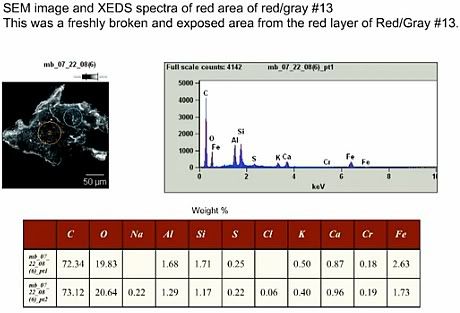
Or you missed the part where Basile shows that the red layer of chip #13 contains only about 1.7-2.6% iron (screenshot from 39:30) ...

Basile_39_30_Chip13_XEDS.jpg


... but has more than 72% carbon and 20% oxygen, so it is mostly some hydrocarbon, so the density of that red material is 1.5 g/cm3 or less (pure epoxy has 1.2; mixing epoxy with much more iron oxide than Basile found, and kaolin, would give the resulting paint about 1.5), so we can estimate that the red layer weighs about 0.000,025,2 g..

From this we can deduce that it contains no more than 0.000,025,2 g * 2.6% = 0.000,000,655,2 g of iron.

If you reduced all that iron (which is bound as oxide) to elemental metal and isolated it, it would take up a volume of 0.000,000,655,2 g / 7.5 g/cm3 = 0.000,000,087,36 cm3, or 0.000,087,36 mm3, or 87,360 µm3.

If you formed one sphere of iron from all of that pure iron in the red layer, you can compute the volume of the sphere thusly:

Volume of a sphere is V = 4/3 pi r3, so r = cubic_root(V / (4/3 pi)), in this case cubic_root(87,360 µm3 / 4,12) = ~27.5 µm
Diameter then would be 55 µm.

Now look at one such droplet drom the residue of chip #13 (screenshot at 47:00):

Basile_47_00_AnotherIronParticle_Composition.jpg


This droplet alone has an average diameter of more than 50 µm, and it is by far not the only one (screenshot from 43:08):

Basile_43_08_Chip13_MicroAfterBurning.jpg


Basile points to several "iron droplets formed from thermite reaction" from #13. Hard to gauge how large they are - there is a size marker that's not clearly visible due to low video/image quality, but it is a marker of 100 µm (or 300 µm?), so it is fair to assume that they all are in the tens of µm across. Much too much of these droplets, they can't possibly come from the little bit of iron in the red layer, even if you take into account that these droplets are only half iron by mass*)!

Now take a clooose look again at this last screenshot - this time not at the greyish blobs that Basile points to, but at the large reddish chips flakes (top left, right of center). Say what - there is some red layer left over from the reaction?? Do you realize the red layer is red because it contains iron oxide pigments? Do you realize it only stays red as long as the iron oxide is still iron oxide and reduced to iron, and still in the ca 100 nm particle size that makes it a bright red pigment?

Where is the gray layer in that image? Do you see any amount of gray layer that is still in original shape, edgy and all? If the red layer reacted and the gray layer did not, would you not expect to find some left over gray layer instead of left-over red-layer?


Senemut, did you miss all that?

Have you read my blog posts?
  • How Mark Basile confirms that red-gray chips are not thermitic ("the hydrocarbon matrix provides more than 100 times the heat that thermite possibly could. The conclusions are inevitable: The red-gray chip is not thermitic by nature"...)
  • Too little thermite to blow up Mark Basile's chip (" 5% Thermite in an organic matrix make no difference. On its on, it couldn't warm the matrix even to onset decomposition, it could not destroy more than a small fraction of the polymer molecules, and it would be incapable of doing any significant work on anything outside of the chip. Whatever reaction is observed in the video of chip #13 burning, it is not driven by a thermite reaction.")


*) The screenshot at 47:00 shows Fe: 53%; O: 21%; C: 8%; Al: 5%; Si: 8%; and traces of other elements. The mass ratio of Fe:O in the iron oxides at the surface of steel is anywhere between 2.3:1 (Fe2O3) and 3.5:1 (FeO); in this droplet, it's 2.5:1. Given the imprecision of Basile's measurements, and the range of possible Fe:O-rations for oxidized steel surfaces, it is easily possible that there is enough O to allow for all the iron to be oxidized and the Si and Al to be Al-silicate, perhaps with some silica, too.

 
Last edited:
Oystein: Thanks for your calculation and reasoning showing that blue-gray "iron" droplets in this chip should originate from the gray layer.At least I am still your devoted reader:cool:

You are right, the remnants of red layers are clearly visible in the screenshot of the burned chip "Lucky Thirteen". And they again indicate that no thermitic reaction occured (because red layers remained red after heating).

It seem that in this case, gray layer of rust was dissintegrated to some small pieces, perhaps because of very rapid heating, leading to some "microexplosions" of gasified/liquified flammable products of paint binder degradation.
Their usually rounded shapes can be perhaps sign that this gray layer could originally contain some different iron oxide phases (of rounded shapes) which were separated during chip burning.

But I can only speculate:cool:
 
Last edited:

what if the chips were switched? i thought about the scenario if millette's did react around 430C and produce iron and silicon rich microspheres. i emailed chris mohr with a plan to address the issue. if i remember correctly, henryco said his chips might have been changed in the mail or something to that extent.


ok

Then what? Can you explain how this could happen when all the other tests show the compounds to be identical?
we do NOT know they are identical materials until they do the test. why are you guys afraid of the dsc test. or for that matter, even heating it up to 430Cish. are you guys afraid it will NOT react to produce iron and silicon rich microspheres?

Can you tell us which chips were which in the DSC tests Harrett et al performed?

yeah, the ones that react to produce iron and silicon rich microspheres! haha...
 
what if the chips were switched? i thought about the scenario if millette's did react around 430C and produce iron and silicon rich microspheres. i emailed chris mohr with a plan to address the issue. if i remember correctly, henryco said his chips might have been changed in the mail or something to that extent.


What if Harrit was given chips that made him think they were "therm?te" but had nothing to do with the WTC site? What is your proof his were not switched?

we do NOT know they are identical materials until they do the test. why are you guys afraid of the dsc test. or for that matter, even heating it up to 430Cish. are you guys afraid it will NOT react to produce iron and silicon rich microspheres?

Oh...we do know. No one here is afraid of the test because we know what DSC testing is. :rolleyes:

yeah, the ones that react to produce iron and silicon rich microspheres! haha...

So you don't know? Are you aware that the paper does not actually tell us what chips were DSC tested?

Have you tried to contact Jone/Harret and ask them the release all their data? You know they did the same tests Chis had done.

What is your fascination with these microspheres? Can you explain (in your words) why you consider them significant?
 
Senenmut: Your paranoid notes above are definitely more interesting than your citations from Basile's presentation:cool:

All closely analyzed red-gray (or red) WTC chips in Harrit's and Millette's papers, as well as in Henryco's and Basile's reports, are compatible with some red paints: a lot of polymeric binder, pigments typical for paints, layer thicknesses, mostly attached gray layers of rust, composition frequently matching two particular primers (Laclede and Tnemec), thermal behavior expectable for paints (comparatively slow burning above 400 degrees C, when slowly heated in DSC machine under air, expectable release of heat, carbon missing in ash after heating, ash remains red).... So what could be here switched with what?

Do you really believe that we are afraid of the results of heating of some more red-gray chips? Really?
Suppose that Jim Millette already heated some of his chips, and they behaved like Harrit's chips, forming microspheres or droplets based on iron oxide. Then what? It could only prove that these chips were paint, since Harrit's data also indicated paint;) As well as in the case that the heating of these chips was accompanied with exotherms expectable for paints (like in Fig. 19, Bentham paper), but no iron-rich microspheres or other rounded things were formed (just another paint, or paint without attached gray layer, or perhaps some other red layered non-pyrotechnic material from WTC).
 
Last edited:
You missed the part where Basile shows that chips #13, which "is approximately 2.1 mm x 1.6 mm in size" = ~3,36 mm2 = 0.003,36 cm2 (screenshot from 39:00)...

[qimg]http://i1088.photobucket.com/albums/i328/MikeAlfaromeo/ActiveThermiticMaterial/MarcBasilePresentation/Basile_39_00_Chip13_Photo.jpg[/qimg]

... so the red layer, at a thickness of, let's say, 50 microns (= 0.05 mm = 0.005 cm) has a volume of 0,168 mm3, or 168,000,000 µm3, or 0.000,016,8 cm3.

Or you missed the part where Basile shows that the red layer of chip #13 contains only about 1.7-2.6% iron (screenshot from 39:30) ...

[qimg]http://i1088.photobucket.com/albums/i328/MikeAlfaromeo/ActiveThermiticMaterial/MarcBasilePresentation/Basile_39_30_Chip13_XEDS.jpg[/qimg]

... but has more than 72% carbon and 20% oxygen, so it is mostly some hydrocarbon, so the density of that red material is 1.5 g/cm3 or less (pure epoxy has 1.2; mixing epoxy with much more iron oxide than Basile found, and kaolin, would give the resulting paint about 1.5), so we can estimate that the red layer weighs about 0.000,025,2 g..

From this we can deduce that it contains no more than 0.000,025,2 g * 2.6% = 0.000,000,655,2 g of iron.

If you reduced all that iron (which is bound as oxide) to elemental metal and isolated it, it would take up a volume of 0.000,000,655,2 g / 7.5 g/cm3 = 0.000,000,087,36 cm3, or 0.000,087,36 mm3, or 87,360 µm3.

If you formed one sphere of iron from all of that pure iron in the red layer, you can compute the volume of the sphere thusly:

Volume of a sphere is V = 4/3 pi r3, so r = cubic_root(V / (4/3 pi)), in this case cubic_root(87,360 µm3 / 4,12) = ~27.5 µm
Diameter then would be 55 µm.

Now look at one such droplet drom the residue of chip #13 (screenshot at 47:00):

[qimg]http://i1088.photobucket.com/albums/i328/MikeAlfaromeo/ActiveThermiticMaterial/MarcBasilePresentation/Basile_47_00_AnotherIronParticle_Composition.jpg[/qimg]

This droplet alone has an average diameter of more than 50 µm, and it is by far not the only one (screenshot from 43:08):

[qimg]http://i1088.photobucket.com/albums/i328/MikeAlfaromeo/ActiveThermiticMaterial/MarcBasilePresentation/Basile_43_08_Chip13_MicroAfterBurning.jpg[/qimg]

Basile points to several "iron droplets formed from thermite reaction" from #13. Hard to gauge how large they are - there is a size marker that's not clearly visible due to low video/image quality, but it is a marker of 100 µm (or 300 µm?), so it is fair to assume that they all are in the tens of µm across. Much too much of these droplets, they can't possibly come from the little bit of iron in the red layer, even if you take into account that these droplets are only half iron by mass*)!

Now take a clooose look again at this last screenshot - this time not at the greyish blobs that Basile points to, but at the large reddish chips flakes (top left, right of center). Say what - there is some red layer left over from the reaction?? Do you realize the red layer is red because it contains iron oxide pigments? Do you realize it only stays red as long as the iron oxide is still iron oxide and reduced to iron, and still in the ca 100 nm particle size that makes it a bright red pigment?

Where is the gray layer in that image? Do you see any amount of gray layer that is still in original shape, edgy and all? If the red layer reacted and the gray layer did not, would you not expect to find some left over gray layer instead of left-over red-layer?


Senemut, did you miss all that?

Have you read my blog posts?
  • How Mark Basile confirms that red-gray chips are not thermitic ("the hydrocarbon matrix provides more than 100 times the heat that thermite possibly could. The conclusions are inevitable: The red-gray chip is not thermitic by nature"...)
  • Too little thermite to blow up Mark Basile's chip (" 5% Thermite in an organic matrix make no difference. On its on, it couldn't warm the matrix even to onset decomposition, it could not destroy more than a small fraction of the polymer molecules, and it would be incapable of doing any significant work on anything outside of the chip. Whatever reaction is observed in the video of chip #13 burning, it is not driven by a thermite reaction.")

*) The screenshot at 47:00 shows Fe: 53%; O: 21%; C: 8%; Al: 5%; Si: 8%; and traces of other elements. The mass ratio of Fe:O in the iron oxides at the surface of steel is anywhere between 2.3:1 (Fe2O3) and 3.5:1 (FeO); in this droplet, it's 2.5:1. Given the imprecision of Basile's measurements, and the range of possible Fe:O-rations for oxidized steel surfaces, it is easily possible that there is enough O to allow for all the iron to be oxidized and the Si and Al to be Al-silicate, perhaps with some silica, too.


millette heated his to 400C. according to his paper, the gray layerl "remained intact." so do you think just a 30C increase would do the trick? i doubt it.
 
What if Harrit was given chips that made him think they were "therm?te" but had nothing to do with the WTC site? What is your proof his were not switched?
i think it was basile that aquired some chips from an unnamed museaum too.


Oh...we do know. No one here is afraid of the test because we know what DSC testing is. :rolleyes:
lets get the ball rolling then. i got money in my pocket to do it.


So you don't know? Are you aware that the paper does not actually tell us what chips were DSC tested?
his chips react around 430C to produce iron and silicon microspheres. i havent heard where they tried to heat anything that they deemed interesting and it NOT react.

Have you tried to contact Jone/Harret and ask them the release all their data? You know they did the same tests Chis had done.
i emailed him about something else but did not get a reply back.

[/quote]What is your fascination with these microspheres? Can you explain (in your words) why you consider them significant?[/QUOTE]

Fe2O3 + 2 Al → 2 Fe + Al2O3
before you say no AL, this is what harriett said about the mek soaked chip:
"The resulting XEDS of this chip (Figure 6, below)
displays tiny blips indicating the presence of chromium and zinc. They disappeared after the
chips had been soaked/rinsed with the organic solvent. Therefore, they are believed to derive
from surface contamination..."
 
millette heated his to 400C. according to his paper, the gray layerl "remained intact." so do you think just a 30C increase would do the trick? i doubt it.

Which 30° increase?

Basile didn't heat his steel strip to just 430°C. He has not the slightest clue to what temperature he heated it.

Whatever temperature that was, he heated it VERY QUICKLY, at a heating rate of thousands of centigrade per second, reaching top temp within seconds at most, while Millette kept his experiment at a constant temperature for 30 to 60 minutes. Totally different experiments! You can try this at home:

  • shave a two little bits of clear plastic off a tooth brush, or similar material
  • Light a candle
  • Place one piece of plastic on a strip of aluminium wrap (only tens of µm thin) (steel wrap if you have), the other on a piece of fire-resistant glass (some mm thick))
  • Hold both just above the candle flame. The piece on the alu strip will heat to close the melting point of aluminium within seconds at most, just like basile did it, the piece on the glass will heat up much more slowly and take tens of seconds to get there
  • Observe how both pieces react - and the differences of reaction kinetics and residue appearance!


HOWEVER, Senemut, you FAILED totally to address anything at all that I wrote in the post you quoted.
Let me condense it for you:

  1. Basiles data shows that there was at most 0.000,000,655,2 g / 87,360 µm3 of iron in the red layer of his chip #13
  2. Basile's data shows that that the residue of chip #13 after reaction had several droplets he considers iron rich that each had a volume in the vicinity of 87,360 µm3 and more
  3. Basile's data shows that these droplets contained ~50% iron and ~20% oxigen
  4. It follows that much more iron was found in such droplets after the experiment than was found in the red layer before the experiment
  5. From this it follows further that most of the iron, if not all, can't come from the red layer! it MUST come from the gray layer!
  6. The Fe:O-ratio in the droplets is consistent with (mostly) iron oxide, which is NOT a product of the thermite reaction
  7. Basile's photos show that significants parts of the red layer have not reacted and are still visible as red layer, while no part of the gray layer is left in its original shape
  8. It follows, again, that the gray layer reacted (probably physically) to form droplets, not the red layer

This all follows from BASILE's experiments. Basile conclusively proves with his experiment that this chip #13 cannot possibly be thermitic in nature.


Please address Marc Basile's study, data, and my conclusions from it! Do not talk about Millette or Harrit! Use Basile exclusively!
 
Oystein: Mark Basile described his heating "tests" in this interview (shortened):

"I have a stainless steel resistive heating element... little less than a quarter of an inch across... and by controlling the amount of electricity that flows through the strip, I can heat it up to pretty much any temperature that I want.... (Temperatures were) somewhere a little over 400 degrees centigrade typically."

This is probably the source of info on temperatures of heating element for e.g. Senenmut (?) Unfortunately, Basile forgot to tell us how these temperatures were measured.

It seems to be quite clear that when some high electrical current is applied to such tiny resistivity element, this element finally (and quickly) reaches certain temperature (like in e.g. electric bulb). I only have a feeling that almost 7 amperes going through such element (having a resistance of some tens of ohms) would heat it up to much higher temperatures than ca 400 degrees C. But this is just a feeling, not based on any calculations.
 
Last edited:
lets get the ball rolling then. i got money in my pocket to do it.
Can you formulate a DSC test proposal: Describe the procedure you want done for your money step by step! For each stepo, explain WHY you want it done! In the end, completely enumerate the possible outcomes, and what they would mean!

his chips react around 430C to produce iron and silicon microspheres.
The fact of the matter is: Basile does not know, and does not tell, at which temperature the chip started to exhibit which behavour. We do know exactly from his description in the video, and from the video itself, that the temperature gradient was extreme (heating rate several thousand °C/min (NB: in an earlier post I mistaken wrote "per second")) and he gives no indication at which time and/or temperature his chip showed the reaction it did.

Again, the reactions of polymers are sensitive to the rate of temperature increase.

Fe2O3 + 2 Al → 2 Fe + Al2O3
before you say no AL, this is what harriett said ...
It doesn't matter what Harrit said. We are talking about Basile's chip. Here is the hard data on chip #13 that Basile presents:

Basile_39_30_Chip13_XEDS.jpg


See that:
1.29 - 1.68% Al
1.73 - 2.63% Fe
but
72.34 - 73.12% C

As I have shown in my blog post How Mark Basile confirms that red-gray chips are not thermitic, Basile's own experiments and data prove that this red layer is well above 80% hydrocarbon, , but only 0-4.7% thermite (0 having a very high likelihood), and that 99%-100% of the reaction energy will come from hydrocarbon combustion.

As I have shown in my blog post Too little thermite to blow up Mark Basile's chip the very low maximum energy of the very low maximum thermite content, as follows from Basile's own precise numbers from his own experiments, is far from sufficient to turn any significant amount of the organic matrix to gas. This clearly means that the reaction seen in the video cannot possibly come from thermite!


If you disagree with these assessment which are strictly based on the data Basile presents in his presentation, you MUST either offer show where my analysis of Basile's data is wrong (you are then not allowed to reference Millette or Harrit, as you can't know which of their chips are the same material as Basile's), OR you must offer a suggestion which of Basile's data is WRONG.
 
i think it was basile that aquired some chips from an unnamed museaum too.

So what was the point of your "switched samples" if you don't really know where the originals came from (with any certainty)?

lets get the ball rolling then. i got money in my pocket to do it.

Who's stopping you? I'm reasonably sure we do not control the samples. Personally, I think it's a waste of money. No one here disputes the data Harret et al presented.

his chips react around 430C to produce iron and silicon microspheres. i havent heard where they tried to heat anything that they deemed interesting and it NOT react.

So what? What's so special about 430 C? Can you show this is a positive identifier of "nano-thermite"?

i emailed him about something else but did not get a reply back.

I'm not surprised. They did the tests that could positively identify their compound but, they didn't include it in the paper and they refuse to release it (data). Funny you have no problem with this. :rolleyes:


Fe2O3 + 2 Al → 2 Fe + Al2O3
before you say no AL, this is what harriett said about the mek soaked chip:
"The resulting XEDS of this chip (Figure 6, below)
displays tiny blips indicating the presence of chromium and zinc. They disappeared after the
chips had been soaked/rinsed with the organic solvent. Therefore, they are believed to derive
from surface contamination..."

I said in your own words. You really don't know why you think it's significant, do you? Could it be because they told you it was?
 
Last edited:
i think basile has reacted a few more of these than sunstealer has!
basile also says this about the gray layer:

"But the gray layer basically seems to be largely iron, although there's some other stuff that's integrated into it too, it seems to have a fairly high carbon and oxygen content as well. But it doesn't ignite, it's just the red layer that ignites. I think if you had a big enough chunk of this, uh.. that I can envision that the gray layer would probably wind up getting consumed into this molten mass of iron that might be produced, but with these small chips you don't get the progression of the event to that level... But I can only speculate."

Sums up CT's right there.
 
Yes the oxidised steel may not ignite but that doesn't mean it's not part of a reaction such as reduction due to carbon released from the burning of an organic material namely paint.

so you think that the reaction will NOT take place at 400C as in millettes study but it could happen alittle over 400C as in basiles experiments?

basile-

"I have a stainless steel resistive heating element... little less than a quarter of an inch across... and by controlling the amount of electricity that flows through the strip, I can heat it up to pretty much any temperature that I want.... (Temperatures were) somewhere a little over 400 degrees centigrade typically."
 
... alittle over 400C as in basiles experiments?

basile-

"I have a stainless steel resistive heating element... little less than a quarter of an inch across... and by controlling the amount of electricity that flows through the strip, I can heat it up to pretty much any temperature that I want.... (Temperatures were) somewhere a little over 400 degrees centigrade typically."

Senemut,

in the video that YOU linked to, where Basile specifically analysed (and heated) chip #13 - when he placed that specimen on the steel strip and applied electric current to it to heat it...
  1. What temperature did the strip start out before current was switched on?
  2. At what temperature did it peak?
  3. How long after heating started did it take to reach peak temperature?
  4. What average heating rate does this compute to?
  5. At what time did the speciment start to react?
  6. What temperature did the strip have when the specimen started to react?
  7. What temperature did the specimen have when it started to react?
  8. How long did the reaction take till completion?
  9. What temperature did the strip have at the end of the reaction?
  10. What temperature did the specimen (or its residues) have at the end of the reaction?

If any of your replies, except perhaps to the first question, is something other than "I don't know", please explain how you know!

This excercise should make you aware that Basile's claim "(Temperatures were) somewhere a little over 400 degrees centigrade typically." is meaningless when discussing this experiment and the analysis of its residues.
 
Last edited:

ISF - Join now!

Every member here is approved by hand. No bots, no spam, just people who care about evidence and honest debate.

Membership is free!

Create your free account

Back
Top Bottom