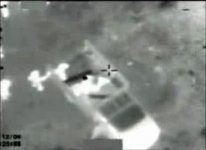
The IDF Now Has A YouTube Channel

Israel will win its deserved peace in the region with 2 states to the two conflicting nations.
Israel will win its fight over Hamas that will lose its continuous attempts for blood shed in the area. The Palestinian people will awake from their sleepy state and realize that their poverty is ONLY because of their support in a terroritic organization of its government.
Israel will win to have Palestinians and Israelis living in peace one state bordering the other with (hopefully) active trading of goods (although this could take even more time).

The Fool said:
firstly congratulations on the biggest Israeli flag so far.
I'm glad you like it.
 
Israel will win its deserved peace in the region with 2 states to the two conflicting nations.
Israel will win its fight over Hamas that will lose its continuous attempts for blood shed in the area. The Palestinian people will awake from their sleepy state and realize that their poverty is ONLY because of their support in a terroritic organization of its government.
Israel will win to have Palestinians and Israelis living in peace one state bordering the other with (hopefully) active trading of goods (although this could take even more time).

What do you base this on?
 
There is no explosion in the Barrel,the shell it self is basicly a rocket . the barrel is basicly a launching tube.

No. That would be somewhat closer to being a description of a missile weapon. For example this is a mortar:

http://commons.wikimedia.org/wiki/File:Mallet's_mortar.JPG

The things in the foreground are what it was meant to fire. They kinda lack any rocket type characteristics. One of the anoying things about war in the middle east is that there are a very large number of people trying to mislead you about what is going on so the minor details that we can get right (rockets vs mortar in this case) are worth hanging onto.
Ok I see what happend here , we are talking about two differant types of mortars . you are right about the ones shown in that link aand I stand corrected ,but I was talking about this type that I used in the Army
http://www.inetres.com/gp/military/infantry/mortar/81mm.html
 
They appear to have been Gas talks. The way the people were treating them (rolling them on the truck bed by pushing them with a foot) appears consistant with gas tanks.
Really? Is this how gas canisters for welding are transported in Oz? I have never seen such gas canisters transported by allowing them to roll about on the bed of a truck. They are always secured in an upright (valve up) position. In fact, that is the law in the US and I'd imagine in most other countries. It's also common sense.

Some guy appears to have claimed ownership of the truck....which apparently still has the gas canisters there. No doubt there will be an investigation (not)
And yet, the pic provided is of intact gas canisters. Where are the pics of the canisters which must have been damaged by the air strike?

Also, look at the size of the "gas canisters". They are the full width of the flatbed truck they are being loaded into. Typically, that is a full 8' or more. Compare the width of the bed to the SUV next to it for size. What welder uses 8' tall gas canisters? Certainly the one shown in your video isn't 8' tall.

Now compare to this pic of a Grad rocket, use the people carrying it for scale: http://cache.daylife.com/imageserve/05yO6pde0i6xg/610x.jpg
 
Last edited:
and it's an infrared video, which is normally used at night.

No, infrared video (thermal imagining) is used both in daylight and during nighttime. In daylight it is very useful in revealing camouflaged targets that otherwise would be invisible to the naked eye. For instance a otherwise well camouflaged soldier would stand out against the background because of infrared radiation from his body heat. Something you can see in the mortar video.

You can clearly see that the mortar video was filmed in daylight because of the shadows cast by the buildings in the sunlight, or to be more specific the infrared heat radiation from the sun. In the video the shadows are pointing northwest with the sun to the southeast, that is consistent with the time of day being approximately 9 am as claimed by Israel.


(Looks as thought the link has gone dead. Found another YouTube video of the mortar firing at the school.)


The effect of shadows in daylight infrared videos you can clearly see in this video of a test firing of the US Viper Strike missile. The target is a car towed behind a tank. The first part of the video shows the scene through an infrared camera, the second part through a daylight camera. Notice the shadows cast by the car and the tank in both parts of the video.


Note that in both of the above videos white pixels are the the hottest parts of the scene. While in other infrared videos the hottest part can be shown as black.
 
Last edited:

Looks as thought the link has gone dead.
Ah, now someone is exploiting the YouTube policy of removing videos based on copyright claims that just about anyone can make.

I find it hard to believe that there could be a legitimate copyright claim from the IDF posting a video made by the IDF!
 
Also, look at the size of the "gas canisters". They are the full width of the flatbed truck they are being loaded into.
Doesn't look like that to me. In the screenshot I took from the video you can see one of the tube like objects lying in the back widthwise. And to me it looks like there is room to spare. Not full width of the truck at all.

Also it doesn't seem like a particularly large truck.
 

Attachments

  • hgfhg.JPG
    hgfhg.JPG
    9.4 KB · Views: 4
Doesn't look like that to me. In the screenshot I took from the video you can see one of the tube like objects lying in the back widthwise. And to me it looks like there is room to spare. Not full width of the truck at all.

Also it doesn't seem like a particularly large truck.
Earlier in the video there is an SUV next to it. Use it for a size comparison.

eta:
size.jpg


It's also night time, you can even see the lights of the vehicles are on.
 
Last edited:
Earlier in the video there is an SUV next to it. Use it for a size comparison.
Size comparisons are tricky if you don't know how big something is. We certainly don't know anything about the size of the car you call an SUV. Might as well be an ordinary station wagon.
 
Size comparisons are tricky if you don't know how big something is. We certainly don't know anything about the size of the car you call an SUV. Might as well be an ordinary station wagon.
Which is still about the same width as an SUV.
 
Which is still about the same width as an SUV.
Give or take half a meter or so... Your argument would be more persuasive if you identified the make and model of that car. Now your argument amounts to "look at how big that truck is compared to that other car I am guessing is also big."

At least you agree that those tubes are not the full width of the truck.
 
Does anyone know how accurate size measurements are in IR cameras? Do they overpredict or underpredict sizes?

The point being, you can look at the grad rocket in the photo and see that it's aspect ratio is vastly different then any common Gas cylinder. if we look at aspect ratios (Height/width)
the IR images show a ratio of ~7.4
the photo of a gauss rocket is 9.25 (of the widest points)

Gas cylinders are much fatter at at ratios of 6.4 to 3.5.

Now, if IR underestimates (e.g. edges are warmer and imit some IR) diameter, then I'd say that they are definitely gas cylinders. If IR overpredicts diameters (e.g., act as black bodies with shadow), then I'd say they are most likely grad rockets.


The cylinders were stored horizontally, which is HIGHLY irregular. that doesn't mean it's impossible, but I would have liked to have seen a photo of the cylinder stockpile that they were loading from to show that they are indeed gas cylinders.
 
Does anyone know how accurate size measurements are in IR cameras? Do they overpredict or underpredict sizes?

The point being, you can look at the grad rocket in the photo and see that it's aspect ratio is vastly different then any common Gas cylinder. if we look at aspect ratios (Height/width)
the IR images show a ratio of ~7.4
the photo of a gauss rocket is 9.25 (of the widest points)

Gas cylinders are much fatter at at ratios of 6.4 to 3.5.
Grads come in different flavors, these are all listed as 122mm but as you can see they vary in aspect ratios: http://bsvt.net/en/content/cat-eng/10/10-6/
 
Does anyone know how accurate size measurements are in IR cameras?
I'd reckon about the same as all other cameras. That is to say, not at all.

if we look at aspect ratios (Height/width)
the IR images show a ratio of ~7.4
the photo of a gauss rocket is 9.25 (of the widest points)
Considering that the IDF video is very blurry and it is very difficult to measure sizes on a photo if you don't know the exact camera angle and three dimensional characteristics of the things that are depicted, I think it is best to take your figures with a grain of salt.
 
Grads come in different flavors, these are all listed as 122mm but as you can see they vary in aspect ratios: http://bsvt.net/en/content/cat-eng/10/10-6/

Well, it seems I severely underestimated the length to width of the grad rockets from the photo. Mostlikely becuase the image I used had the rocket at a perspective angle which prevented me from getting an accurate length.


From that photo you provided, the H/W ratio varies from
~15 to 26. I'd like to hear from an IR image expert, but a this point I'm more inclined to think that these tubes were gas cylinders rather than grad rockets.

Also, I'd like someone else to confirm my image ratio numbers. I only did a couple of the images, and it's possible that I biased my calculations.
 
Considering that the IDF video is very blurry and it is very difficult to measure sizes on a photo if you don't know the exact camera angle and three dimensional characteristics of the things that are depicted, I think it is best to take your figures with a grain of salt.

I agree. I'm backing away from any definite claims.

The only thing is that way they carry the tubes is completely bizarre if they are gas cylinders and the cylinder they show in the al-J video is stored in a standard upright position.
 
Give or take half a meter or so... Your argument would be more persuasive if you identified the make and model of that car. Now your argument amounts to "look at how big that truck is compared to that other car I am guessing is also big."

At least you agree that those tubes are not the full width of the truck.

The truck that was attacked was a Mercedes-Benz Vario Chassis Cab.

Overall width of the Vario is 2.18 meters. And the objects loaded on to the truck is clearly shorter than this.

According to Wikipedia most versions of the Grad rocket is about 3 meters, though there is at the least one version shorter than 2 meters.

Here is the Israeli human rights organization B'Tselem's article on the incident:
http://www.btselem.org/English/Gaza_Strip/20081231_Army_bombs_metal_workshop_in_Gaza.asp

Together with the article there is an interview with the owner of the workshop:
http://www.btselem.org/English/Testimonies/20081229_Army_bombs_metal_workshop_in_Gaza.asp

And also a Zip file containing several photos of the aftermath of the attack. Note that it looks like they have conducted some clean up work after the attack, the truck has been moved out of the way closer to the building and some the of wreckage has been loaded back onto the the truck.

After having reviewed the available information, this looks very much like a honest mistake by IDF.
 
Last edited:
From that photo you provided, the H/W ratio varies from
~15 to 26. I'd like to hear from an IR image expert, but a this point I'm more inclined to think that these tubes were gas cylinders rather than grad rockets.

Also, I'd like someone else to confirm my image ratio numbers. I only did a couple of the images, and it's possible that I biased my calculations.

I'm far from a weapons expert, but the wiki page on the Grad has a nice list of projectiles. It lists most projectiles at around 3m, with two odd ones out at 2.25 and 1.92 m.
 

ISF - Join now!

Every member here is approved by hand. No bots, no spam, just people who care about evidence and honest debate.

Membership is free!

Create your free account

Back
Top Bottom