Science of Global Warming And Possible Man Made Causation

Argument from authority or what? Weaselling is what it is - not yours, Beck's, you just report it.

I really don't agree with this attitude. We're skeptics, right? We argue the idea, not the person.

Verified? Can anything really be said to be verified?

Yup. It's called independent confirmation in science. A different and independent lab or team will run the experiment exactly as reported and confirm the finding or fail to confirm. It's a crucial step in the acceptance of an hypothesis. Fleischman and Pons sure wish they had waited for this step now.

On a more relevant note, this is why I've been asking if there is an alternative carbon dioxide sink that could be used to confirm ice core data. The answer so far is no, am I correct? Is it that there is none or that the candidate formations don't confirm the core findings and the consensus is that the ice cores are more accurate?

No he doesn't. Unless he defines his own "precision". What is that, 3%? Compared to what?

Precision has a precise definition in analytical chemistry and you'll find it precisely here.

You're an easy mark for precision when it says precisely what you want to hear.

Really, the term you want to use is "accuracy", not "precision". A measurement can be precise but not very inaccurate.

As to 1, I wouldn't make much of ice-cores for the last century myself. Gases can percolate through snow; it's only when snow gets deep enough to be compacted into ice that trapped gasses are immobilised. Thus the time-resolution of ice-cores is about 60-80 years. That said, the percolation is very slow so there's something to learnt from 20thCE ice-cores. Just not too much.

This is one of the assumptions I really find to be wildly speculative. How do you know that gas in ice is immobilized? That's a huge assumption and I can't say offhand that I agree with it at all, especially given that carbon dioxide especially is water soluble and could flow quite easily through ice by processes other than diffusion. I agree that the rate of loss may be significantly reduced but I can't agree that gases are immobilized without proof.

As to 2, 420ppm sixty years ago is laughable. That would be represented in modern ice-cores, for one thing, and for another : where did it come from, where did it go, and why? If Beck's data shows this it shows Beck's data for what it is. Self-serving BS.

I'm not defending the precise figure but don't make the assumption that all carbon dioxide produced by industry stays in the atmosphere. That's another assumption that I find difficult to swallow.

As to 4, it makes no sense to me. What chemical means, except the burning of fossil-fuels at an even more alarming rate than currently? What the heck was going on back in the 40's that nobody noticed? Admittedly there was a lot of anthropogenetic stuff that demanded attention but all the same somebody would surely have noticed whatever was behind it. Beck doesn't even speculate on what it was. It just happened.

Now that's a fascinating question. Someone posted a "sine-wave" type graph of ice-core carbon dioxide data the other day that clearly showed the same cyclical pattern has been occuring even before the Industrial Revolution. I have no idea whether or not those data are accurate (not precise, accurate) but, if they are, a mechanism is at play on this planet that no one has explained yet. Really, this is pretty cool in that we might be discovering a new phenomenon about this planet. Pretty exciting stuff, really.

The data series have been reviewed, Callender did that as best he could. Beck just takes everything from before the modern measurement era unquestioningly. The modern era he ... avoids. You may call it scientiofic diligence. Taking refuge in the past, I calls it.

I really don't see your point here. Say there is a set of modern data that we all agree was collected using proven, standardized techniques that we are all overjoyed with and are unquestionable. Whether you believe record A, B, or C of ancient data not collected with the moder method, you are still constrained by science from plopping the modern data on top of it without regard to accurace and precision. Any way you argue it, you lose. It doesn't really matter who's version of past measurements are correct, they're unusable. For that matter, I see ice core data as unusable too because quality assurance has not been done to insure accuracy of results. Precision may not be a problem but accuracy sure is.
 
Last edited:
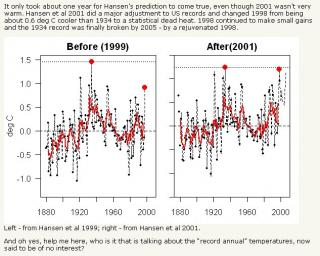
You come up with a lot of pictures, but nothing in the way of sources.

If you enlarge the graphs, the source references are noted on them. The two smaller graphs merely give "Hansen et al" and a date which could be problematric to find if Hansen was lead author of more than one paper in either of those years.
 
Earth is getting wetter and more humid. And, as we are all being reminded all the time, water is the major greenhouse gas.

Bad luck for where I live, though, mid latitudes will be getting less rain.

http://news.bbc.co.uk/2/hi/science/nature/7038278.stm

The atmosphere is becoming more humid in a pattern consistent with man-made climate change, researchers have found. Their study, reported in the journal Nature, confirms the global increase in humidity found in previous studies.
They say that the pattern of humidity increases in various parts of the world resembles that projected by computer models of man-made global warming.
Water vapour is a greenhouse gas, and it is thought that having more of it in the air could amplify temperature rise.
The major report released earlier this year by the Intergovernmental Panel on Climate Change (IPCC) said that this amplification was the largest "positive feedback" mechanism they had identified.
Previous research has shown that humidity increases in Europe, a response to higher temperatures, were amplifying the temperature rise by about a factor of two.


Becks paper isn't really that good is it?

Here he argues that his curve is globally meaningful. His argument doesn't really make much sense to me. I'm not convinced I followed how he made his curve that well, but...The accuracy of the data taken at those locations could be as high as he likes but it doesn't follow that he can then say that those values are then globally significant.

I could probably take temperature measurements of the air surrounding the gas hob in my kitchen. I would be able to see cycles that correspond to other activities in the house, but to then say that the temperature of the air around the hob can be thought of as a proxy for the air temperature inside my house is nonsense. I think that is the kind of thing that he is trying to do. If he isn't doing that then I am willing to be corrected.

Fsol, thanks for your reply. I'm going to try to clarify several points raised by CapelDodger and Schneibster in this reply. This question originates with an issue brought up in the low 100s posts which I am reprinting below. Because of some thread drift, the focus of the original question may have been lost. It was related to "are there other CO2 measurements for the 19th and 20th century by which to confirm the shallow ice core data that's patched onto Mauna Loa data?" If so, do those other measurements vindicate the data quilting?

As CapelDodger notes, 70-80 years for CO2 dating in ice cores is very iffy. CD, note this is "shallow ice core data" that's patched in - the worst type. As Schneibster notes, ice core work has gotten very good - but less good for gas analysis than temperature. And the issue here is very specific - not is ice core work good today, but the specific ice core experimental results used by Keeling when he decided to make the 83 year offset, would that work stand to today's standards?

So the question came up, are there other 19th and 20th century CO2 measurements. That led to Beck's compilation - on it, I also have questions - and yes, it is like opening a can of worms. I'm not even sure I want to "defend Beck" in this context - at least, when the question was patching the shallow ice core data to Mauna Loa. But it would be nonsense to not ask the simple question, is it okay to throw out all the historical analysis of CO2 in answering this question. More comments later, but I've got the raw excel CO2 spreadsheet loaded up and want to study it for a day or two.

Here is the reprint.

Ice core and Mauna Loa data fraud? Has anyone seen this before? Looks like the data series were changed to make them fit...(double click to enlarge to original size)


Analysis of the problem by Jaworowski -
The problem with Siple data (and with other shallow cores) is that the CO2 concentration found in pre-industrial ice from a depth of 68 meters (i.e. above the depth of clathrate formation) was "too high". This ice was deposited in 1890 AD, and the CO2 concentration was 328 ppmv, not about 290 ppmv, as needed by man-made warming hypothesis. The CO2 atmospheric concentration of about 328 ppmv was measured at Mauna Loa, Hawaii as later as in 1973[8], i.e. 83 years after the ice was deposited at Siple.
​
Originally Posted by Slimething
I went to http://www.warwickhughes.com/icecore/zjmar07.pdf and read the section entitled "The Truth About Ice Cores". On p. 4, there is a list of four assumptions concerning gases in ice that I find very difficult to agree with. Can you rebut them? ....the assumptions I found in the above paper are untenable. Is there a different carbon dioxice reservoir avialable for cross-checking the ice core data? Stalagtites/stalagmites? Mineral formations? Any such thing?

mhaze: This is just one of a number of "divergence problems". Historical proxy data from tree rings for example do not line up with 20th century temperature series. More data splicing is required or the series are truncated....

Here is the list for four assumptions that you referenced in Z. Jawowowrski's 2007 paper.


Double click to enlarge.

Analysis of ice cores has came a long way. I believe When Gore's movie was made ice core data analyzed at 1000 year intervals, seemed to indicate that today we have "unprecedented warming". Later, the techniques improved and the ice cores showed the various historical warm periods such as the Medievel Warming Period. Gore's "documentary" was not updated and corrected for this or any other more recent findings.

The analysis of CO2 in the shallow ice cores was very early work.

Slimething asks an interesting question -

Is there a different carbon dioxice reservoir avialable for cross-checking the ice core data? Stalagtites/stalagmites? Mineral formations? Any such thing?

And that leads us back to Beck's review article, 180 Years of Gas CO2 Analysis by Chemical Means.
 
Indeed not, Beck takes refuge in history before accuracy and consistency were well-established.

As to 1, I wouldn't make much of ice-cores for the last century myself. Gases can percolate through snow; it's only when snow gets deep enough to be compacted into ice that trapped gasses are immobilised. Thus the time-resolution of ice-cores is about 60-80 years. That said, the percolation is very slow so there's something to learnt from 20thCE ice-cores. Just not too much.

As to 2, 420ppm sixty years ago is laughable. That would be represented in modern ice-cores, for one thing, and for another : where did it come from, where did it go, and why? If Beck's data shows this it shows Beck's data for what it is. Self-serving BS.

As to 3, I have to ask, why does Callender speculate while Beck shows?

As to 4, it makes no sense to me. What chemical means, except the burning of fossil-fuels at an even more alarming rate than currently? What the heck was going on back in the 40's that nobody noticed? Admittedly there was a lot of anthropogenetic stuff that demanded attention but all the same somebody would surely have noticed whatever was behind it. Beck doesn't even speculate on what it was. It just happened.

The data series have been reviewed, Callender did that as best he could. Beck just takes everything from before the modern measurement era unquestioningly. The modern era he ... avoids. You may call it scientiofic diligence. Taking refuge in the past, I calls it.

Of course - a review of historical peer reviewed studies is more or less a refuge in the past, and in a review of historical studies....the modern era by definition is avoided....

#2 and #4 makes no sense to me either, unless natural variation of CO2 on land where (let's suppose) these measurements were predominately taken varies by that much compared to the Mauna Loa data. That has other consequences, by the way. You say at one point that the resolution of ices is 60-80 years and then you say that a 420ppm level would be showed in an ice core 60 years ago...

This boils down to is (A) accept Keeling's throwing out of all historical CO2 data (B) independently review the data and determine if that decision was correct. (A) is what the IPCC did. I'm not totally opposed to (A), it just seems rather peculiar.

Suppose we said we need to throw out all 18th and 19th century thermometer measurements...
 

1. The first two charts seem correct.
2. Hansen's chart looks wrong.
3. There is no global warming.
4. Why is there supposedly a "consensus there is global warming" then? (and man is to blame yada-yada-yada)...
 
Earth is getting wetter and more humid. And, as we are all being reminded all the time, water is the major greenhouse gas.

Bad luck for where I live, though, mid latitudes will be getting less rain.

http://news.bbc.co.uk/2/hi/science/nature/7038278.stm


[/size]

I don't see any link to the actual article there, but that's typical of the bbc.

Funny...when I brought in for discussion Wentz 2007 "How much more rain will global warming bring?" you shrugged it off. Here is a concise summary of the paper from yes, co2science. Pdf is also available if anyone wants.

http://www.co2science.org/scripts/CO2ScienceB2C/articles/V10/N33/EDIT.jsp
 
This boils down to is (A) accept Keeling's throwing out of all historical CO2 data (B) independently review the data and determine if that decision was correct. (A) is what the IPCC did. I'm not totally opposed to (A), it just seems rather peculiar.

You do understand that A and B are not mutually exclusive, don't you?

Suppose we said we need to throw out all 18th and 19th century thermometer measurements...

Suppose someone told you all the measurments were made indoors, or next to a hot spring, or even that the people making the measurments would rub the thermometers for a while before reading the values. Wouldn't you throw out the data?
 
You could just give us a link to where they came from?

I'd love to help you out, AUP, but I didn't post them. I was just pointing out that some references are on the plots themselves. You have to wait until DR reads your question or you can PM him.

The top plot has the entire url in it. You could try cutting it and pasting and then lopping off sections to get to a viable root, like I did with the plot that opolol posted. I had to follow the breadcrumbs until I got to the data. Sometimes this doesn't work, though.
 
Earth is getting wetter and more humid. And, as we are all being reminded all the time, water is the major greenhouse gas.

Bad luck for where I live, though, mid latitudes will be getting less rain.

http://news.bbc.co.uk/2/hi/science/nature/7038278.stm


[/size]

These claims are puzzling. The planet would not get more humid if the warming were natural? A warmer Earth will be more humid, regardless of the cause.

Also, if water vapor is THE major greenhouse gas, why are we worrying about carbon dioxide? Humidity varies by percents; carbon dioxide in parts per million. :confused:
 
So the question came up, are there other 19th and 20th century CO2 measurements. That led to Beck's compilation - on it, I also have questions - and yes, it is like opening a can of worms. I'm not even sure I want to "defend Beck" in this context - at least, when the question was patching the shallow ice core data to Mauna Loa. But it would be nonsense to not ask the simple question, is it okay to throw out all the historical analysis of CO2 in answering this question. More comments later, but I've got the raw excel CO2 spreadsheet loaded up and want to study it for a day or two.

If the data can be shown to be unreliable then, yes, throw it out. From a quick look at Becks paper it would seem that the data he says represents global CO2 concentrations is unreliable for primarily the reason of poor choice of sampling sites. That alone, regardless of how diligent their work was in other areas, makes the data unreliable.

Ice core and Mauna Loa data fraud? Has anyone seen this before? Looks like the data series were changed to make them fit...(double click to enlarge to original size)

http://www.internationalskeptics.com/forums/imagehosting/thum_1422447013a2077a34.png

Analysis of the problem by Jaworowski -
The problem with Siple data (and with other shallow cores) is that the CO2 concentration found in pre-industrial ice from a depth of 68 meters (i.e. above the depth of clathrate formation) was "too high". This ice was deposited in 1890 AD, and the CO2 concentration was 328 ppmv, not about 290 ppmv, as needed by man-made warming hypothesis. The CO2 atmospheric concentration of about 328 ppmv was measured at Mauna Loa, Hawaii as later as in 1973[8], i.e. 83 years after the ice was deposited at Siple.​
So a quick google brings up all sorts of critiques of Jaworowski and not very favourable ones at that. And those critques lead to the reasoning behind the apparent time shift of the data that Jaworowski picks up on without actually following the research that backs it up.

This link should be of some interest here.

http://nigec.ucdavis.edu/publications/ar/annual95/northeast/project12.html

It turns out that far from being arbitrary, there are well researched reasons why it should be so.


Slimething asks an interesting question -

Is there a different carbon dioxice reservoir avialable for cross-checking the ice core data? Stalagtites/stalagmites? Mineral formations? Any such thing?

And that leads us back to Beck's review article, 180 Years of Gas CO2 Analysis by Chemical Means.
And that leads us back to Becks conclusions being unreliable because they are founded on unreliable data. Here you can agree with me or not, but I don't have to figure out what caused all that up and down of CO2 levels or why it suddenly stopped.
 
So a quick google brings up all sorts of critiques of Jaworowski and not very favourable ones at that. And those critques lead to the reasoning behind the apparent time shift of the data that Jaworowski picks up on without actually following the research that backs it up.

This link should be of some interest here.

http://nigec.ucdavis.edu/publications/ar/annual95/northeast/project12.html

It turns out that far from being arbitrary, there are well researched reasons why it should be so.

Thanks for sharing that link. I found the reasoning to be pretty good although some statements are made without references, for example the differential leaching rates of isotopically-enriched gases. Also, some figures mentioned in the text are missing.

Anyway, here's my observations. The paper still works on the premise that carbon dioxide is immobilized in ice horizons below the firn. This is taken from the paper, bolding mine:

Lock in: At the bottom of the firn, the tortuosity of the ice may be so great that gases will essentially not diffuse even through there is actually open porosity. The gas signal thus gets "locked in" above the firn - ice transition.

Yet the paper continues after that point as if the above were fact and not conjecture. The paper does point out that 15-N enriched nitrogen becomes fairly well stabilized but then hints that it still continues to decline. Nitrogen is not very labile, or anyway, a lot less labile than carbon dioxide. Also, carbon dioxide is water-solube whereas nitrogen is not. Even a small decline in nitrogen concentrations over time could mean much larger losses of carbon dioxide.

There's another thing that struck me reading the paper. The very fact that the authors refer to permanent gases as "greenhouse gases" from the very start signals a bias in the author's outlook. I'm not saying that they are biased, I'm just pointing out that, if I had proofed the paper, I would have advised the authors to change their terminology to a more general nomenclature such as "selected gases", "permanent gases", or plain "gas".

Anyway, to me, an assumption that carbon dioxide is not lost over time even in the deepest ice strata is too huge to accept. I will again point out to you that the particular graph that the correction factor was applied to is exactly the pattern one would expect from measuring the concentration of anything with fairly constant dissipation
 
Last edited:
These claims are puzzling. The planet would not get more humid if the warming were natural? A warmer Earth will be more humid, regardless of the cause.

Also, if water vapor is THE major greenhouse gas, why are we worrying about carbon dioxide? Humidity varies by percents; carbon dioxide in parts per million. :confused:

ALL warming is AGW in some peoples' minds, and the Main Force is CO2.:D
 
If the data can be shown to be unreliable then, yes, throw it out. From a quick look at Becks paper it would seem that the data he says represents global CO2 concentrations is unreliable for primarily the reason of poor choice of sampling sites. That alone, regardless of how diligent their work was in other areas, makes the data unreliable.

So a quick google brings up all sorts of critiques of Jaworowski and not very favourable ones at that. And those critques lead to the reasoning behind the apparent time shift of the data that Jaworowski picks up on without actually following the research that backs it up.

This link should be of some interest here.

http://nigec.ucdavis.edu/publications/ar/annual95/northeast/project12.html

It turns out that far from being arbitrary, there are well researched reasons why it should be so.

And that leads us back to Becks conclusions being unreliable because they are founded on unreliable data. Here you can agree with me or not, but I don't have to figure out what caused all that up and down of CO2 levels or why it suddenly stopped.

Thank you for the paper. As I read it it seemed more a report on ongoing research than anything with specific conclusions.

However, I was able to pull a few statements out that are relevent to the discussion of shallow ice core work:

1. The increase in gas age is about 14 years in each meter of depth.

2. "Surface wind stress causes advection of air through the top of the firn. Advection can extend to a depth of 12 m or more. This process causes the composition of air in the top layer of the firn to be similar to the composition in the overlying atmosphere."

Twelve meters takes us back to 1839.....
 
These claims are puzzling. The planet would not get more humid if the warming were natural? A warmer Earth will be more humid, regardless of the cause.

Also, if water vapor is THE major greenhouse gas, why are we worrying about carbon dioxide? Humidity varies by percents; carbon dioxide in parts per million. :confused:

That's the whole point of the AGW argument. Positive feedback effects, like this one. You bump up CO2, which only directly causes a small rise in temperature, feedback effects multiply that rise in temperature.

Have you read the IPCC reports yet? It's all in there.
 

ISF - Join now!

Every member here is approved by hand. No bots, no spam, just people who care about evidence and honest debate.

Membership is free!

Create your free account

Back
Top Bottom