Gawdzilla Sama
TImeToSweepTheLeg

As for the argument that Ranneft said the carriers were west of Hawaii, instead of northwest, this seems nit picky on its face.
That's all you do, so you'd know it when you saw it.

As for the argument that Ranneft said the carriers were west of Hawaii, instead of northwest, this seems nit picky on its face.
Again, what possible would Ranneft have had to lie about this? His journal is hard evidence that some officers in ONI knew there were Japanese carriers near Hawaii on 6 December. And Ranneft himself later confirmed the accuracy of Toland's treatment of his account.

Why lie? Why do you think one guy isn't lying and thousands others are?

Oh, gosh, I just can't imagine why those ONI officers would not have backed up Ranneft's account!
A better question is, What possible motive would Ranneft have had for lying about this? Why would he have made false entries in his diary about this? Why?
Kramer changed his story and perjured himself about the Winds execute message. And all three--Wilkinson, McCollum, and Kramer--would have invited enormous condemnation if they'd admitted that they knew there were Japanese carriers near Hawaii on 6 December and failed to inform Kimmel and Short.
His journal is hard evidence that some officers in ONI knew there were Japanese carriers near Hawaii on 6 December.
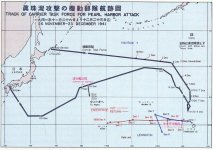
I realise we've mentioned this before wrt Ranneft, but Lexington and Enterprise were both a few hundred miles out on the 6th, and were both West of Honolulu.
They're pretty close together on the 6th, aren't they?
I now wonder when the entries in the diary were written.

The IJN had carriers supporting The Southern Advance. I'll have to look up which ones were assigned to which attack, that will tell us where they were on that day.In the book Popular Controversies in World History, Steven Danver notes that the IJN had more carriers than just the six assigned to the Kido Butai, and if Ranneft was talking about ONI tracking two carriers, obviously they weren't tracking the six-carrier Kido Butai. Danver states it was two carriers at Kwajalein in the Marshall Islands that ONI was tracking and told Ranneft about, though I don't know nearly enough about IJN's fleet dispositions to be able to check that.
I do know that, right at the time of Renneft's diary entries, the Ryujo was heading from Saeki to Palau for the strike on the Philippines, and the Taiyo was also headed to Palau from Sasebo to deliver fighters as well.
Sorry? Expand on that, please, and I'll see if I can find what you're looking for.
The closeness of the carriers on the 6th, when Ranneft supposedly saw the map at ONI, and their location suggests (hey, guesswork) that he may have misunderstood what he was looking at. If he filled in that diary entry anytime after the attack he may well have misremembered what he was looking at.
Michael Slackman, in his book Target: Pearl Harbor, says that in 1983 Robert Haslach, a Dutch historian specializing in intelligence matters, sent a letter to Admiral Kimmel's son Thomas K. Kimmel (which Kimmel in turn provided to Slackman), saying that the Renneft diary entry "was compiled and edited at some considerable time after the events recorded."

The closeness of the carriers on the 6th, when Ranneft supposedly saw the map at ONI, and their location suggests (hey, guesswork) that he may have misunderstood what he was looking at. If he filled in that diary entry anytime after the attack he may well have misremembered what he was looking at.
After all, at that point on the 6th there were 2 carriers a few hundred miles west of Hawaii...just not Japanese ones. He put 2 and 2 together and got 5.
It's not evidence or anything.
I did think about the other Japanese carriers, but the positions I was coming up with for the 6/7th (some guessing involved) didn't match anywhere near as well as the US ones.
Michael Slackman, in his book Target: Pearl Harbor, says that in 1983 Robert Haslach, a Dutch historian specializing in intelligence matters, sent a letter to Admiral Kimmel's son Thomas K. Kimmel (which Kimmel in turn provided to Slackman), saying that the Renneft diary entry "was compiled and edited at some considerable time after the events recorded."
Regarding the fact that I-72 was ultimately under Admiral Nagumo's command, I repeat what I documented many weeks ago: Admiral Fukudome explained that the 3rd Submarine Squadron, to which I-72 belonged, was part of the Hawaii Operation attack force and that Nagumo was in command of the Hawaii Operation attack force ("Hawaii Operation," in Paul Stillwell, editor, Air Raid: Pearl Harbor!, pp. 66-68). In fact, Admiral Fukudome noted that the 3rd Squadron was part of the "Advance Force" of the attack force (p. 66).