Merged Pearl Harbor: "Revisionists" vs. "Traditionalists"

You keep ignoring the point that it was commonly believed back then that it was safe to transmit low-powered radio messages, just as the Germans thought it was safe in WW I. So in the minds of the KB ships that made those broadcasts, they were not taking a risk, because they thought those transmissions had a short range and didn't think they could be received by enemy listening stations.

You also keep ignoring the point that the radio silence order contained some exceptions.

And your only answer to the considerable anecdotal evidence that KB radio transmissions were heard by some American and Allied listening stations is to simply wave it all aside as lies.

Your only answer to Grogan's account of hearing KB transmissions is to cite Jacobsen's now-shredded nonsense, and of course you ignore the fact that Jacobsen's theory (actually, theories) contradicts the earlier "scholarly" theory that Grogan heard Russian signals.

Your only answer to the documented reception of a KB carrier communicating directly with tankers on a tactical circuit is to float the silly explanation that this, too, was just part of the IJN's radio deception effort, and never you mind that such communication would have been highly unusual for ships in home waters.

You asked if I am saying that Kimmel did a good job. Yes, that is exactly what I am saying: that given what he knew, and what he did not know, he did a very good job. He improved the training and significantly improved the combat skills of his sailors. Others noted how much Kimmel had done to improve the fleet's readiness and efficiency. Kimmel also did a great deal to improve morale. He even leaned on his orders and ordered that Japanese subs be fired at on sight. So, yes, I'm saying he did an outstanding job under the circumstances, and a whole slew of his peers and many admirals who served later said the same thing.

As for another poster's argument about using signal lights in bad weather, one could also raise the objection that the thick fog that occurs in the North Pacific at that time of year would have rendered those signals useless as well, not to mention the horrific storm weather that the KB encountered for a few days. We're not just talking about any old "bad weather" but a severe North Pacific storm.

How many ships were damaged in this severe North Pacific storm?
 
I almost think the plane pilots would've had a harder time than the ships in the task force, given the range at launch. It hadn't really sunk in how far the flight had to fly (and the need for Kido Butai to come in closer for recovery) to press home the attack. They really didn't have time to do more than shoot and scoot.

The bird farms were closing on Hawaii to shorten the return trip, make it easier for cripples to make it back. The most important navigation lesson for carrier pilots was "where will this damn thing be when I want to land", and the squadrons usually had one man designated as group navigator with another doing the math just to check on No. 1. Fuchida lingered over Pearl for most of the attack, IIRC. He was very low on push-water by the time he got back to the carrier.
 
You keep ignoring the point that it was commonly believed back then that it was safe to transmit low-powered radio messages, just as the Germans thought it was safe in WW I. So in the minds of the KB ships that made those broadcasts, they were not taking a risk, because they thought those transmissions had a short range and didn't think they could be received by enemy listening stations.

You also keep ignoring the point that the radio silence order contained some exceptions.

So if the KB ships were transmitting what they thought were “safe” low power signals, and they were doing so under legitimate exceptions to their orders not to transmit, why didn’t they log those transmissions? After all, from their point of view it was all perfectly safe and legit, no reason to hide anything, right?
 
So if the KB ships were transmitting what they thought were “safe” low power signals, and they were doing so under legitimate exceptions to their orders not to transmit, why didn’t they log those transmissions? After all, from their point of view it was all perfectly safe and legit, no reason to hide anything, right?

Bob's "commonly believed" is absurd. The KB went to great lengths to make sure NO transmissions would be sent. Shipboard telegraphy keys were locked in the Captain's safe. The airplane keys were jammed with paper to prevent accidental tripping of even a single "dot". They were set up that way because they'd be needed if resistance was encountered. There wouldn't be time to reinstall them on each plane if the USN came steaming over the horizon.

Bob, do you go hunting? Do you take a calliope with you?
 
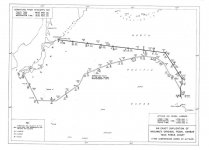
Just remembered I had this. Not seeing this storm.


"each line represents two meters per second".

One meter per second is equal to 1.94 knots. So 5 ticks represents 19.4 knots. Which would generate waves 2-3 meters high from a very long fetch.
 
"each line represents two meters per second".

One meter per second is equal to 1.94 knots. So 5 ticks represents 19.4 knots. Which would generate waves 2-3 meters high from a very long fetch.

Yep, the good ole "pacific" ocean actually behaving for once. The kicker for the weather, however, is that the force reached it's designated way points on time each day. Turn south made on time, not late for the launching of the planes. No need to slow down for foul weather.
 
You keep ignoring the point that it was commonly believed back then that it was safe to transmit low-powered radio messages, just as the Germans thought it was safe in WW I.

And you keep ignoring that WW1 ended over 20 years before Pearl Harbour. You haven't shown that the Japanese were unaware of this. After all, the allies were aware of it.

Oh, oh, ok. So the Japanese documents are absolutely reliable, and all the American and Allied military personnel who reported that the KB was heard and tracked were all lying! Yeah, ok.

How many times do you have to have pointed out to you that there was an entire deception plan laid out including the use of the carriers comms people to ensure that the dummy transmissions would continue to sound like they came from those carriers.
 
Not only do we have the accounts of a number of American and Allied military personnel that KB transmissions were heard and tracked, we also have supporting accounts from non-military personnel, such as:

* Joseph Leib, a New Deal Democrat, journalist, and friend of Secretary of State Cordell Hull. Leib said Hull told him they had Japanese intercepts that revealed a coming attack on Pearl Harbor.

* Don C. Smith, head of the Red Cross War Service. His account was relayed by his daughter, Helen Hamman, in the 1990s when she heard about Kimmel family efforts to clear Admiral Kimmel's name. According to the daughter, Smith told her that shortly before the attack FDR met with him, told him that Pearl Harbor was about to be attacked, that they had to let the Japanese surprise Pearl Harbor to get the American people to support entering the war, and that Smith was to transfer extra supplies and personnel to Hawaii to prepare for the aftermath. Dr. Sniegoski notes that:

Borquist was able to confirm the basics of Hamman’s story--the Red Cross did quietly send large quantities of medical supplies and experienced medical personnel to Hawaii shortly before December 7, 1941. ("The Case for Pearl Harbor Revisionism," The Occidental Quarterly, Winter 2001, p. 35, http://home.comcast.net/~transparentcabal/pearlharbor.pdf)​

* John Burns, head of the Honolulu Police Department's Espionage Bureau. Burns reported that the FBI Agent in Charge in Honolulu, Robert Shivers, told him on 12/3 that the Japanese would attack Hawaii by the end of the week. By the way, Burns went on to become governor of Hawaii, and he gave his account after he knew he was dying. In addition, Burns' account was corroborated in 1982 by one of his deputies (William Kaina). Burns' account is lent further credence by the account of Colonel Carlton Ketchum.

* Martin Dies, senior Democratic congressman from Texas. Dies chaired the House Un-American Activities Committee. In the course of investigating Japanese espionage, Dies' committee came into possession of a Japanese military map that indicated plans for an attack on Pearl Harbor. When Dies called Secretary Hull, Hull asked him to keep quiet about the document and to let the president handle matter because this was a delicate matter of national security. Dies said officials from the State Department, the Navy, and the Army came to examine the map. Dies revealed this information in 1963 in his memoir. He expressed frustration at the failure to act on the information he provided to the White House:

I have never been able to understand why our government did not take the necessary precautions to protect our fleet from destruction after our committee had furnished such precise information on the proposed attack. (Martin Dies Story, New York: Bookmailer, 1963, p. 165)​

But, nah, according to traditionalists, ALL of these people were just lying--they just made it up. In fact, according to our resident "expert," all of this evidence is "nothing." So said the emperor's lackeys when the young boy noted that the emperor wasn't wearing any clothes.

Oh, but we're told that there are Japanese documents that claim that radio silence was maintained. Well, we also have a Dutch document that says that shortly before Pearl Harbor the U.S. Navy's Office of Naval Intelligence (ONI) knew there were Japanese naval ships near Hawaii: I refer to the official diary of Captain Johan Ranneft of the Dutch Navy in which Ranneft says that ONI personnel informed him shortly before the attack that there was a Japanese naval force a few hundred miles from Pearl Harbor. But, humm, let me guess: We're supposed to believe the Japanese documents and reject Captain Ranneft's official diary. Yeah, and never mind all the lies the Japanese were caught telling about the war.
 
Last edited:
Another fringe reset. We've been over all that nonsense in this thread already.

(And I still can't stop laughing at the claim that FDR spilled the conspiracy beans that we knew the Japanese were going to attack Pearl Harbor to some random FBI agent in Hawaii, who in turn blabbed the whole thing to some random police official. Worst. Conspiracy. Ever.)
 
Dies got a copy of a map of Pearl Harbor found in an airplane that crash.

The rest is hearsay. You have low standards of evidence. "The green mass above you is a frog's belly in a swamp." (Paraphrased folk saying, not an insult.) (Much.)
 
Not only do we have the accounts of a number of American and Allied military personnel that KB transmissions were heard and tracked, we also have supporting accounts from non-military personnel, such as:

* Joseph Leib,

Not KB intercepts. Could be anything.

* Don C. Smith,

No intercepts here.

* John Burns,

Nor here.

* Martin Dies,

or here.

So, again, you have nothing to show KB was monitored crossing the Pacific.

Oh, but we're told that there are Japanese documents that claim that radio silence was maintained.

Hey, at least we have documents.

Well, we also have a Dutch document that says that shortly before Pearl Harbor the U.S. Navy's Office of Naval Intelligence (ONI) knew there were Japanese naval ships near Hawaii: I refer to the official diary of Captain Johan Ranneft of the Dutch Navy in which Ranneft says that ONI personnel informed him shortly before the attack that there was a Japanese naval force a few hundred miles from Pearl Harbor. But, humm, let me guess: We're supposed to believe the Japanese documents and reject Captain Ranneft's official diary. Yeah, and never mind all the lies the Japanese were caught telling about the war.

Blimey...do we have to go over this one again?
 
The bird farms were closing on Hawaii to shorten the return trip, make it easier for cripples to make it back. The most important navigation lesson for carrier pilots was "where will this damn thing be when I want to land", and the squadrons usually had one man designated as group navigator with another doing the math just to check on No. 1. Fuchida lingered over Pearl for most of the attack, IIRC. He was very low on push-water by the time he got back to the carrier.

Yeah, I knew that was why they were coming in closer, I just didn't realize the distance involved. I mention the navigation because of the near-disaster the US aviators had at Midway, but then, that was with a target whose location wasn't precisely known. I suppose flying from a known point to a known point would've been rather a simple matter.
 
Yeah, I knew that was why they were coming in closer, I just didn't realize the distance involved. I mention the navigation because of the near-disaster the US aviators had at Midway, but then, that was with a target whose location wasn't precisely known. I suppose flying from a known point to a known point would've been rather a simple matter.
True. Plus the carriers were jigging around like mad, so navigation was dicey. The launch point for Kido Butai was chosen for making return navigation dead simple, magnetic north and go. The fear was there would be few planes to make the return trip, and the group navigators would be among the casualties. The IJN had respect for the potential of Pearl Harbor.
 
Originally Posted by Kent1

What made John Toland bad was that he just got caught too many times telling falsehoods about his sources and creating false information that his own sources didn't support. His most famous example was the diary of Rear Admiral J. E. Meijer Ranneft of the Dutch Navy. During the subsequent printings of his book (softcover) he later removed the section showing the pictures of the diary since what he claimed about the diary was not true.

This is another common traditionalist myth. George Victor discusses this in The Pearl Harbor Myth, pp. 45-47. Ranneft confirmed the accuracy of Toland's translation. Also, many of the illustrations from the hardback edition were changed in the paperback edition, not just the diary page, but the translation of the diary notes was retained in the paperback.

Ranneft added that the position of the Japanese ships that ONI showed to him on December 6 was about 300 miles from Hawaii (The Pearl Harbor Myth, p. 46). However one wants to reach and grasp in reading Ranneft's diary, there's no getting around the fact that Ranneft, at the very least, made it clear that ONI told him there were Japanese naval ships in the general vicinity of Hawaii. And, again, Ranneft himself, when he was later asked about this issue, stated that Toland's characterization was accurate and that ONI told him there were Japanese naval ships about 300 miles from Hawaii on December 6.

As mentioned earlier, Ranneft's account is supported by numerous other accounts from military and non-military personnel alike, including a journalist who was a friend of Secretary Hull and the head of the HPD Espionage Bureau who later became governor of Hawaii.

The 2006 article hardly refutes anything, I didn't think much of it in 2006 when I got the early copy from Jacobsen.

If you look around hard enough you will see Jacobsen wrote in fact numerous letters and an article after the 2006 publication. See for example his 2007 article (Radio Silence of the Pearl Harbor Strike Force Confirmed Again: The Saga of Secret Message Serial (SMS) Numbers). (posthumous)

After talking with these guys like Wiley, Stinnett, and Villa, (Wilford never seems to talk) I've long considered the ball in their court and have been waiting to see something new.

I've read the "Radio Silence . . . Confirmed Again" article. Where does it refute the specific arguments and evidence that Villa and Wilford raise? Where? It's largely more of Jacobsen's overheated, dogmatic polemic. Nor Jacobsen explain his demonstrably misleading characterizations of some of Wilford's statements, the origin of the "tactical circuit" reference, and Grogan's use of directional terms.
 
Last edited:
bob, can you tell us why the perpetrators who were conspiring to keep the knowledge of the upcoming Japanese attack on Pearl Harbor a secret were, nevertheless, so apparently keen on telling everyone within earshot? Why did they blab openly to such a motley collection of people who absolutely had no need-to-know, such as a Dutch Navy captain, an FBI agent, and the head of the Red Cross?

Why do "conspiracies" like this always have the conspirators doing the absolutely worst things possible for conspirators to do if they actually intend to keep the conspiracy secret?

Your description of who was told and under what circumstances is a silly strawman. A "motley collection"? Really? Do you know who Captain Ranneft was and the relationship he had with the U.S. Navy? And since when do an FBI Agent in Charge and the Director of the Red Cross War Services warrant the label of "motley"? Just more silly denialism.

If you'd dare yourself to take off your denialist blinders and do a little homework, you'd know exactly why ONI shared that info with Ranneft, how Shivers would have known about the attack, and why FDR would have informed Smith (he then demanded that Smith not tell anyone what he'd been told).
 
Your description of who was told and under what circumstances is a silly strawman. A "motley collection"? Really? Do you know who Captain Ranneft was and the relationship he had with the U.S. Navy? And since when do an FBI Agent in Charge and the Director of the Red Cross War Services warrant the label of "motley"? Just more silly denialism.

Because they have nothing in common except for the fact that none of them needed to be told about the conspiracy, because their knowledge of the conspiracy did nothing to advance the purported goals of the conspiracy (and, in fact, was counterproductive, since two of the people listed below blabbed in turn about the conspiracy to others, and the third purportedly wrote it down in his diary).

What was the purpose of telling the Dutch naval attache in Washington DC that ONI knew Japanese carriers were on their way to Pearl? What was he supposed to do with the knowledge, and what was the dissemination of this knowledge that the conspirators otherwise wanted to keep secret from everyone supposed to accomplish? How would things be different had he not been told and instead remained entirely ignorant of the US government's purported foreknowledge of the Japanese attack on Pearl Harbor?

What was the purpose of telling the FBI's Agent in Charge in Hawaii the timing of the Japanese attack? What was he supposed to do with the knowledge, and what was the dissemination of this knowledge that the conspirators otherwise wanted to keep secret from everyone supposed to accomplish? How would things be different had he not been told and instead remained entirely ignorant of the US government's purported foreknowledge of the Japanese attack on Pearl Harbor?

What was the purpose of telling the head of the Red Cross that the President knew the Japanese were going to attack and where, and that the President didn't want anyone else to know about it? What was he supposed to do with the knowledge, and what was the dissemination of this knowledge that the conspirators otherwise wanted to keep secret from everyone supposed to accomplish? How would things be different had he not been told and instead remained entirely ignorant of the US government's purported foreknowledge of the Japanese attack on Pearl Harbor?

If you'd dare yourself to take off your denialist blinders and do a little homework, you'd know exactly why ONI shared that info with Ranneft, how Shivers would have known about the attack, and why FDR would have informed Smith (he then demanded that Smith not tell anyone what he'd been told).

So tell me, then.
 
Last edited:
Your description of who was told and under what circumstances is a silly strawman. A "motley collection"? Really? Do you know who Captain Ranneft was and the relationship he had with the U.S. Navy? And since when do an FBI Agent in Charge and the Director of the Red Cross War Services warrant the label of "motley"? Just more silly denialism.

If you'd dare yourself to take off your denialist blinders and do a little homework, you'd know exactly why ONI shared that info with Ranneft, how Shivers would have known about the attack, and why FDR would have informed Smith (he then demanded that Smith not tell anyone what he'd been told).
Bob, you ignore the simple fact that anyone with half a brain would not be telling a bunch of people who had no real need to know about their conspiracy plans! This is one of the things (but not the only thing) that makes all this supposed anecdotal evidence so ******* ridiculous!

By the way...
picture.php
 

ISF - Join now!

Every member here is approved by hand. No bots, no spam, just people who care about evidence and honest debate.

Membership is free!

Create your free account

Back
Top Bottom