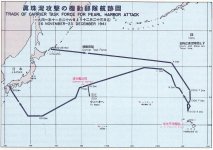
And the lost lamb would have sucked it up. They knew for certain where they could find the KB on the return route, so they would have laid low and waited if they were unable to continue due to, say, a mechanical breakdown.
Or they could have just waited on a line between Hawaii and Midway and the Midway Bombardment Force would be along to collect them shortly.
Anything but stupidly broadcast their presence to the world. They weren't as dumb as the people who put forward that idea.
You keep ignoring the point that it was commonly believed back then that it was safe to transmit low-powered radio messages, just as the Germans thought it was safe in WW I. So in the minds of the KB ships that made those broadcasts, they were not taking a risk, because they thought those transmissions had a short range and didn't think they could be received by enemy listening stations.
You also keep ignoring the point that the radio silence order contained some exceptions.
And your only answer to the considerable anecdotal evidence that KB radio transmissions were heard by some American and Allied listening stations is to simply wave it all aside as lies.
Your only answer to Grogan's account of hearing KB transmissions is to cite Jacobsen's now-shredded nonsense, and of course you ignore the fact that Jacobsen's theory (actually, theories) contradicts the earlier "scholarly" theory that Grogan heard Russian signals.
Your only answer to the documented reception of a KB carrier communicating directly with tankers on a tactical circuit is to float the silly explanation that this, too, was just part of the IJN's radio deception effort, and never you mind that such communication would have been highly unusual for ships in home waters.
You asked if I am saying that Kimmel did a good job. Yes, that is exactly what I am saying: that given what he knew, and what he did not know, he did a very good job. He improved the training and significantly improved the combat skills of his sailors. Others noted how much Kimmel had done to improve the fleet's readiness and efficiency. Kimmel also did a great deal to improve morale. He even leaned on his orders and ordered that Japanese subs be fired at on sight. So, yes, I'm saying he did an outstanding job under the circumstances, and a whole slew of his peers and many admirals who served later said the same thing.
As for another poster's argument about using signal lights in bad weather, one could also raise the objection that the thick fog that occurs in the North Pacific at that time of year would have rendered those signals useless as well, not to mention the horrific storm weather that the KB encountered for a few days. We're not just talking about any old "bad weather" but a severe North Pacific storm.