So are you saying Kimmel and Short didn't need to be informed that Japanese intelligence was seeking info on Hawaii that could be used by the IJN in the event of war?
No, we are saying that senior military commanders make themselves aware of the general diplomatic situation as a matter of course and can apply their training and judgement as to the likelyhood of conflict and take appropriate measures. Kimmel did not, and Short only took very limited measures to deal with potential sabotage.
It would be negligence of a very high order for Kimmel and Short not to realize that a foreign power, already at war with a significant trading partner of the US and raising a very public outcry against the US not selling them the materiel they are using to prosecute said war would be using their intelligence service to gather information about the US. Indeed it would be negligence to presume that any foreign power would not be attempting to gain information about your military bases for possible use in times of war - either for friendly or not-so-friendly purposes.
What nonsense. You're seeing the Emperor's New Clothes again, and are also showing the one-sided, incomplete nature of your research. A number of senior intel officers disagreed with your dismissal of the bomb plot messages, and even some of MacArthur's staffers discerned that the BP messages indicated preparations for an air raid. As you should know, there was a huge battle over withholding those messages from Kimmel and Short, and it took Stark's personal intervention to keep the messages from being forwarded to Hawaii. But, yeah, right: they were meaningless. Of course.
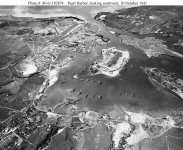
So, Bob - this beign the text of the "Bomb Plot Message" from September - what useful information do you glean?
“Henceforth, we would like to have you make reports concerning vessels
along the following lines insofar as possible:
“1. The waters (of Pearl Harbor) are to be divided roughly into five
subareas (We have no objections to your abbreviating as much as you
like.)
Area A. Waters between Ford Island and the Arsenal.
Area B. Waters adjacent to the Island south and west of Ford Island.
(This area is on the opposite side of the Island from Area A.)
Area C. East Loch.
Area D. Middle Loch.
Area E. West Loch and the communication water routes.
2. With regard to warships and aircraft carriers, we would like to have
you report on those at anchor (these are not so important) tied up at
wharves, buoys and in docks. (Designate types and classes briefly. If
possible we would like to have you make mention of the fact when
there are two or more vessels along side the same wharf.)”
And given that the message of December 2 was:
"Striking Force telegram No. 994. Two battleships (Oklahoma, Nevada), 1 aircraft carrier (Enterprise) 2 heavy cruisers, 12 destroyers sailed. The force that sailed on 22 November returned to port. Ships at anchor Pearl Harbor p.m. 28 November were 6 battleships (2 Maryland class, 2 California class, 2 Pennsylvania class), 1 aircraft carrier (Lexington), 9 heavy cruisers (5 San Francisco class, 3 Chicago class, 1 Salt Lake class), 5 light cruisers (4 Honolulu class, 1 Omaha class)"
Note that this message was out of date almost immediately, and that all it served to do was alert the IJN that the fleet was generally in anchorage on a weekend. A reasonable commander would note that, given the war warning he had recieved a week earlier, that keeping to a set schedule allows an enemy to take advantage of said routine.
Now as to that infamous in-clear transmission of December 2 "Climb Mount Niitaka 1208" without the OP order for the attack (which was NOT sent by radio), the intelligence boys have a phrase that could mean anything, or nothing.
And how can you not know that info from the BP messages were in fact used? They were used to train/brief some of the attack force members, and the most recent BP messages were the basis for Nagumo's final Go/No Go decision. Again, how can you not know this?
You might recall, or perhaps not, that for years the Japanese denied that the task force received any intel from the Japanese consulate in Hawaii. But of course that was later exposed as yet another lie.
Because of course all intelligence agencies are open and honest brokers.
Yet, you continue to trust the Japanese claim that the attack force never broke radio silence, even though we have radio transmissions in hand that prove otherwise. (Oh, but of course, your argument is that radio transmissions from subs that were part of the "Hawaii Operation" attack force, that were operationally attached to the KB and working in support of it, and that were under Nagumo's overall command--well, nah, those don't count as breaking radio silence. Yeah, right.)
Actually, they don't count as breaking radio silence because they were made after the attack had begun - if the US didn't know they were under attack at that point, nothing would have helped....
Craig Shirley and several news stories say it was not disclosed until 2011. Whether it was disclosed in '46 or '11, the point is that it should have been forwarded to Kimmel and Short.
If Kimmel didn't take precautionary measures on receipt of the war warning, why would you presume that he would have done so on receipt of a message that says "They know what ships are in port."?