Merged Pearl Harbor: "Revisionists" vs. "Traditionalists"

If I miss anything important, point me at it, please.

(And sorry for the late appearance, Washington gifted me with fifty cases of books on WWII, and I'm happier than a hog in fresh slop right now.)
Nice to see you again, and thanks for your comprehensive demolition of this nonsense. Again.
We'll call you for the next Hiroshima thread, one's due soon. :rolleyes:

One comment to the CTers in this thread. I'm not giving you hell to protect FDR or anybody else. I'm just sick of people who are appallingly ignorant, completely disingenuous, or badly deluded, you pick it, making a hash out of history through poor scholarship, blatant axe-grinding or a deeply held belief that reptiles are living in the skins of the British royal family. Do not feel insulted, because there's nothing personal about this, I don't care what you believe, but I do hope you are not surprised to find out that some people do care about getting the facts straight and doing history without lying about the details.
Well said.

True, but those areas were also armored in most cases, and the fragments from a bomb would penetrate them, or if they did, would do less damage. The ship would need some fix-up time, but it could still steam and fight if it had to. There were more productive targets for the dive bombers, like the cruisers and destroyers.
Or oil storage tanks.

Yell if you need me. "Gawdzilla Sama" on Facebook.
Thanks.
 
The oil tanks are often put forward as a major target. But they were in berms and the only oil that would have been lost is that lost before the fire suppression was employed. One young Ensign was nominated for a Medal of Honor for climbing to the top of one tank and setting the sprinklers off. (Yes, they didn't think to put the trigger valve at ground level, just another indication of the "rear area" mentality in T. H.)

However, if all the tanks had been killed and all the oil burned up they could have replaced the storage capacity until the rebuild was done by loading up small tankers that weren't suitable for the Atlantic runs. The capacity would have been replaced fairly quickly, I do believe.
 
However, if all the tanks had been killed and all the oil burned up they could have replaced the storage capacity until the rebuild was done by loading up small tankers that weren't suitable for the Atlantic runs. The capacity would have been replaced fairly quickly, I do believe.

I believe the Japanese thinking came from their belief they could control the sea lanes and stop the US resupply process. The other consideration is disruptions to supplies to places like Wake Island etc Making these locations even more vulnerable to Japanese attacks.

I think if I had been in the driving seat I would have put some effort into destroying US infrastructure around Pearl

They had no hope of controlling the sea lanes between T. H. and the Mainland. Their disdain for submarine warfare in general made it next to impossible conduct effective interdiction of supply routes anywhere during the war that wasn't supported heavily by surface ships. I'm not aware of a USN vessel lost to submarine action east of Hawaii after 1941. Anybody know that one way or the other?
 
They had no hope of controlling the sea lanes between T. H. and the Mainland. Their disdain for submarine warfare in general made it next to impossible conduct effective interdiction of supply routes anywhere during the war that wasn't supported heavily by surface ships. I'm not aware of a USN vessel lost to submarine action east of Hawaii after 1941. Anybody know that one way or the other?

Well Japanese belief and reality where not things that intersected all that often in the Pacific War

This is a long stretch but can I claim the Yorktown for the Imperial Japanese Submarine fleet?
 
Coup de grace, yeah. Balanced out by the Shinano. ;)

Did the US commander get full credit - the ship was only half finished when it was sunk - I agree there were only minor bits missing like water tight doors, fire control systems etc lol But still, a good nose blow would have taken it out :p

But to your point of how the Japanese valued their sub fleet. Their most successful commander Takakazu Kinashi finished last in a class of over 250 at the naval academy - says a lot in my mind
 
Because fighting a two-front war is a sound military idea, right? How did that work out for Shicklegruber again?


And the paperhanger's two fronts were a train ride away from each other. The fronts that the U.S. were fighting were more than 12 time zones apart.
 
We managed.

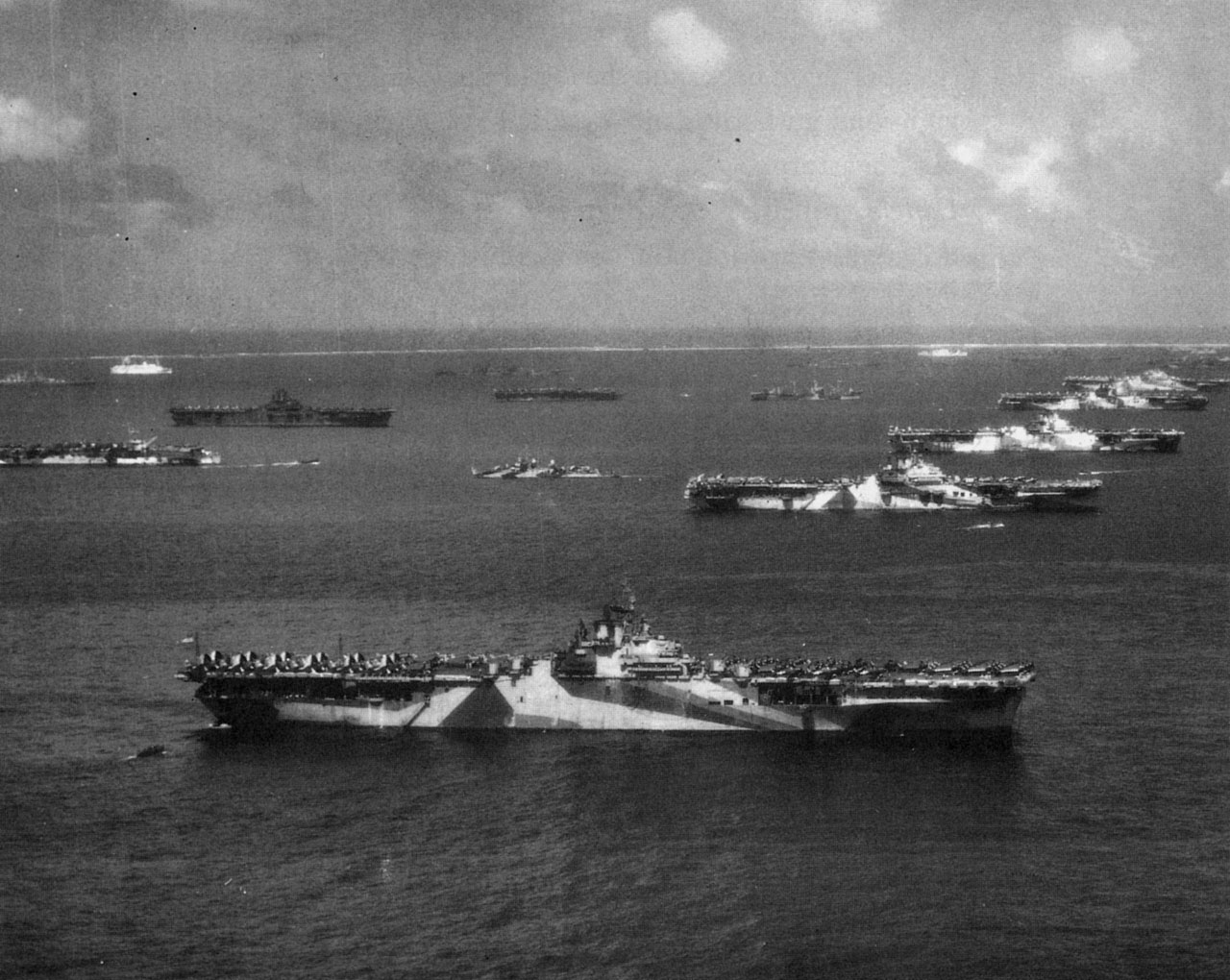
1944_12_08_Murderers_Row_Ulithi_Atoll_1280x.jpg
 
We managed.

[qimg]http://3.bp.blogspot.com/_aks0cupRxl0/TS_I0ob7NDI/AAAAAAAAAZ4/d_STCi1fYd8/s1600/1944_12_08_Murderers_Row_Ulithi_Atoll_1280x.jpg[/qimg]

Any guesses what the carrier back left without the dazzle paint scheme is?
 
Okay, that's Lexington on the left.

(CV-16: dp. 27,100; l. 872'; b. 93'; dr. 28'7"; s. 32.7 k.; cpl. 3,748; a. 12 5", 68 40mm., 62 20mm., ac. 103; cl. Essex)


The fifth Lexington (CV-16) was laid down as Cabot 15 July 1941 by Bethlehem Steel Co., Quincy, Mass.; renamed Lexington 16June 1942; launched 26 September 1942; sponsored by Mrs. Theodore D. Robinson; and commissioned 17 February 1943, Capt. Felix B. Stump in command.
 
What? How does that work? One moving ship can't triangulate another moving radio source. All they can do is establish a bearing from their position to the transmitter. IF the transmitter is moving then the bearing moves. In the Atlantic the Anti Submarine Escorts used HF/DF that gave an automatic bearing, they then followed it to run down the U-Boat sending the signal but it needed several escorts gto get simultanious receipt to establish a position. RN Ships used the same HF/DF gear when I was in the Navy in the 80s with exactly the same 'Birdcage' Antenna and CRT in the Ops Room.. All that was different was the Valves had been replaced with solid state boards.

One moving ship can "essentially" triangulate another moving ship--that's why I said "essentially triangulate." If we were talking about objects that moved much faster, like cars, no, that would be impossible. But for a cruise liner to "essentially" triangulate a target like the task force, which was strung out over several hundred yards and was moving no faster than 20 mph, it would not have been hard at all. Again, we're talking about "essentially" triangulating or "ballpark" triangulation. When you can take DF bearings over the course of several days on a large, slow-moving target, you can most certainly get a reasonably accurate triangulation if you are moving no faster, or slower than, the target.
 
Last edited:
Wait, what? :confused: You don't posit foul play because you dislike FDR; you posit foul play because you increasingly dislike FDR? :confused: That's a bizarre definition of "reverse".

That's not what I said at all. You have simply ignored the plain English of my statement and answered a statement that I did not even imply.
 
One moving ship can "essentially" triangulate another moving ship--that's why I said "essentially triangulate." If we were talking about objects that moved much faster, like cars, no, that would be impossible. But for a cruise liner to "essentially" triangulate a target like the task force, which was strung out over several hundred yards and was moving no faster than 20 mph, it would not have been hard at all. Again, we're talking about "essentially" triangulating or "ballpark" triangulation. When you can take DF bearings over the course of several days on a large, slow-moving target, you can most certainly get a reasonably accurate triangulation if you are moving no faster, or slower than, the target.

Pity all that didn't pan out after examination to be anything useful. But, as I said, hearing Japanese from the direction of Japan is largely unshocking.
 
true, a Destroyer can be bombed to the bottom in no time. Same for a Cruiser.

Although there are examples in the Med of bombs going right through destroyer hulls in one side and out the other or even through the decks and out the bottom.


That's because destroyers essentially had no armour (hence their nicknames 'tin cans') so armour-piercing bombs or shells would pass right through them without detonating.
 
That's not what I said at all. You have simply ignored the plain English of my statement and answered a statement that I did not even imply.

Perhaps you'd like to rephrase yourself because that certainly seems like what you said.
 

ISF - Join now!

Every member here is approved by hand. No bots, no spam, just people who care about evidence and honest debate.

Membership is free!

Create your free account

Back
Top Bottom