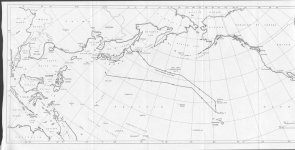
I am about to begin my third reading of Jacobsen's article on Grogan and the Lurline evidence. I must say that if Jacobsen's material is "some of the best scholarship" that the traditionalist camp has to offer, then traditionalists are in a world of hurt.
After having now read two of Jacobsen's other articles, and having read his attack on Grogan twice, I do not hesitate to say that Jacobsen was pathologically committed to denying any and all evidence of foreknowledge of the Pearl Harbor attack, and that he was a blindly partisan polemicist who seemed incapable of reasoned, scholarly discussion on the subject.
Before I post a detailed reply to Jacobsen's article on Grogan, I would make the following points about Jacobsen's scholarship to supplement the points I made in my previous reply:
* His treatment of evidence that he does not like is often so selective and distorted as to be severely misleading.
* He constantly engages in sharply polemical rhetoric to characterize views and people with which he disagrees.
* Some of his arguments are downright confused and incoherent as he seems to get lost in his own polemics.
* He frequently resorts to throwing up smokescreens that, while appearing to display an awesome mastery of technical information, are loaded with sophistry, distortion, and glaring omissions.
* He constantly--and I do mean constantly--seizes on the slightest variations between two sets of recollections/statements/documents and then greatly exaggerates their significance--IF he's dealing with evidence that indicates foreknowledge in the slightest degree.
* At times he commits some severe errors in logic and seems unaware of the marked inconsistency in his arguments.
Some specifics:
-- He summarily dismisses the mass of anecdotal evidence that British and Dutch intelligence tracked the Japanese task force or otherwise knew that a Japanese fleet was heading toward Pearl Harbor, even though much of this evidence comes from former senior officers with solid reputations, and even thought some of the accounts were corroborated by other sources--e.g., the disclosure by the former head of England's Joint Intelligence Committee that British intelligence was tracking the Japanese task force and even knew when it turned south (see Richard Aldrich, Intelligence and the War Against Japan, Cambridge University Press, 2000, pp. 86-87).
-- His discussions on Robert Ogg are misleadingly incomplete. Not once does he mention--at least in the three articles of his that I've read--that Ogg's account is supported by a memorandum written in December 1941 by one of Ogg's superior officers, Lt. Ellsworth Hosmer. Hosmer said "at least six, possibly eight, Jap units were operating between Hawaii and the Aleutians" (Stinnett, Day of Deceit, p. 194). Hosmer even recounts how, a few days before the attack, a lieutenant commander became enraged when Hosmer told him about Japanese ships being north/northwest of Hawaii.
Jacobsen gives the misleading impression that Ogg essentially denied his story when he was interviewed by an expert from the Naval Security Group. But as Edward Barkin and L. Michael Meyer point out, a full reading of the interview indicates the opposite ("COMINT and Pearl Harbor: FDR's Mistake," International Journal of Intelligence and Counterintelligence, 2:4, 1988, pp. 513-531). Barkin and Meyer also point out the consistency between Grogan's bearings and Ogg and Hosmer's accounts of knowledge that Japanese ships were north/northwest of Hawaii in the days leading up to the attack.
-- Jacobsen suggests that Admiral Layton terminated his interview with Stinnett "most likely when he learned where the book was going." Apparently Jacobsen didn't read Stinnett's book with much care, because in his book Stinnett explains exactly why Layton terminated the interview: Layton ended the interview when Stinnett began to ask him about inconsistencies in his testimony and about his failure to pass along the Niitaka dispatch. Until that point, the interview had gone well.
-- Jacobsen accuses Grogan of fabricating most of his story--especially those parts of his story that Jacobsen has a hard time explaining. One should read Farago's postscript on Grogan and his friend Dickow. Grogan and Dickow both impressed Farago as credible, serious people. Before Farago agreed to meet with Dickow, he checked him out with credible people who knew him, and all of them vouched for Dickow's character.
-- Jacobsen claims that Grogan's good bearings were 18 and 44 degrees off from the course of the task force. But he seems to base this claim on a ridiculous reading of two of Grogan's statements about the location of the Japanese ships. Neither of the statements that Jacobsen quotes mentions bearings, and both of them, when read with even a modicum of common sense, plainly put the ships northwest of Hawaii.