Merged Pearl Harbor: "Revisionists" vs. "Traditionalists"

I see lots of claims being made about what the Japanese were doing. What I don't see is any corroborating evidence for those claims. In the quote you cites it supplies precisely zero in the way of corroboration. Just arguments from incredulity which boil down to: "Well, ships in a task force must use radio communication or else they get lost/don't know what to do/insert other reason here!"

So again we are still left with my question from before, and still unanswered: What do Japanese sources say about radio communication from the task force? If Japanese records indicate the fleet made no transmissions, then either Grogan is wrong about the source, or the Japanese falsified their records. If the latter is the claim, then one must provide compelling reasons why the Japanese would falsify their records to indicate the task force did not transmit radio messages when in fact it did.

I cited one example of a Kido Butai transmission found in a traditionalist collection of Japanese naval documents. On 12/6 submarine I-72, one of the subs of the task force's supporting sub forces, transmitted a message to the advance force and the task force that "the enemy is not in the Lahaina anchorage" (The Pearl Harbor Papers, p. 243).

Villa and Wilford, among others, have documented several other task force intercepts that clearly were not among the false messages broadcast from Japan (e.g., Wilford, Pearl Harbor Redefined: USN Radio Intelligence in 1941, pp. 45-95).

And, as I've mentioned previously, those same IJN sources that claimed absolute radio silence made other claims that turned out to be false. They claimed that they received no intel from the Hawaiian consulate, but they received intel from it on at least two occasions. They claimed that no written records survived, but that was proven false too.

I also repeat the fact that there is a mass of evidence that British and Dutch intelligence intercepted transmissions from the task force, and that they warned American officials that Japanese ships were headed toward Pearl Harbor (e.g., Wilford, Pearl Harbor Redefined: USN Radio Intelligence in 1941, pp. 97-102).

And to keep replying to this evidence with the bald assertion that "the Kido Butai did not transmit" is specious circular reasoning. It's like saying "all your evidence that the Earth is round is wrong because the Earth is flat." The IJN was not about to broadcast false messages that would indicate comms between carriers and tankers when they were trying to make us think those carriers were in home waters.
 
* World War II-era submarines frequently had to surface or come very close to the surface in order to receive radio transmissions. So sending repeat-backs would have ensured full radio reception by the subs--and also by the smaller vessels.


World-War II-era submarines also traveled on the surface most of the time, because they had higher surface speeds, and because their submerged endurance was limited. They submerged only when they desired to avoid detection. The three submarines that were attached to the Japanese strike force had no need to submerge at any point; anything that could have detected them would have detected the surface ships. Further, all of the supporting submarines would have always been surfaced at night, in order to recharge their batteries; any messages intended for them would have been transmitted during those times.

I've read Jacobsen's review of Stinnett's Day of Deceit. If Jacobsen's article on the Lurline bearings is anything like this "review" of Stinnett's book, it will be of limited value. Yes, Jacobsen did make some valid points, and many revisionists have noted those same problems, but Jacobsen simply ignored or waved aside a lot of Stinnett's evidence--I suspect because he had no good answer for it.


Have you read Stinnett? I have. The book's conclusions are complete and utter garbage. Phil Jacobsen's review is spot on, and I always reference it when discussing Stinnett's accuracy. Please list the evidence that you feel Jacobsen "ignored or waved aside."

* As for the claim that Grogan was hearing radio-deception repeat-backs from Japan, how do you explain the fact that the bulk of Grogan's bearings are consistent with the track of the task force in the North Pacific for those days?


Because, as has been demonstrated upthread, when plotted properly, those bearings are also consistent with transmissions coming from Japan.

Also, we have records of intercepted Japanese naval communications that clearly were not part of any radio-deception effort but that were sent by the task force en route to Hawaii. I think Villa and Wilford prove this beyond a reasonable doubt.


I'll deal with Villa and Wilford in a later post, but the short version is, I've read their claims, and they're simply wrong. If you think that their arguments constitute proof beyond a reasonable doubt, it is frankly either because you're not sufficiently familiar with the subject to see the fallacies in their arguments, or because you're blinded by ideology and a conspiracist worldview.

* Another problem with the idea that Grogan was hearing and DFing false radio transmissions from Japan is that the repeat-backs were broadcast late at night, which means that the ships that were transmitting those signals had to be under darkness at the same time the Lurline was under darkness. So those signals could not have been coming from Japan.


First, how do you know what time the retransmissions occurred?

Second, here are sunrise/solar noon/sunset for December 1, 1941 (NOAA Sunrise and Sunset Calculator) in UTC:

Tokyo: 2132 (Nov 30)/0230/0728
Honolulu: 1653/2220/0349 (Dec 2)
San Francisco: 1506/1915/0051 (Dec 2)

Therefore, on December 1, the sun set at Tokyo about 0730, but didn't rise at Lurline's position until around 1600, giving at least eight hours of darkness for both Lurline and Tokyo.

More later, including discussion of "short-range" radio.
 
Last edited:
Signal Lamp and Flag were routinely used for inter ship communication up until the 70s at least. When I was in the RN Semaphore was still in use. For short messages they are are quicker than dictating a message to a bridge rating, taking it down to the Radio Room, having it transmitted and then taking it up to the bridge on the other ship. It can even be quicker than using the direct RT Net.

Certainly in the 30s it would be standard for all communication between ships. Hoists of signal flags to send pre prepared codes were also fast. All ships in the squadron can see the message at the same time. If you want to send a message to detached unit or another squadron, well, that's what Destroyers are for.
 
A few points in reply:

<snip>

* In the replies I've read as of this writing, I haven't seen anyone deal with Farago's point that the German Navy did exactly what the Lurline evidence indicates the Japanese task force did. As Farago noted, the German Navy was so confident that their low-power rebroadcasts would not be heard beyond a relatively short distance that they used them frequently. And Farago goes on to note that the British were able to intercept those signals and gleaned a great deal of useful intelligence from them.

Just because Germany and Japan were "allies" it doesn't mean that there was a commonality of doctrine between the two.

* It seems apparent that no one who has replied so far has bothered to read Villa and Wilford's article on the Lurline bearings, because people keep repeating claims that are refuted by Villa and Wilford. Here is a link to their article on the Lurline bearings:

http://www.thestormunleashed.com/files/docs/warning_at_ph.pdf

The above article states that Grogan and another radio officer, Mr. Apslund, tracked the transmissions from 30 November to 2 December, 1941, presenting their findings to Naval Intel on December 3, 1941.

"The signals emanated from northwest of Honolulu, three full days before the first bombs fell on Pearl Harbor. Grogan noted that these were simultaneous "repeat-backs" of signals originally transmitted by Japanese shore stations. Grogan and Apslund reported their findings on 3 December to Lt. Cmdr. G.W. Pease of the 14th Naval District in Honolulu." (page 3 of the article)

First bit of criticism on this is the timeline. Three days before the attack is December 4, 1941, which you will note is 2 days after the Lurline got to port, and 1 day after they handed off their reports.

Second, the Japanese fleet was North of Honolulu (well, more of a North - Northwest), but Japan - where the Japanese documents put their radio deception plan into effect - was definitely North West.

* It also seems apparent that no one who has replied so far has bothered to read any of the other Villa and/or Wilford sources that I've cited. One person asked me if I was not "honestly" aware that the Japanese engaged in radio deception from Japan to try to create the radio-signal illusion that the task force's ships were in home waters. Yes, of course, I am aware of that. Villa and Wilford discuss this deception and they also answer the claim that that deception accounts for all the USN intercepts.

Actually, Prof. Villa discusses the deception, mentions that the veterans of the Kido Butai maintain that they kept radio silence, indicates that the interceptions that are noted were from Japan, but doesn't provide anything other than his own doubts that it happened. Not sure how he gets from - different intercepts were made of transmissions TO the Kido Butai and there is some evidence that AT OTHER TIMES the Japanese Navy used the frequencies on which some transmissions were detected, to the Kido Butai used an internationally allocated RDF frequency to transmit when ordered to be on radio silence.

The professor brings up that the Japanese documents support the order for radio silence, the veterans of the fleet maintain that they kept radio silence, and that no released US docs contradict the assertion that the fleet kept radio silence, and then doesn't bring up anything convincing to indicate that the Japanese fleet did NOT keep radio silence.

* Finally, as for the claim that even taking numerous DF bearings over the course of two days on a huge, slow-moving target would not yield even a ballpark triangulation effect, we'll just have to agree to disagree. This claim strikes me as convoluted and as missing (or avoiding) the forest for the obvious trees. And, again, we are left with the fact that the bulk of Grogan's bearings match up well with the track of the task force for those days--they don't match exactly, of course, but they are certainly close enough to render silly any suggestion of chance.


You do realize of course that all Grogan's bearings only match up with the track of the Kido Butai because we are looking at it after the fact, being able to plot the bearings with the known course of the Lurline and the known course of the Kido Butai. At the time, all the USN would have had is the Lurline's course, coupled with the bearings - the probable errors would have put the potential location of the Japanese fleet in a vast area of the North Pacific - hardly conducive to even starting a search.
 
...
And to keep replying to this evidence made up BS with the bald assertion fact that "the Kido Butai did not transmit" is specious circular reasoning hurts my feelings because it doesn't agree with my crazy belief system. It's like saying "all your evidence that the Earth is round flat is wrong because we have proof that the Earth is flat round." The IJN Kido Butai was not about to broadcast false messages that would indicate comms between carriers and tankers when they were trying to make us think those carriers were in home waters.

ftfy. Now it more closely resembles reality.
 
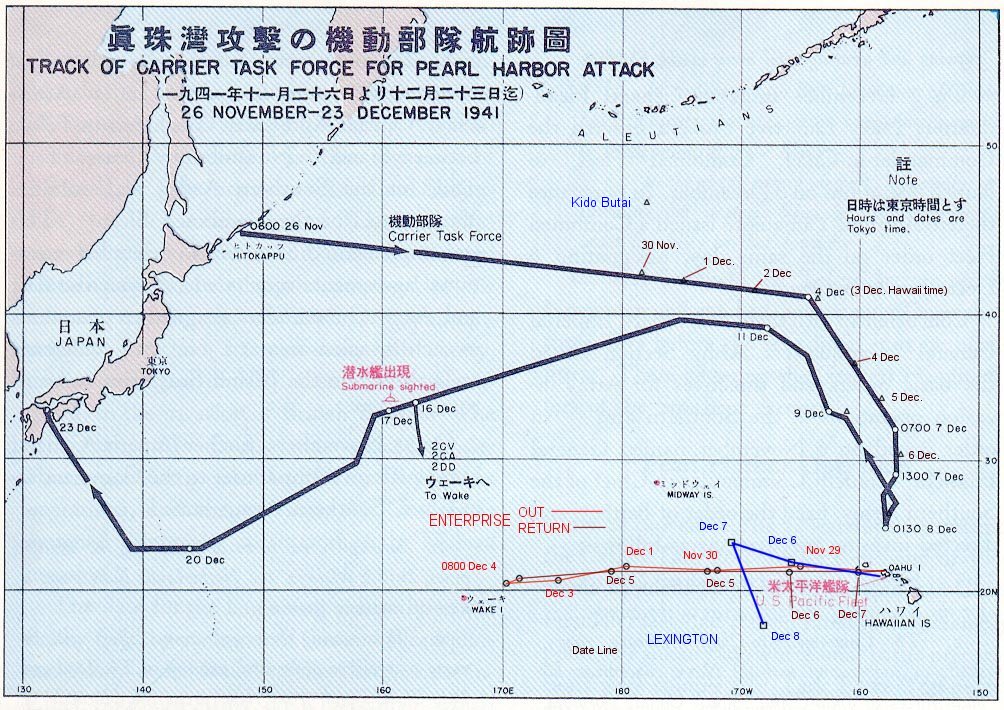
Um, the Kido Butai was north of Hawaii on the 3rd.

CarrierChartE.jpg


(And that's my site, mods. I gave me permission to post it. I give everybody permission to post it.)
 
* World War II-era submarines frequently had to surface or come very close to the surface in order to receive radio transmissions. So sending repeat-backs would have ensured full radio reception by the subs--and also by the smaller vessels.


Since submarines may be fully submerged when sent messages the messages are transmitted at regular intervals (every hour, every two hours, etc) for a predetermined time span (12 hours, 24 hours, etc). For instance, if a sub is on a 12 hour broadcast schedule and she copies the broadcast at 0800 she can remain fully submerged until 2000 and not miss any message intended for her. Any new messages intended for her while she is submerged is added to the broadcast and will be repeated for 12 hours.

The plan called for I-72 to scout the fleet anchorage and inform the IJN of the enemy vessels present. The plan also called for the attack fleet to maintain radio silence. To construe that one submarine transmitted one short message as blanket permission for the fleet to transmit whenever they wanted is to completely fail comprehending that this massive coordinated attack required a plan.

* As for the claim that Grogan was hearing radio-deception repeat-backs from Japan, how do you explain the fact that the bulk of Grogan's bearings are consistent with the track of the task force in the North Pacific for those days?


By the simple fact that they are not consistent with the task force's position.

* Another problem with the idea that Grogan was hearing and DFing false radio transmissions from Japan is that the repeat-backs were broadcast late at night, which means that the ships that were transmitting those signals had to be under darkness at the same time the Lurline was under darkness. So those signals could not have been coming from Japan.


As the link you keep repeating states, 1941 was a very good year for radio comms. Oh, wait, you meant for that info to bolster Grogan's claims, not to refute them. Sorry.

* In the replies I've read as of this writing, I haven't seen anyone deal with Farago's point that the German Navy did exactly what the Lurline evidence indicates the Japanese task force did.


Yes, absolutely nobody learned anything about radio wave propagation in the intervening 23 years.

One person asked me if I was not "honestly" aware that the Japanese engaged in radio deception from Japan to try to create the radio-signal illusion that the task force's ships were in home waters. Yes, of course, I am aware of that. Villa and Wilford discuss this deception and they also answer the claim that that deception accounts for all the USN intercepts.


So how do you account for the USN failing to detect the task force's transmissions? Stations Cast and Hypo had huge antennas, much, much bigger than the Lurline's.


* Finally, as for the claim that even taking numerous DF bearings over the course of two days on a huge, slow-moving target would not yield even a ballpark triangulation effect, we'll just have to agree to disagree.


Sigh. Again with the "huge" and "slow-moving" nonsense. I can't agree to disagree with you because you are wrong.
 
...

And, as I've mentioned previously, those same IJN sources that claimed absolute radio silence made other claims that turned out to be false. They claimed that they received no intel from the Hawaiian consulate, but they received intel from it on at least two occasions. They claimed that no written records survived, but that was proven false too.

...
Oh, good, you finally addressed it. Still no sources, but at least you - hey, this is just poisoning the well!

Every country in the war lied about things. What you need to do is prove these specific claims are lies. Which you can't.

And to keep replying to this evidence with the bald assertion that "the Kido Butai did not transmit" is specious circular reasoning.
No, it's not. Your claim is that the Kido Butai transmitted. Disagreeing with it is not circular reasoning. What's circular is implying the IJN lied because your evidence says something other than they did, therefore your evidence must be right.

It's like saying "all your evidence that the Earth is round is wrong because the Earth is flat." The IJN was not about to broadcast false messages that would indicate comms between carriers and tankers when they were trying to make us think those carriers were in home waters.
The assertion was no transmissions from the group. None. Not merely some kind of false messages.

And, of course, you're ignoring the possibility that the messages were actually from Japan.
 
* As for the claim that Grogan was hearing radio-deception repeat-backs from Japan, how do you explain the fact that the bulk of Grogan's bearings are consistent with the track of the task force in the North Pacific for those days?

The bulk of Grogan's bearings are also consistent with the track of Hokkaido, Honshu, Shikoku, and Kyushu for those days.
 
I cited one example of a Kido Butai transmission found in a traditionalist collection of Japanese naval documents. On 12/6 submarine I-72, one of the subs of the task force's supporting sub forces, transmitted a message to the advance force and the task force that "the enemy is not in the Lahaina anchorage" (The Pearl Harbor Papers, p. 243).


Now find something indicating the carrier strike force itself transmitted. That is the key point here. We'll wait.


And, as I've mentioned previously, those same IJN sources that claimed absolute radio silence made other claims that turned out to be false. They claimed that they received no intel from the Hawaiian consulate, but they received intel from it on at least two occasions. They claimed that no written records survived, but that was proven false too.


What other documents do or do not show about other matters is not relevant. What is relevant are the orders given the strike task force, the logs of the ships involved, and the testimonies of the personnel involved. What do all those sources say? If you are saying that evidence is wrong, then it is up to you to offer proof demonstrating that evidence is false. You haven't done that.


And to keep replying to this evidence with the bald assertion that "the Kido Butai did not transmit" is specious circular reasoning. It's like saying "all your evidence that the Earth is round is wrong because the Earth is flat." The IJN was not about to broadcast false messages that would indicate comms between carriers and tankers when they were trying to make us think those carriers were in home waters.


You never answered this question, and it's key to your thesis: Why would a Japanese strike force engaged on a risky, top secret mission transmit so many radio messages that could be detected? All you've offered is some vague suggestion that ships must use radio communication to keep on station and coordinate activities, but you've not supported that suggestion with evidence in any way whatsoever.


And in any case the whole "FDR let the raid happen" proposition is silly, as was discussed previously. A successful Pearl Harbor attack was hardly necessary for war between the U.S. and Japan; the mere attempt of an attack would have been more than sufficient. Even without the Pearl Harbor raid the attack on the Philippines would have resulted in war. So on purely logical grounds your allegation makes no sense.
 
Last edited:
Looks like the OP has changed tack from the FDR angle to the Lurline. I don't see progress being any better on the red herring theme than it was on the original.

When physics, history, geography and evidence are all against you, where do you go next?
 
Looks like the OP has changed tack from the FDR angle to the Lurline. I don't see progress being any better on the red herring theme than it was on the original.
His exhaustive, decades long research into the matter, spanning many authors' works and delving deep into the primary source material has given birth to a one-trick pont.
When physics, history, geography and evidence are all against you, where do you go next?
"Damn the logic torpedoes, full circle ahead!"
 
And in any case the whole "FDR let the raid happen" proposition is silly, as was discussed previously. A successful Pearl Harbor attack was hardly necessary for war between the U.S. and Japan; the mere attempt of an attack would have been more than sufficient. Even without the Pearl Harbor raid the attack on the Philippines would have resulted in war. So on purely logical grounds your allegation makes no sense.

In January 1941, Sen. Robert "Bob" Taft* said of the Lend-lease Act (paraphrased), "If you pass that act, it must be because you're ready to pass a declaration of war."

The Lend-Lease Act passed.

FDR didn't need a massively defeat to get into the war. A massive defeat would have been a stupid way to enter a war. CTers propound this moronic idea because they have nothing else. Not even sanity or rationality.
 
Looks like the OP has changed tack from the FDR angle to the Lurline. I don't see progress being any better on the red herring theme than it was on the original.

When physics, history, geography and evidence are all against you, where do you go next?

Bang on the table.
 
I just finished my first reading of Jacobsen's article "Pearl Harbor: Radio Officer Leslie Grogan of the SS Lurline and His Misidentified Signals" (Cryptologia, 29:2, 2005, pp. 97-120). I think I can best sum up my reaction to Jacobsen's article in one sentence: "You must be kidding."

I will deal with Jacobsen's article in considerable detail in a future posting, but for now I will make a few quick points:

* He sees "contradictions" and "differing versions" in the slightest, insignificant variations in wording between two accounts in an effort to cast doubt on their veracity, and at times his claims of contradictions are based on downright misleading readings of the texts.

Here's one example of how utterly silly-- and misleading--Jacobsen gets in claiming "contradictions": He asserts that Grogan contradicted himself about the signal strength by saying the signals were barely audible and then saying they were "blasting away." What Jacobsen doesn't tell you, but what he surely knew, is that in the first case Grogan was talking about when he first heard the signals, i.e., when the task force and the Lurline were much farther away from each, and that in the latter case he was talking about later, when the task force and the Lurline would have moved closer to each other.

* He ignores Ladislas Farago's discussion on the German naval precedent for repeat-backs, even though he mentions and quotes from Farago's book.

* He repeatedly misrepresents statements made by Villa and Wilford, as Villa and Wilford note in their 2006 article "Signals Intelligence and Pearl Harbor: The State of the Question." Some of Jacobsen's misrepresentations are rather egregious and seem to indicate a deliberate effort to mislead.

* He cites several pages from Goldstein and Dillon's The Pearl Harbor Papers to prove that the task force did not "stop" (Grogan said "bunched up"). However, as chance would have it, I have that book, and the pages he cites do not prove his point.

* He repeats the myth of radio silence but doesn't address the fact that Goldstein and Dillon's The Pearl Harbor Papers, which he cites, documents the fact that one of the submaries of the Kido Butai's submarine forces did in fact break silence: on 12/6 submarine I-72 radioed the task force that "the enemy is not in the Lahaina anchorage" (p. 243).

If this is the best shot that traditionalists have to offer on the Lurline evidence, then they are in a weak position on this issue.

And, finally, it bears repeating that for years the "scholarly, expert" explanation was that Grogan heard a few Russian commercial ships that were in the North Pacific. Now, the latest "scholarly, expert" (read: traditionalist) explanation is that Grogan was hearing Japanese commercial ships in Japan's home waters.
 
Last edited:

ISF - Join now!

Every member here is approved by hand. No bots, no spam, just people who care about evidence and honest debate.

Membership is free!

Create your free account

Back
Top Bottom