Origins of Covid

Status
Not open for further replies.
How do you square that with your claim that the virus was loose in early September? Surely the pattern of pneumonia that you said we would see would have been visible.
Sept cases if they occurred would not have been enough to establish a pattern of the virus simmering unless they included cases of a pneumonia outbreak of unknown origin.

Another experience of what we see in new pathogen outbreaks:
Lucey notes that the discovery of the coronavirus that causes Middle East respiratory syndrome, a sometimes fatal disease that occurs sporadically, came from a patient in Saudi Arabia in June 2012, although later studies traced it back to an earlier hospital outbreak of unexplained pneumonia in Jordan in April 2012. Stored samples from two people who died in Jordan confirmed they had been infected with the virus.
Just like SARS 1 and the H5N1HPAI experiences, zoonoses leave a trail.


Keep this in mind: The removal of the database from online could be a red-herring. The evidence isn't conclusive. But if it is connected, all that had to have happened to trigger the move was a breach of containment. Maybe it wasn't clear the virus actually infected anyone. Or maybe it infected one or two people and it was thought that was all that would happen.

Regardless of those possibilities from a red herring to a couple cases, it doesn't include evidence of a simmering pathogen. You only need to have had one case in Sept.

We have cases being recognized in Dec. There had to be an incubation period before the cases were in the hospital. We know patient zero wasn't among these cases because those first recognized cases were from the seafood market cluster.

More patients were found that came earlier than the Seafood market. These are recognized cases (from the A lineage I believe) but for which China will not release any information on them about their cases or exposure history.


Do you have a source for this?
Multiple sources have been posted. I can't believe you don't know that. But whatever, here are some again.

Science; Jan 26, 2020: Wuhan seafood market may not be source of novel virus spreading globally
Description of earliest cases suggests outbreak began elsewhere

a description of the first clinical cases published in The Lancet on Friday challenges [first cases at the seafood market] hypothesis.

The paper, written by a large group of Chinese researchers from several institutions, offers details about the first 41 hospitalized patients who had confirmed infections with what has been dubbed 2019 novel coronavirus (2019-nCoV). In the earliest case, the patient became ill on 1 December 2019 and had no reported link to the seafood market, the authors report. "No epidemiological link was found between the first patient and later cases," they state. Their data also show that, in total, 13 of the 41 cases had no link to the marketplace. ...

Earlier reports from Chinese health authorities and the World Health Organization had said the first patient had onset of symptoms on 8 December 2019—and those reports simply said "most" cases had links to the seafood market, which was closed on 1 January.

Lucey says if the new data are accurate, the first human infections must have occurred in November 2019—if not earlier—because there is an incubation time between infection and symptoms surfacing.

Keep in mind, by end of Jan 2020 there were hundreds of cases showing up all over the world.


WSJ: China Refuses to Give WHO Raw Data on Early Covid-19 Cases - Officials withhold personalized information on patients that could help determine pandemic’s origins
BEIJING—Chinese authorities refused to provide World Health Organization investigators with raw, personalized data on early Covid-19 cases that could help them determine how and when the coronavirus first began to spread in China, according to WHO investigators who described heated exchanges over the lack of detail.
The rest is paywalled but this same story has been repeated by other researchers asking China for information on the first cases.

BBC: Covid-19 pandemic: China 'refused to give data' to WHO team
Microbiologist Dominic Dwyer told Reuters, the Wall St Journal and the New York Times the team requested raw patient data from early cases, what he called "standard practice".

He said they only received a summary. ...
 
Sept cases if they occurred would not have been enough to establish a pattern of the virus simmering unless they included cases of a pneumonia outbreak of unknown origin.

Exactly! And yet you rule out the possibility of the virus taking its time to develop adaptation to humans any earlier on the basis of the same system that would not be sensitive enough to pick up the early cases.

This is my whole point about there being plenty we just don't know about.

There are gaps in our knowledge. My approach is to say, "We don't know."

Your approach is to say, "Come on! It's lab leak! What about Shi lying about the miners getting a fungus when we know for sure it was totally a SARS spillover!"

Multiple sources have been posted. I can't believe you don't know that. But whatever, here are some again.


The examples you are giving me are just the official ones, are they not? These are from early December. We know about these.

Is there anything earlier than December?
 
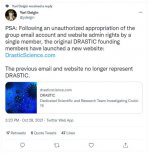
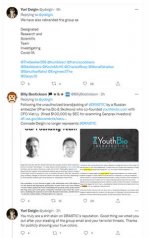
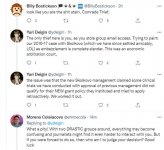
Uh oh, DRASTIC times call for DRASTIC measures.
 

Attachments

  • DRASTIC split a.jpg
    DRASTIC split a.jpg
    31.8 KB · Views: 5
  • DRASTIC split.jpg
    DRASTIC split.jpg
    23.4 KB · Views: 9
  • DRASTIC split c.jpg
    DRASTIC split c.jpg
    42.1 KB · Views: 6
Re Shi lying about the miners: everyone else knows they didn't die of a primary fungal infection.
This is an obvious lie. I know that know that the miners probably did of a fungal infections. Other posters have said the same. The scientific consensus is that they probably probably did of a fungal infections.
 
Last edited:
Has anyone seen any quote "claiming there were no in vitro CoV cultures at the WIV"

Plus there are pictures of the bat cages at WIV and Daszak discussed on the record how they were experimenting with live coronavirus cultures, 2 things Shi denied. Again you choose to ignore the evidence.
Skeptic Ginger knows that this is untrue.
There is a probably fake video produced by DRASTIC where they say that bat cages are at WIV. The truth is that there is a Chinese video with some bats in cages somewhere. They are not the bats carrying coronavirus that the WIV was studying because no lab in the world has been able to keep them. No Chinese or foreign scientist working at WIV has stated that there were live bats there.
Daszak was right. WIV had isolated and grown a total of 3 live coronavirus cultures.
Repeating fantasies does not make Shi into a liar.
Has anyone seen any any quote "claiming there were no in vitro CoV cultures at the WIV" from Shi?
Sounds like just another unfounded assertion from Skeptic Ginger or maybe rubbish from DRASTIC. It is well known that the WIV isolated and grew 3 bat CoV. Shi would know that!

The rest of the post is argument from ignorance. We have seen viruses that "go from some kind of silent circulating (silent as in unnoticed mild cases) to a sudden explosion of highly infectious cases". That is what happens when a virus spillovers from animals to humans :eye-poppi. There are the unnoticed mild cases from exposure to the animals before spillover. Then as in SARS, COVID-19 and many other brakouts, there is an explosion of cases.
 
Last edited:
Exactly! And yet you rule out the possibility of the virus taking its time to develop adaptation to humans any earlier on the basis of the same system that would not be sensitive enough to pick up the early cases.

This is my whole point about there being plenty we just don't know about.

There are gaps in our knowledge. My approach is to say, "We don't know."

Your approach is to say, "Come on! It's lab leak! What about Shi lying about the miners getting a fungus when we know for sure it was totally a SARS spillover!"

The examples you are giving me are just the official ones, are they not? These are from early December. We know about these.

Is there anything earlier than December?

Earlier than Dec? WTF is it you don't understand?

I also don't get your confusion about the period of time a virus needs to adapt to humans and the trail it leaves.

You need many cases where the virus is multiplying and mutating in people or in an animal reservoir and passing back and forth in people.
You will see some pneumonia cases in people as the virus mutates to become more virulent.​

Why don't you educate yourself as to how this happens in spillovers. There are likely dozens of examples you could find in a net search.
 
Uh oh, DRASTIC times call for DRASTIC measures.

I'm not that surprised. Decades ago I signed up for the email notices from the ProMED mail I get infectious disease updates from. It was teeming with viruses and they never did much about it. I cancelled the email service and now I just go to their site to look at what is new.
 
Skeptic Ginger continues making up misinformation

The Chinese government acknowledges there were cases prior to Dec for which records exist. They refuse to share the records of the first patients despite multiple requests.
Skeptic Ginger continues making up misinformation. Skeptic Ginger has given no evidence that
  • The Chinese government "acknowledges there were cases prior to Dec for which records exist.".
  • The Chinese government "refuse to share the records of the first patients despite multiple requests".
The Chinese government states that the first known case was in early December 2019. The Chinese government has refused to give raw, personalized patient data for those December cases.

When Skeptic Ginger is asked for the sources we get irrelevant sources :eye-poppi.
Wuhan seafood market may not be source of novel virus spreading globally is not anything from the Chinese government.
It is a news article from 26 January 2020. It is mostly the opinion of Daniel Lucey, an infectious disease specialist at Georgetown University. It is about Clinical features of patients infected with 2019 novel coronavirus in Wuhan, China by Huang et.al. in the Lancet, January 24, 2020 which said the earliest case was a patient who became ill on 1 December 2019 and had no reported link to the seafood market. That suggests that there are unknown, undocumented cases in November 2019.
China Refuses to Give WHO Raw Data on Early Covid-19 Cases is not the Chinese government refusing to share data that they had already given to the WHO team! It is the Chinese government refusing to give further raw, personalized patient data for the known December onwards cases.
BBC: Covid-19 pandemic: China 'refused to give data' to WHO team is a repeat of the WHO team refusal.

No sources for the Chinese government acknowledging and having records for cases before December 2019.
No sources for refusals by the Chinese government to supply these so far imaginary records of cases before December 2019.
One (not multiple) refusal by the Chinese government to supply raw patient data to the WHO team.
 
Last edited:
Earlier than Dec? WTF is it you don't understand?

You are claiming that there are known cases from earlier than December, right? But these cases have been covered up.

Is that right?

I mean, I also don't really know where you stand on a lot of the points you have raised in the past.

For example the supposed October lockdown of Wuhan. I think there is no evidence of that and the theory is ludicrous.

And, the idea that the database being taken offline coincided with the outbreak, which means that you think the outbreak was around early September.

The latter bit is a problem because the very lack of evidence that you say is there for the virus becoming more adapted to humans should be visible on the early warning system you mentioned before. Yet you also claim that there was none, so there is no evidence of a spillover. Your theory is incoherent to me.

I also don't get your confusion about the period of time a virus needs to adapt to humans and the trail it leaves.

You need many cases where the virus is multiplying and mutating in people or in an animal reservoir and passing back and forth in people. You will see some pneumonia cases in people as the virus mutates to become more virulent.​

Why don't you educate yourself as to how this happens in spillovers. There are likely dozens of examples you could find in a net search.

This asserion you make here is something that need not be the case. As far as I understand.

For a start, viruses do NOT need to mutate over a period of time to become more virulent. I think you meant to say more transmissable.

But anyway, as far as the evolution of transmissability is concerned, I think you are merely asserting this. The discovery of the BANAL-52 virus shows that viruses may have the RBD that makes them able to bind to the ACE2 receptor. So we don't need to claim that either you have a long trail of observable cases in the wild OR you must conclude lab manipulated virus.

I think Stuart Neil gives a good explanation for why it is that what you claim needs to have happened, doens't necessarily need to happen:

If you go to 1:12 (one hour and twelve minutes) on this podcast, he talks about the RBD and the FCS:

https://decoding-the-gurus.captivat...sode-interview-with-stuart-neil-on-sars-cov-2
 
You are claiming that there are known cases from earlier than December, right? But these cases have been covered up.

Is that right?
No. Here's one of your problems right here. We know about the some of the cases. China is withholding the details about their potential exposure histories, date of onset, stuff like that. And we don't know if there are more cases China has not disclosed.


I mean, I also don't really know where you stand on a lot of the points you have raised in the past.
You would if you weren't being so OCD that every bit of evidence has equal value, that every potential event has to be true or none are, that any weakness you find in any single bit of evidence is some gotcha, and if you were looking at the bigger picture.

Take this for example:
For example the supposed October lockdown of Wuhan. I think there is no evidence of that and the theory is ludicrous.
The lab leak is not dependent upon this or the military games in Oct. Those are interesting possibilities which have yet to be clarified. Someone must know more about the claims of the ill participants but we don't have that information yet.


And, the idea that the database being taken offline coincided with the outbreak, which means that you think the outbreak was around early September.
Something happened in Sept that led to the Chinese reaction. I don't find Shi's claim about being concerned about hacking given she hasn't shared any of the information with other researchers, something that could be done without putting the data back online.

Both Shi and Daszak have information not being disclosed. I have posted about both cases up thread, lots of little bits and pieces of evidence that suggest missing parts.


The latter bit is a problem because the very lack of evidence that you say is there for the virus becoming more adapted to humans should be visible on the early warning system you mentioned before. Yet you also claim that there was none, so there is no evidence of a spillover. Your theory is incoherent to me.
You are conflating two different sets of evidence.
1) The precursor period when a virus jumps species in a spillover event where it becomes better adapted to the new species.

2) The time from patient zero until the virus takes off to become an epidemic or a pandemic if it was a single introduction into the population.​

In the case of COVID the evidence supports the conclusion it was well adapted to humans and quite contagious from the very start when it was introduced into patient zero.

If it were a spillover event it would have taken some time to become adapted well to humans despite having many of the pieces already in place. Did you look at the history of SARS becoming adapted to humans after several people were infected from civet cats in 2 different wet markets?

If the spillover proponents come up with evidence supporting that hypothesis and they share it, then a reassessment can be made. But they have been unable to do so.


I'm cutting this reply in half because you don't seem to be reading my tl;dr posts.
 
The Chinese government acknowledges there were cases prior to Dec for which records exist.


Your own link says the first know case became ill on Dec 1. Your demand China "release data" on cases that occurred before the first know case is unreasonable. There is no possible way for them to have information on cases before the first know.


They refuse to share the records of the first patients despite multiple requests.

The reason given for this is that releasing a patients private medical information violates their health information laws. Do you believe it's ethical to release a patients private health information without their consent?
 
Last edited:

Here is your exact claim

The Chinese government acknowledges there were cases prior to Dec for which records exist.

You have not shown there are records for cases before Dec while your own link says the first know case became ill on Dec 1. Do you have evidence for data existing on cases from before this or will you retract this claim?
 
Some background in the epidemiology of spillover events:

2008: Cross-Species Virus Transmission and the Emergence of New Epidemic Diseases

Note Daszak is one of the authors.
Summary: Host range is a viral property reflecting natural hosts that are infected either as part of a principal transmission cycle or, less commonly, as “spillover” infections into alternative hosts. Rarely, viruses gain the ability to spread efficiently within a new host that was not previously exposed or susceptible. These transfers involve either increased exposure or the acquisition of variations that allow them to overcome barriers to infection of the new hosts. ... Steps involved in transfers of viruses to new hosts include contact between the virus and the host, infection of an initial individual leading to amplification and an outbreak, and the generation within the original or new host of viral variants that have the ability to spread efficiently between individuals in populations of the new host. Here we review what is known about host switching leading to viral emergence from known examples, considering the evolutionary mechanisms, virus-host interactions, host range barriers to infection, and processes that allow efficient host-to-host transmission in the new host population.

Three stages of viral disease emergence leading to successful host switching can be identified: (i) initial single infection of a new host with no onward transmission (spillovers into “dead-end” hosts), (ii) spillovers that go on to cause local chains of transmission in the new host population before epidemic fade-out (outbreaks), and (iii) epidemic or sustained endemic host-to-host disease transmission in the new host population (Fig. ​(Fig.2).2).

To infect a new host, a virus must be able to efficiently infect the appropriate cells of the new host, and that process can be restricted at many different levels, including receptor binding, entry or fusion, trafficking within the cell, genome replication, and gene expression. The production and shedding of infectious virus may also be host specific. Multiple host barriers to infection would each require one or more corresponding changes in the virus, making the host range barrier increasingly difficult to cross.

While the evolutionary relatedness of the hosts may be a factor in host switching, the rate and intensity of contact may be even more critical. Viral host switches between closely related species (e.g., between species within genera) may also be limited by cross-immunity to related pathogens or by innate immune resistance to related viral groups. ...

The initial viral interaction with cells of a new host is a critical step in determining host specificity, and changes in receptor binding often play a role in host transfer. For example, the SARS CoV was derived from viruses circulating enzootically in a number of bat reservoirs, and the bat-derived viruses interact differently with the angiotensin-converting enzyme 2 (ACE2) receptors of humans and carnivore hosts such as Himalayan palm civets (Paguma larvata), which harbor viruses that are closely related to the human viruses (see also below) (69, 71, 96).


Gaining the ability to bind the new receptor effectively may be a complex process and require multiple changes in the virus.
Note this paragraph goes on to provide specific examples.


After receptor binding, restriction may also occur at other levels in viral infection cycles.
This paragraph goes on to give specific examples.


Evolutionary changes are not always required for viruses to emerge in new hosts. For example, canine distemper virus has a very wide host range in mammals, naturally infecting marine mammals, lions, black-footed ferrets, and other hosts, and its emergence in these species appears to be limited primarily by contact.
One would still expect to find these or very similar viruses in the initial hosts. Once again, there would be a trail spillover proponents have after 2 years yet to find.


However, in other cases emergence requires the evolution of the virus to allow efficient infection and transmission within the new host. The evolution of viruses to allow adaptation to new hosts is still not well understood. The level of genetic variation is important, and most viruses transferred to new hosts are poorly adapted, replicate poorly, and are inefficiently transmitted, so that the greater the rate of variation the more likely a virus is to adapt to the new host.
after a host-switching event combinations of genetic drift and selection will determine the viral genetic variation that remains in the long term. ...

For many host-switching viruses, full host adaptation may take months or even years to complete. ...

Isolates of Nipah virus collected at the end of the outbreak also differed significantly from those collected at the beginning, suggesting either adaptation (1) or possibly the occurrence of more than one introduction (94).
We didn't see that bolded bit in COVID initially in the outbreak. The variants took a couple months to start showing up.
 
Some background in the epidemiology of spillover events:

2008: Cross-Species Virus Transmission and the Emergence of New Epidemic Diseases

Note Daszak is one of the authors.


Note this paragraph goes on to provide specific examples.


This paragraph goes on to give specific examples.


One would still expect to find these or very similar viruses in the initial hosts. Once again, there would be a trail spillover proponents have after 2 years yet to find.


We didn't see that bolded bit in COVID initially in the outbreak. The variants took a couple months to start showing up.

You are conflating "Viruses get better at infecting a new host species over time" with "viruses can't infect their new host species efficiently when they first cross over."

While this is true some viruses may initially struggle to infect their new host, there are others that jump between host species and can spread effectively right out of the gate. It's why we can have outbreaks of influenza spread into human population from pigs or birds.


In fact we already know that SARS-CoV-2 can jump between species and immediately be contagious. The original strain of Covid was even more infectious to Mink than it was to humans even with *no* known time to adapt. (There were Mink in the Wuhan market, so it's conceivable they served as the intermediary species for the crossover into humans. That would blow the whole lab leak hypothesis out of the water though)

We also know that when it was given time to adapt SARS-CoV-2 has become much more effective at infecting humans, so in fact this adaptation process is in fact playing out.
 
Some background in the epidemiology of spillover events:

2008: Cross-Species Virus Transmission and the Emergence of New Epidemic Diseases

Note Daszak is one of the authors.


Note this paragraph goes on to provide specific examples.


This paragraph goes on to give specific examples.


One would still expect to find these or very similar viruses in the initial hosts. Once again, there would be a trail spillover proponents have after 2 years yet to find.


We didn't see that bolded bit in COVID initially in the outbreak. The variants took a couple months to start showing up.

That paper merely shows a number of different variables that may, or importantly, may not have to occur for a virus to infect a new host.
 
That paper merely shows a number of different variables that may, or importantly, may not have to occur for a virus to infect a new host.
:rolleyes:

So once again you are not really interested in a discussion. You need to find the source of the virus, whereas a lab leak explains the evidence we have.
 
Last edited:
What do you mean I am not interested.

What do you think I am doing?

Was my statement true or false?
A better answer for me would have been, "Maybe pixies sprayed pixie dust on someone starting the pandemic."

If you want to give magical answers that ignore the facts, that is not a serious discussion.

The example of the Nipah virus in the link I cited noted it had enough in common with human pathogens to jump to them without a lot of adaptation. But later in the article it was noted that you could find that virus in the fruit bats who were the reservoir for it.

So if an animal virus jumps to humans (or another species) it isn't some magical one-off that jumps species and the source can never be found. It is a virus circulating in one species that a person comes in contact with. IOW you can find the species and the virus circulating in that species. The virus doesn't make a magical one-off genetic change, even a recombinant change, that just so happens to infect one patient zero but doesn't circulate within the original species.

Yes, lots of pieces of COVID 19 can be found in horseshoe bats from Laos to Yunnan. And the pangolin coronavirus genetic segment that lines up nicely with COVID genetics can be found IIRC in the Yunnan caves where a recombinant event resulted in it mixing with other bat coronaviruses.

But what hasn't been found and what should have been found after a 2 year intensive search is something with all those parts in one circulating virus.
Claiming it took X number of years to find the source of HIV is not analogous in the least. It took from the 70s to 1983 just to identify the virus. And the cases in Africa (Uganda IIRC) weren't noticed because that is what happens when a county has a poor public health infrastructure. What happened for HIV to begin spreading was the construction of a highway from a place HIV was circulating in humans to a more populated area. And with that came spreading the virus through prostitutes who sold their wares to the truck drivers.

None of that is comparable to a virus which hits a human population and abruptly takes off. None of it is comparable to the technology we now have for quickly identifying genomes through PCR techniques.

So we are back to recent examples that include influenza which frequently jumps to humans and SARS 1 which jumped one time so far. In all those cases finding the source species/location occurred over a matter of months at most.

There are other examples: Nipah, ebola, MERS and a few others which have not become human pandemics in anything like COVID. Yes there was human to human spread and in the case of MERS it was spread across continents. But in none of those cases had it yet fully adapted to humans allowing it to spread like wildfire.

And in all of those cases the source species were found rather quickly.

How long are you going to wait before you consider the source species isn't out there and start looking for another explanation? 10 years, 20 years? Your confirmation bias gets more extreme with each passing month.


If you want a serious discussion, go find something besides a headline that says a virus close to COVID was found in Laos. Because in that case, no one virus like COVID was circulating in bats in Laos. Rather closely matching genetic segments were found in 3 different sources.

Find some evidence for how a virus that did have all the segments not only found its way to Wuhan, but found its way to infect one patient zero without infecting anyone else along the way.

Find evidence all those genetic segments are circulating and recombining with bat coronaviruses in Yunnan. There have been WIV field trips to the Mojiang mine and other caves in Yunnan to collect coronavirus samples from bats. There is a record they collected > 1,000 specimens. Where are the genetic records for that many specimens? You would think China would want to show evidence for a spillover event. They have certainly gone to a lot of trouble to test nearly 80,000 specimens from animal farms, wild animals, poultry and livestock.


WSJ from Oct 5, 2021: Science Closes In on Covid’s Origins Four studies—including two from WHO—provide powerful evidence favoring the lab-leak theory.
Based on experience with SARS-1 in 2003 and MERS in 2012, we know that many people are infected by a host animal long before a coronavirus mutates to the point where it can jump from human to human. An extensive data set from late 2019—more than 9,000 hospital samples—is available of people exhibiting flulike (thus Covid-like) symptoms in China’s Hubei and Shaanxi provinces before the epidemic started. Based on SARS-1 and MERS, the natural zoonotic theory predicts 100 to 400 Covid infections would be found in those samples. The lab-leak hypothesis, of course, predicts zero. If the novel coronavirus were engineered by scientists pursuing gain-of-function research, there would be no instances of community infection until it escaped from the laboratory. The World Health Organization investigation analyzed those stored samples and found zero pre-pandemic infections. This is powerful evidence favoring the lab-leak theory.
The rest is paywalled but that's enough to make the point.
 

That's an opinion piece written by Richard Muller and Steven Quay, whose opinions were already well known. Repeating their views in the opinion pages of the Wall Street Journal adds as little to the scientific discussion as Skeptic Ginger repeating her opinions here, just as Donald Trump repeating his lies in the opinion section of that same newspaper added nothing to our knowledge of the 2020 presidential election.

Note to moderators: The reference to Trump's editorial is not off-topic, as it illustrates the fact that publication of an opinion piece in the WSJ does not merit any presumption of credibility.​

Note also that Muller and Quay were the ones who claimed the double-CGG sequence proved SARS-CoV-2 had to have been engineered in a lab, a claim real experts were quick to debunk. Quay also wrote the risible "Bayesian analysis" paper that claimed to have proved "beyond a reasonable doubt that SARS-CoV-2 is not a natural zoonosis but instead is laboratory derived".
 
Status
Not open for further replies.

ISF - Join now!

Every member here is approved by hand. No bots, no spam, just people who care about evidence and honest debate.

Membership is free!

Create your free account

Back
Top Bottom