Origin of the paint that was found as red-gray chips - any ideas?

Hi, Oystein,
as for your points 1. and 2.:

1) I read here that strontium chromate forms yellow monoclinic crystals (prisms, but I have just lost the link). It seems that one micrograph of "chrome yellow" (strontium chromate) can be seen here . Declared magnification is 200x. This is in fact the pigment collected from some old painting, but all other micrographs I have found yet are much worse.
I have already suggested in post No 770 that (comparatively rare) bigger particles up to ca 4 microns visible in Fig. 5 in Bentham paper may be just particles of strontium chromate, but... who knows? Generally, I think that such a kind of proof of strontium chromate (through some search using SEM with a high magnification) would be quite difficult and/or inconclusive (?). Anyway, some guy experienced in crystallography can say more on this specific matter... We have to remember that there was at most some 2 % of this material in Laclede paint. And, strontium chromate pigments could come in various particle sizes on the market.

2) Concerning this, I suggested in some post that I can collect some chips of red primers on rusted steel here in Prague and see how they look under some good microscope; but all such research would be too indirect and cannot bring anything conclusive. I think:confused:
 
Last edited:
Oystein:
Btw it is written that strontium chromate is strongly birefringent and can give some typical "figures" under microscopy using polarized light, see Fig. 9 in the linked paper (after magnification of this Fig.). Perhaps this is some clue for us (and for Chris and his "lab guy"):cool:
 
Oystein:
Btw it is written that strontium chromate is strongly birefringent and can give some typical "figures" under microscopy using polarized light, see Fig. 9 in the linked paper (after magnification of this Fig.). Perhaps this is some clue for us (and for Chris and his "lab guy"):cool:
Oystein/Ivan,
This too is very interesting. "Lab Guy" thinks he can get back to me in a few days after talking to some other chemists about the thermite testing protocol.
In the meantime, I am reluctant to give him too much of this information. But once he suggests a protocol, you guys might know if strontium chromate could be findable in the data he produces(?)
 
Just collecting some data on strontium chromate:

http://www.atsdr.cdc.gov/toxprofiles/tp159.pdf - Table 4.2:
Chemical formula: CrH2O4Sr
Molecular weight: 203.62
Density: 3.90 g/cm3Page 257: "The EPA has not classified stable strontium for human carcinogenicity (IRIS 2002). A number of agencies have classified strontium chromate as a human carcinogen by the inhalation route, on the basis of occupational and animal studies. The carcinogenicity of strontium chromate is attributed to the hexavalent chromium ion and not to strontium. The American Conference of Governmental Industrial Hygienists (ACGIH) has given strontium chromate the classification A2, suspected human carcinogen, and has established an 8-hour time-weighted-average (TWA) of 0.0005 mg/m3 for occupational exposure (ACGIH 2002). The International Agency for Research on Cancer (IARC) has assigned strontium chromate, along with other chromates, to Group 1, as a human carcinogen (IARC 1990, 2002a). No other stable strontium compound is listed by IARC."


http://www.inchem.org/documents/cicads/cicads/cicad77.pdf
On page 8, Table 4, lists analytical methods for determining strontium in environmental samples (adapted from ATSDR, 2004).

Material Safety Data Sheet: http://www.sciencelab.com/msds.php?msdsId=9925108

http://www.ias.ac.in/matersci/bmsaug2008/603.pdf
The authors prepared nano-structured CrO4Sr structures. Not sure if the the SEM images help us much, but there are several kinds of spectra (XRD, Fluorescent, UV-Vis)

The crystal structure of strontium chromate (IV), Sr2CrO4 (1966, by Karl-Axel Wilhelmi)
http://openlibrary.org/books/OL5577608M/The_crystal_structure_of_strontium_chromate_(IV)_Sr₂CrO₄.

http://www.chemicalbook.com/ProductChemicalPropertiesCB1184992_EN.htm

The pigment compendium: optical microscopy of historical pigments, Vol. 2
by Nicholas Eastaugh


Not really any good images or useful data as far as I can see :(
 
I have often wondered if threads about thermite would exist if the chips of paint submitted to harrit where in fact Blue or Yellow or Green.

Thermite painted on an inch think would not amount to much, even if ya could get it to ignite and keep it in place. 70 years on and we still can't even guarantee that a solid ball of thermite encased in a steel shell will melt a tanks barrel let alone help demolish two 110 story building. Give it a rest will ya.


Further evidence that for Truthers "thermite" is nothing more than a placeholder magic word. They might as well be claiming the flux capacitors were inverted" or some other made up pseudo-technical nonsense. You see the same thing in other CT - claims based on "quantum physics" being the most prevalent.
 
Oystein: Sorry, it seems that "chrome yellow" is a term used for more chromate pigments, there is some mismatch...
Anyway, some strontium chromate crystals are visible in "The pigment compendium: optical microscopy of historical pigments" you linked, p. 180, as (mostly) needles. Those needles are again birefringent and can show "rainbow" colours under polarized light, Citation: "It forms medium to coarse-grained acicular crystals, which are translucent and yellow in colour.... Under crossed polars, birefringence is high... Larger crystals with stronger body colour mask the interference colours and bright yellow is seen... etc." I don't clearly see any such needles in micrographs in Bentham paper, but they can be hidden in the mass of red layers.

Chris: It seems to me that polarized light microscopy of red layers could prove/identify strontium chromate crystals, if we are lucky enough. But I am not sure. And, to be conclusive enough, such a microscopic proof has to be accompanied with some independent determination of strontium, e.g. by flame atomic absorption spectrometry (according to document Oystein also linked http://www.inchem.org/documents/cica...ds/cicad77.pdf).
 
Last edited:
In my experience the common primer for steel at that time was alkyd based “red lead primer” (lead tetroxide). It was the preferred primer to protect steel structures from rust because it forms a chemical bond with the steel.

http://www.gravitaindia.com/redlead.html

Conference Facilitator: Our next speaker is
RogerMorse of MorseAssociates.RogerMorse, Morse Associates:
My name’s RogerMorse. I’m an architect. My practice is centered largely around forensic investigations of buildings. As part of that work, I investigated the fireproofing in hundreds of buildings, maybe in thousands of locations. One of the things that I was called upon to do was to look at the fireproofing in the WorldTradeCenter. I did that over about a ten year period of time, starting in the early 1990s, and the last time I was in the building was in June of 2001. There were problems with the fireproofing in the WorldTradeCenter.
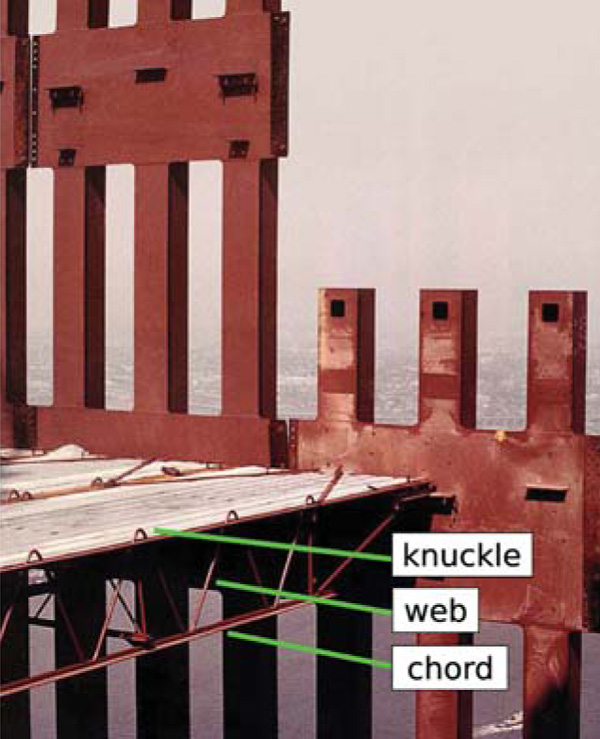
…… This is a slide of the fireproofing on a long span joists. This is the end of the long span joist. The red color that you see toward the bottom
is the red lead primer that’s on the joist. …..Another view of the end of one of the long span joists. You can see red lead on the bottom strand of the truss ….., the diagonal is going up to the outside wall. This is the end of the long span joist…… You can see the red lead on the top of the truss ….. You can see cement paste has run down over the surface of the red lead. ….. You can see in the main truss coming forward in the photograph that you can see the red lead where the fireproofing is missing completely from the webs of the truss on the tributary truss. ….. Again, this is one of the tributary trusses and you can see red lead at the top on the angles that form the top cord of the truss. ….. I found upon careful examination that the fireproofing was sticking just fine to the rust, the problem was that the rust was coming loose from the face of the steel. When I looked at the back of the rust deposits that remained on the column, I saw that there was cement, excuse me, cement paste on the back of the rust flakes, so that it was clear that the rust existed at the time of the fireproofing installation….

http://letsrollforums.com/hollow-asbestos-and-health-t24276p2.html


From the Jones, Harrit paper:
We have observed that some chips have additional elements
such as potassium, lead, barium and copper. Are these
significant, and why do such elements appear in some red
chips and not others? An example is shown in Fig. (31)
which shows significant Pb along with C, O, Fe, and Al and
displays multiple red and gray layers.
http://www.benthamscience.com/open/tocpj/articles/V002/7TOCPJ.pdf


I found no mention of how many red/gray chips were collected or mention of how many of these chips contained lead. None of the lead containing magnet-captured chips were tested. It puzzles me that the primers being considered and discussed are not red lead primer paints.
 
In my experience the common primer for steel at that time was alkyd based “red lead primer” (lead tetroxide). It was the preferred primer to protect steel structures from rust because it forms a chemical bond with the steel.

http://www.gravitaindia.com/redlead.html


http://letsrollforums.com/hollow-asbestos-and-health-t24276p2.html


From the Jones, Harrit paper:
http://www.benthamscience.com/open/tocpj/articles/V002/7TOCPJ.pdf


I found no mention of how many red/gray chips were collected or mention of how many of these chips contained lead. None of the lead containing magnet-captured chips were tested. It puzzles me that the primers being considered and discussed are not red lead primer paints.
I may be wrong here, but Kevin Ryan did tell me he has paint chip samples and red-gray thermitic chip samples, and "I can tell you they are not the same." He would probably claim that the test results he showed in his paper were of the chips thattested positive for thermitic material.

My Lab Guy has not gotten back to me about his proposed testing protocol. I will be contacting him today but for all I know he's on Christmas vacation.


If what you say is right then we don't know the density of chips that did not "test positive for thermitic material" vs the "thermitic" chips in the dust. If all the chips were selected by magnet, why wasn't a tally done?
We know then that some similar iron containing chips were not "thermite". Their tests then produced paint chips and their results were skewed to not show or quantify these "anomalies".
 
Last edited:
In my experience the common primer for steel at that time was alkyd based “red lead primer” (lead tetroxide). It was the preferred primer to protect steel structures from rust because it forms a chemical bond with the steel.

http://www.gravitaindia.com/redlead.html


http://letsrollforums.com/hollow-asbestos-and-health-t24276p2.html


From the Jones, Harrit paper:
http://www.benthamscience.com/open/tocpj/articles/V002/7TOCPJ.pdf


I found no mention of how many red/gray chips were collected or mention of how many of these chips contained lead. None of the lead containing magnet-captured chips were tested. It puzzles me that the primers being considered and discussed are not red lead primer paints.

The reason why I am not discussing red lead primer paints is that there is no reason to, and no evidence to go by. The multi-layered chip in Fig (31) is very obviously very different from the other chips they consider, and we have no data on it, beyond a vague "significant Pb along with C, O, Fe, and Al and displays multiple red and gray layers" - gray layers of two different shades of gray. What are we to do with this? What to compare it to? And why? You quote a man at length from letsrollforums who claims several times it's red lead on the floor joists, but I see no reason to believe him. Did he analyse the paint in a lab? I don't know that. What I do know is the specification of the primer paint with which LaClede Steel Company was required to prime the floor joists. That paint contains no lead.

We are here concentrating on chips a-d and the data we have on those, because these are the only chips of which we have more than one specimen on which more than one test was done with data published. All the other chips may well be of different origin and very certainly are, but too little data to identify them, with the possible exception of the MEK soaked chip.

Chips a-d contain no lead. That's why we did not consider read lead paint.
 
If what you say is right then we don't know the density of chips that did not "test positive for thermitic material" vs the "thermitic" chips in the dust. If all the chips were selected by magnet, why wasn't a tally done?
We know then that some similar iron containing chips were not "thermite". Their tests then produced paint chips and their results were skewed to not show or quantify these "anomalies".

You are right, one of the biggest flaws that permeates throughout the Harrit paper is their failure to tally and quantify differently looking chips and analyse and identify them consistently and thoroughly. That's why most of the data in the paper is useless and must be discarded. It is blatantly obvious that there is more than one kind of red-gray material - I always maintain "at least two", but of course you will quickly find four or even more. Chips a-d seem to be the same, and have been identified as LaClede primer paint from floor joists. The MEK chip is different and is very likely Tnemec primer from columns. The multilayered chip might contain red lead, but we don't even know if the Pb is in the red, dark gray or light gray layer; all we know it's obviuously different from a-d and from the MEK chip. And then they have chips where they found significant Ti after burning (Fig. 29) , which none of the three other kinds of chips showed before or after. Obviously, the very first thing everybody thinks when they see Ti is "paint" - who is to seriously doubt that Fig. 29 has the residues of a fourth, unidentified, kind of paint chip?
 
It puzzles me that the primers being considered and discussed are not red lead primer paints.

I don't want to get off the track hear but, it's unlikely there was much "red lead" in the building. It would not be used for the floor joists because the pans were welded in place. Even in the 60's it was known not to use it on assembles that needed welding. (same thing with welding galvanized metals).
 
I don't want to get off the track hear but, it's unlikely there was much "red lead" in the building. It would not be used for the floor joists because the pans were welded in place. Even in the 60's it was known not to use it on assembles that needed welding. (same thing with welding galvanized metals).

Which pans? Sorry, my construction vocabulary may be a bit weak here, but I don't know which part of the floor joists, or the conections to thge columns, would be called "pans" and welded. I am fairly certain I remember the joists were assembled fully at the LaClede factory and attached to the columns at their ends - not sure what was boltet and what was welded there. I do not recall how the corrugated metal decking was then attached to the joists before they layed rebar and poured concrete.

One minor objection to lead primer would be that lead primer is a material of choice for outdoor applications, while the floor joists were obvoiusly indoors.
 
Which pans?................................. I do not recall how the corrugated metal decking was then attached to the joists before they layed rebar and poured concrete.
.

We (in the trade) call them pans, rolls off the tongue better. Normally they are secured to the trusses with a "spot weld". For lack of better explanation. you burn the rod though "pan" and stick it to the heavier truss it's sitting on (not how it's done today).
 
DGM (BasqueArch, Chrismohr): I also don't know what exactly you mean by "pans", DGM. It is quite clear now from NCSTAR 1-6b report that floor trusses were painted as whole units by anodic electrocoating in Laclede Steel factory with the red epoxy primer of our main interest (which contained no lead).
As regards floor connectors (places where trusses were connected to the seats welded to perimeter columns), they were thoroughly investigated in NCSTAR 1-3, since they belonged to the elements critical in respect to the behavior of the buildings during the catastrophe. Perhaps they were painted with a different paint than trusses themselves but we have no info in this regard.

There were maybe tens of various red primers and other paints used in WTC, as has been mentioned already at the beginning of this thread (e.g., Leftysergeant mentioned red paint applied on numerous fire extinguishers). But, only few of them were used in really large amounts (for corrosion protection of construction steel elements) and they are clearly the main "culprits" in our detective investigation. As Oystein pointed out, we have been simply lucky enough that closely analyzed chips (a) to (d) could be identified with one particular red paint provably used for painting of floor trusses and that's all. We do not care that much if other paint (or nanot...te:cool:) chips were found in the WTC dust samples since they were not analyzed in more detail in Bentham paper (except "MEK chip", which was very, very probably Tnemec primer particle).
 
Last edited:
DGM (BasqueArch, Chrismohr): I also don't know what exactly you mean by "pans", DGM. It is quite clear now from NCSTAR 1-6b report that floor trusses were painted as whole units by anodic electrocoating in Laclede Steel factory with the red epoxy primer of our main interest (which contained no lead).
As regards floor connectors (places where trusses were connected to the seats welded to perimeter columns), they were thoroughly investigated in NCSTAR 1-3, since they belonged to the elements critical in respect to the behavior of the buildings during the catastrophe. Perhaps they were painted with a different paint than trusses themselves but we have no info in this regard.

There were maybe tens of various red primers and other paints used in WTC, as has been mentioned already at the beginning of this thread (e.g., Leftysergeant mentioned red paint applied on numerous fire extinguishers). But, only few of them were used in really large amounts (for corrosion protection of construction steel elements) and they are clearly the main "culprits" in our detective investigation. As Oystein pointed out, we have been simply lucky enough that closely analyzed chips (a) to (d) could be identified with one particular red paint provably used for painting of floor trusses and that's all. We do not care that much if other paint (or nanot...te:cool:) chips were found in the WTC dust samples since they were not analyzed in more detail in Bentham paper (except "MEK chip", which was very, very probably Tnemec primer particle).

The "pans" are hot dipped galvanized (zinc) not painted, steel corrugated (for strength) sheets atop the trusses onto which concrete was poured.

figAa.jpg


You might be able to see where the pans were affixed to the transverse trusses (two rows of dark spots- spot weld or screws and washers?)

DGM- The MSDS for the Strontium Chromate primer used on these trusses looks just as bad as the lead or zinc. Down heah they still spot weld before adding the shear studs. (OSHA?- we don't need no ....)
 
Last edited:
The reason why I am not discussing red lead primer paints is that there is no reason to, and no evidence to go by. The multi-layered chip in Fig (31) is very obviously very different from the other chips they consider, and we have no data on it, beyond a vague "significant Pb along with C, O, Fe, and Al and displays multiple red and gray layers" - gray layers of two different shades of gray. What are we to do with this? What to compare it to? And why? You quote a man at length from letsrollforums who claims several times it's red lead on the floor joists, but I see no reason to believe him.

I would not be a bit surprised if it were from an old fire extinguisher. The things are incredibly durable and long-lasting if kept indoors in a dry place. I recall refilling a couple of them when I was in the Air Force back in the sixties that had manfacturing dates from 1940. As long as they passed periodic hydrostatic testing, we would refill them and place them back into service. Since there was still some lead-based paint in use in homes until 1970 or so, I would not be surprised to have found a lead-painted extinguisher at the WTC. It's not like they were among the items that rug rats would be chewing on at all often.
 
BasqueArch: Aha, now it seems to be clear what DGM meant by "pans":cool:

Leftysergeant You can be right as for the source of lead paints, but who knows? The multilayered chip on Fig. 31, containing lead, looks really strange, and I think that it could be easily just some accidental "defect" of some paint layer.
Bentham paper deserves perhaps one "praise": up to now, it is the only paper which dealt in some detail with various red paints found in WTC dust (unfortunately without any reasonable purpose, for which it should be clearly nominated for an Ig Nobel prize. I think:cool:)
 
Last edited:
Lab Guy Update on Thermite Protocol

My lab guy has been busier than I thought, talking to several chemists and trying to create an economically viable protocol to test for thermitic material in the WTC dust. In the meantime, his curiosity inspired him to do a few more preliminary tests of his own on the WTC dust his lab has in its possession. By the end of this week Santa may have something for us yet. It's fun finding a chemist who won't weigh in on an opinion until he gets the data, even for a theory that is unpopular in most of the scientific community. This is the kind of guy who will lend credibility to the results.
 
Leftysergeant You can be right as for the source of lead paints, but who knows? The multilayered chip on Fig. 31, containing lead, looks really strange, and I think that it could be easily just some accidental "defect" of some paint layer.
It could also have been repainted several times after decades of service under varied conditions. Generally, fire extinguishers are provided by a contractor which exchanges them on the customer's premises and takes them back to the shop for testing, maintenance or refilling. Occassionally, repainting would be part of that routine, such as when a busines changes hands and the extinguishers are re-labelled. As I mentioned elsewhere, pigments in some sorts of paint migrate during the curing process. Thus, the multi-layer chip is likely from some object which would have been subject to periodic repainting. Fire extinguishers or other compressed gas installations are a good candidate as donors.
 

ISF - Join now!

Every member here is approved by hand. No bots, no spam, just people who care about evidence and honest debate.

Membership is free!

Create your free account

Back
Top Bottom