Origin of the paint that was found as red-gray chips - any ideas?

Here is a paper that looks at the formation of oxide layers on low carbon steel at high temperatures.
http://www.metal2012.com/files/proceedings/metal_05/papers/16.pdf

Some interesting results:

  • At 650°C, oxide layer remains very thin (<10µm), at 900°C it grows to more than 100µm eventually. Are these upper and lower bounds to the temperatures at which LaClede steel member were hot-rolled?
  • The oxide layer classically is itself layered, with Fe:O-ratio decreasing from steel substrate to surface: Near the unoxidized steel, FeO (wüstite), then Fe3O4 (magnetite), and then Fe2O3 (hematite) on top. Of course, magnetite is ferrimagnetic, wüstite strongly magnetic (the latter according to German Wikipedia)
  • Hardly any hematite forms at lower temps.


So there we have layers of magnetic iron oxides that form on hot steel.

Now back to the steel specs for LaClede - and to what extent these oxide scales were remived before painting, and hmmmmm what happens with the cool steel over the course of 30 years?
 
Oystein: If I understand, ASTM A242 steels belong to "weathering steels" or "Corten steels" designed to form protective "rust layer" during years. Owing to this layer, such steel does not require primer painting, but can be painted anyway for even higher durability.

A quote from the web ruukki.com:
"The atmospheric corrosion resistance of weather resistant sheet and strip is based on the chemical composition of the steel. As a result of alloying elements, a dense protective patina layer composed of corrosion products is formed on the surface of the CORTEN A steel under the influence of weather conditions, which significantly slows down the rate of rusting. The protective layer develops within 18–36 months under normal atmospheric conditions provided that the steel surface regularly becomes wet and dry.
At first, the protective layer is reddish-brown, but gains a darker hue with time. In an industrial atmosphere the patina is formed quicker and becomes darker in colour than in a rural atmosphere. Thanks to the patina, unprotected CORTEN A steel can be used in outdoor applications regularly exposed to changes in weather. However, the protective layer does not form if the steel surface is constantly wet."


I think that observed gray layers in chips from WTC dust are consistent with this "picture", since they are dense, quite homogeneous and dark after "all these years":cool: (And perhaps, their appearance can be used for distinguishing of "Laclede chips" from "Tnemec chips", since Tnemec paint was apllied to ASTM A36 steel with different corrosion behavior.)
 
Last edited:
Oystein: If I understand, ASTM A242 steels belong to "weathering steels" or "Corten steels" designed to form protective "rust layer" during years. Owing to this layer, such steel does not require primer painting, but can be painted anyway for even higher durability.

A quote from the web ruukki.com:
"The atmospheric corrosion resistance of weather resistant sheet and strip is based on the chemical composition of the steel. As a result of alloying elements, a dense protective patina layer composed of corrosion products is formed on the surface of the CORTEN A steel under the influence of weather conditions, which significantly slows down the rate of rusting. The protective layer develops within 18–36 months under normal atmospheric conditions provided that the steel surface regularly becomes wet and dry.
At first, the protective layer is reddish-brown, but gains a darker hue with time. In an industrial atmosphere the patina is formed quicker and becomes darker in colour than in a rural atmosphere. Thanks to the patina, unprotected CORTEN A steel can be used in outdoor applications regularly exposed to changes in weather. However, the protective layer does not form if the steel surface is constantly wet."


I think that observed gray layers in chips from WTC dust are consistent with this "picture", since they are dense, quite homogeneous and dark after "all these years":cool: (And perhaps, their appearance can be used for distinguishing of "Laclede chips" from "Tnemec chips", since Tnemec paint was apllied to ASTM A36 steel with different corrosion behavior.)

Floor joists were dry all their life except possibly during erection of the tower, and in addition they were painted, which keeps the water away from the steel surface even if it rained on the day they were installed.
So I don't think we should see this particular patina.
 
Floor joists were dry all their life except possibly during erection of the tower, and in addition they were painted, which keeps the water away from the steel surface even if it rained on the day they were installed.
So I don't think we should see this particular patina.

This was just the first link I have found in this matter, I will try to find more about the behavior of "weathering steel" under different conditions:cool:
 
Oystein: interesting paper on the weathering steels and patina formation:

It seems that patina film is formed on the steel during several years in average.

A quote, as for indoor applications: "It is also not advisable to use bare weathering steels in indoor atmospheres due to the lack of alternate wetting and drying cycles which are necessary to physically consolidate the rust film, or in marine atmospheres where the protective patina does not form."

This perhaps basically means that even indoor, such steel is slowly corroded forming oxidized layer, but this patina is not of high quality.
(Any paint can only slow down the corrosion, but it cannot prevent it completely.)

I have read somewhere (but lost the link) that painted weathering steels are recommended for such indoor applications, where the steel elements are not easily accessible for "repair paint jobs", which is of course the case of WTC floor trusses.

After ca 30 years, some patina may be developed even on the surfaces of WTC indoor steel elements, covered by protective primer, I think. But I have no references yet.
 
Yes, Ivan. Over time, some surface oxidation occurs. Details depend on a lot of factors: Steel alloy, primer, environment, the state of the surface when it was primed, etc. This is true for all steels, not just weathering steel, that gets its particular properties precisely from many cycled of getting wet and dry.

Even if we could locate some LaClede floor joist steel today, it would be questionable if its surface is basically still in the same conditiion that it was during and right after the 9/11 collapses.
Also, the dust samples (Jones's as well as Millette's) could have undergone changes by just sitting there in a bag for years. For example: While the iron oxide layer closest to the steel substrate on a steel member is not fully oxidized (more FeO, not Fe2O3), this would change when it gets chipped off, because then the FeO layer is in direct contact with ambient ennvironment, so oxidation can continue.


What I am really looking for eventually is good reasons to assume that
  • the top layer of a steel member could spall off from the the forces experienced in the collapse, with paint still attached
  • this layer would be magnetic (contain magnetite and/or wüstite)
  • layer thickness can range from 10-100µm (or beyond)
I think it is unrealistic that we find references for just the kind of steel LaClede used in just the same kinds of environment. Also, if the paint tends to stick or not would surely depend on the properties of the paint. So my search of literature goes towards papers that explain "normal" surface oxidation in dry conditions.

We see in NCSTAR 1-3C Appendix D
http://www.nist.gov/customcf/get_pdf.cfm?pub_id=101432
p.156 pdf Figure-D4 that most of the spalled red primer column paint does not contain a gray steel/rust layer. Based on this picture alone, one would expect most (by surface area) of the red primer paint not to contain a gray steel layer.
This result was after application of >650C temperatures alone and may not reflect the bonding of the primer and steel/rust layer due to impact and spalling.

Millette’s culling of the red/gray paint chips (to match Harrit et al) would have excluded the red/no gray Laclede and other primer paint chips.
The Laclede paint unlike the Tnemec paint (likely spray painted) was electrocoated. This process allows coating of complex, hard to reach surfaces, like the trusses. In this process, likely anodic, (cathodic was first put in use in 1970) “ substrate metals dissolve and become incorporated into the coating, which affects surface properties.” (see below)
This might additionally explain the lack of or minimal and thin gray layer in the excluded red/no gray paint chips.
The electrocoating process may be anodic or cathodic, depending on the charge applied the substrate. Although the processes are virtually the same, properties of the resultant coating are dissimilar. Anodic systems, which were the first to be used for electrocoating, apply paint to positively charged substrates. The negatively charged pigment and resin particles deposit onto the substrate (anode). One disadvantage of this process is that substrate metals dissolve and become incorporated into the coating, which affects surface properties.

The water content of the paint/vat solution evaporates during the subsequent baking (20 min at 350F or so) after the immersion of the trusses. The primer and epoxy remain as a hard coating on the steel.

Laclede chips properties to look for: (from the three south of WTC1,2 samples, not the one north of WTC7 sample)
a. Magnetic (the iron pigment content),
b. Red (seen in photos of the trusses),
c. With no or minor (thickness compared to the ones selected) gray iron oxide layer (anodic electrocoating process),
d. Smaller sized chips than the ones selected since they electrobonded more firmly to the steel than the larger columns and beams gray (“rust”) chips and would chip off in smaller pieces.
e. Contains SrCr
f. A greater net surface area of these Laclede chips, perhaps near 50% of all red/gray plus red/no gray chips due to our previous painted primer surface area calculations.
 
Last edited:
A) We see in
http://www.nist.gov/customcf/get_pdf.cfm?pub_id=101432
p.156 pdf Figure-D4 that most of the spalled red primer column paint does not contain a gray steel/rust layer. Based on this picture alone, one would expect most (by surface area) of the red primer paint not to contain gray steel layer.
This result was after application of >650C temperatures alone and may not reflect the bonding of the primer and steel/rust layer due to impact and spalling.

Millette’s culling of the red/gray paint chips (to match Harrit et al) may have excluded the red/no gray Laclede and other primer paint chips.

The Laclede paint unlike the Tnemec paint (likely spray painted) was electrocoated. This process allows coating of complex, hard to reach surfaces, like the trusses. In this process, likely anodic, (cathodic was first put in use in 1970) “ substrate metals dissolve and become incorporated into the coating, which affects surface properties.” (see below)
This might additionally explain the lack of or minimal and thin gray layer in the excluded red/no gray paint chips.


The water content of the paint/vat solution evaporates during the subsequent baking (20 min at 350F or so) after the immersion of the trusses. The primer and epoxy remain as a hard coating on the steel.
Wow, thanks for the leads!

a. The NIST images you show (from NIST NCSTAR 1-3C Appendixes) show Tnemec. A different paint with a different kind of matrix, applied differently to a different steel using a different method (heating inteand of mechanical stress). I Don't think we can compare the two. The matrix is sure to deteriorate at 650°C and lose its former properties, one of them perhaps being adhesiveness.

b. I believe that red-only chips of any kind of paint do not show up (prominently) in Jones's studies because they are not magnetic, which would indicate that the gray layer is the magnetic one.
Ohhhh that gives rise to a specific, cheap and simple request to Jones/Harrit/Ryan: If they could please...
- Select red-gray chips based on their being magnetic
- separate red and gray layers
- test each layer individually
Which layer is attracted to a magnet?


c. Baking the freshly coated steel at 350°F/177°C fopr 20 minutes would probably not do much to oxidize the surface, given the data in the paper that I linked to a few posts up. (Not that anyone suggests this, just mentioning it). So any surface oxidation happened either during manufacture (hot-rolling) of the angles and chords (before electrocoating), or during the electrocoating itself (if "substrate metals dissolve and become incorporated into the coating") involves oxidation), or during the 30 years of sitting in more or less air-conditioned, dry environment under paint - or a combination of the three.

d. We can say nothing about red-only chips as no ome has studied them. With the exception of HenryCo, afaik.
http://www.darksideofgravity.com/News_english.html
HenryCo however does not tell us how he obtained red-only chips from his 7g of dust samples. With magnet or by sight? I just sent him an email, asking.
(Anyway, I am not convinced that his one (?) red-gray chip is "our" kind of chip - red layer only 10µm.)

Laclede chips properties to look for:
a. Magnetic (the iron pigment content),
b. Red (seen in photos of the trusses),
c. With no or minor (thickness compared to the ones selected) gray iron oxide layer (anodic electrocoating process),
d. Smaller sized chips than the ones selected since they electrobonded more firmly to the steel than the larger gray (“rust”) chips and would chip off in smaller pieces.
e. Contains SrCr
f. A greater net surface area of these Laclede chips, perhaps near 50% of all red/gray plus red/no gray chips due to our previous painted surface area calculations.

B) Of course perhaps another anti-oxidant besides the SrCr was used by Laclede.
Hmmm
a. I disagree. Pure Hematite is at most very weakly magnetic. Rust is not readily attracted to a magnet. Other iron oxides are more magnetic, but should be present at most in trace amounts.
b. Sure.
c. Why? How do you know the thickness of the steel layer affected by electrocoating? Plus, processes before and after the coating could create more surface oxidation.
d. Again, why? Before or after electrocoating, other processes may have produced larger spalls. Plus, since the mere presence of red-gray chips from LaClede paint would indicate that paint adheres more strongly to the gray layer than gray layer to the steel substrate, this means that the bond between substrate and gray layer must have been relatively weak to begin with, for whatever reasons.
e. Sure
f. As a first approximation, yes. Deduct from this ~50% a bit to account for red paints other than those from twin tower structural steel (perhaps WTC7 steel, and non-steel paint). Then there is a possibility that different primers and different steels spall off bi-layered chips in different ratios, and finally I think that the different levels and kinds of mechanical stress that the different types of steel suffered in the collapses would also affect the relative abundance of the various kinds of chips.

B) Yes, that is a logical possibility, but I think it not very likely, for two reasons: 1. The formulation we know (From NCSTAR 1-6B, App. B, p. 157) is not a specification communicated to LaClede, but more an information from LaClede of what their shop primer actually was in 1967. Could of course be that they changed the formulation later, and we have no record thereof. 2. I am still somewhat confident that the Sr and Cr signals in Harrit's letter mean something.

 

The Laclede paint unlike the Tnemec paint (likely spray painted) was electrocoated. This process allows coating of complex, hard to reach surfaces, like the trusses. In this process, likely anodic, (cathodic was first put in use in 1970) “ substrate metals dissolve and become incorporated into the coating, which affects surface properties.” (see below)
This might additionally explain the lack of or minimal and thin gray layer in the excluded red/no gray paint chips.


The water content of the paint/vat solution evaporates during the subsequent baking (20 min at 350F or so) after the immersion of the trusses. The primer and epoxy remain as a hard coating on the steel.

Laclede chips properties to look for: (from the three south of WTC1,2 samples, not the one north of WTC7 sample)
a. Magnetic (the iron pigment content),
b. Red (seen in photos of the trusses),
c. With no or minor (thickness compared to the ones selected) gray iron oxide layer (anodic electrocoating process),
d. Smaller sized chips than the ones selected since they electrobonded more firmly to the steel than the larger columns and beams gray (“rust”) chips and would chip off in smaller pieces.
e. Contains SrCr
f. A greater net surface area of these Laclede chips, perhaps near 50% of all red/gray plus red/no gray chips due to our previous painted primer surface area calculations.


Thanks, BasqueArch, your finding that anodic electrocoating (used for painting of WTC floor trusses) can lead to the "anodic dissolution" of steel is interesting. Btw, I asked several months ago if the electrocoating process can influence the painted steel itself - and here is the answer: yes, it can, namely during anodic electrocoating:cool: Here is another link in this matter.

It seems that if the painted steel is anode, some iron is oxidized to Fe2+ ions, which can be incorporated into the paint film, or can be simply washed away, or can react forming some kind of insoluble iron oxide (here I have found some clues). Perhaps this could explain the formation of some "steel patina" already in the "paint shop". But, this is just remark...

I would like to note again than at the end of Golden Sixties, even anodic electrocoating was a brand-new technology and perhaps nobody knew really well how the electrocoated steel would be corroded in the course of several next decades.
 
Last edited:
Followong a recommendation from The Almond, I downloaded and installed DTSA-II, a multiplatform software package for quantitative x-ray microanalysis.
http://www.cstl.nist.gov/div837/837.02/epq/dtsa2/index.html

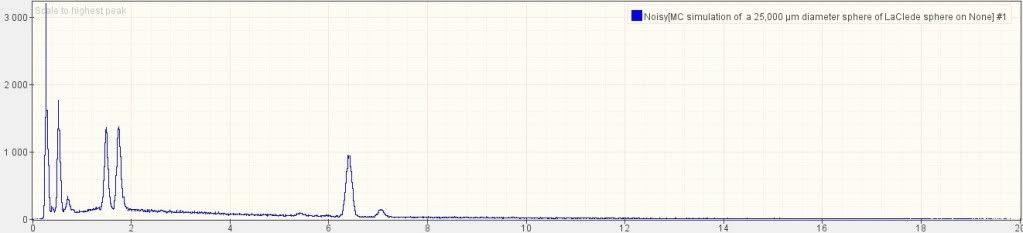
Among other things, it does Monte Carlo simulations of XEDS spectra, and here is one I did for our LaClede formulation:

LaClede_Sphere25micron_01.jpg


Notice:
- Strontium is practically invisible (flat at 14.16 and 15.83 keV)
- Nitrogen is a really small blip (between the two highest, C and O, on the left)

I modelled the paint with a 20 keV beam as a 25µm bulk sphere with the composition
C| O| Fe| H| N| Si| Al| Sr| Cr
48.7%| 21.1%| 11.0%| 6.8%| 6.7%| 2.5%| 2.4%| 0.5%| 0.3%


Pretty much the same as The Almond's own graphs - only mine extends beyond 10keV and shows how flat it is where there should be Sr at 14.16 keV (K-alpha) and 15.83 keV (K-beta), while the L-alpha at 1.81 keV is hiding under the Si-peak (K-alpha and K-beta in close proximity at 1.74 and 1.83 keV):

Sim_XEDS_LaCledeSpec_0-10000keV.png


I also, for our paper, rescaled The Almonds's sim and Fig. 7b such that the Si-peaks appears to have the same height in pixels (red curve on top is LaClede bulk). This illustrates very nicely just how similar they are:

Sim_vs_Fig_7b.jpg


(7b has additionally a liiiittle bit of S and Ca - perhaps a grain of gypsum after all?)
 
Last edited:
Wow! Thanks, Oystein, you become a kind of expert on XEDS:cool:

So, our white-paper is going better and better and it is very good indeed that Almond provided you with the necessary info how to calculate those XEDS spectra simulations.

On the other hand the white-paper is rather complex and we cannot expect many interested readers. Quite naturally, the most of interest will be focused on the discussion of the results of Jim Millette's research. And "strontium chromate issue" (together with "surface contamination issue") is apparently our main problem here, although we know well that it would not be easy to detect this compound in the red chips.
 
Oystein: Now, I am perhaps willing to provide some more money to Jim Millette for some additional research concerning the detection/determination of strontium in the selected red chips. I have already suggested some methods (e.g. atomic absorption spectrometry) in this respect. But, I can happily live even without such a proof of strontium:cool:
 
Last edited:
Btw, as a chemist, I am thinking about possible methods how to detect strontium and chromium in the selected chips.

We know that strontium chromate is soluble in mineral acids like hydrochloric acid (but not in water or any organic solvent).
What it could happen if the chips corresponding to Bentham chips (a) to (d) are treated with some (let say) 5% HCl for a long time? Crosslinked polymer binder will probably not be substantially changed in this way, as well as kaolinite. But strontium chromate (if any) will be slowly extracted from these tiny chips, perhaps together with iron oxide (slightly soluble in cold HCl, it seems). So, we would get in principle a quite simple solution of strontium chromate and iron compounds in HCl. I think that it should not be so difficult to detect/determine strontium (and chromium) in such a solution:cool:
 
Last edited:
To illustrate how Sr can be missed, I ran three XEDS simulations. Left to right:

a) LaClede paint as is
b) LaClede paint minus Strontium
c) LaClede paint minus Silicon
a):
LaClede_Sphere25micron_05_Detail.jpg
b):
LaCledeMinusSr_02_Detail.jpg
c):
LaCledeMinusSi_01_Detail.jpg


The signals for both Si and Sr are near 1.8 keV on the x-axis. You can see that without silicon, there would be a small but nice peak for strontium (its L-alpha level).

Now let's superimpose them - first b) vs. c):
LC_compare_MinusSi-MinusSr.jpg

The blue line shows what the Si-peak would look like if there was no strontium, the red line shows what the Sr-peak would look like if there was no silicon. You can see that the Sr-peak fits smug under the Si peak.


Now let's see how LaClede paint would look like if we subtract the strontium, and compare that with the actual formulation:
LC_compare_Original-MinusSr.jpg

Blue line is LaClede paint as is, with strontium. Red line is LaClede paint minus strontium.

Do you see where the only real difference is between both graphs? Low on the right schoulder of the Si-peak, the red line dips steeper and deeper and dives into the noise earlier, while the blue line slopes off more gently!


Now let's compare that to Harrit's graphs (Fig 7a-d, showing only the Al- and Si-peaks):
(a):
Fig7a_AlSi_streched.jpg
(b):
Fig7b_AlSi_streched.jpg
(c):
Fig7c_AlSi_streched.jpg
(d):
Fig7d_AlSi.jpg


I stretched a-c vertically such that the Si-peak has the same height in all four, while they have the same scale horizontally. Strike me dead, but I think the right shoulder of Si is stonger than the left shoulder at least in chips (a), (b) and (d)! Somehow, (c) is the outlier graph in many respects (has additional Na, S, K, Ca)
 
Last edited:
A formatting nitpick:

C| O| Fe| H| N| Si| Al| Sr| Cr
48.7%| 21.1%| 11.0%| 6.8%| 6.7%| 2.5%| 2.4%| 0.5%| 0.3%

If you're in time to edit your post, can you put a / at the last
so it looks like this?:

C| O| Fe| H| N| Si| Al| Sr| Cr
48.7%| 21.1%| 11.0%| 6.8%| 6.7%| 2.5%| 2.4%| 0.5%| 0.3%
 
A formatting nitpick:


If you're in time to edit your post, can you put a / at the last
so it looks like this?:

C| O| Fe| H| N| Si| Al| Sr| Cr
48.7%| 21.1%| 11.0%| 6.8%| 6.7%| 2.5%| 2.4%| 0.5%| 0.3%


Sorry, I didn't check my post after I sent it :o
 
Wow! Thanks, Oystein, you become a kind of expert on XEDS:cool:

So, our white-paper is going better and better and it is very good indeed that Almond provided you with the necessary info how to calculate those XEDS spectra simulations.

On the other hand the white-paper is rather complex and we cannot expect many interested readers. Quite naturally, the most of interest will be focused on the discussion of the results of Jim Millette's research.
Yeah, there is always a trade-off...

By the way: I am anticipating a qualified and benevolent review of our draft this weekend or perhaps a few days later. Next version after that. That's why I am now focussing on my blog and some rapid-fire debunking of their reactions.

And "strontium chromate issue" (together with "surface contamination issue") is apparently our main problem here, although we know well that it would not be easy to detect this compound in the red chips.
Oystein: Now, I am perhaps willing to provide some more money to Jim Millette for some additional research concerning the detection/determination of strontium in the selected red chips. I have already suggested some methods (e.g. atomic absorption spectrometry) in this respect. But, I can happily live even without such a proof of strontium:cool:
Btw, as a chemist, I am thinking about possible methods how to detect strontium and chromium in the selected chips.

We know that strontium chromate is soluble in mineral acids like hydrochloric acid (but not in water or any organic solvent).
What it could happen if the chips corresponding to Bentham chips (a) to (d) are treated with some (let say) 5% HCl for a long time? Crosslinked polymer binder will probably not be substantially changed in this way, as well as kaolinite. But strontium chromate (if any) will be slowly extracted from these tiny chips, perhaps together with iron oxide (slightly soluble in cold HCl, it seems). So, we would get in principle a quite simple solution of strontium chromate and iron compounds in HCl. I think that it should not be so difficult to detect/determine strontium (and chromium) in such a solution:cool:
Strontium Chromate is THE marker that distinguishes LaClede paint from ordinary paints, and would establish that a MAJOR portion of Harrit's chips are really just that paint! So yes, I would very much like to start a hunt on it!

First step would be to look at Millette's chips and identify those that are most likely the same as (a)-(b). Main markers:
- Contain kaolin (Al=Si, platelets visible, FTIR shows kaolin)
- Contain at least a trace of Cr
- Contain no major other stuff (except C, O, Fe of course)
We should agree on precisely which chips we think fit that profile and give Millette the IDs of these chips.

Second step then to inspect them visually (including electron microscopally, or whatever - Millette will know best) and find acicular pigments, shape like this:
SrCr_7_Image.jpg

Size very roughly 1 micrometer long, 100 nm thick.
Chips ought not be treated thermally too much as SrCrO4 decomposes at 500°C.

I'll defer to Millette and you to find the best method to identify it then. I am sure FTIR will do.
I don't think you don't need HCl to solve it, boiling water will do: Solubility is 0.12 g/100 ml water at 15°C, 3 g/100 ml at 100°C, but the epoxy might be against that. http://toxnet.nlm.nih.gov/cgi-bin/sis/search/a?dbs+hsdb:@term+@DOCNO+2546
 
Last edited:
I don't think you don't need HCl to solve it, boiling water will do: Solubility is 0.12 g/100 ml water at 15°C, 3 g/100 ml at 100°C, but the epoxy might be against that. http://toxnet.nlmCross.nih.gov/cgi-bin/sis/search/a?dbs+hsdb:@term+@DOCNO+2546

Aha, those data on the solubility of strontium chromate are new for me:cool:
Crosslinked epoxy should withstand the action of boiling water without problems, but anyway, we have now at least three suitable solvents for extraction/dissolution of strontium chromate crystals: hydrochloric acid, acetic acid and boiling water. I would just eliminate nitric acid, since it is a strong oxidative agent and can affect even epoxy resin to some small extent.

As concerns the microscopy, I am already rather skeptical, since Jim Millette simply have not found anything like strontium chromate needles. I would prefer some chemical/spectroscopic method.

In this case, perhaps even some "bulk analysis" of several/many chips would be good enough, since strontium should not originate from anything else than from Laclede paint chips:cool:

Of course, the choice of the method is also a matter of the cost.
 
Millette conducted low temperature ashing at 400°C in order to remove the binder material and separate the iron oxide pigment from the kaolin platelets. I would expect this process to reveal acicular strontium chromate particles. There may be a problem in that the percentage of these particles is low in LaClade.

On the other hand Millette's samples subjected to ashing and further analysis may not be LaClade as documented, but with a different Chromate/inhibitor or a different paint altogether.

BTW - nice work on the Monte Carlo simulation and correlations between that and the Si "tail" peak widening. We had discussed that a bit before with The Almond.

A simple, cheap and very quick test for assessing if Sr is present is Mass Spectrometry. However, it vaporizes the sample, so it would be a crap-shoot to examine whether Sr is present. I'm not keen on destroying samples for the sake of it.
 
Last edited:
BTW - nice work on the Monte Carlo simulation and correlations between that and the Si "tail" peak widening. We had discussed that a bit before with The Almond.
Thanks!
Yes, we discussed this before and I had always been aware of it, but only vaguely, and basically it was a matter of believing the expert.
It's nice to have pictures to go with that, and to have a freeware program to play with. Now anyone can reproduce what we are doing. That was one problem with using The Almond's Monte Carlo sims: They were correct, but I could not provide the algorithm, so it was basically not reproducible. I still don't have the algorithm, but that program is probably known and accepted among real experts. It comes from a source of accepted standards.

Millette conducted low temperature ashing at 400°C in order to remove the binder material and separate the iron oxide pigment from the kaolin platelets. I would expect this process to reveal acicular strontium chromate particles. There may be a problem in that the percentage of these particles is low in LaClade.

On the other hand Millette's samples subjected to ashing and further analysis may not be LaClade as documented, but with a different Chromate/inhibitor or a different paint altogether.
Yes, could be, could be. Hard to tell how much he looked for that stuff.

A simple, cheap and very quick test for assessing if Sr is present is Mass Spectrometry. However, it vaporizes the sample, so it would be a crap-shoot to examine whether Sr is present. I'm not keen on destroying samples for the sake of it.
True, that would be a method of last resort.
 

ISF - Join now!

Every member here is approved by hand. No bots, no spam, just people who care about evidence and honest debate.

Membership is free!

Create your free account

Back
Top Bottom