Origin of the paint that was found as red-gray chips - any ideas?

Millette conducted low temperature ashing at 400°C in order to remove the binder material and separate the iron oxide pigment from the kaolin platelets. I would expect this process to reveal acicular strontium chromate particles. There may be a problem in that the percentage of these particles is low in LaClade.

On the other hand Millette's samples subjected to ashing and further analysis may not be LaClade as documented, but with a different Chromate/inhibitor or a different paint altogether.

BTW - nice work on the Monte Carlo simulation and correlations between that and the Si "tail" peak widening. We had discussed that a bit before with The Almond.

A simple, cheap and very quick test for assessing if Sr is present is Mass Spectrometry. However, it vaporizes the sample, so it would be a crap-shoot to examine whether Sr is present. I'm not keen on destroying samples for the sake of it.

Thanks, Sunstealer. If I remember correctly, strontium chromate decomposes at temperatures below 400 degrees, so this kind of ashing would destroy the crystals. But strontium should be still available for chemical detection after the ashing.
Mass spectrometry seems to be a comparatively good choice, together with atomic absorption spectrometry.
As for extraction of chips with some solvents I suggested, chips are still to "thick" (ca 20 microns) for an efficient extraction of "hidden" crystals, so as chips should be somehow disintegrated before the extraction.
 
Last edited:
I am quoting these posts from the "Millette dust study" thread, as I think discussion of identity of paints, LaClede amd strontium belongs more here than there. After all, Millette has NOT (yet) identified strontium...

Almond: Thanks. So, if I understand, a proof of strontium using available XEDS data is not really possible. Pity...

Chris: Considering that Jim Millette used only methods not well suitable for detection of strontium (or strontium chromate), I do not wonder that he did not detect this element (or strontium chromate). I was rather skeptical in advance (contrary to Oystein).
Now, it is a time to try better methods:cool:
I do not really understand your attitude here, Chris: you were even able to admit that red chips may by thermite (what is an apparent nonsense), but, on the other hand, you are still not able to admit that Laclede paint is indeed an excellent candidate as the material of the many/most chips (despite the current absence of proof of strontium chromate). There is simply no other red paint (except Tnemec for perimeter columns) which can be present in WTC dust in such abundance. And, results of analyses of Jim Millette are basically consistent with some red paints. Would you agree?
(Well, some red primer from WTC7 can not be ruled out, but then, it should have a composition close to Laclede paint; that is still possible)
Of course, as the scale of the spectra stops at 10 keV, the Strontium CANNOT be detected on this spectra (peaks around 14 and 16 kev)!

BUT, Strontium is BOUNDED with Chroma...


AND Chroma is several times detected in the chips candidates for Laclede primer paint (p26 p27 and p42)

Almond, tell me if I'm wrong....
Problem is that chromium was present (as zinc chromate) also in Tnemec primer paint (and perhaps even in some other minor primers, unknown to us). So, clearly only strontium detection can be good enough as the "final" proof of Laclede paint.

We need to keep in mind that strontium is not a rare metal in nature: In the earth's crust, it is about as abundant as sulfur, only slightly less abundant than carbon, and more abundant than chlorine.

Ivan correctly points out that chromium can come from other pigments, but also from steel alloys and I don't know what else. So if you have a mixed material and you find both Cr and Sr, that is no proof at all that strontium chromate is present. It merely gives rise to the possibility.

Bulk spectra are of limited use. We'd need to find actual pigment of SrCrO4. It's basically searching for a needle in a clay stack.

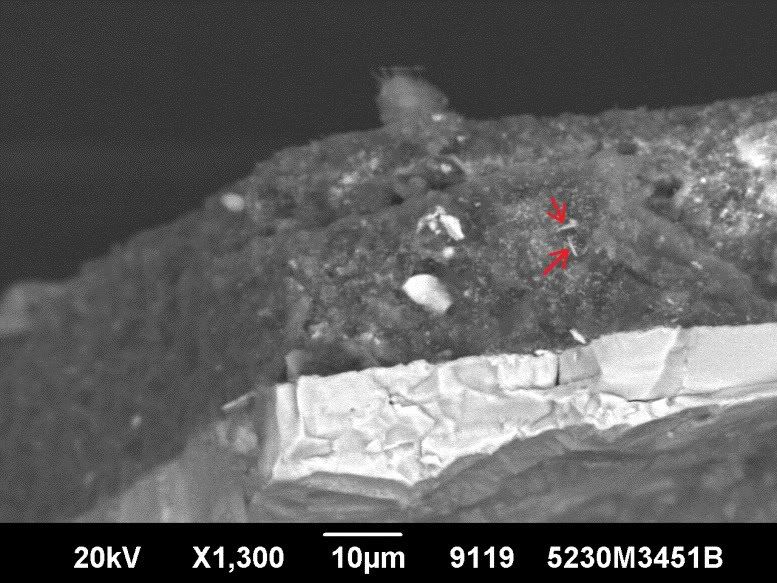
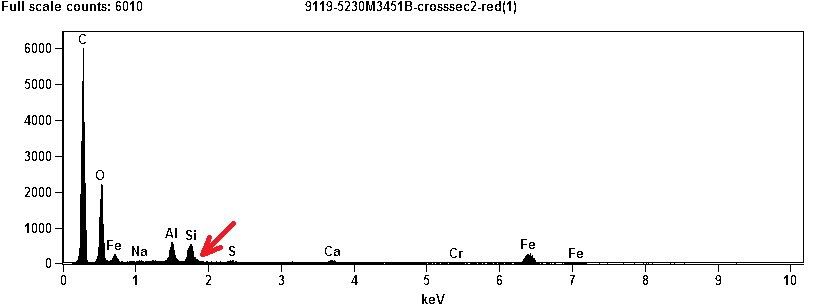
I have previously said that I think specimen 9119-5230M3451B-crosssec2, shown in Appendix D, is my best candidate for being LaClede paint. It has Cr, it has the tell-tale pregnant Si-peak, and even a few bright needles in the SEM-image.
9119-5230M3451B-crosssec2-SemImage_1300x.jpg


9119-5230M3451B-crosssec2-red1_Xeds20kV.jpg


If Millette could retreive that particular chip and focus an EDS beam on the needles...
  • Suppose they are strontium chromate: Focussed on the individual particle, the strongest peaks should be near 0.5 keV for O, 1.8 keV for Sr and 5.4 keV for Cr. Sr should easily give a good enough count compared to Si to distinguish the two, and anyway, an association of Cr with Si would make little sense chemically.
  • Suppose they are not strontium chromate: Then there will be no Cr, or no signifikant peak ar the Sr/Si ambiguity, or neither.
 
Oystein: Good idea:cool: Now, I just do not know how difficult could be to find again those two needles in this "Lucky 5230M3451B Chip":rolleyes:
The scale mark is 10 microns, so the whole photographed area is ca 100 microns long. Well, perhaps it is not so hard task for Jim...

Let us suppose that Jim proves strontium chromate as a material of those two needles. Than, this chip simply MUST be Laclede primer particle. What could be the real consequences of such finding for our Laclede paint hypothesis? (Just a question, I am not sure at present...)

1. It would prove that the painted surface of the floor joists spalled as red-gray chips and mixed with the general WTC dust that settled around GZ

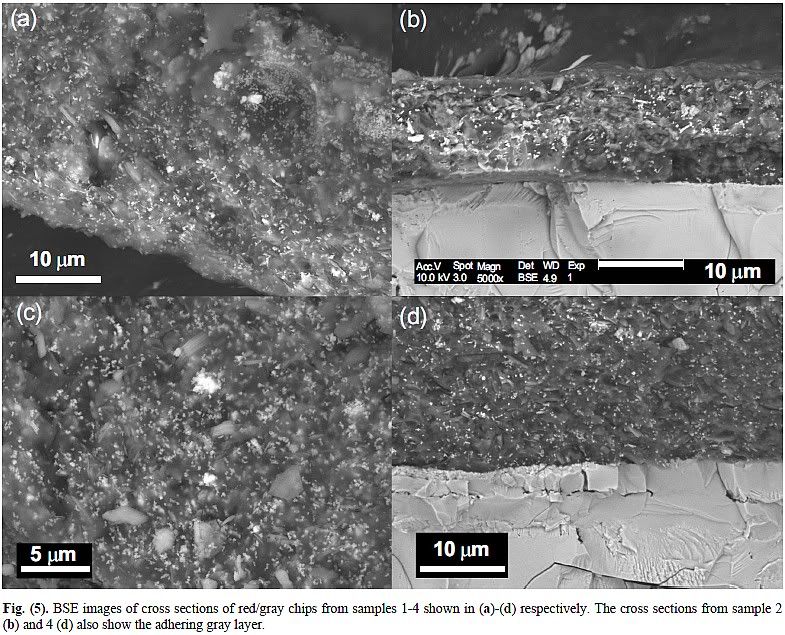
2. It would confirm a prediction we made from our inspection of the data on chips (a)-(d) in the Harrit paper, and the theory would be elevated to one with prediction power - the knighthood of scientific theories

3. It would thus prove that chip (a) IS LaClede primer, and that LaClede primer is the best explanation for chips (b)-(d) as well, on account of their being so similar in every way to chip (a).


In short: We'd have proven that (a)-(d) are LaClede primer, not thermite.


Truthers would then have to decide:
- Are ALL red-grey chips basically the same? Then ALL red-gray chips are not thermite - total refutation of the Bentham paper
- Are there substantial differences between different kinds of chips? Then, in order for them to cling to the thermite claim, they first have to discard all the data about chips (a)-(d), and they could no longer claim that any two chips are basically the same. Then, having admitted that it is unclear which kind of chips were in the DSC, which was soaked in Tnemec, which were flame-tested, which were resistivity tested etc., there are no two data point they can use together.

In short: Proving (a)-(d) totally rips the Bentham paper to pieces, with nothing left that proves any thermite at all.
 
Someone who calls himself Poseidon (his name links to a site that blames Israel for 9/11 :rolleyes:) wrote a surprisingly good critique of my blog post on our LaClede theory:

http://oystein-debate.blogspot.com/...howComment=1335912618700#c6281021123525212076
(and several following comments)

Some excerpts:
Poseidon said:
I downloaded the DTSA-II software package and ran the Monte Carlo simulations of XEDS spectra, and I can confirm that when I inputted the Oystein assumptions for "the elemental composition of LaClede Standard Primer", I replicated the spectrum as shown above. (I do have some queries about these assumptions.)

...

Harrit et al found that the "paint solvent" methyl ethyl ketone (MEK) failed to dissolve any of the red layer of their chips even after 55 hours of soaking with frequent agitation. In comparison, [normal] "paint chips" partly dissolved when subjected to the same treatment. But the fact is, a cured (crosslinked) epoxy resin does not dissolve at all in MEK or paint solvents / strippers; it merely softens.

The Laclede primer included cured epoxy resin and kaolin! Although if we suppose Harrit's MEK-soaked chip was Tnemec primer, does that also fail to dissolve? The "vehicle" is soya alkyd resin solids (16.5%), hard resin (2.8%), raw linseed oil (35.1%), thinners (32.3%), etc. Harrit's (Tnemec) swelled; Millette's (Laclede) softened as expected.

...

The heat of combustion of epoxy is 25 kJ/g according to Quintiere, Fundamentals of Fire Phenomena, Appendix, Table 9.

...

There remains the fact that the exotherm for epoxy peaks below 400 C, whereas Harrit's chips exhibited narrow exotherms above 400 C. I see Ivan believes the increase in peak temperature is due to additional oxidation; it would be nice if some reference were available.

...

Then when we consider the gray layers, it has to be mill scale formed as Laclede rolled the shapes for the trusses. Structural steel has an ultimate strength of at least 400 MPa, compared to only 12 to 30 MPa for epoxy adhesive, which is claimed to achieve a lap shear strength to aluminum of 2,300 psi or 15.8 MPa. However, mill scale's adhesion strength ranges from 1 to 18 MPa. Thus, slivers of this could fracture away whilst epoxy remained attached. Moreover, mill scale is mostly magnetite, which is consistent with the red-gray chips being attracted by a magnet and with the gray layer appearing gray rather than the "red-brown-orange" of rust. And mill scale has a total layer thickness of around 50 microns. (Cont.)

...

Those who claim there is no resemblance between the simulated spectra for Laclede primer and Harrit's red chips are being a bit silly. But here's some differences I have: First the nitrogen. Even if we take your 7% (or 6.7%) Oystein, there is a small but unmistakeable N peak observed between the large C and O peaks. No such peak is observed in Harrit's or Millette's spectra.

From what I can tell, 7% for both N and H seems to be towards the low end of estimates for N. Here is an estimate for elemental composition that I calculated: C 39.25%, O 20.8%, Fe 10.96%, H 2.59%, N 18.44%, Si 2.54%, Al 2.44%, Sr 0.49%, Cr 0.29%, Cl 2.19%. (We are in near enough agreement for six elements, and differ for C, H, N and Cl.)

I took an example of TETA (C6HN4) as a "typical" hardener and added this to C21H25ClO5 (epoxy) to get C27H26N4O5Cl as the 45% "unmodified epoxy amine" (MW=521.5), and C6HN4.H2O or C6H3N4O (MW=147) as the 55% "deionized water plus amine", these adding up to the 71.5% "vehicle".

I accept my chlorine figure is likely to be too high - that would assume none was dissipated as a gas during the curing process. Patents for "extremely low" chlorine epoxies (e.g. for electronics applications) state 100 ppm or lower, and claim 1,000 ppm and up is typical. 0.1% Cl shows up as a small peak on XEDS; not consistent with most Harrit spectra, but is similar to their Fig. 18 of a high-iron region on MEK-soaked chip. At 0.3% the peak is clearly larger, and gets very significant at 2%.

And so different assumptions about the H - N ratio in the amine could lead to an increase in N above 6.7% and a larger N peak.

...

The Laclede primer was specified to a film thickness of 1 mil which is 25.4 microns. Its density was 9.3 lbs/US gal which is 1114 kg/m^3. For a compromise estimate, let's suppose that the "unmodified epoxy amine", 32.175% of the total, yields 25 kJ/g, or 8.04 kJ/g for the dried paint. So for every 1 square meter of steel, there is 0.0000254 m^3 of paint = 28.3 grams of paint, yielding 227 kJ.

I especially liked
  • That he reproduced the Monte Carlo sim for my LaClede composition
  • Looked into the chemistry of epoxies and computed a slightly different composition
  • The referencing of the energy density of epoxy
  • Provides data on the physical properties of cured epoxy and mill scale to strengthen our case that indeed the surface of painted steel might chip off as bi-layered flakes


Some not so good points:
Poseidon said:
Harrit et al measured the electrical resistivity of their "thermitic" material and found it to be approximately 10 ohm-m, at least nine orders of magnitude smaller than tabulated values for "typical" paints which they found were over 10^10 ohm-m. But this is interesting: 10 ohm-m is the very value for kaolin clay, and bang in the middle of clays and fresh water. I would suggest that Millette measures the resistivity of his chips.

...

There remains Harrit's migration of elemental Al, and the production of iron-rich microspheres when ignited.

...

it's surprising that it's taken 2 or 3 years after Harrit's publication before the Laclede paint thesis took off. Some of the "debunkers" / JREFers boast about how they practise "critical thinking". With their "superior" brains, you'd have thought they'd have worked it out sooner. ;-)
 
A curious article from May 3rd shows up on my Blogger reading list, but the link is dead:

ScootleRoyale said:
Red chips or blue pills?: A warning to AE911Truth
ScootleRoyale on Debunking the Debunkers - 3 days ago

And I'm not just talking about the DSC tests, but also what is observed after: iron microspheres. The 700°C temperature reached in the DSC can not melt iron. It can't even melt iron nanoparticles, which apparently have a lower melting point than bulk iron (900°C, according to Dave Thomas). But even if it could, there isn't any elemental iron in the chips. In some of the post-ignition spheres (Figures 21 and 25, for example), the iron peak greatly exceeds the oxygen peak, meaning much of the iron at least is elemental. But in the pre-ignition chips, the iron is in oxide fo... more »
The article is adorned with my graphic: http://3.bp.blogspot.com/-vJPlKgnI-...t73rI2yEjg/s1600/OysteinLaCledeHarritetal.png


This post is gone at http://911debunkers.blogspot.com/2012/05/red-chips-or-blue-pills-warning-to.html


Dang, would have loved to read what ScootleRoyale is warning AE911T about :D
 
A curious article from May 3rd shows up on my Blogger reading list, but the link is dead:


The article is adorned with my graphic: http://3.bp.blogspot.com/-vJPlKgnI-...t73rI2yEjg/s1600/OysteinLaCledeHarritetal.png


This post is gone at http://911debunkers.blogspot.com/2012/05/red-chips-or-blue-pills-warning-to.html


Dang, would have loved to read what ScootleRoyale is warning AE911T about :D
ScootleRoyal says

The 700°C temperature reached in the DSC can not melt iron.
and by doing so shows that he has absolutely no idea how a DSC works or what it's measuring.

The DSC was not measuring temperature. DSC measures heat flow. The DSC heats the sample at a rate (iirc of 10°C per minute) and that is plotted on the x-axis.

Lets say that at 500°C there is an exothermic reaction and that reaction produces temperatures of 2000°C then the DSC will not record or measure that figure or for that matter any other temperature from the reaction.

ScootleRoyal is a typical truther - Dunning-Kruger in action. If he spent some time actually learning about the equipment he's talking about he might be worth playing with otherwise he's best ignored.
 
Scootle also says

the iron peak greatly exceeds the oxygen peak, meaning much of the iron at least is elemental.
in reference to EDX spectra.

This statement is astounding. He's performing complex calculations in his head and then telling us the answer. Wow I just wish the scientific community could use this fellow. Why would we ever need complex software to produce semi-quantitative analysis from qualitative results when a quick email to Scootle will allow you to determine the results? So is that FeO, Fe3O4 or Fe2O3? How is he determining this oxide ratio in his head when it's difficult to determine Fe2O3 from Fe3O4 using EDX?

Again he shows that he doesn't understand how a SEM and EDX works nor how to interpret the spectra.
 
Last edited:
ScootleRoyal says

and by doing so shows that he has absolutely no idea how a DSC works or what it's measuring.

The DSC was not measuring temperature. DSC measures heat flow. The DSC heats the sample at a rate (iirc of 10°C per minute) and that is plotted on the x-axis.

Lets say that at 500°C there is an exothermic reaction and that reaction produces temperatures of 2000°C then the DSC will not record or measure that figure or for that matter any other temperature from the reaction.

ScootleRoyal is a typical truther - Dunning-Kruger in action. If he spent some time actually learning about the equipment he's talking about he might be worth playing with otherwise he's best ignored.

I understand that a DSC controls temperatures. You have a small (2-digits micrograms) probe of red layer, with inert gray layer attached, on a massive (if 2-digit grams, that's 1 million times the mass of the probe) metal plate, and an exotherm reaction that slowly procedes over the course of many minutes. I think ScootleRoyale is basically right that the burning chips never exceeded 700°C in the DSC. He is wrong in asserting or implying that temperatures in excess of 1000°C are necessary to form spheres consisting of a mix of substances.

What you probably find there is not a matrix of iron and iron oxides, but a matrix of residues of the organic degradation that has captured and concentrated (via giving off of gasses such as COx, H2O etc.) the original iron oxide and clay content. Is it possible that some of the iron oxide gets reduced in these processes? Perhaps, if CO is present and steals some O, but that is speculation on my part, and I am eagerly awaiting Jim Millette's next interim report, where he supposedly will report on the microshere issue.
 
To illustrate how Sr can be missed, I ran three XEDS simulations. Left to right:

a) LaClede paint as is
b) LaClede paint minus Strontium
c) LaClede paint minus Silicon
a):
LaClede_Sphere25micron_05_Detail.jpg
b):
LaCledeMinusSr_02_Detail.jpg
c):
LaCledeMinusSi_01_Detail.jpg


The signals for both Si and Sr are near 1.8 keV on the x-axis. You can see that without silicon, there would be a small but nice peak for strontium (its L-alpha level).

Now let's superimpose them - first b) vs. c):
LC_compare_MinusSi-MinusSr.jpg

The blue line shows what the Si-peak would look like if there was no strontium, the red line shows what the Sr-peak would look like if there was no silicon. You can see that the Sr-peak fits smug under the Si peak.


Now let's see how LaClede paint would look like if we subtract the strontium, and compare that with the actual formulation:
LC_compare_Original-MinusSr.jpg

Blue line is LaClede paint as is, with strontium. Red line is LaClede paint minus strontium.

Do you see where the only real difference is between both graphs? Low on the right schoulder of the Si-peak, the red line dips steeper and deeper and dives into the noise earlier, while the blue line slopes off more gently!


Now let's compare that to Harrit's graphs (Fig 7a-d, showing only the Al- and Si-peaks):
(a):
Fig7a_AlSi_streched.jpg
(b):
Fig7b_AlSi_streched.jpg
(c):
Fig7c_AlSi_streched.jpg
(d):
Fig7d_AlSi.jpg


I stretched a-c vertically such that the Si-peak has the same height in all four, while they have the same scale horizontally. Strike me dead, but I think the right shoulder of Si is stonger than the left shoulder at least in chips (a), (b) and (d)! Somehow, (c) is the outlier graph in many respects (has additional Na, S, K, Ca)

Oy
Can you run the same simulation with the Tnemec composition to see how it matches Harrit's, Millette's, and Laclede's?
 
Last edited:
Oy
Can you run the same simulation with the Tnemec composition to see how it matches Harrit's, Millette's, and Laclede's?

I am not sure I really have that composition. Two main problems:

  1. The composition as documented by NIST lists relative amounts of pigments, and separately relative amounts of vehicle components, but not the ratio in which pigments and vehicle are mixed
  2. The pigments include the proprietary Tnemec pigment. Harrit found a Material Data Sheet for it, but that doesn't give an exaxt composition, AND I am not sure it's the same as was used back around 1970.
And a minor problem:
  • I have to make a assumptions about what percentage of vehicle (and pigment!) is volatile and would have to be subtracted for the dry, aged paint)
 

http://www.nist.gov/customcf/get_pdf.cfm?pub_id=101432
Laclede trusses. Most of the primer is missing. “Figure 19”, “Figure F-B-8a”
Tnemec perimeter columns. Much of the primer is still on. “Figure F-A-8” et al.

Thanks, BasqueArch:cool:
I downloaded these images of Laclede floor trusses to my "databank" and here are Fig. 18 and 19 from NIST report:

picture.php


picture.php


The quality is however worse after I've used just primitive "printscreen" option.

Why do you think that most of the primer is missing?
 
- I think that what we see on the images can be either red rust, or red primer, or both, at least at first glance.

- Arrows on the second image point out the "longitudinal rib typical of floor trusses manufactured by Laclede steel", according to caption. Since they have lighter red color, it can be a sign that primer is mostly off there. But... inconclusive sign.

- If this prevailing red stuff is mostly red rust, as we suppose, why there is no "gray rust" visible anywhere? Could it be that all "gray rust" was stripped off the steel in the form of scales with the attached paint during collapses?

- Or perhaps these lighter parts visible are gray or similar rust in fact?
 
Last edited:
...On the other hand, detailed images of trusses ("piece C-53") probably show quite well that the most of primer is missing (as we reasonably expect) and mostly several kinds of corrosion are visible. The detailed structure seems to be mostly "rough", "grainy", highly damaged/corroded, just like on any heavily corroded steel in my neighbourhood:

picture.php


picture.php


picture.php


As for the second picture: those lighter, "pinkish" and smoother areas still can be red primer paint, I think...
 
Last edited:
Thanks, BasqueArch:cool:
I downloaded these images of Laclede floor trusses to my "databank" and here are Fig. 18 and 19 from NIST report:

picture.php


The quality is however worse after I've used just primitive "printscreen" option.

Why do you think that most of the primer is missing?

The perimeter vertical columns fell once, fewer collisions, although other building debris may have fallen atop them, releasing some paint, at ground level. The horizontal trusses collided an average ~ 50 times with the concrete atop, more collisions, paint chips expelled with the building dust. Three of the four faces of the perimeter columns and plates did not suffer from the interior collapse of the slabs. Perimeter columns were seen falling away generally whole.

My opinion is that some the missing paint from the columns is due largely from the salvage, hauling operations, and collisions at the base of the towers.
The dust samples from Millette and Harrit were taken a long distance from the buildings, being carried there by the collapsing dust clouds.
Similar for the vertical and horizontal core members.

- I think that what we see on the images can be either red rust, or red primer, or both, at least at first glance.

- Arrows on the second image point out the "longitudinal rib typical of floor trusses manufactured by Laclede steel", according to caption. Since they have lighter red color, it can be a sign that primer is mostly off there. But... inconclusive sign.

- If this prevailing red stuff is mostly red rust, as we suppose, why there is no "gray rust" visible anywhere? Could it be that all "gray rust" was stripped off the steel in the form of scales with the attached paint during collapses?

- Or perhaps these lighter parts visible are gray or similar rust in fact?
Speculation - I'm not familiar with gray rust. Unless you are talking of the Millette, Harrit chips. Remember the Laclede electrocoating process where the paint is electro-chemically bonded to the surface of the steel? Those chips might be paint atop the delaminated electro-bonded steel without a rust layer. This might be a clue that all those chips are Laclede. Other non- electrocoated red primer paint chips might be paint with no steel attached to them ( I don't see why the paint bonding is so strong that it would separate and carry away a layer of steel), or paint attached to a weak oxidized layer (no gray layer but an all rust colored steel layer), not sufficiently magnetically attractive and therefore not studied. But I don't know.

...On the other hand, detailed images of trusses ("piece C-53") probably show quite well that the most of primer is missing (as we reasonably expect) and mostly several kinds of corrosion are visible. The detailed structure seems to be mostly "rough", "grainy", highly damaged/corroded, just like on any heavily corroded steel in my neighbourhood:


picture.php


As for the second picture: those lighter, "pinkish" and smoother areas still can be red primer paint, I think...
My opinion is that the pinkish color on the steel is red color covered with pressed concrete dust, and/or pressed SFRM (for the columns and beams).
We know all the primer was red colored, therefore the yellowish areas above must be non primer materials pressed onto the steel.
 
Last edited:
Hypotheses:
1) Hitting a piece of electropainted epoxy steel (dipped in the same process as Laclede) with a concrete piece can cause spalling of a paint chip attached to a piece of unrusted steel.

2) Hitting a piece of spray painted epoxy steel (Tnemec or similar) with a concrete piece can cause spalling of a paint chip attached to a piece of unrusted steel.

This could also be a test for the magnetic properties of the chips.
The idea is to make it as realistic as the actual event. Perhaps placing a piece of both type primers on steels in one of those rock tumblers. Perhaps aged paints might also make a difference.

Is that a rust layer at the interface of the primer and steel? (b)
ActiveThermiticMaterial_Fig05.jpg
 
Last edited:
...
Is that a rust layer at the interface of the primer and steel? (b)
[qimg]http://i1088.photobucket.com/albums/i328/MikeAlfaromeo/ActiveThermiticMaterial/ActiveThermiticMaterial_Fig05.jpg[/qimg]

I am not a metallurgist, so don't take my word in any way as authoritative, even though I have looked into this stuff intensely for a while now.

It's my understanding that the "dry" corrosion of steel is quite different from the "wet" corrosion that we know as the red-brown, coarse stuff that comes off the surface easily: In particular, there will be less hydroxides. Instead, you'll see a gradient from unoxidized iron inside the piece to fully oxidized Fe2O3 on the surface. The deeper you dig into the surface, the higher the Fe:O ratio becomes: Fe2O3 = Fe1O1.5 (hematite), followed by Fe1O1.333 (magnetite), followed by Fe1O1 (wustite).
Of course these don't come as neatly separated layers, and instead of mixed grains and whatever topologies.
All these oxides, in solid bocks, appear mostly some sort of gray.

I understand that along this gradient of oxidation states, there's bound to be some depth where cohesion is weaker than in the others - and that's where the surface will spall under sufficient stress. Not entirely surprising that paint adheres stronger - it's made to do just that!


In my Blog, I have a Comparison of Gray Layer XEDS by Harrit vs. Millette. I think I showed that, while the gray layers of Harrit's chips a-d (Fig 6) are more uniform than several of Millette's chips, they all arent't much different from each other: They have Fe:O-ratios within a reasonably narrow span, all have some C, but I see different allyoing partners.
 

ISF - Join now!

Every member here is approved by hand. No bots, no spam, just people who care about evidence and honest debate.

Membership is free!

Create your free account

Back
Top Bottom