New evidence of Nibiru / Planet 9

Yes, as I thanked the OP for linking to a paper yesterday. It was a surprise to me that such a cycle was detectable in traces left by climate trends.

I have to admit to still being sceptical that an effect on that long scale could realistically be blamed for a prompt phenomenon like an earthquake, or that a disruptive influence which could cause earthquakes wouldn't leave many more and larger signs of its having happened.

But it was a useful reminder not to assume a phenomenon isn't real just because I never heard of it.
As has already been said here, this is indeed a very small force for an earthquake. I explain this by the complex impact on the climate, including through the planet's influence on solar activity. The earthquakes in question are typical for the region. The strongest was in 31 AD, not 60 AD. It's just that their frequency increased during this period. This is rather a consequence of general climate change due to the planet's influence on solar activity. The influence of planets on the sun is also considered in climatology. Although this is debatable, the shifted barycenter Solar system indicates that this is possible.
 
I saw a great illustration once, a galaxy with two arms rising out of it. As we zoom in we see the hands are working flipper handles which drive the flippers that bat the solar systems around. I chortled. My hillbilly cousin said "as good as any!" I replied "and better than you would have figured out on your own."
 
Can you tell me what kind of evidence this should be? Besides direct detection with a telescope. When it comes to the main Planet Nine hypothesis, it is perceived as something serious and well-founded. Do you take into account that this alternative hypothesis of Nibiru, besides being based on the same evidence, including the results of Batygin and Brown's modeling, explains many other things as well and is supported by historical evidence?

By the way, regarding the gravitational influence, I checked the resonance of the period with the Milankovitch cycles and there really are coincidences there. 1/5, 5/3, 10/3 I updated the section with resonances https://doi.org/10.5281/zenodo.18640206
If you are developing your own hypothesis, as per your OP, I would expect you to know how to format it and what evidence you would need to include to support it. Most of what you have provided here thus far is no more than speculation.
 
If you are developing your own hypothesis, as per your OP, I would expect you to know how to format it and what evidence you would need to include to support it. Most of what you have provided here thus far is no more than speculation.
Actually, a hypothesis only has one assumption. Almost the entire length of my article is a list of the facts on which it's based. This is far from the same as if I said that there is a city inside the moon or something like that.
 
I personally find the article so interesting that I’m going to wait for the confirmation in about 37000 years.
 
This is rather a consequence of general climate change due to the planet's influence on solar activity. The influence of planets on the sun is also considered in climatology

I've learned quite a bit about climatology in the last twenty years, and this is news to me.

The gravitational influences of the other planets perturbing the Earth's orbit and axial inclination sufficiently to affect the average insolation, and hence the climate, yes: that's the Milankovich cycles, which I posted the wiki article for previously. But planets affecting solar activity? I'm pretty sure that's not a thing.

The mass distribution of the Solar System

The Sun... 99.86%
The eight planets and all of their moons, all of the asteroids and minor planets, all of the dwarf planets and other objects in the Kuiper Belt. All of the dust and material in the Oort Cloud... 0.14%

The planets are not going to affect solar activity. The planet with the greatest measurable effect on the sun is Jupiter. The barycentre (the centre of balance between the sun and Jupiter's orbit) is very slighty outside the photosphere. about 1.07 solar radii (about 47,000 km). This is because of Jupiter's immense mass being roughly 1/1000th that of the sun.
 
I've learned quite a bit about climatology in the last twenty years, and this is news to me.

The gravitational influences of the other planets perturbing the Earth's orbit and axial inclination sufficiently to affect the average insolation, and hence the climate, yes: that's the Milankovich cycles, which I posted the wiki article for previously. But planets affecting solar activity? I'm pretty sure that's not a thing.
The most cited open access article is the 2007 NASA technical report titled "Apparent Relations Between Solar Activity and Solar Tides Caused by the Planets" by Ching-Cheh Hung. It has been cited 77 times and directly addresses the potential links between planetary tidal forces and solar activity, including flares and the sunspot cycle.You can access the full PDF here: https://ntrs.nasa.gov/api/citations/20070025111/downloads/20070025111.pdf
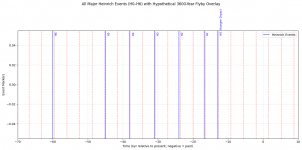
I've also updated the article with illustrations. These are the Heinrich Events, the iceberg ejection, and the period 3600 (in red), which also coincides with 60 CE. https://doi.org/10.5281/zenodo.18670857
 

Attachments

  • Без названия (3).png
    Без названия (3).png
    52.2 KB · Views: 7
Last edited:
The most cited open access article is the 2007 NASA technical report titled "Apparent Relations Between Solar Activity and Solar Tides Caused by the Planets" by Ching-Cheh Hung. It has been cited 77 times and directly addresses the potential links between planetary tidal forces and solar activity, including flares and the sunspot cycle.You can access the full PDF here: https://ntrs.nasa.gov/api/citations/20070025111/downloads/20070025111.pdf
I've also updated the article with illustrations. These are the Heinrich Events, the iceberg ejection, and the period 3600 (in red), which also coincides with 60 CE. https://doi.org/10.5281/zenodo.18670857
And therefore..?
 
There is aso another fly in @MasterOgon's ointment...
Actual astronomers searching for Planet 9, Caltech researchers Mike Brown and Konstantin Batygin, have estimated its orbit to be a highly elongated, eccentric path, with a semi-major axis of approximately 260 to a 400 AU. It is predicted to be a 5-10 Earth-mass super-Earth or mini-Neptune, taking 10,000 to 20,000 years to complete one orbit, situated 20–30 times farther from the Sun than Neptune. If the proposed planet being disussed in this thread were for real, the calculations carried out by Brown and Batygin would have yeilded hugely different results.

At the very least, if @MasterOgon's proposed planet really existed, it would show up in their calculations...it doesn't.

 
Last edited:
There is aso another fly in @MasterOgon's ointment...
Actual astronomers searching for Planet 9, Caltech researchers Mike Brown and Konstantin Batygin, have estimated its orbit to be a highly elongated, eccentric path, with a semi-major axis of approximately 260 to a 400 AU. It is predicted to be a 5-10 Earth-mass super-Earth or mini-Neptune, taking 10,000 to 20,000 years to complete one orbit, situated 20–30 times farther from the Sun than Neptune. If the proposed planet being disussed in this thread were for real, the calculations carried out by Brown and Batygin would have yeilded hugely different results.

At the very least, if @MasterOgon's proposed planet really existed, it would show up in their calculations...it doesn't.
Their calculations and simulation results, the latter of which they published, are just one of many possible options. In their first simulations, they also tried more elongated orbits, but this made the solar system unstable. This would require a lot of additional explanation. Then instead of being top scientists, they would become outsiders.
 
Let’s see, two Caltech astronomers published the results of their simulations and calculations in a peer reviewed paper. You “published” lots of words in a somewhat obscure Internet forum. Yes, they may be wrong, but you’ve yet to offer anything but ideas and have ignored requests to produce an inference, let alone a claim that could be evaluated.
 
It looks like you ignored everything I wrote. I wrote a whole article with evidence and conclusion. What idea are you even talking about?
 

ISF - Join now!

Every member here is approved by hand. No bots, no spam, just people who care about evidence and honest debate.

Membership is free!

Create your free account

Back
Top Bottom