John Jones
Penultimate Amazing

Wasn't there amazed speculation amongst the pathologically credulous about the fusion bomb neutron equivalent necessary to produce this image? And no crater!

I still don't understand why some have to go to such incredible lengths to negate the enormous mass of actual evidence that the Shroud is not authentic, just to be able to conclude that the "evidence" proves the miracle of Christ's death snd resurrection. If it was a miracle then why try to prove it happened using science? Especially if all the actual science strongly indicates that "This is not the clothe you are looking for."

In my opinion, the shroud dates before the carbon dating tests' proposed date of c. 1290 AD. This is because the history of the shroud can be traced earlier to Constantinople in the 12th century. According to many records, Constantinople had a shroud that matches the description, and according to the Hungarian Pray manuscript illustration of that Byzantine shroud, the cloth itself had the same weave and the unique pattern of holes in the middle.
The Turin shroud came to early 14th century Turin from Lirey, France, from a French Crusader treasury. It's probably no coincidence that over a century previously the Crusaders were recorded as taking the shroud from Constantinople, which was occupied by the French.
The best way I see to explain the carbon dating of c. 1290 is to say that either (1) the cloth sample for the dating was taken from part of the cloth that was interwoven from the repair patch we know was made at that time (this was the explanation of Raymond Rogers, who reversed his position on his original 1290 dating of the shroud), or else
(2) the chemical, burning or heating process that created the image on the shroud or that occurred in the medieval fire affected the carbon dating of the image.
Still, this does not rule out that the shroud was made as a forgery in the 6th century or earlier, when Constantinople acquired the shroud from Edessa.
[qimg]http://greatshroudofturinfaq.com/images/shroud-map.jpg[/qimg]
Can you tie that shroud to the Shroud of Turin?

Can you tie that shroud to the Shroud of Turin?
I'd recommend a sheet bend.

Honestly because I don't think faith works as well as people pretend it does, even for the faithful.
I don't think a lot of people really have faith in the sense of the "Faith is all I need" level where they actually are not looking for evidence for what they believe in. What they have is this vaguer low faith + higher level rationalization thing going on.
I've long said that the faithful (in general) are not as dependant on their faith as they claim to be. If tommorow the news broke that they have found... the wreckage of the literal Noah's Ark or if Jesus literally returned tommorow or if any other event that objectively proved or gave strong evidence for a traditonal religious "miracle" story was found not a single mainstream, non-crazy religious person would shrug and go "Don't care. Don't need evidence. Got my faith. This introduction of evidence does not increase my stance in the accuracy of my statements because I don't need evidence, I already had faith." No they would grasp at that straw like a drowning man because no matter what they've told themselves the faith was never really enough.
This is why apologetics bothers me far more than traditional "faith" does. Pure, raw faith is actually pretty rare and marginalized, mainly because it's indistinguisable from pure insanity. What is far more common and far more dangerous are people with a little bit of core faith who have become masters of convincing themselves that actual objective evidence supports their faith.
In my opinion, the shroud dates before the carbon dating tests' proposed date of c. 1290 AD. This is because the history of the shroud can be traced earlier to Constantinople in the 12th century. According to many records, Constantinople had a shroud that matches the description, and according to the Hungarian Pray manuscript illustration of that Byzantine shroud, the cloth itself had the same weave and the unique pattern of holes in the middle.
The Turin shroud came to early 14th century Turin from Lirey, France, from a French Crusader treasury. It's probably no coincidence that over a century previously the Crusaders were recorded as taking the shroud from Constantinople, which was occupied by the French.
The best way I see to explain the carbon dating of c. 1290 is to say that either (1) the cloth sample for the dating was taken from part of the cloth that was interwoven from the repair patch we know was made at that time (this was the explanation of Raymond Rogers, who reversed his position on his original 1290 dating of the shroud), or else
(2) the chemical, burning or heating process that created the image on the shroud or that occurred in the medieval fire affected the carbon dating of the image.
Still, this does not rule out that the shroud was made as a forgery in the 6th century or earlier, when Constantinople acquired the shroud from Edessa.
.....<pointless map deleted>.....

Your unsupported opinion is worthless.In my opinion, the shroud dates before the carbon dating tests' proposed date of c. 1290 AD.
No, actually it can't.This is because the history of the shroud can be traced earlier to Constantinople in the 12th century.
Rubbish. The sampled area was examined microscopically before and after the sampling by textile experts, there was no patch.<snippage of various made-up nonsense>
The best way I see to explain the carbon dating of c. 1290 is to say that either (1) the cloth sample for the dating was taken from part of the cloth that was interwoven from the repair patch we know was made at that time
Also rubbish. You are obviously unaware of the amount of contaminant material that would be necessary and of the decontamination techniques used by the testing laboratories.(2) the chemical, burning or heating process that created the image on the shroud or that occurred in the medieval fire affected the carbon dating of the image.
This rubbish is ruled out by the evidence. The image is anatomically impossible, painted on a cloth not found in the first century Middle East, conflicts with Jewish funerary practices, comes into existence in the fourteenth century during the relic craze (one of more than forty such shrouds), was investigated by the church and found to be a fake, and stylistically in keeping with medieval Byzantine style with Gothic elements.Still, this does not rule out that the shroud was made as a forgery in the 6th century or earlier, when Constantinople acquired the shroud from Edessa.
Yes some of the more pathetically desperate believers preach about magical "resurrection energy" that transmuted elements in the fabric.Wasn't there amazed speculation amongst the pathologically credulous about the fusion bomb neutron equivalent necessary to produce this image? And no crater!
[snip]
Still, this does not rule out that the shroud was made as a forgery in the 6th century or earlier, when Constantinople acquired the shroud from Edessa.

Monza,Yes, I'm not trying to confuse the situation. I'm pointing out that the logic is pretty simple. There is a mathematical property that says if A = B and B = C, then A = C. If the sample was dated to the 13th century, and the sample is representative of the shroud, then the shroud is dated to the 13th century. In fact, the basics of this logic were the reason the C14 testing was performed in the first place....
Monza,Yes, I'm not trying to confuse the situation. I'm pointing out that the logic is pretty simple. There is a mathematical property that says if A = B and B = C, then A = C. If the sample was dated to the 13th century, and the sample is representative of the shroud, then the shroud is dated to the 13th century. In fact, the basics of this logic were the reason the C14 testing was performed in the first place.
Back to our summary....
1)You admit that this test was performed on a sample in order to determine the age of the shroud.
Jabba> Yes.
2) There is no evidence that the sample was not representative of the shroud
as a whole.
Jabba> No. There is some evidence.
3)In fact, the evidence indicates that the sample area was indeed part of the original weave of the shroud.
Jabba> So far, mostly, it does.
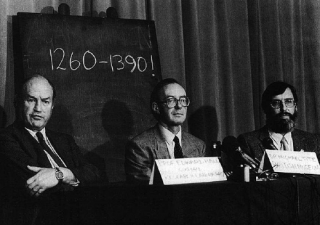
4a) The three independent labs measured the age of the sample to be ~1260-1390 AD,
Jabba> No. There is still room for doubt.
4b) ...ergo the shroud linen was made ~1260-1390 AD.
Jabba> You're saying that given #s 1, 2, 3 and 4a, 4b is true. If that's what you're saying, I basically agree. (I would just say that 4b is probably true.)
5)Do you agree with this logic?
Jabba> I basically agree.
For #2, it would be nice to see this evidence especially in light of the link I included in my previous post.
For #4a, note that this says nothing of where the sample was taken from, if it was a patch, etc. It only states that the 3 labs tested the sample they were given and came up with a result, and that these 3 results were in general agreement. If there is doubt here, you need to address what it is. Do you doubt the ability of the machines to measure C14, the calibration, the cleaning process used, something else?
For #4b and #5, I don't understand the equivocation.
So what? Will you be addressing the points made, or continuing to evade them?1. The Skeptical Inquirer is not a peer-reviewed journal. It has the primary goal of appealing to skeptics. That's how it makes its money.
Again, so what?2. That's how Joe Nickell makes his money. He is paid to provide skeptic-friendly articles.
Again, so what?3. Joe is not a scientist. His Phd is in English. From Wikipedia: Nickell has worked professionally as a stage magician, carnival pitchman, private detective, blackjack dealer, riverboat manager, university instructor, author, and paranormal investigator, listing over 1000 personae on his website. Since the early 1980s, he has researched, written, co-authored and edited books in many genres.
Irrelevant.4. According to Barrie Schwortz (phone), Joe had one debate with him on radio, but refused any more.
Irrelevant aspersion casting.5. Just as theists have their biases, skeptics have theirs.
Untrue.6. McCrone has been discredited by many of those studying the shroud -- including Harry Gove.

- I'm not sure that I currently understand your question

Monza,
- For this response, I'll have to focus on #2 -- and probably, it will be just the beginning of an answer.
- Over the years, I've provided various bits of what I consider to be evidence. The side you have offered to represent just doesn't think much of what I've provided. The Rogers' article is an example. If you wish, my next focus will be on digging up what evidence I can re-find.
- For now, I'll just present my immediate reactions to your post.
1. The Skeptical Inquirer is not a peer-reviewed journal. It has the primary goal of appealing to skeptics. That's how it makes its money.
2. That's how Joe Nickell makes his money. He is paid to provide skeptic-friendly articles.
3. Joe is not a scientist. His Phd is in English. From Wikipedia: Nickell has worked professionally as a stage magician, carnival pitchman, private detective, blackjack dealer, riverboat manager, university instructor, author, and paranormal investigator, listing over 1000 personae on his website. Since the early 1980s, he has researched, written, co-authored and edited books in many genres.
4. According to Barrie Schwortz (phone), Joe had one debate with him on radio, but refused any more.
5. Just as theists have their biases, skeptics have theirs.
6. McCrone has been discredited by many of those studying the shroud -- including Harry Gove.
Their abstract explains: “A close-up analysis of the pyrolysis mass spectra reported in the original paper [by Rogers] reveals that the differences found between the samples coming from different parts of the Shroud are just due to the presence of a contaminant with a long aliphatic chain. Except for the presence of the contaminant, the two pyrolysis-mass spectra look alike rather than different. Therefore, the pseudoscientific theory stating that the C14 sample might come from a ‘medieval invisible mending’ remains unsupported by evidence.” (See Thermochimica Acta 617 [2015]: 169–171.)
3. Joe is not a scientist.

According to many records, Constantinople had a shroud that matches the description, and according to the Hungarian Pray manuscript illustration of that Byzantine shroud, the cloth itself had the same weave and the unique pattern of holes in the middle.

- For now, I'll just present my immediate reactions to your post.
1. The Skeptical Inquirer is not a peer-reviewed journal. It has the primary goal of appealing to skeptics. That's how it makes its money.
2. That's how Joe Nickell makes his money. He is paid to provide skeptic-friendly articles.
3. Joe is not a scientist. His Phd is in English. From Wikipedia: Nickell has worked professionally as a stage magician, carnival pitchman, private detective, blackjack dealer, riverboat manager, university instructor, author, and paranormal investigator, listing over 1000 personae on his website. Since the early 1980s, he has researched, written, co-authored and edited books in many genres.
4. According to Barrie Schwortz (phone), Joe had one debate with him on radio, but refused any more.
5. Just as theists have their biases, skeptics have theirs.
6. McCrone has been discredited by many of those studying the shroud -- including Harry Gove.


