Gazpacho
Master Poster

- Joined
- Jan 11, 2007
- Messages
- 2,136
They do all the things that make GOP propagandists like yourself scream "bolshevik!" when they're done in the US.All that means Hong Kong is not communist.

They do all the things that make GOP propagandists like yourself scream "bolshevik!" when they're done in the US.All that means Hong Kong is not communist.
The evidence is to be found in books. Do you read books? Then read "America's Great Depression" by F. Murray Rothbard.


Wow, thanks so much for that. I've bookmarked the links.So sure, I could read a book. Or I could use the internet to investigate a number of different sources. The best part is being able to share those sources and allow others to look into them and provide their own feedback regarding the information. It's kind of this new age way to communicate information on the internet. You might look into it, Robert Prey.
\Or you could find plenty of evidence online as well. You could have linked to this ...
FDR's policies prolonged Depression by 7 years, UCLA economists calculate
Two UCLA economists say they have figured out why the Great Depression dragged on for almost 15 years, and they blame a suspect previously thought to be beyond reproach: President Franklin D. Roosevelt.
After scrutinizing Roosevelt's record for four years, Harold L. Cole and Lee E. Ohanian conclude in a new study that New Deal policies signed into law 71 years ago thwarted economic recovery for seven long years.
The interesting thing is these economists don't blame any of the New Deal giveaways you'd like to blame. Here's their conclusion as to the cause of the extended depression ...
"President Roosevelt believed that excessive competition was responsible for the Depression by reducing prices and wages, and by extension reducing employment and demand for goods and services," said Cole, also a UCLA professor of economics. "So he came up with a recovery package that would be unimaginable today, allowing businesses in every industry to collude without the threat of antitrust prosecution and workers to demand salaries about 25 percent above where they ought to have been, given market forces. The economy was poised for a beautiful recovery, but that recovery was stalled by these misguided policies."
In the three years following the implementation of Roosevelt's policies, wages in 11 key industries averaged 25 percent higher than they otherwise would have done, the economists calculate. But unemployment was also 25 percent higher than it should have been, given gains in productivity.
Meanwhile, prices across 19 industries averaged 23 percent above where they should have been, given the state of the economy. With goods and services that much harder for consumers to afford, demand stalled and the gross national product floundered at 27 percent below where it otherwise might have been.
"High wages and high prices in an economic slump run contrary to everything we know about market forces in economic downturns," Ohanian said. "As we've seen in the past several years, salaries and prices fall when unemployment is high. By artificially inflating both, the New Deal policies short-circuited the market's self-correcting forces."
The number of antitrust cases brought by the Department of Justice fell from an average of 12.5 cases per year during the 1920s to an average of 6.5 cases per year from 1935 to 1938, the scholars found. Collusion had become so widespread that one Department of Interior official complained of receiving identical bids from a protected industry (steel) on 257 different occasions between mid-1935 and mid-1936. The bids were not only identical but also 50 percent higher than foreign steel prices. Without competition, wholesale prices remained inflated, averaging 14 percent higher than they would have been without the troublesome practices, the UCLA economists calculate.
Recovery came only after the Department of Justice dramatically stepped up enforcement of antitrust cases nearly four-fold and organized labor suffered a string of setbacks, the economists found.
And you thought it was because FDR was giving relief to the poor.
Anyway, the problem with sources is that there are almost always conflicting accounts. Here's one that debunks the notion that FDR's policies extended the length of the Great Depression (I've only briefly excerpted the article. I recommend following the link and reading the whole thing for anyone interested) ...
The "FDR Failed" Myth
... it is imperative to expose a dangerous popular myth regarding the efficacy of President Roosevelt’s actions: that it was not the programs of the New Deal, but only the placing of the nation on a wartime footing years later, that restored the health of the nation’s economy.
This belief, though widely held, cannot stand up to even the most basic economic analysis. Yet the mainstream corporate media, which abound with anti-government ideology, seek to reinforce this myth.
Myth and ideology aside, the data show that from 1933 through 1936 the New Deal produced double-digit annual growth in GDP, production, after-tax income and private investment, with strong consumer spending and job growth exceeding their peaks in the 1929 bubble. The Great Depression ended by late 1936.
While a new, severe recession began in May 1937 because FDR prematurely slashed public spending on New Deal programs, rapid growth quickly resumed in late 1938 when funding was restored.
So sure, I could read a book. Or I could use the internet to investigate a number of different sources. The best part is being able to share those sources and allow others to look into them and provide their own feedback regarding the information. It's kind of this new age way to communicate information on the internet. You might look into it, Robert Prey.

\
The fantasy that WWII ended the Great Depression illustrates the Broken Window theory of economics. You need to study how Depressions are ended quickly by studying the depression of 1920-21 with a man in office who understood economics -- lowered taxes and spending and ushered in the prosperous Roaring 20s.
Horse hockey. The investor class just had more money to pump into an artificially-inflated housing market and similar froth.
POP!
The First Republican Depression was ending when the war began. We had the infrastructure, a reasonably healthy and skilled work force in place to switch to war time production, and the copuntry had been spared a revolution that would have gone either Fascist or Communist. (There had been an attempted Fascist coup, you should recall.)
We had a domestic industrial base. That made the difference. Left to themselves, the capitalists would have imported a lot of steel. That would have left our mills to decay. Not the way you want to enter a war, is it?And the rest of the industrial world was destroyed, while America's industry was left in tact. The broken window theory of economics.

And the rest of the industrial world was destroyed, while America's industry was left in tact.


I’m going to say that PBS is going to have to have advertisement.”
In the late 1970s, the Federal Trade Commission determined that advertising to children under the age of 6 was unfair and deceptive. Research has also shown that children under the age of 8 have no defenses against advertising and often take advertising claims at face value.
I think Cole and Ohanian talk out their asses. Where do they get the idea that wages were"higher than they should have been?"\
The fantasy that WWII ended the Great Depression illustrates the Broken Window theory of economics. You need to study how Depressions are ended quickly by studying the depression of 1920-21 with a man in office who understood economics -- lowered taxes and spending and ushered in the prosperous Roaring 20s.
I think Cole and Ohanian talk out their asses. Where do they get the idea that wages were"higher than they should have been?"
I got more from the other article I linked to, The "FDR Failed" Myth. I find this part the most interesting [bolding mine] ...
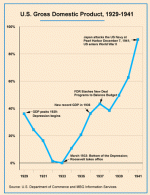
GDP, only available as annual averages, plunged 25.6 percent from 1929-1932, including by 13.0 percent in 1932. It stabilized in 1933, and then soared by 10.8 percent, 8.9 percent and 12.0 percent, respectively, in 1934, 1935 and 1936. Real GDP surpassed its 1929 peak in 1936 and never again fell below it. After-tax personal income, consumer spending, real private investment and jobs all reached or surpassed their 1929 peaks by late 1936.
It's pretty hard to argue that GDP growth like that is a "failure". The chart below (from the article) shows FDR's New Deal policies certainly didn't hinder the U.S. recovery. As McMillion says in his article, the only downturn occurred after the New Deal was slashed in an effort to balance the budget.
The GDP growth is a numerically fallacious due to a rise from small numbers. And as to unemployment:
QUOTE: “No, gentlemen, we have tried spending money. We are spending more than we have ever spent before and it does not work. ...I say after eight years of this Administration we have just as much unemployment as when we started.” – FDR's U.S. Treasury Secretary Henry Morgenthau, Jr., 1939.
The GDP growth is a numerically fallacious due to a rise from small numbers. And as to unemployment:
That is so incredibly weak Robert. It took only three years for the GDP to exceed the previous high set before the crash in 1929. How that equals "small numbers" is something only you could fathom.