Lily the Muppet Loves Free Food

As I read the chart in question, it is not about GDP but about percentage increase in GDP. Big difference.
That makes no sense at all.

In order for there to be even 1% growth in GDP, somebody has to go back to work doing things or making stuff.
 
As I read the chart in question, it is not about GDP but about percentage increase in GDP. Big difference.


So prove this statement wrong. This isn't about percentages of GDP ...

Real GDP surpassed its 1929 peak in 1936 and never again fell below it. After-tax personal income, consumer spending, real private investment and jobs all reached or surpassed their 1929 peaks by late 1936.​
 
So prove this statement wrong. This isn't about percentages of GDP ...

Real GDP surpassed its 1929 peak in 1936 and never again fell below it. After-tax personal income, consumer spending, real private investment and jobs all reached or surpassed their 1929 peaks by late 1936.​

GDP includes wasteful government spending (New Deal). As the unemployment figures show, the Great Depression did not end till after WW II ended.
 
GDP includes wasteful government spending (New Deal). As the unemployment figures show, the Great Depression did not end till after WW II ended.

No that is saying something, the statement you replied to was:
So prove this statement wrong. This isn't about percentages of GDP ...

Real GDP surpassed its 1929 peak in 1936 and never again fell below it. After-tax personal income, consumer spending, real private investment and jobs all reached or surpassed their 1929 peaks by late 1936.

Do you have any proof? How about settling for evidence?
 
No that is saying something, the statement you replied to was:
Do you have any proof? How about settling for evidence?

GDP is a fool's statistic used by Keynsians to falsely show an improving economy. As previously noted, the afore cited chart is not GDP but GDP percentage change. Real GDP in 1929 was 130.6 billion. In 1935, 73.3 billion. In 1938, 86.1 billion. But the numbers are fairly meaningless due to the inclusion of government expenditures in the totals as well as inflation of the money supply.

http://www.economics-charts.com/gdp/gdp-1929-2004.html
 
It's a troll people. Stop feeding it.

  • I don't know that Robert is a troll.
  • Even if he were his behavior would not come anywhere near the point where I would think it appropriate for me to boycott him.
  • If any two people want to discuss and debate and they are following forum rules then let them.
  • I believe in the dialectic. So long as I can make arguments that others can read then I really do not give a damn about Robert one way or another.
 
How would govt spending impact GDP so as to make it meaningless?

Wasteful government spending such as make work projects like Solyndra, bridges to nowhere, cowboy poetry festivals and the like is an economic negative, whether the funding for such projects is stolen from taxpayers, borrowed, or simply counterfeited via the Fed.
 
Wasteful government spending such as make work projects like Solyndra, bridges to nowhere, cowboy poetry festivals and the like is an economic negative, whether the funding for such projects is stolen from taxpayers, borrowed, or simply counterfeited via the Fed.
What percentage of GDP are these projects?
 
Wasteful government spending such as make work projects like Solyndra, bridges to nowhere, cowboy poetry festivals and the like is an economic negative, whether the funding for such projects is stolen from taxpayers, borrowed, or simply counterfeited via the Fed.


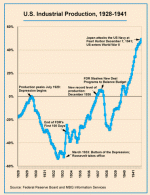
Even if that were true ... that GDP in no way indicative of economic recovery, then what about industrial production as a means of measure? Robert, you suggested I read a book, yet it would seem you won't even read a short article I provide a link to. Because just under the part about GDP was this section (and chart below) on industrial production (please note how closely industrial production mimics GDP growth) ...


The "FDR Failed" Myth

And although many suffered and most economic measures did fall back below their 1929 levels, not one fell anywhere close to its March 1933 low. For example, although industrial production fell sharply in the 1937-38 recession, at its low point, in April 1938, it remained 49 percent above its level of March 1933.

Myth and ideology aside, the data show that from 1933 through 1936 the New Deal produced double-digit annual growth in GDP, production, after-tax income and private investment, with strong consumer spending and job growth exceeding their peaks in the 1929 bubble. The Great Depression ended by late 1936.

While a new, severe recession began in May 1937 because FDR prematurely slashed public spending on New Deal programs, rapid growth quickly resumed in late 1938 when funding was restored.
​
 

Attachments

  • Depression-GDP-output-2.gif
    Depression-GDP-output-2.gif
    36.6 KB · Views: 4
What percentage of GDP are these projects?


Good question. Government spending would account for only a fraction of GDP, and the "wasteful" government spending that Robert complains about would only be a fraction of that fraction.
 
What percentage of GDP are these projects?

Government consumption and gross govt. investment is displayed in the url previously given (http://www.economics-charts.com/gdp/gdp-1929-2004.html). But dumb projects are mixed in with necessary projects.Noneheless in pre-war 1938 the number was 13.8 billion out of 86.1 billion. One would have to add up the alphabet soup of projects put in place by both Hoover and FDR and then subtract that from the GDP number to get a more accurate analysis. In the midst of WW II in 1944, it was 105.3 billion out of 219.8 billion but that of course must include necessary military spending. While the unemployment rate plunged when the US entered the war it must be remembered that countless millions of young men were in foxholes or the like on ships and planes, and in a very depressed situation But they were counted as employed, at least while still alive.
 
Government consumption and gross govt. investment is displayed in the url previously given (http://www.economics-charts.com/gdp/gdp-1929-2004.html). But dumb projects are mixed in with necessary projects.Noneheless in pre-war 1938 the number was 13.8 billion out of 86.1 billion. One would have to add up the alphabet soup of projects put in place by both Hoover and FDR and then subtract that from the GDP number to get a more accurate analysis. In the midst of WW II in 1944, it was 105.3 billion out of 219.8 billion but that of course must include necessary military spending. While the unemployment rate plunged when the US entered the war it must be remembered that countless millions of young men were in foxholes or the like on ships and planes, and in a very depressed situation But they were counted as employed, at least while still alive.
Thanks Robert. I'm sorry but what does the 13.8b number represent?
 
Last edited:
What an anarcho-capitalist considers dumb, some more rational mind would probably not.

The important thing about projects like the Civilian Conservation Corps is that it did the things that everybody agreed that somebody should do, but that nobody was doing. One example is the removal of bayberry bushes in wheat growing areas. There was no ecconomic incentive for anyone to do it, but it needed to be done. CCC did it.

Poor people suddenly had a way to make a bit of money, small businesses had customers, families got fed. We entered WWII with far fewer malnourished, stunted young men than would have been the case otherwise.

This is the problem witrh anarcho-capitalists. They can't think in terms of a society.
 
The important thing about projects like the Civilian Conservation Corps is that it did the things that everybody agreed that somebody should do, but that nobody was doing.


It's a very good point. In the FDR state of the union address I linked to earlier, he said that it wasn't sufficient to simply create any work for people, but to create work that would benefit the country both in the immediate future and in the long-run.

Why Obama didn't follow this model is beyond me. Here we have a crumbling infrastructure that simply begs for repair and would create any number of good jobs, and three years later, still remains unattended. My only hope is that he finally finds his balls after getting re-elected. But what a lost opportunity.
 

ISF - Join now!

Every member here is approved by hand. No bots, no spam, just people who care about evidence and honest debate.

Membership is free!

Create your free account

Back
Top Bottom