Kinetic energy at atmospheric reentry from lunar mission

All my examples and calculations of this thread are correct; at least nobody has brought forward evidence that they are wrong. The only relevant error I am aware of is post #1, corrected already in my next post. The most important post is probably #196, after which the thread degenerated more and more.

Well folks there you have it classic delusional denial of the most direct kind.

I guess you COULD go over it all again OR just stop posting to this lost cause of a thread.

Oh and I thank everyone* (not wogoga) who provided real world info on heat shields, re-entry, etc, THAT was interesting.
 
Last edited:
From the psychological point of view, it is less demanding to understand "meter eight.po three eight four" than "three-point-eight-four times ten-raised-to-the-power-of-eight meter". After "meter" we know that we deal with distance in space, after "meter eight.po three" we may recognize a distance close to a light-second. The rest simply adds less and less important accuracy.
Special pleading! I most certainly do not agree that your system is any less psychologicaly taxing than the well established convention.
Your continuation to sig digits is absolutely no different than standard convention and adds nothing.
The principle is more straightforward: In order to get a negative exponent, we simply apply the standard subtraction rule, i.e. we regularly subtract from zero:

…01000 minus …00001 equals …00999
…00100 minus …00001 equals …00099
…00010 minus …00001 equals …00009
…00001 minus …00001 equals …00000
…00000 minus …00001 equals …99999

pi = …000p314159… ≈ 0p31416 = p31416 ≈ p314
1/pi = …999n318309… ≈ 9n31831 = n31831 ≈ n318​

It astounds me that you feel this is less confusing than the standard conventon.
83n means an exponent of …99983 (i.e. 17 below zero). 90n means an exponent of …99990 (i.e. 10 below …00000). In this system multiplication of numbers always results in direct addition of exponents. So we get "…99983 + …99990 = …99973" resp. "83n ∙ 90n = 73n".
It astounds me that you think this is less confusing.

I always get confused when I have to multiply or divide numbers in scientific notation with negative exponents. In the system proposed here, multiplication always results in addition, and division in subtraction of an exponent. And computer science demonstrates every day that implementing negative numbers by regular subtraction from zero works fine.

NEVER, since learning scientific notation when i was barely in my teens, have I ever had difficulty with operating with it.

Such reading would destroy the main advantage of the number system, which is easy recognizability of orders of magnitude. The most important information is next to the po-ne-indicator: 3p126. In case of 23p6022.1408, the last digit "8" is the least important part. For comparison: 6.022,140,8 x 10^23.
It astounds me that you think this is less confusing.


All my examples and calculations of this thread are correct; at least nobody has brought forward evidence that they are wrong. The only relevant error I am aware of is post #1, corrected already in my next post. The most important post is probably #196, after which the thread degenerated more and more.

Perhaps instead of trying to argue your point using your own personal non-standard numbering notation had sonething to do with the thread drift and posters trying to figure out what the **** you are talking about.

Your arithmetic can all be correct, but if you gave to try and teach the thread readers your notation, you are simply begging for OT posts.

Your arithmetic can be all correct and yet be totally in error in your understanding of the concept.
 
Of, now I'm scheming on how to get free lab-sample sized amounts of $500 per gallon adhesives to play with. :D
 
Citing my personal experience. We would leave the hut, go ice fishing for hours, come back and the hut interior was warmer than exterior air.

I could easily imagine that stepping into a windbreak or a confined space "feels warmer." I've noticed that I've "felt cooler" immediately when the AC clicks on, even though there's no way it had enough time to actually lower the temperature. There's a real psychological component to this.

However, in a thermal discussion, I think actual temperature reading is necessary.
There you go.

It looks like jaydeehess' experience is borne out by scientific measurement.
 
There you go.

It looks like jaydeehess' experience is borne out by scientific measurement.

Well, sort of. The test you link to had each type of snow shelter occupied during the test. I am wondering at interior vs. exterior temps when unoccupied.
I also found it odd that they did not perform all three tests on the same day. Probably due to tripling equipment costs to do that.
This is the set up I do envision though.

The snow cave and igloo both employ cold traps. That places the floor above the earth surface. A guinzhee otoh can have a floor on earth surface since it uses a "door".
 
Last edited:
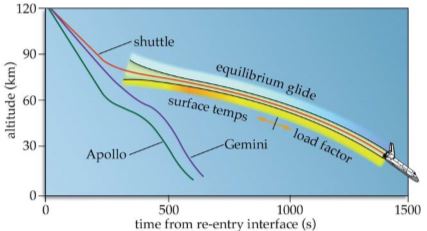
The problem is that the figure (see #1) of Returning from Space: Re-entry constitutes disinformation insofar as it implies an entry speed of only 2100 m/s instead of 11000 m/s = 4p11 m/s.

It is a lie that Figure 4.1.7-25 of Returning from Space: Re-entry (PDF) has any entry speeds :eye-poppi!
It is a lie that anything in that section of the document "implies an entry speed of only 2100 m/s". Figure 4.1.7-24 explicitly has the Space Shuttle with a speed of 7300 m/s at 80 km.


Space Shuttle is different from Apollo. Here again Returning from Space – Re-entry, Figure 4.1.7-25:

apollo_reentry.JPG

​
If you elongate straightforward the upper left part of the green Apollo line, you reach zero altitude at around 500 sec. This means a decrease in altitude of ~240 m/s at the beginning of reentry. Taking into account a reentry angle of 6.5°, reentry speed results in ~2100 m/s (see #14).

In the meanwhile, I found a hypothesis why the textbook authors may have assumed such a low altitude-decrease at entry interface (apart from heat shield calculations). Quote from NASA Technical Note D-5399 of Apollo 4:

After the CM separated from the SM [Service Module] and prior to reaching the entry interface at 400 000 feet [120 km = 5p12 m], the spacecraft was oriented in pitch with its stability axis along the AGC-estimated relative wind-velocity vector … Pitch and yaw attitude control was maintained until 0. 05 g deceleration was reached. … At the entry interface, the initial roll program of the INITIAL ENTRY phase was in command. … When 0.05 g was sensed (0. 05 g interface), the AGC [Apollo guidance computer] automatically began the entry computations... A decision was made to continue the flight with the lift vector up. When thermodynamic deceleration level exceeded 0.2 g and the altitude was decreasing at a rate less than 700 ft/sec, control was transferred to the HUNTEST phase.
​
"Deceleration exceeding 0.2 g and altitude decreasing at less than 700 ft/sec = 210 m/s" may be somehow misleading. So the textbook authors could erroneously have interpreted this as "when deceleration first exceeded 0.2 g, altitude-decrease became less than ~210 m/s". And with a lift-to-drag ratio of ~0.4 they may have calculated their altitude-decrease of ~240 m/s at entry interface.

Further quote from the Apollo 4 Note:

The principal objectives of the Apollo 4 mission were to demonstrate the structural and thermal integrity of the space vehicle and to verify the adequacy of the heat shield when subjected to entry at lunar return flight conditions. To reach lunar return flight conditions, the service propulsion system (SPS) engines were fired, and an entry velocity of 36 545 ft/sec was obtained.​

To 36 545 ft/sec correspond 11.139 km/s ≈ 4p111 m/s. "Entry velocity" with respect to what? My previous posts have been written under the premise that entry velocity is speed relative to the ground below the entering spacecraft, since this speed is relevant to "thermodynamic deceleration", resp. heating due to kinetic energy. Yet at the latest in NASA Technical Note D-7564 of 1974, there is a clear distinction between "inertial velocity at 400 000 ft" and "relative velocity at 400 000 ft". The latter is given as 35 220 ft/sec = 10.735 km/s ≈ 4p107 m/s, a value which cannot be found in the original Apollo 4 note (maybe the value is hidden as a Mach number, where the speed-unit Mach depends on pressure and temperature, i.e. on altitude and weather).

It seems that "inertial velocity" means relative to the Earth's center, and "relative velocity" relative to the surface below the spacecraft. Nevertheless, Figure 7b, Earth relative velocity of the Apollo 4 note starts with a value that seems to be closer to 36 545 than to 35 220 feet.

In any case, the difference in "thermodynamic deceleration" energy due to the two different entry-speed values is not relevant in this discussion (58 MJ/kg = 7p58 J/kg versus 62 MJ/kg = 7p62 Joule per kg).

In Figure 6, Entry trajectory control programs, ground distance from 'entry interface' to '0.05 g interface' is around 2180 - 2035 = 145 nautical miles = 265 km = 5p265 m. As 30.5 sec = 1p305 s are needed (TABLE I.), we calculate a speed of 265 km / 30.5 s = 5p265 / 1p305 m/s ≈ 3p87 m/s = 8.7 km/s, which is incompatible with an entry speed close to 11 km/s = 4p11 m/s and an entry angle of ~7°. So we can be quite sure that this "best-estimate trajectory" as presented in Figure 6 of the Apollo 4 note is not (fully) consistent.

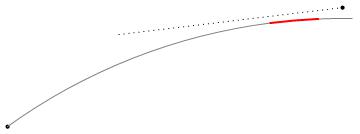
Here a scaled graphic of reentry interface and angle of Apollo 4 (based on data from Figure 6):

apollo_4_graphic.JPG

​
Point with dotted line represents entry point with entry direction. The red surface part ranges from '0.05 g interface' (on the right side) to 'peak g' (resp. 'HUNTEST', see Figure 6). The left end of the surface corresponds to the landing site of Apollo 4 at a distance of 2180 nautical miles = 3980 km ≈ 6p4 meter from 'entry interface' (see Figure 6).


Because high vaporization resp. pyrolysis energy is only one of several other constraints (such as stability and low thermal conductivity), the real heat shield of Apollo 4 could probably not even have absorbed 1% = 8p1 of reentry energy, or do I miss something?

Yes, you missed the undeniable fact that Apollo 4 (if that is the example you are going to use) took off, orbited and returned to Earth. [...] and this youtube video of mine shows all the orbital images strung together as a movie: https://www.youtube.com/watch?v=viOTyjEdu0Y


Where does the wiggling in your video come from? Did the engine run when the photos were taken? In purely inertial motion, the Apollo 4 camera position should not move at all or only smoothly and slowly. And at what distance where the photos taken?

So if Apollo 4 launched and orbited but then burned up, how did we get those photos?


The photos are not clear and sharp enough to exclude a fake. And even if they are genuine, they could have survived in an additionally protected container within the disintegrating spacecraft.

Cheers, Wolfgang
The Apollo Space Program – A gigantic conspiracy?

 
... Here again Returning from Space – Re-entry, Figure 4.1.7-25:

[qimg]http://www.pandualism.com/upload/apollo_reentry.JPG[/qimg]
​
If you elongate straightforward the upper left part of the green Apollo line, you reach zero altitude at around 500 sec. This means a decrease in altitude of ~240 m/s at the beginning of reentry. Taking into account a reentry angle of 6.5°, reentry speed results in ~2100 m/s ...

Have you considered the possibility that you may be attempting to take precise measurements from an imprecise and simplified illustration that's intended to convey a different point?
 
Where does the wiggling in your video come from?

The photos were taken at irregular intervals, do you think that a body in orbit doesn't move slightly?

Did the engine run when the photos were taken?

No

In purely inertial motion, the Apollo 4 camera position should not move at all or only smoothly and slowly.

Proof of that? Again, there is nothing inconsistent between something being in orbit and moving slightly around an irregular axis as it does this

And at what distance where the photos taken?

Do they not have google where you live? Try doing some reading:

http://klabs.org/history/history_docs/jsc_t/apollo_2004_Saturn_v.pdf

http://ntrs.nasa.gov/archive/nasa/casi.ntrs.nasa.gov/19750018952.pdf

The photos are not clear and sharp enough to exclude a fake.

Nonsense. Try downloading the 200 Mb TIFF image here:

http://tothemoon.ser.asu.edu/data_a70/AS04/raw/AS04-01-0410.tif

from the March to the Moon website:

http://tothemoon.ser.asu.edu/gallery/apollo/AS04_Hasselblad (70 mm)/list

and tell me they are low resolution.

And even if they are genuine,

They are. Can't fake the weather sonny.

they could have survived in an additionally protected container within the disintegrating spacecraft.

That will come as a bit of a shock to the people who picked out of the sea, as shown in this

https://www.youtube.com/watch?v=SM2KWCMrOYw

John C. Stennis Space Center, who have it on display.

Picking random unsubstantiated nonsense out of [insert appropriate origin] does not amount to evidence, neither does it prove your stupid maths to be correct.
 
Space Shuttle is different from Apollo.

In more ways than one, not the least of which is the principle by which its thermal protection system operated, something about which you appear to be wholly ignorant.

If you elongate straightforward the upper left part of the green Apollo line...

What makes you think an illustration is meant to be data to that precision and accuracy? What makes you think your subsequent speculation carries any value? It's clear you really don't know what you're reading in these reports you cite.

In purely inertial motion, the Apollo 4 camera position should not move at all or only smoothly and slowly.

Nonsense.
 
Last edited:
There is no way to sugar coat this.

Your numbers are wrong.
Your calculations are wrong.
Your reentry model is wrong.
Your underlying assumptions are wrong.

I wholeheartedly agree but I predict he will return and deny his being wrong.

Then what?
 
Meanwhile, now that I am no longer firewalled by work, have an example of just how dreadful Apollo 4's imagery is.

You can hardly make out the shadows being cast by the clouds over sub-Saharan Africa, or the north African coast. :rolleyes:

1192i3k.jpg
 
I wholeheartedly agree but I predict he will return and deny his being wrong.

Then what?

Well, if he attempts re-entry into the thread then, by his own calculations, he will burn up into a vapor: 4p11 posts x 2n3 joules of thermal energy per post...

Of course I may well have gotten the numerical notation incorrect. Nonetheless his arguments are based on such fundamentally wrong principles of science (and history) as to be unable to remain viable on re-entry into the thread.
 
Space Shuttle is different from Apollo.
Well duh - but a delusion about Apollo missions being impossible because of ignorant fantasies about reentry also means that ignorance makes all reentries impossible - including the Space Shuttle missions :jaw-dropp!

Again the delusional act of using of illustration of Space Shuttle missions instead of learning about the missions!
How Space Shuttles Work
When re-entry is successful, the orbiter encounters the main air of the atmosphere and is able to fly like an airplane. The orbiter is designed from a lifting body design with swept back "delta" wings. With this design, the orbiter can generate lift with a small wing area. At this point, flight computers fly the orbiter. The orbiter makes a series of S-shaped, banking turns to slow its descent speed as it begins its final approach to the runway.


Irrelevance about "inertial" and "relative" and "Mach" velocities does not stop Apollo missions from successfully reentering - ask the Apollo astronauts!

A delusion of "an additionally protected container within the disintegrating spacecraft"!
 
Last edited:

ISF - Join now!

Every member here is approved by hand. No bots, no spam, just people who care about evidence and honest debate.

Membership is free!

Create your free account

Back
Top Bottom