Identification of the Toshiba radio from PA103

Which examination ended in July 1990? Does this torpedo my nice theory?

ETA: OK, Hayes finishes sorting the rubbish. Page 172. I'm not clear that makes any difference, I hadn't even noticed your slip-up which is in any case correct in the quote.

Not unless you are going to tell me Feraday didn't go to Japan till April 1990!

Rolfe.
 
Last edited:
Some great theorising folks and trying to nail down some of that dog's breakfast that is the evidence trail, cataloguing and notes made by the Feraday/Hayes/Thurman/ cabal who all appear avid followers of 'Columbo'. However, in this case the switcheroo has come from the unsuspected side.

As for Cannistraro, well according to Ashton in an article from The Mail on Sunday 1996;

As the head of CIA's Lockerbie investigation until October 1990, Cannistraro had helped provide the intelligence that pointed the finger away from drug-running and towards Libya. Previously he had worked alongside Colonel Oliver North in a secret program designed to destabilize the Gadafy, regime.
http://www.copi.com/articles/lockerbie.html
 
Yes, indeedy, Buncrana. I'd just picked up on pretty much that point from a different source. (That's a fascinating article, by the way.)

I was previously going by the statement of one of the interviewees in The Maltese Double Cross - I think it might have been le Winter. He insisted that the switch to Libya coincided with Cannistraro's appointment to head up the Lockerbie investigation for the CIA - "he wasn't in charge at the beginning". As we're realising, the intent to link this to Libya very much pre-dated the public perception of that link, so if Cannistraro wasn't involved until later, then it actually doesn't fit. Also, according to Wikipedia, Cannistraro apparently left the CIA completely in September 1990, which is exactly when the public link to Libya started.

It seems that le Winter was wrong, and in being wrong, he was right all the time. I was re-reading Paul Foot's account last night, and came across this, that I hadn't spotted before. He's talking about the first public reports of the Libya link - first in September in L'Express, then quite a lot of detail in the Independent on 14th December, a paper that had previously been very hot on the PFLP-GC theory.

“Libya was behind the bombing of Pan Am 103 two years ago, according to sources close to the inquiry. The proof, described as ‘conclusive’ by high-level sources, is based on analysis of a detonator fragment recovered from the Lockerbie debris. The evidence has come to light only in the last three months.”

The article went on: “One source said: ‘Not only do we now know Gaddafi was responsible, he also knows we know’.” The identity of this “source” was not revealed in the article but [a few days later another article gave a clue].

Leonard Doyle from New York reported: “The former head of the CIA’s counterterrorism section yesterday said the Independent’s report of a Libyan link to the Lockerbie bombing was accurate.”

Who was he? “Vince Cannistraro, who left the CIA in September.” Cannistraro had worked with Oliver North in President Reagan’s Security Council. He had been a leading figure in the illegal campaign to support the Contras against the revolution in Nicaragua, and the rebellion against the government of Angola by Unita.

His speciality was Libya, and he became an expert above all else in providing and circulating information damaging to the Libyan regime. He had been head of the CIA inquiry into Lockerbie during all the period in which the finger of suspicion had been pointed at the Syrians. Exactly as the Syrians were joining the allied forces against Saddam Hussein, he confirmed that the new suspects for the bombing were Libyans.


As someone else commented, Cannistraro - Reagan's guy for making :rule10 up about Libya. Foot is usually right, and Buncrana's article essentially confirms it. Cannistraro was in charge right through the period when all these plans were (we surmise) being laid. He left just when they came to fruition and Libya became the dominant narrative. Job done?

I wonder when he was put in charge? Might I guess at late March 1989? If he was in charge any earlier than that, it would make me wonder once again if the bombing was actually expected and anticipated by the US authorities - which is a rabbit hole I've tended to stay out of.

Rolfe.
 
I agree a date when Cannistraro started would be useful.

Not much else to add myself, but Bollier (Ebol) made an interesting point, in comments at my site and Robert Black's.
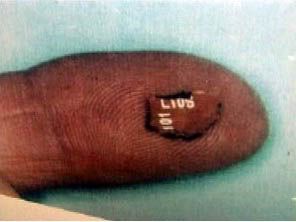
After the ultrasonically cleaned charred fragment AG/145 at RARDE laboratoy on January 17-22 January 1989, the WHITE PRINTED CHARACTERS on its upper surface 'L106'...101' and the GREEN COLORED LACQUERED on its rear surface, was always still perfect visible... see photo no.246 (front) and no.247 (rear). That is absolutely not normal and cannot correspond to the truth! That proves that the alleged original fragment AG/145 had charred not before by an explosion!!!
I'm inclined to agree with him here.

AG-145_color.jpg

This is clearly the labeled, brown side where elements connect. The other side is the green lacquer with solder traces. (sorry for imprecise language). I could buy these numbers being readable if that side of the board were facing away from the Semtex.

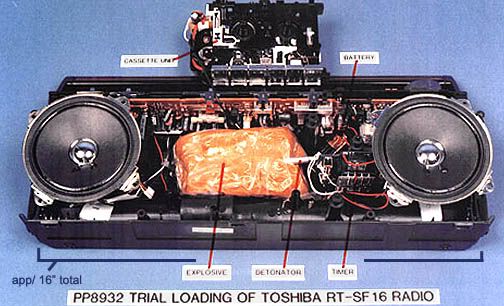
But looking again at this photo, that doesn't seem to be the case, does it? Unless some crafty terrorist inverted the CB to fool us.
PP8932_16inch.jpg


It just doesn't ever start making sense, does it?
 
A good tip is to ignore 99.9% of everything Edwin says. He's useful for posting actual evidence, but his conclusions are wild, and constantly changing.

I'm not yet convinced it was impossible for tiny fragments of circuit board to survive as suggested. It's the paper manual I completely baulk at. I'm going to be very difficult to convince that Claiden's discovery was a fake. If you want to go down Charles's rabbit-hole, send me a postcard....

I then tried to put together a very modest account of what must have happened. (i) As a CIA/DIA gent, one of McKee's suitcases must have contained a radio transponder activated by the crash. (ii) He set it before he left Beirut (presumably in accordance with standing instructions) . (iii) We can conclude therefore than Mr McKee did not know he was going to his death. (iv) The crash happens and the radio transmitter is activated. (v) It is located by a CIA agent in a helicopter, who retrieves it, locates in the vicinity AVE4041 PA from which it fell, and to which the CIA will carry out certain operations (namely the planting of a pre-blown suitcase and the placing of a piece of Toshiba cassette circuitry (the wrong side of the AVE 4041 PA maker's plate). (vi) This is given by the AAIB to RARDE without comment, which means that the AAIB did not believe it, because if that chip had got there genuinely it would have given a good indication of the size of the explosion.


Please, stay on the rational side of the line!

Rolfe.
 
I agree a date when Cannistraro started would be useful.


Well, I don't know. I surmise it may have been pretty early - certainly before the end of March 1989. As you say, add the knowledge of the Autumn Leaves findings to the 38-minute detonation, and you may figure out fairly quickly how the investigation is likely to proceed. If it was also realised that this wasn't something the USA wanted to air in public, there might not have been a very long time-lag. The March phone call might simply have been the affirmation and acknowledgement of how Bush had been thinking since about Christmas.

So why not set Cannistraro on to it, with the understanding that he can use this as one more piece of :rule10 to pin on Gadaffi, because Bush sure as hell doesn't want the whole PFLP-GC/Syria/Jordan/Iran stuff being picked over in court. With or without Khreesat, Abu Elias, Khaled Jafaar, Charles McKee et al.

I'm surprised it took him 18 months to do it, but it may not have mattered too much so long as the PFLP-GC investigation wasn't showing any sign of arresting anyone. Letting the investigating authorities come to their own conclusions was probably quite an important part of it. However, by mid-1990 the rapidly-evolving middle east situation caused them to push the button on the Libya theory already brewing. So once Thurman got his mitts on the timer fragment, they didn't hang around.

Interestingly, the Giaka thing was going on at exactly the same time. Paul Foot thinks this was unconnected to Lockerbie until a 1990 decision to blame Libya caused the CIA to sit up and take notice of him. However, I'm not so sure. Giaka was there, telling his handlers stuff about Fhimah and Megrahi even before the bombing. I think it might have come together in someone's eyes relatively early.

Private Eye said:
Majid Giaka originally approached the American embassy in Malta in August 1988, four months before the Lockerbie bombing. His long series of meetings with American intelligence officials in Malta began in September 1988, the same month he started getting regular payments from the CIA.

His information was patchy and unreliable. He pretended he was a senior official in the Libyan intelligence organisation JSO though in reality (as the Americans quickly realised) he was a former garage mechanic who helped to maintain JSO vehicles and had graduated to the exalted position of assistant station manager for Libyan Arab Airlines. [....]

Scraps of information passed on by Giaka during 41 clandestine meetings between August 1988 and July 1991 were duly logged. In October 1988 he revealed that a managerial colleague at Luqa airport, Lamin Fhimah, had kept explosives in his desk drawer. In December 1988, the month of the Lockerbie bombing, he was asked about the movements of JSO officials through Luqa airport. He replied that a man he regarded as a senior JSO officer, Abdelbasset Ali Mohamed Al Megrahi, had passed through Luqa airport on 7 December. These two men eventually became the suspects for the Lockerbie bombing.

Yet none of Giaka’s information about them seemed even remotely interesting at the time, and the CIA agents in Malta began to grow weary of Giaka’s interminable visits. He begged for fake surgery to cause injury to his arm so that he could escape Libyan army service. He also wanted money to set up a hire car business in Malta.

He was becoming a nuisance and the agents told him so. On 4 September 1989, his CIA handlers in Malta told Giaka he was “on trial” until the next New Year (1990). Somehow he survived the New Year deadline but in February 1990 a CIA cable from Malta told headquarters: “Giaka is becoming desperate.” Giaka must have wondered how he survived those first few months in 1990, and how and why the payments continued. He could hardly have understood the significance or the relevance of the looming confrontation in the Gulf, though he must have noticed that the questions from his handlers about the JSO officers he had already named were increasing in intensity.

As the hot war started in the Gulf early in 1991, the US enquiries into the Lockerbie bombing gathered momentum. In February 1991, Scottish police showed photographs of Megrahi, the man Giaka had identified as a senior JSO officer more than two years previously, to Tony Gauci. [....]

This rather unreliable identification was enough for the CIA. They had their Libyan suspect. Indeed, if they could rid themselves of their original scepticism about Giaka, they had a second suspect – the man who, according to the selfpromoting garage mechanic, had kept explosives in his desk drawer at Malta airport – Lamin Fhimah.

Suddenly the agent who had almost been sacked because he couldn’t come 12 Abu Talb up with any useful information became a man of supreme importance to the CIA. On 11 July 1991, the US Department of Justice let Giaka know that they would “accept or reject him based on his response to their inquiries”. On 12 July, with the Gulf War won and Saddam’s troops blitzed out of Kuwait, Giaka, to his intense gratification, was taken off Malta by an American warship, and interrogated there by an FBI officer, Hal Hendershot. [....]

The result, in November 1991, was a detailed indictment charging Megrahi and Fhimah with murder by planting a bomb in a suitcase on a flight from Malta to Frankfurt and thence to London – and the explosion over Lockerbie.


It could be worth re-examining this from the point of view that the CIA knew they wanted to implicate Libya in Lockerbie all along, or at least from about April 1989. Unfortunately I haven't found Foot saying anything about Megrahi's presence at the airport on the morning of the bombing - I don't think the coincidence of tray 4489 and that presence really struck him. I think that's a really central point and I'd love to know when the investigators picked up on it.

Rolfe.
 
Last edited:
A good tip is to ignore 99.9% of everything Edwin says. He's useful for posting actual evidence, but his conclusions are wild, and constantly changing.

I'm not yet convinced it was impossible for tiny fragments of circuit board to survive as suggested. It's the paper manual I completely baulk at. I'm going to be very difficult to convince that Claiden's discovery was a fake. If you want to go down Charles's rabbit-hole, send me a postcard....

Please, stay on the rational side of the line!

Rolfe.

Oh, I think I am being rational. Maybe a little too certain, but...

I could buy a fragment this size surviving, maybe, or it not being completely melted. Not because I know what's rational, but because I don't know,a as an explosives non-expert. What I'm having a hard time with is that it looks like that. I'm pretty sure in the radio photo the main board is that along the top, about 1 inch from the edge of the Semtex there. And there's nothing between them, really - just air.

And here that surface is its original brown color with its delicate white paint still there? After a 6000 degree (??) detonation? Saying "101" "L106"? It's possible, but I'm not giving it any undue credence just to seem rational.

And FWIW, the smaller one says "02", neither was tested for explosives residue (too small/not worth the work), they're said to have appeared with unusual white plastic, and found in an unusual spot where there are questions of how it could have happened. All bad signs.

On the other hand, this isn't one of the more necessary points to insist on.

Great thoughts lately, otherwise, Rolfe. In particcular, the illogic of running after PT/30 when PT/35 was (supposed to be) available is telling.
 
What I'm having a hard time with is that it looks like that. I'm pretty sure in the radio photo the main board is that along the top, about 1 inch from the edge of the Semtex there. And there's nothing between them, really - just air.

And here that surface is its original brown color with its delicate white paint still there? After a 6000 degree (??) detonation? Saying "101" "L106"? It's possible, but I'm not giving it any undue credence just to seem rational.


Yes, I'm seeing it now. Your colour photos make it clearer - I was working from Paul Foot's copy, which is B&W. Interestingly, there doesn't seem to be a problem of colour reproduction with this as there is with the MST-13 fragment. The brown of the circuit boards and the chip are the same in both pictures.

Do you think these numbers were actually "delicate white paint"? When you put it that way, yes, you very definitely have a point. Though once again I come to the objection which someone raised with respect to the survival of the Horton pages. If it was that impossible, wouldn't everybody and his dog be saying so? Wouldn't the explosives guys faking this know better than to pretend the impossible happened?

(I was peeking inside my computer mouse last night, because I'd dropped it and it had concussion. I noticed the circuit board, which is bright green. I'm sure that's the standard "green circuit board" colour we see all over the place, and it's the colour the MST-13 would have been. Even if PT/35 was badly discoloured by the explosion - and nobody really mentions that - why are all the comparison boards shown as the same indeterminate shade of grey? Topic for the other thread.)

Rolfe.
 
Last edited:
In particcular, the illogic of running after PT/30 when PT/35 was (supposed to be) available is telling.


There are two points arising from that. One is that the keenness to chase after PT/30, allegedly discovered about a month after PT/35, is wildly at variance with the idea that PT/35 was simply seen in May, noted down, and filed. Back when the "debunkers" were trying to support the Official Version (I note Paul Foot calls it that too), several people said, well, maybe Hayes just assumed the fragment was another part of the Toshiba so he wasn't too bothered about it.

They were extremely keen to get their hands on more parts of the Toshiba. To the point where, you note, Feraday took a trip to Dextar in September to see if there was any more. And yet we're supposed to believe PT/35 was just sitting there all along? It's a far bigger piece than any of the others, and even though there are no numbers the pattern of circuitry is obviously distinctive enough to be potentially identifiable. Especially if you have intact radio models you're trying to match it up with! No, the idea that it was ignored because it was thought to be part of the Toshiba is ridiculous.

And if it wasn't Toshiba? A piece of blast-damaged circuit board blasted into a piece of Maltese clothing, along with actual bits of Toshiba? A five-year-old could figure out that this could be an actual part of the IED. Are we supposed to believe that Thomas Hayes PhD was a complete moron?

The other point, though, is Feraday's total lack of interest in chasing up the timer fragment personally. Look what he did to get the identification on the radio. Germany, Camberley (OK, that wasn't far), and then even when he thought he had identified it he goes to Japan. Then back to Dextar months later looking for more fragments. But he handed over PT/35 to Williamson with a cursory note, and seems to have taken little interest in it after that, leaving it to Williamson and the Scottish team to trail round Europe looking at circuit boards. It's almost as if it was important that this identification link be made quite independently.

Rolfe.
 
Yes, I'm seeing it now. Your colour photos make it clearer - I was working from Paul Foot's copy, which is B&W. Interestingly, there doesn't seem to be a problem of colour reproduction with this as there is with the MST-13 fragment. The brown of the circuit boards and the chip are the same in both pictures.

Do you think these numbers were actually "delicate white paint"? When you put it that way, yes, you very definitely have a point. Though once again I come to the objection which someone raised with respect to the survival of the Horton pages. If it was that impossible, wouldn't everybody and his dog be saying so? Wouldn't the explosives guys faking this know better than to pretend the impossible happened?

(I was peeking inside my computer mouse last night, because I'd dropped it and it had concussion. I noticed the circuit board, which is bright green. I'm sure that's the standard "green circuit board" colour we see all over the place, and it's the colour the MST-13 would have been. Even if PT/35 was badly discoloured by the explosion - and nobody really mentions that - why are all the comparison boards shown as the same indeterminate shade of grey? Topic for the other thread.)

Rolfe.

glad you can see that, then. The paint things is kind of evident - not brushed by hand, of course. PT/20 was similarly marked,
The upper face of the fragment bears part of the white painted characters C32 and a depiction of an electrical resistor. The information detail and spatial configuration of these markings were found to correspond precisely with one specific area located on the Toshiba control circuit board DC/1477 (f 1)".

That's exactly what it shouldn't do - match up with the painted marking on an intact board. Strangely enough, the other side is more damaged, suggesting the alleged terrorists DID invert the board (after knocking everything loose so the brown side could fit flush against the top?)

It has been partially delaminated by the blast and, hence, does not possess the expectedgreen lacquer and/or solder tracking upon its rear face as this has been ripped completely away.
:confused:
 
There are two points arising from that. One is that the keenness to chase after PT/30, allegedly discovered about a month after PT/35, is wildly at variance with the idea that PT/35 was simply seen in May, noted down, and filed. Back when the "debunkers" were trying to support the Official Version (I note Paul Foot calls it that too), several people said, well, maybe Hayes just assumed the fragment was another part of the Toshiba so he wasn't too bothered about it.

They were extremely keen to get their hands on more parts of the Toshiba. To the point where, you note, Feraday took a trip to Dextar in September to see if there was any more. And yet we're supposed to believe PT/35 was just sitting there all along? It's a far bigger piece than any of the others, and even though there are no numbers the pattern of circuitry is obviously distinctive enough to be potentially identifiable. Especially if you have intact radio models you're trying to match it up with! No, the idea that it was ignored because it was thought to be part of the Toshiba is ridiculous.

And if it wasn't Toshiba? A piece of blast-damaged circuit board blasted into a piece of Maltese clothing, along with actual bits of Toshiba? A five-year-old could figure out that this could be an actual part of the IED. Are we supposed to believe that Thomas Hayes PhD was a complete moron?

The other point, though, is Feraday's total lack of interest in chasing up the timer fragment personally. Look what he did to get the identification on the radio. Germany, Camberley (OK, that wasn't far), and then even when he thought he had identified it he goes to Japan. Then back to Dextar months later looking for more fragments. But he handed over PT/35 to Williamson with a cursory note, and seems to have taken little interest in it after that, leaving it to Williamson and the Scottish team to trail round Europe looking at circuit boards. It's almost as if it was important that this identification link be made quite independently.

Rolfe.

That's exactly right. Feradaywas "keenly interested in" any items of circuitry, almost to the point of obsession. I don't think I would be holding my breath for bits of the bomb radio - keep an eye out just in case, sure, but he seems to expect major finds. AG/145, just that one piece and the rest still months away from examination, has him "completely satisfied" of the radio model within days! PT/30 found months later leads to a slower search for a match - AFTER the matching SF16 was identified already. So he remains open-minded, and wonders if this piece is from an alarm clock trigger.

And in between, we're told, something we're led to believe they thought was from the radio, but would not match their control sample DC/1477. Largest circuit bard chunk yet by a factor of four, and it's just glossed over for months? And what's up with this 15 Sept. letter sent BY FERADAY to Williamson regardinng PT/35, the day AFTER he searched Dextar for a match to PT/30 (sez Williamson's note to Henderson).

I Just noticed that one. Would appreciate a tip if I goofed up again.
 
This is very peculiar. The circuit boards were back to front? I suppose that's possible, if the terrorists didn't need the thing to work.... The great luck in getting legible numbers is a bit of a fluke though.... And I remember the queries about the logistics of the Toshiba chip actually getting into the space behind the data plate.

On the other hand, if you start suggesting items found in Scotland in January were planted at that point, this throws the whole thing so far open I don't know where you'd find yourself. Right up there in LIHOP territory, almost. It's so complex, it starts to get fairly incredible, to be honest. I know there have been LIHOP rumours surrounding this affair for many years, but honestly, I'm very reluctant to go that far.

There comes a point when you start postulating multiple fabrications, starting very early, that you introduce so many new coincidences that the Official Story starts looking almost attractive by comparison. Obviously, one has to keep an open mind, but also a sense of proportion.

Rolfe.
 
And here that surface is its original brown color with its delicate white paint still there? After a 6000 degree (??) detonation? Saying "101" "L106"? It's possible, but I'm not giving it any undue credence just to seem rational.


White will tend to reflect heat and the usual glass epoxy composites are pretty poor conductors so somewhat viable if blow clear fast enough. How the expxy remained attached to the glass during the explosion is a seperate issue.
 
Geni, my good and dear friend, what do you think of the Horton fragment?

And which canal is that, by the way?

Rolfe.
 
A slightly bigger and hopefully clearer photo of that control RT SF16

[qimg]http://img809.imageshack.us/img809/9589/toshibaradiortsf16contr.th.jpg[/qimg]

That's awesome! Where are you getting images that I never found? I need... In that resolution, you can see (but not read) the labels on the board. The MST-13 is visible enough to see how it's oriented - edgewise to the Semtex.

What I'd like to see now is a frontal high-res view of the main board itself, to see where these fragments allegedly came from and where that is in relation to the bomb.
 
This is very peculiar. The circuit boards were back to front? I suppose that's possible, if the terrorists didn't need the thing to work.... The great luck in getting legible numbers is a bit of a fluke though.... And I remember the queries about the logistics of the Toshiba chip actually getting into the space behind the data plate.

I haven;t taken the time to explain that from testimony, but skimming it sounded interesting.

On the other hand, if you start suggesting items found in Scotland in January were planted at that point, this throws the whole thing so far open I don't know where you'd find yourself. Right up there in LIHOP territory, almost. It's so complex, it starts to get fairly incredible, to be honest. I know there have been LIHOP rumours surrounding this affair for many years, but honestly, I'm very reluctant to go that far.

It is pretty early, but we supposedly have a visit to Toshiba UK and a letter specifying RT-8016 on Feb 2 and 3. I'm open to backdating in general, but here it'd require a false RARDE receipt entry, a phony letter, phony visit, and Claiden's collusion. I'm actually open to all those that I'm like 50-50 on this, considering the

... well, actually, more like 60-40. I don't think it suggests LIHOP, just some quick thinking. The radio is a more ambiguous point, could go to almost anywhere (76% is not make or break) but the Libya door is propped open.

Point taken about peoples' responses to this sort of theorizing. It's not a leading argument, but - just gotta call it how I'm seeing it.
 
White will tend to reflect heat and the usual glass epoxy composites are pretty poor conductors so somewhat viable if blow clear fast enough. How the expxy remained attached to the glass during the explosion is a seperate issue.

Yeah, 'ats a nice pic. From what I know, white does reflect white light. It's a consideration if you've left something on your dashboard in August. Not seeing a dab of white paint holding back a one-inch-fresh Semtex detonation. Those foil blankets are supposed to shield one from a wildfire's heat, up to a point. But I'm still not seeing it in the case.

Plus Hayes' exam og PT/30 suggests the reason this is intact is it was on backwards - the green and solder side was blasted away. I'm not sure I trust that. PT/30 emerged well-after AG/145 (it seems) - perhaps to help explain it? (doesn't explain AG/145's presence of tracking pattern and lacquer on the reverse, but hey...)

At this point, I need to add the 454-680 grams number I've been using, from the Indian head test findings, does have competition - an official estimate read in the transcripts (I forget where) said the amount was 400, plus or minus 50 grams. So 350-450. I suspect that's not completely level reasoning - perhaps fudging together the low end of the container-damage-oriented IH tests, and some finding that radio debris was more consistent with around 350 g. It could indirectly show an actual disconnect between the faked and non-faked physical evidence! Would be interesting, on the to-do list.

Also, it was accepted the manual was likely in its plastic bag, and the mains lead (we say power cord) was likely present. Not as clear whether it was confined within the transit box with the IED. That's re: PK/689.
 
Geni, my good and dear friend, what do you think of the Horton fragment?

Well paper fragments have been known to survive explosions. A 12:1 glide ratio is basicaly imposible (there are paper planes than can do it but they have some very well done folding) but wind could do it. On the other hand poor chain of custody and there are alturnative explanations.


And which canal is that, by the way?

Droitwich Canal should in theory open this this year. Full pic at:

http://commons.wikimedia.org/wiki/File:Hanbury_locks.jpg
 
Yeah, 'ats a nice pic. From what I know, white does reflect white light. It's a consideration if you've left something on your dashboard in August. Not seeing a dab of white paint holding back a one-inch-fresh Semtex detonation.

Doesn't have to to it for very long since it would get blown clear fairly quickly. White paint is enough to stop the initial flash damage of a nuclear weapon at a range of a few tens of meters (the following shockwave less so).
 

ISF - Join now!

Every member here is approved by hand. No bots, no spam, just people who care about evidence and honest debate.

Membership is free!

Create your free account

Back
Top Bottom