Identification of the Toshiba radio from PA103

The RT-SF16 had to have its bulky tape mechanism removed to fit the explosives, so that can't work out. In skimming testimony quite a bit I've seen no mention of spindles, motors, tape heads, etc. anywhere. Splinter of speaker magnet comes up one, but the hard and heavy mechanics, no.

I second a hurrah for Buncrana's brief return. You should make sure to make a cameo appearance once in a while, even if just to say "yeah, cool." Tat's an interesting image you have. Where the heck did you get it?

It again illustrates an odd point I still don't get. Note the top image, intact cover, is labeled PT/1. Now, PT is a prefix usually meaning evidence removed from another previously-logged piece of evidence. PT/35 from inside PI/911 for example. Within a category, the numbers are usually sequential relative to find time.

But here, the first number in that category goes to a control sample intact RT-Sf16 manual they acquired. And the second item in the category, PT/2, is a crumpled piece of the same manual, removed from the slalom shirt collar PI/911. At the same time PT/35 was discovered there.

How does that make sense?

There was a switch at some point to the PT/system - previously they'd used initials (like TSH/ for Dr Hayes). Must have switched over immediately after introducing the category as for radio manual control samples, then by PT/2 it means recovered evidence and just so happens to start with recovered manual?

Anyway, I'm also working up a piece about the actual radio debris, sewing together a few points I've made in this thread and some other observations, that paints a pretty compelling picture of Mr. Feraday overseeing the planting of AG/145 et al. I didn't mean to see this happening as well, but it seems pretty likely. Should be good, but I can use a critique to correct any delusions.

Indeed that is very odd. Initially it would lead you to think that the Horton's page was identified as part of the radio-bomb, before the scraps had been extracted from the shirt collar, yes?

However, at some later stage all the evidence that was deemed of relevance to the trial (or simply the bomb?) was relabeled with a change of catalogue lettering and numbers..? Am I following this right here CL?
 
As an aside, I think CL is right about the tape transport being removed to make room for the Semtex. I just thought I remembered someone using that hypothesis to explain the survival of the manual fragment.

By the way, I was right about the folding of the manual. You can see from the image of the intact page that it's designed to be folded in three. That doesn't mean it couldn't have been supplied flat, or stored flat, but it would be interesting to see an intact version with all the pages present.

Rolfe.
 
Great stuff, guys! It's so awesome to find - on the Internet! - a few different people at once that can essentially make sense WHILE standing outside the lines!

Not much to add ATM. I can see the manual folding thing now - I didn't realize this isn't the bulk of a A1 (?) upright page, but the middle of a wider page. How lucky it wasn't a blank corner instead of the readable middle. Then we'd have to rely on the less clear internal pages. And if not for them, nothing but the circuit board and black plastics. And if not for those, we'd have to admit the bomb radio apparently disappeared itself and we have no idea.

The lettering thing can't go anywhere further unless we know more. But I think PT/1 - PT/2 is a noteworthy anomaly to get people wondering. In case you're ever at a loss for an anomaly. Huh, yeah, like that'll happen.
 
Actually, remember the tale that the paper fragments found in the shirt collar were from the same page of the manual as the Horton fragment?

That seems unlikely unless they simply mean a blank section. Or it matched up from the type on the reverse.

Buncrana, do you have any diagram to show whereabouts on that sheet the shirt collar fragments were supposed to have come from?

Rolfe.
 
Sorry to skip anything - that piece I was working up got more complicated and less clear than I thought. Still some interesting hints, but I'll have to study a bit more and sort out some details. Here's part of a timeline I'm working up od radio identification.

First, note that evidence found in the field is labeled by its find area. These were lettered A-K, with A, B, etc. in and around Lockerbie, and K up near the North Sea.

  • - Late Dec and into 1989 – Dr T. Hayes’ examinations work alphabetically, from PA/ to PB/ etc. It will take a while to get to PH/, PI/ and PK/ where the bomb damaged stuff will be.
  • - mid-Jan (date not noted) – T. Claiden at AAIB finds a lump of stuff in a data plate for container AVE4041.
  • - Jan 17 – This is recieved by RARDE, and designated AG/145.
  • - Feraday: "very early on, I thought we'd probably got a white case, because I'd got white fragments with that AG/145 fragment."
  • - Jan 23-25 Feraday trip to Germany “to compare the Lockerbie circuit board fragments (AG/145) with the radio/cassette device recovered in Germany.” No match.
  • - Feb 2 – Feraday goes to Toshiba UK headquarters at Camberley, Surrey. He examined “over 130” service data sheets and found the AG/145 pattern “was tentatively identified as originating from a Toshiba brand portable radio/cassette player, model number RT-8016.” 8026 also matched. Both have white cases.

  • - Feb 3 letter, Feradat to DCI to Orr: “I am completely satisfied that these fragments originate from a Toshiba brand radio stereo cassette recorder types RT-8016 or RT-8026 […with] a white plastics case.”
  • - April 18-21 (app) Indian Head forensics tests, Maryland. Five tests, RT-8016 used as the IED housing in all 5. Feraday prepares all the devices, and oversees the low-end test, using 360 grams Semtex-H. He made no detailed report, relying on DCI Bell’s police report, which he’s not even sure RARDE got a copy of.
  • - April 23-May 1 – Feraday visits Toshiba HQ, Japan, learns the board he’s looking at was put in seven different models. One and only one of these is, surprisingly, a BomBeat – the RT-SF16 and surprisingly sold mostly to a Libyan company! Identical to the 8016 except for the black case.
  • - ?? Control sample PR/105 is obtained – RT-SF16 new in its box. The owmners manual is “removed” frpm this “evodence” and dubbed PT/1.
  • - May 11 – radio manual cover PK/689 is received at RARDE, matches the bulk of the cover of control PT/1.
  • - May 12 – “PT/2” is discovered, alongside PT/35, by Dr. Hayes. Five crumpled bits of paper, consistent with pages of from PT/1.
  • - May 12- first black plastics find I have a date for – PT/35(a) – found by Hayes. Lowest number of the 15 deposits of black radio plastic is PT/32(b) (date not available, probably May).
  • - May 16 – Hayes examines PK/689. “And I've concluded there that the two-page fragment of paper appears to have survived a close-range explosion involvement.”
  • - May 16 – Black plastics PT/34(b) found by Hayes.
  • - June 30 – Feraday notes: "On the 30th of June 1989, some explosively damaged paper fragments [PK/689] were received at this laboratory, thus conclusively establishing which of the seven models of the Toshiba radio had been employed in the Lockerbie bomb.” He meant May 11. “It's a mistake that I made when I wrote the reports. […] because sometimes items would come and go to the laboratory several times.” [Day 18 p 3030]
  • - Aug 17 – Dr. Hayes examination of AG/145 fragments.

The black plastic doesn't appear until May, and then in every batch of PT removals - PT/32, 33, 34, 35, 36, 37... Very fruitful stretch.

Dang it's gotten late.
 
Actually, remember the tale that the paper fragments found in the shirt collar were from the same page of the manual as the Horton fragment?

That seems unlikely unless they simply mean a blank section. Or it matched up from the type on the reverse.

Buncrana, do you have any diagram to show whereabouts on that sheet the shirt collar fragments were supposed to have come from?

Rolfe.

Sorry Rolfe, I don't have a diagram illustrating where these portions extracted from the collar came from in relation to the 'control' manual.

IIRC though, I'm sure there is a reference to them being of the same page as that of Mrs Horton's find. This assertion may have possibly came from the Crown Office (in refuting Dr Wyatt's tests for Newsnight?), or the Zeist judges conclusions themselves. I'll check back..
 
Sorry to skip anything - that piece I was working up got more complicated and less clear than I thought. Still some interesting hints, but I'll have to study a bit more and sort out some details. Here's part of a timeline I'm working up od radio identification.

First, note that evidence found in the field is labeled by its find area. These were lettered A-K, with A, B, etc. in and around Lockerbie, and K up near the North Sea.

  • - Late Dec and into 1989 – Dr T. Hayes’ examinations work alphabetically, from PA/ to PB/ etc. It will take a while to get to PH/, PI/ and PK/ where the bomb damaged stuff will be.
  • - mid-Jan (date not noted) – T. Claiden at AAIB finds a lump of stuff in a data plate for container AVE4041.
  • - Jan 17 – This is recieved by RARDE, and designated AG/145.
  • - Feraday: "very early on, I thought we'd probably got a white case, because I'd got white fragments with that AG/145 fragment."
  • - Jan 23-25 Feraday trip to Germany “to compare the Lockerbie circuit board fragments (AG/145) with the radio/cassette device recovered in Germany.” No match.
  • - Feb 2 – Feraday goes to Toshiba UK headquarters at Camberley, Surrey. He examined “over 130” service data sheets and found the AG/145 pattern “was tentatively identified as originating from a Toshiba brand portable radio/cassette player, model number RT-8016.” 8026 also matched. Both have white cases.
  • - Feb 3 letter, Feradat to DCI to Orr: “I am completely satisfied that these fragments originate from a Toshiba brand radio stereo cassette recorder types RT-8016 or RT-8026 […with] a white plastics case.”
  • - April 18-21 (app) Indian Head forensics tests, Maryland. Five tests, RT-8016 used as the IED housing in all 5. Feraday prepares all the devices, and oversees the low-end test, using 360 grams Semtex-H. He made no detailed report, relying on DCI Bell’s police report, which he’s not even sure RARDE got a copy of.
  • - April 23-May 1 – Feraday visits Toshiba HQ, Japan, learns the board he’s looking at was put in seven different models. One and only one of these is, surprisingly, a BomBeat – the RT-SF16 and surprisingly sold mostly to a Libyan company! Identical to the 8016 except for the black case.
  • - ?? Control sample PR/105 is obtained – RT-SF16 new in its box. The owmners manual is “removed” frpm this “evodence” and dubbed PT/1.
  • - May 11 – radio manual cover PK/689 is received at RARDE, matches the bulk of the cover of control PT/1.
  • - May 12 – “PT/2” is discovered, alongside PT/35, by Dr. Hayes. Five crumpled bits of paper, consistent with pages of from PT/1.
  • - May 12- first black plastics find I have a date for – PT/35(a) – found by Hayes. Lowest number of the 15 deposits of black radio plastic is PT/32(b) (date not available, probably May).
  • - May 16 – Hayes examines PK/689. “And I've concluded there that the two-page fragment of paper appears to have survived a close-range explosion involvement.”
  • - May 16 – Black plastics PT/34(b) found by Hayes.
  • - June 30 – Feraday notes: "On the 30th of June 1989, some explosively damaged paper fragments [PK/689] were received at this laboratory, thus conclusively establishing which of the seven models of the Toshiba radio had been employed in the Lockerbie bomb.” He meant May 11. “It's a mistake that I made when I wrote the reports. […] because sometimes items would come and go to the laboratory several times.” [Day 18 p 3030]
  • - Aug 17 – Dr. Hayes examination of AG/145 fragments.
The black plastic doesn't appear until May, and then in every batch of PT removals - PT/32, 33, 34, 35, 36, 37... Very fruitful stretch.

Dang it's gotten late.


CL, I want to know where you're going with this. Get on with it!

Rolfe.
 
CL, I want to know where you're going with this. Get on with it!

Rolfe.

Well, it won't get done soon, not sure if it's worth it. Just saw Feraday cavorting around with blown uo 8016s, finding bits that could be that (though earlier, minus backdating), etc. His Indian head involvement has the building blocks for that. But he's got visits around with the fragemnt before the tests as well, so... There might be something there, or not. I dunno.

I will share a few thoughts
expanded/refined timeline here
Note that Feraday examined suitcase chunk PI/911 back on January 26. I noted elsewhere how e first thought this was in contact with the metal floor, and only later did blue suitcase material become evident on its bottom side, proving it was not on the floor.

In that same exam, he either failed to note black radio plastics embedded, or gave them number PT/42(c), waaaay ahead of sequence. Otherwise, no date I can find for a second exam, but probably May 18 by the exam notes. These clues are scattered around my compiled Days 13-25 file, still sorting it out. I thought radio finds only ran may 11/12 and 15-18, but just found at least one (w PT/56) on May 22.

Aaargh!!!
 
Timeline expanded with better-sorted details and extra new weirdness I found on a second sweep.

Check PT/30, discovered in mid-June - just after PT/31 and a few days after PT/56. Part of the RT-SF16 main board. Found by Hayes June 8 and Feraday again on June 18. Melted into that blue foamy American Tourister that was *under the bomb case.* Not kosher.
All papers show radio IDd with certainty by May 11 or June 30 depending. AG/145 was a match, so was PT/30. But in September Feraday's going to Dextar to find a match for PT/30, and in December Williamson asks Henderon if they can check the BKA's stash and see if it matches Khreesat's alarm clocks.

So I don't have a coherent narrative, but just about all of this chronology doesn't make much sense from any angle. I'm starting to think the MO was to scramble everything so bad it couldn't be unraveled clearly. Encrypted almost. It's just insane.

ETA: I goofed above thinking Hayes re-examined PI/911 on May 15. It was PI/991, another suitcase altogether. One last ammendment to the timeline then, I dearly hope.
 
Last edited:
And, for what it's worth, I just found a twist on that inserted page 51 of Dr. Hayes' notes. Page 50 may not be the original page 50 either. Check page 49. This is from, i dunno, Days 16-21 somewhere in there:

Q If we can return to page 49, do we there see that the date at the top of the page is 15/3/89?
A We do, sir.


15 March 1989. Okay. But the next entry on the same page in for an examination on May 15. Represented on page 49 is thus a two month interruption. I suspect *something* happened or was decided in this time. The Indian Head tests were held in that time.

... the first item that you recorded as examining on the 15th of May, we find, do we, on page 49?
Could we have page 49 on the screen.
We see that towards the bottom of the page, there is an entry for PI/991.
A I do see that, sir.
Q That's dated 15/5/89?
A Yes, sir.


THEN we have page 50, inserted after the first May 15 entry, covering MAY 12. And page 51 headed 51 also covers May 12, and finding PT/35 and PT/2.

Then pages 51 52, 52 53, 53 54, 54 55, 55 56 all deal again with May 15. Page 57 and on are not slashed out. There is no page 56 that wasn't a 55 before.

It almost seems he's inserted a page on May 12 for the old page 50 of May 15, which had something embarrassing on it. Either forgetting or not caring that date was already broached on 49. Then added page 51 as well but without wanting to lose the old page 51, instead dropped the old page 56. Perhaps another blunder there.

:boggled:

ETA: I suspect Feraday, not Hayes, initiated the page changes.

Interesting how Hayes is so "circumspect' about the exact date of his retirement in 1989 and the nature of his consultancy after that.
 
Last edited:
I can't say I'm following this at the moment - time to go to bed really. It's one helluva dog's breakfast for forensic work, I have to say. What was Hayes thinking of? On the other hand, he did say he used loose-leaf notes, and numbered them later.

This is very bad practice, and we did have evidence earlier that previously, the RARDE scientists had used proper lan notebooks. I wonder if they switched to make it easier to muddy the water?

On the other hand, the defence already worked out all the stuff about the interpolated page 50. If the rest of it was that big a mess, why didn't they challenge the whole thing?

Rolfe.
 
You think they cooked the whole idea up at Indian head, brought the bits back to concoct the Libya story, and then fudged the reports?

It's awfully early. But maybe these things take time....

I'm struck by how long things seem to lie hidden in this evidence trail. The Erac printout is examined by the BKA in late January, but doesn't surface till 17th August. Hayes supposedly found the MST-13 fragment on 12th May, but Feraday doesn't send it to Williamson till September.

If Cannistraro was the one who decided to make this all about Libya, when did he take that decision and when did he set Thurman and the rest to get it done? I'm still having trouble believing this could be as eary as April. Was Cannistraro even working on Lockerbie then?

And if they had all the bits in May, why make such a pig's ear of the paperwork? That all points to items being inserted in the evidence trail at a later date. I'm still fascinated by the red-circle picture, wondering when it was taken, if it's a polaroid or if it had a negative, and why we never see a copy of the picture without the red circle.

Rolfe.
 
I'm not sure what to make of this, and am suspecting that was the point.

If it were some planting of that sort, anything could be backdated. The Indian head tests less so, various visits would be recorded, but things at RARDE, and perhaps between Claiden and RARDE are pretty much on their word and the word of paperwork they controlled.

But as I've stated, if it really did come out to May, I have no problem seeing Libya clues emerging. If I knew about the Khreesat bombs, the PFLP-GC motive, Iran's role and motive, the Bedford suitcase, the timing after Heathrow, any of these things that could be found out in early 1989, I'd be thinking about how to redirect it within minutes. Libya would pop to mind early on, but mull it over with a very few like-minded folks. Within weeks we'd have an agreement that that's what we need to do and start thinking of how.

There does seem to be a 'sustained release' aspect to this medicine, an unnaturaal simulation of that slow, rigorous work that usually yields results.
On the radio planting theory, I'd say this is what I can sort of see, and it might not be so:
A decision is made on the model they want to find - BomBeat RT-SF16. They love hoe terrorists seem to love anything BomBeat, and they are ready to POINT to Libya, or Libyan help. The AG/145 fragments are secured somehow, "found" with white plastic, and found to match the RT-8016. (or that whole early AG/145 story is made up?)

It is odd how with no real investigation, not a look at the luggage where the radio was blasted into, Feraday announces he's totally satisfied of the model on Feb 3, based on one sample. They can dink around for a while with this, do tests at Indian Head that show a radio that size and shape COULD have done 103. The April-May visit to japan then could also draw on the IH tests for the fragment he takes. (His own test yielded the biggest chunks).

After getting that list of seven they have an official reason to suspect the SF-16 and get a control sample. Its manual is called PT/1. PT/2 is NOT the removed manual of the next Toshiba model they looked at. They seem to have picked one only, and PT/2 - found in the debris - happens to be a perfect match. Maybe they did look at two, but it was of the same model.

The black plastic and speaker mesh that suddenly appears could be from the tests IF the bit about the model used was fudged, or from the real black case radio, or from elsewhere. It's later said the white plastic, a fluke that allows that fruitful detour, was from some interior plastic of the SF-16 that is white.

All telltale circuit board pieces could be from the real bomb (if it was in one of those models), or planted (including melted in - it was photographed that way). The manual remains had to be planted. I don't know when. After June 30? After September, December?

I'm not able to follow anymore either. Sorry. Let's just leave this tangled lump of noodles for a bit. Maybe it'll separate easier once dry.
 
You know, April isn't really too early to start this. We know that it was mid-March when Bush and Thatcher apparently decreed that the PFLP-GC were not the obvious perps who were about to be brought to justice. It's just the disconnect between the timing of the apparent efforts to redirect the investigation away from the Palestinians (and presumably towards Libya) and the actual emergence of Libya as a possible suspect in the public record I find strange.

September 1989 is the very latest we can reasonably place any insertion of the MST-13 fragment into the evidence. The Erac printout, if there is indeed anything shady about that, surfaced in August 1989. And yet it was a full year later, September 1990, before press reports blaming Libya started to appear - apparently as a result of the identification of the timer fragment in June 1990. Hence the popular association between the change of direction and the Gulf War.

In that timescale, whether the start of the shenanigans was August/September 1989 or April/May 1989 is perhaps not all that important. There was a gap of at least a year between any intent to manipulate the evidence and the public change of emphasis to Libya. During that time, the Scottish investigation at least still seemed focussed on the PFLP-GC, especially as regards trying to implicate Talb in the clothes purchase.

We had been assuming that this was largely due to the Scottish police keeping the timer fragment close to its collective chest and not allowing the identification of it as a Libyan-originating item. However, you have there clear in the evidence that Feraday was suspicious that the radio was a model sold in large numbers to Libya in May, and reported that in June 1989. It seems nobody put two and two together at that point.

Just speculating again but what if the intent to derail the investigation in the direction of Libya came quite soon after the Bush/Thatcher telephone call. I have no idea if Cannistraro was involved at this stage or not - even if he wasn't officially in charge of the CIA Lockerbie investigation at that stage, it's not impossible that he was consulted. This could have been what led to him being put in charge later.

This was of course well before the invasion of Kuwait and Desert Storm, but Libya was still a pariah state at that time. Britain in particular might have been quite keen to pin stuff on Libya in terms of getting leverage to stop the munitions supply to the IRA. The rationale for non-implication of Syria/Iran was already there even then, for whatever reason (Foot goes into this in some detail), so why not Libya? The fact that this became even more advantageous 18 months later may have been simply fortuitous.

So that's all decided in March, and in April we have Indian Head, where Thurman and Feraday are working together again, having I think worked together in Scotland in January. I don't know if any actual bits from Indian Head would have appeared in the evidence, but it's a perfect opportunity for a bit of planning.

Feraday thought the radio was an RT-8016, which doesn't seem to have led anywhere in particular. After Indian Head, however, he heads off for Japan and comes up with this new idea about it being an RT-SF16, apparently before the Horton fragment had come to anyone's attention. Handy, that, to have discovered a radio that points to Libya, and secured a sample, and paid attention to the manual in particular - then to find a legible piece of that manual among the debris. If that's what happened, I'm even more suspicious than I was before.

There's no particular reason the timer fragment would have needed to be in the chain of evidence at this point, just because there was funny stuff going on relating to the radio identification. It's still perfectly possible that the timer fragment was a much, much better plant than the radio model, but wasn't organised and prepared until September, when it was retrospectively inserted among all the rest of the stuff going on in May.

How does that fly in relation to the evidence?

Rolfe.
 
Rolfe, you rock. This radio stuff seems to have been a good first step towards Libya. It's not conclusive, tentative enough for the early phase when you're not certain you want to go that way. Could just be a coincidence or a Libyan provided radio that the PFLP-GC or whoever used.

But of course that path was followed. I'm definitely more keen on backdating for the timer fragment now. The page 51 before seemed too obvious and s tupid blunder - a lightning rod for controversy with the piece actually was found on May 12. I suppose that was me trying to be original, but by now I'm not impressed with "it doesn't make sense." Nothing in this sequence does.

Also to add to the timeline, Dr Hayes' notes run to page 172, dated as last day of examination, July 2 1989. From p. 50 on May 15, that 123 pages in about two weeks.
Q And just so we can see the extent of your notes, if we turn on to page 172, which is the last page in this bundle of notes -- that is E172. Do we see that you completed your investigative work, which is recorded in your notes on 2nd of July 1990?
A That appears to be the case, assuming there are no insertions through the notes. And I haven't a clear recollection of whether there are. I'm sure there will be somewhere.
Q In other words, there may have been further pieces of work that you carried out and which were recorded by way of some annotation to an existing note?
Uh, yeah. He's got his first examination of AG/145 on August 17, page 110. Etcetera.

So I consider the timeline highly scrambled, and I'm not confident of just when much of this really happened. But it's clearly not normal investigative work, and all-in-all another excellent clue of shady operations.

ETA: I wanted to add, considering planting radio parts and such using the IH tests as a pool, remember these also incorporated luggage. For all we know the items selected from FAA stores and arranged to mimick theories re: 4041. A softshell blue American Tourister, especially, may have wound up beneath Feraday's Toshiba bombs at least once. That PT/30 was photographed melted into that case...
 
Last edited:
If anyone rocks here, you do. You dug up this stuff. I'm mostly sitting mulling over timelines and wondering if we can find the answers to specific questions that occur to me.
/mutual admiration society

I'm not seriously nuts about the idea evidence was actually planted in Scotland. It seems to me it would have been much too early for anything like that during January, when most of that stuff was being picked up. If stuff was planted, it's much more likely to have happened at RARDE months later, when the strategic goal of such manipulation woud have been clearer, and Feraday had close control over what was going on.

I would imagine that the favoured method would be to substitute what was really picked up with the planted evidence. I mean, for goodness sake, how closely was any of that stuff described on the labels ("cloth" or "debris"?) and how likely was any searcher to remember the details of one particular piece of sodden rubbish, months or years later? Any discrepancy could be put down to a trick of the memory.

And yet there are such discrepancies noted. Gwen Horton, of course, saying that the Toshiba page was essentially undamaged when she picked it up. The mountain rescue guys who insisted the blue babygro was intact and not blast-shredded when they handed it in (never figured what that was about, but we could be closing in on that). And so on.

So I tend to believe Mr. Claiden and his discovery. It surfaces early, and he seems to have realised it might be important at the time. Feraday is running around trying to identify that fragment himself early on. (Er, conspicuously NOT sending a polaroid of it to Williamson and suggesting that the SCRB have a look-see, then washing his hands of it - this strikes me as quite significant, now I think of it.) It's really there, in January, and I don't think there would have been a chance to tamper with it. I know some people have questioned the item, but I'm inclined to view it as kosher.

What isn't very kosher is the switch in identification of the source radio model from RT-8016 to RT-SF16. That, with the whole manual thing, is about as fishy as the Peterhead quay. There seems to be no particular significance to the RT-8016. However, when Feraday goes to Japan he finds that a big batch of the RT-SF16 was sold to Libya. Carpe diem, maybe.

To simplify your timeline....

  • Mid-January, Claiden finds the debris in the data plate of AVE4041. It's examined straight away, because its significance is recognised at once.
  • Late January to early February, Feraday personally visits Toshiba offices. Visits Germany first (still on the Khreesat trail at that point) but finds nothing, gets a match in England.
  • Early February, Feraday is happy the bomb radio was an RT-8016, with a white case.
  • Mid-March, Thatcher and Bush decide to back off on involving the PFLP-GC, Syria and Iran in the atrocity.
  • Mid-April, Indian Head tests. Thurman and Feraday get a chance to renew their acquaintance, and possibly Thurman is able to get Feraday onside as regards pointing the evidence at Libya instead of Iran.
  • Late April, Feraday goes to Japan and finds that the RT-8016 has a black cousin, the RT-8016, which has a fairly strong link to Libya. (Dare we ask why he bothered, with so much else to do, when he already thought he had a match for the radio?) He acquires a sample radio, in its box with manual.
  • He pays particular attention to the manual of this sample, giving it its own number, even though (as far as I can see) no bits of manual have yet surfaced in the evidence.
  • 11th May, the Horton fragment shows up at RARDE, which amazingly enough is a perfect match to the sample manual. Yes children, in spite of being absolutely right beside an exploding fireball of Semtex, exactly the right part of this manual has survived to allow the model number to be clearly read, as the very model out of the seven possibles Feraday had become so interested in.
  • 12th May, the shirt collar is examined (oh yes, pull the other one....) and amazingly enough, more tiny scraps of the same manual right there alongside the timer fragment, and some black plastic fragments.
Have I missed anything? Is this really correct? If so, it stinks to high heaven. No black plastic found until after the trip to Japan? Horton fragment doesn't show up till after the Japan trip either?

It also makes better sense of the involvement of the Met with the Horton fragment. No need to postulate that they looked at the original - in this timeline, the substitution happens before the thing is sent to the Met.

This could be going somewhere, if you're right about these points.

Rolfe.
 
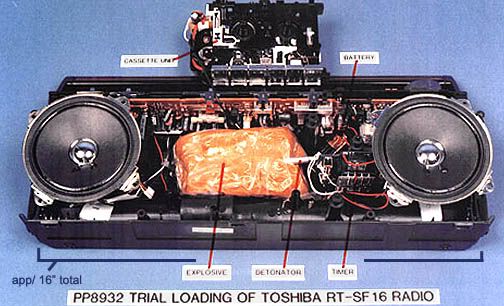
On the radio itself, I've picked up the colour picture of the mock-up you have on your blog.

PP8932_16inch.jpg


I take your point about the cassette transport being removed to get the Semtex in. It seems to have been swivelled out in that picture, and it wouldn't go back with the explosive in place.

It also doesn't have a solid plate of metal or anything that would have punched out that bit of manual anyway. It's a collection of little components. It would have blown to bits.

So, where's the white plastic? Not a lot. There are some clips or something that could be white, but for everything that was first recovered to be white? Really? I strongly suspect the actual radio was white, and all the black plastic was planted.

Rolfe.
 
So, on the current theorising, the Toshiba radio is real enough, but a white one. Only after Indian Head does Feraday start moving away from that conclusion.

In May, parts of a manual from the black, Libyan model RT-SF16 are introduced into the evidence, the main part substituting for a rather similar piece of debris handed in in Cumbria, and other fragments introduced into strategic places. Some of the small fragments might have been introduced later and backdated, in particular the one in the shirt collar.

Also in May, bits of black plastic consistent with a RT-SF16 case are introduced into strategic places, again some of this possibly done later and backdated, especially the bits in the shirt collar. And another piece of the circuit board for good measure?

In June, Feraday writes his report saying that the radio was an RT-SF16. Does he point out the Libyan origin? Whether he does or doesn't, nobody seems to go screeching in pursuit of Libya at this point at all.

Meanwhile , Thurman is concocting the MST-13 plan. I don't know where the shirt collar came from (remember Gauci's shop wasn't fingered as the source of the clothes until early September), but also remember that a grey shirt was one of the things Gauci was induced to remember selling after initially denying he sold the mystery customer a shirt. The timer fragment is planted in it, and bits of black plastic and a bit of the manual added for effect. This is substituted for something found on the ground sometime in January (but which was poorly documented, and so required retrospective witnessing by people prepared to sign for stuff "to keep the paperwork right"). The finished item gets to RARDE by early September.

Hayes does the examination as described, and this assumes the red-circle photo is a polaroid and/or no negative exists. (If a negative existed, why have we never seen a print without the red circle?) He interpolates the new page 50 into the notes, close to the rest of the related discoveries.

Feraday pretends to discover these notes as if they've been filed for four months, unregarded (as if anyone would have just filed the description of that circuit board fragment, considering how mad-keen they were on bits of circuit board....). Contacts Williamson, and frees the evidence into the system. This time, Feraday absolutely doesn't chase around circuit board manufacturers himself, he leaves that strictly to Williamson.

Against all the odds, Williamson not only doesn't identify it, he and Henderson won't turn it over to the Americans to identify, until finally Thurman gets a shot at identifying it at the US conference in June 1990. He knows what it is immediately, goes straight to that guy at the FBI, and Henderson has to turn round at Heathrow and go straight back.

Now, finally, the Libyan origin of the radio and the Libyan provenance of the timer fragment become significant, and recognised, and finally the public pursuit has somewhere else to go apat from increasingly repetative and futile descriptions of the PFLP-GC as the perpetrators. By September/October, Libya did it. Which was very handy, because by this time the political necessity of not falling out with Iran and marginalising Libya was real urgent, and Desert Storm began to blow up.

By February 1991, the police were trying to persuade Gauci that the mystery shopper was Megrahi all along.

Now, I just want to know if tray 4489 really existed or not, and at what point it was realised that "Ahmed Khalifa Abdusamad" who flew out on LN147 which was checking in at Luqa at the same time as KM180, at the adjacent desk, was actually Abdelbbaset al-Megrahi. And if Gauci ever had the actual clothes found in Scotland in his shop at all.

Rolfe.
 
Sorry about the run of posts, but I'm on a roll.

I already said I was hugely cynical about the suggestion Hayes saw "a fragment of green circuit board" in a blast-damaged shirt collar in May, and simply made a note of it and filed it. That thing is sitting there in the red-circle photo screaming "CLUE!!!" even without the red circle. He's jumping up and down about another tiny piece of Toshiba circuit board he (allegedly) found on 8th June, and Feraday was describing it as "most important". So Hayes didn't think twice about a much bigger piece found on 12th May? Pull the other one.

I'm also struck by the way Feraday personally chases the identity of the radio. He himself goes to Germany and then to Camberley to try for a match. Then even after he thinks he's got a match, he returns to it two months later and personally takes a trip to Japan to change his mind.

But when it comes to the timer fragment, no such enthusiasm. It's almost as if he wants to let the Scottish police identify it without any input from him - all nice and natural. (I don't suppose anyone expected that nine months later they still wouldn't have managed it. Pity Thurman then couldn't restrain himself in the same way when he finally got his hands on it....)

I'm not saying I'm completely convinced, but I find all this remarkably persuasive.

Rolfe.
 

ISF - Join now!

Every member here is approved by hand. No bots, no spam, just people who care about evidence and honest debate.

Membership is free!

Create your free account

Back
Top Bottom