EGarrett, thanks for referring me to the Bitcoin FAQ.
Do you really think it never occurred to me to look at that goofy document before reading the whitepaper that details the specific workings of the Bitcoin software suite, and examining the source code?
It's not an FAQ so much as an infomercial sales pitch, but thanks anyway.
I can see you're quite drunk off that kool-aid, so don't sweat it.
When we say that a currency is backed up by gold, we mean that there's a promise in place that you can exchange the currency for gold. In a sense, you could say that Bitcoin is "backed up" by the price tags of merchants – a price tag is a promise to exchange goods for a specified amount of currency.
You really don't see the circular reasoning in the above statement? Nice doubletalk they use to obfuscate the issue that Bitcoin is backed by absolutely
nothing. No laws, no Fort Knox gold, no nation's GDP, absolutely no substance there at all.
Absolutely! Even before the creation of coins ends, the use of transaction fees will likely make creating new blocks more valuable from the fees than the new coins being created. When coin generation ends, what will sustain the ability to use bitcoins will be these fees entirely. There will be blocks generated after block #6,929,999, assuming that people are still using Bitcoins at that time."[/i][/url]
"the use of transaction fees will likely make creating new blocks more valuable from the fees than the new coins being created"
That doesn't even make sense. Again, a masterful job of flim-flamming the credulous dupes interested in investing their hard earned cash in worthless Internet funny money.
At this point, which is estimated to be over 130 years in the future, if Bitcoins replace conventionally taxed and inflated money, there would be hundreds of millions of computers verifying transactions so the amount of power available to process them would scale along with their use. Furthermore, the amount of money each person has access to would be dramatically different and probably increased so I doubt by then the transaction fee would be an issue.
There would be a bottleneck in transaction processing, because with no more coins to be "mined," there would be no more "miners" and therefore nobody to perform the work of verifying the transactions.
How did we ruin the world economy?
I dunno, man. You tell me. I was kind of wondering about that part myself.
You're the one who seems to be getting off on the idea that all the world's governments will go broke because of Bitcoin. Have you not even considered the disastrous effect that would have on the world economy?
Or is Bitcoin supposed to magically replace all liquid assets, life savings, financial regulations, etc. with a totally equitable Utopia based on mutual trust and brotherly love?
You tell me what you think would happen if Bitcoin displaced the economies of even a few major governments. Go ahead, give it a shot.
You think regulation and oversight are the only ways to assure honesty or regularity?
Which government official inspects the hamburger that McDonalds gives you? What government regulation insures that Ipod technology continues updating at an insane rate?
Market forces do that. Not the government.
The food McDonald's serves is inspected by the USDA. You didn't know that?
Yeah, we have this big, bloated government bureaucracy that's supposed to make sure the food supply is safe or some such boring crap. Go figure. Honestly, I don't know why they don't just let the market forces take care of it. After all, if you buy some bad food and get poisoned, at least your surviving family will know not to eat there any more. Caveat emptor, up, up and away!
I don't buy Ipods because I think they're overpriced and there are better products on the market for less money. I wouldn't even say their technology is "updating at an insane rate." They make products and sell them, just like any other company. BFD.
All the rest is just marketing hype, just like that Bitcoin FAQ that you seem to have lost your critical faculties over.
Oh yeah, I almost forgot. When it comes to financial stuff, yeah, you pretty much
need some government and body of laws to regulate things. Otherwise, you get all kinds of scammers operating freely with total impunity and nobody has any security. The Bitcoin micro-economy is a perfect example of that dynamic right now.
How many people have lost their shirts by speculating in Bitcoin?
And on the other hand, how many of your everyday goods and services do you pay for in your precious bitcoins?
(You never answered that question before, so I'm giving you a second chance.)
To ExchangeBTC...Tradehill...Bitcoin7. There are a number of sites that offer processing and trading services.
So then tell me, which of those services is the most trustworthy?
Which is the most secure?
What recourse do I have if one of them goes out of business and reneges on whatever money I was transacting with them?
The fact that other Bitcoin money-changers exist doesn't address the fact that the Bitcoin model offers no security at all for the process of exchanging bitcoins with any other real currency, and it offers no protection at all if somebody steals your money or cheats you.
You can't be 100% certain of that with the U.S. dollar right now. The notion of needing 100% certainty is a red-herring. There's only reasonable certainty based on available evidence...and the Bitcoin creators appear to have done a very good job of giving evidence that transactions can't be hacked...combine that with market forces (the same ones that have given us basically all the comforts of modern first-world life) and you can have quite reasonable certainty that you can make safe Bitcoin transactions.
If my bank goes belly-up (which isn't likely; it's a very large and stable bank, unlike the Bitcoin exchanges) the government insures all my funds through FDIC, up to the sum of $250,000. Of course, you can also split your money up into $250,000 increments and store each of them in different banks so you'll still be reimbursed even if they all go under. This system worked to save a lot of people when lots of banks failed in the recent banking crisis.
My credit and debit cards also have insurance against fraud and theft. This works. I've personally used it on more than one occasion. If I were dealing in bitcoin at the time, I'd have been SOL. Thank goodness I was using real money instead!
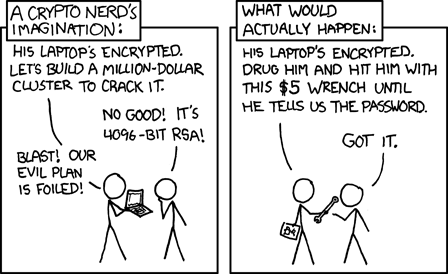
Bitcoin offers zero protections in cases like that. If somebody swindles me out of my bitcoins, I can't even go to the police, because bitcoins are illegal tender. I might as well have gotten burned in a street drug deal. Imagine if the whole world economy were as volatile and insecure as the black market. That's what you get with Bitcoin. All the laws and protections of civilized modern life are stripped away, and you're left with the Law of the Jungle.