gold bull/bear survey

Where do you think the gold price is going?


  • Total voters
    138
Last edited:
In that particular market, at that exact time - yes, It was 'worth' that much to those who bought and sold it.

But over a longer term the price tends to stabilize, and then you can see what it is 'worth' to most people most of the time. For example, by historical standards gold is grossly overvalued right now, and should be trading at around $600~$900/oz. Looking at the chart below, you can understand why some analysts are expecting it to drop below $1000 within the next 2 years.

"by historical standards" should include the pre-fiat experiment data too, as you cannot pick the start of an experimental period and call that "historical standards" - especially when never before in the whole of human history have we had a purely fiat standard.

the data back to 1900 or so is more informative so according to that - "by historical standards" should see us back towards $500 or even $250?

or did something change dramatically in 1970 and again around 2000? hint, you could try looking at it using at least the same "inflation adjusted calculation" divisor all the way through your reporting period

you would find the picture looks somewhat different and that CPI has fooled you and these "analysts" exactly like it was designed to do

but I suppose you might be correct, whenever this corrects back to "pre historical levels" gold might also :D
 
Last edited:
so actually after the early Asian silver flash crash, gold & silver both had pretty decent days by the close, both putting in "outside reversal" days and closing higher than where the drops started, and on significantly higher volume on the up move.

not that you would know it from media coverage of yesterday really. CNBC loudly trumpeted the drops all morning long and then stopped talking much about it but occasionally referred to the afternoon bottom and rally as "have seen corrections" for the rest of the day. they are hilarious, obvious bias is very obvious.

Apple is still in deep bear market territory too with a deeper correction than gold, and we don't hear the same language used about that.

gold-apple.png


if they continued to fall at the same kind of rates and gold was at $1000 it's about AAPL $275 isnt it
 
Last edited:
I suppose the glee with which gold price falls are greeted isn't matched by a similar glee w.r.t. Apple shares is because there are fewer "Apple Bugs" who claim that the only way for the Apple share price is exponentially up (to a gajillion dollars a share) and few people who advocate liquidating everything and putting it into Apple shares. There are also not a large group of people who advocate going on an Apple standard because Apple shares represent a more stable representation of wealth than fiat currency :D
 
I suppose the glee with which gold price falls are greeted isn't matched by a similar glee w.r.t. Apple shares is because there are fewer "Apple Bugs" who claim that the only way for the Apple share price is exponentially up (to a gajillion dollars a share) and few people who advocate liquidating everything and putting it into Apple shares. There are also not a large group of people who advocate going on an Apple standard because Apple shares represent a more stable representation of wealth than fiat currency :D

haha. :D .. perhaps. I think there are probably exponentially more Applebugs in fact, in the west at least, however they have traditionally expressed their applebuggery by buying their products rather than their shares.

here's the fiat cheerleading squad pumping the bubble prior to last years burst

http://www.cnbc.com/id/46857053

Half of all U.S. households own at least one Apple product, according to CNBC’s All-America Economic survey.

That’s more than 55 million homes with at least one iPhone, iPad, iPod or Mac computer. And one-in-10 homes that aren’t currently in that group plan to join it in the next year.

But Apple doesn’t have to worry about brand saturation any time soon. Americans don’t stop with just one device. Homes that own least one Apple, own an average of three. Overall, the average household has 1.6 Apple devices, with almost one-quarter planning to buy at least one more in the next year.

“It's a fantastic business model — the more of our products you own, the more likely you are to buy more,” says Jay Campbell, a vice president of Hart Research Associates, which conducts the CNBC survey along with Bill McInturff. “Planned obsolescence has always been a part of the technology industries sales model, but Apple has taken it to a whole new level.”

Our survey shows Apple buyers tend to be male, college-educated, and younger. They’re just as likely to own a home as not. Not surprisingly, the more money you earn, the more Apple products you’re likely to own.

edit, I just noticed this, I remember seeing it actually, lol about a week before Obama's banker meeting and same night one-in-5000 year gold event. http://www.cnbc.com/id/100593584

Gold fever continues to grip the nation.

The CNBC All-America Economic Survey finds that Americans once again chose gold as the top investment choice, beating out real estate, stocks, savings accounts and bonds.

The poll of 800 Americans finds that 35 percent picked gold as their best investment choice, down from 37 percent a year ago, but still beating real estate, which was the top pick of 27 percent of the public. That was followed by 21 percent who chose stocks.

A look at who make up the nation's gold bugs shows a distinctive demographic profile, one dominated by concern about the nation's economic outlook.

Forty-five percent of Tea Party supporters chose gold, compared with 35 percent of the overall public. And half of those Americans who believe their home values will decline in the coming year think gold is the best investment bet.

Other groups with an above average yen for gold include men, those with little money in the stock market and those with a high school education or less.

:rolleyes:

lulz, I'll leave the final word on this to The Onion.

http://www.theonion.com/articles/everyone-who-started-watching-mad-money-in-2005-no,32346/

NEW YORK—According to a report released this week by Forbes magazine, every person who has regularly watched CNBC’s financial program Mad Money since its 2005 premiere is now a multibillionaire. “[Host] Jim Cramer turned out to be 100 percent accurate with every stock he said to buy, sell, or hold; I started out by investing $600, and now I have a net worth of $4.1 billion,” said former dishwasher Paul Welling from the plush 100-seat TV room aboard his custom luxury yacht.

“All I had to do was follow Jim’s investment instructions and then sit back as the millions upon millions rolled in every day for the past eight years. And actually, I myself watched no more than three times weekly, and today I own a media conglomerate.”


The findings reportedly came as welcome news for the cable channel following recent reports that over half the regular viewers of the morning show Squawk Box had died of exposure after winding up penniless and destitute on the street.
 
Last edited:
Forty-five percent of Tea Party supporters chose gold
Only 45%? Perhaps they are not all as crazy as I thought (or perhaps the others already spent all their money on guns and ammo).

Half of all U.S. households own at least one Apple product,
And in this case 'own' means that they have in their hands a product that they actually use. How many gold bugs can say that they have physical possession of all the 'gold' they have invested in, and have found a practical use for it in their daily lives?
 
And in this case 'own' means that they have in their hands a product that they actually use. How many gold bugs can say that they have physical possession of all the 'gold' they have invested in, and have found a practical use for it in their daily lives?

68%
 
Your figure seems to be a bit off.

But besides I was talking about gold bugs, ie. people who own gold as an 'investment' - not people who like to wear jewelry.


and you think the 2 are mutually exclusive? what I find interesting here is the gram/per head capita just how small it is, for a bubble, that is.. and given that 2.5 billion people, all living next door to each other who are the world's largest gold demand zone actually seem to like it when the price falls 30%..

so it seems to me that western "investment in gold", which is primarily a piece of paper or electronic contract, which is tied to the price of the metal (fractional reserve ponzi) and is promises only to pay you the bid, (not ask) price of the metal (in more paper) but is in no way a purchase of the metal, leads to a flawed perception of things over time.

and that's where we are now, although in the last few weeks the relentless drawdowns in GLD, and unprecedented physical demand suggest that people are currently selling their paper "investments" and going to the real thing as fast as possible. the days of the tail (bucketshop futures market) wagging dog (real world physical) are fast coming to an end IMO

http://www.gold.org/media/press_releases/archive/2013/05/gdt_q1_2013_pr/

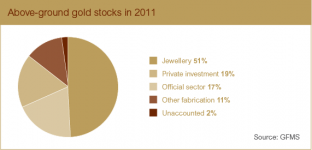
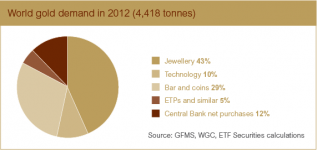
Press releases: May, 2013 - Bars and coins, jewellery and consumption in the technology sector still make up 81% of the market

Global demand for gold jewellery up 12% in Q1 2013 driven by significant increases in India and China

The latest World Gold Council Gold Demand Trends report, which reports on the period January-March 2013, shows a market driven by diverse global demand, and an appetite for owning gold jewellery that continues to grow.

Total jewellery demand was up 12% year-on-year in Q1 2013, driven in the main by Asian markets. Jewellery demand in China was up 19% on the same period last year and stood at a record 185 tonnes(t). Demand in both India and the Middle East was up 15% respectively and in the US, demand showed a significant increase, 6%, for the first time since 2005.

Demand for gold in China and India was also driven by an increase in bar and coin sales - up 22% year-on-year in China and 52% in India. In the US demand for bars and coins was up 43% compared with the same quarter in 2012. Globally, bar investment was up 8% while official coins (such as American Eagles and Canadian Maple Leafs) were up 18%.

Gold held by gold-backed ETFs, which in 2012 accounted for 6% of the world’s gold demand, fell by 177t.
Central Banks remained significant acquirers of gold, making purchases in excess of 100t (109t) for the seventh consecutive quarter.

Overall total global demand for gold in Q1 2013 was 963t, down 19% from Q4 2012.

Marcus Grubb, Managing Director, Investment at the World Gold Council commented:

“The price drop in April, fuelled by non-physical moves in the market, proved to be the catalyst for a surge of buying that has left many retailers short of stock and refineries introducing waiting lists for deliveries. Putting this into context, sales of bars and coins, jewellery and consumption in the technology sector still make up 81% of the market.

“What these figures show is that even before the events of April, the fundamentals of the gold market remain robust with; growing demand in India and China, central banks consistently adding gold to their reserves and strong buying of investment products such as gold bars and coins.”

 
Last edited:
More anti-gold propaganda:

China’s Gold Demand to Slow From April Surge: Association

Gold demand in China, the world’s largest consumer after India, may slow in the second half of this year after surging in April, said Zhang Bingnan, secretary-general of the China Gold Association.

“The kind of frenzied buying in late April and early May won’t be repeated,” Zhang said. Some of the jewelry demand earmarked for festivals or weddings later this year may have been brought forward to April and May after prices fell, he said.

Gold has declined 16 percent this year on concern the U.S. Federal Reserve may rein in stimulus that helped bullion cap a 12-year bull run in 2012 and as some investors lost faith in the metal as a store of value. Gold takes center stage in weddings in China in the form of jewelry and other gifts as a promise of a long and happy future together.

Chinese consumers rushed to buy jewelry, bars and coins as a 14 percent drop in prices in the two days through April 15 was seen as a buying opportunity, Zhang said in an interview from Shanghai on May 28. Uncertainty about whether gold will fall further this year may deter some investors in China from buying in the second half, he said.
 
More anti-gold propaganda:

maybe.. :D ..meanwhile..

http://www.reuters.com/article/2013/05/29/gold-demand-wgc-idUSL5N0E93U920130529

LONDON, May 29 (Reuters) - Asian gold demand from this April to June will reach a quarterly record as bullion consumers in the region take possession of supply freed up by selling from exchange-traded funds (ETFs), the World Gold Council (WGC) said on Wednesday.

Gold prices fell to their lowest in more than two years at $1,321.35 an ounce in mid-April on signs of economic improvement in main markets and fears that central banks around the world could start to curtail their bullion-friendly policy measures.

The move scared investors in the West, triggering a sharp liquidation of speculative and ETF positions. But lower prices also prompted strong physical demand from price-sensitive countries such as India and China, which together account for more than 50 percent of consumer demand for bullion.

"Asian markets will see record quarterly totals of gold demand in the second quarter of 2013," WGC Managing Director Marcus Grubb said.

"Even if ETF outflows continue in the United States, it is quite likely that the gold previously held in ETFs will find a ready market among Indian, Chinese and Middle Eastern consumers who are taking a long-term view on the prospects for gold.

these figures are best looked at in hindsight really, where (unusually these days) they are not continually revised after the fact.
 
Last edited:
Gold has declined 16 percent this year...

OK so far...

...on concern the U.S. Federal Reserve may rein in stimulus that helped bullion cap a 12-year bull run in 2012 and as some investors lost faith in the metal as a store of value.

...and...

Gold prices fell to their lowest in more than two years at $1,321.35 an ounce in mid-April...

OK so far...

...on signs of economic improvement in main markets and fears that central banks around the world could start to curtail their bullion-friendly policy measures.

These are the sort of post hoc analyses that drive me crazy.

It's not that hard to come up with reasonable causes after the fact. Gold may have pulled back for those reasons, other reasons, or some combination of reasons both known and unknown.

Or just drifted randomly.

Anyone have concrete future predictions?

Predicting is the hard part!
 
Last edited:
Anyone have concrete future predictions?

Predicting is the hard part!

I don't have a concrete prediction myself. I'm one of the ones who clicked "I don't know. Anything could happen." in the poll. I still feel that way.

However, I did link to a specific prediction with a specific price and a specific time range in post #657. I'm not endorsing that prediction, but it's one we will be able to evaluate in a year.

people who come out with more bearish doom predictions after a big move has already happened are almost always wrong. this was Credit Suisse's 2013 prediction prior to the move

http://www.lbma.org.uk/pages/index.cfm?page_id=152&title=forecast_2013

Tom Kendall - Credit Suisse Securities (Europe) Ltd
High $1,885
Low $1,545
Avg $1,740
Range $340

to be fair the pop up box there does say he thought it likely the cycle would peak and roll over due to a "recovery"
 
Correction:

I said before that "Predicting is the hard part!"

That's wrong of course.

It's obvious that predicting is easy. So easy nearly anyone and everyone does it.

What's hard is making predictions that then reliably play out in the real world.

And what's really hard is making predictions with enough accuracy and consistency to profit from trades in and out of an asset class over time, after transaction costs and taxes are factored in.

Aye, there's the rub!
 
Gold looks to be setting up for a breakout here, in one direction or the other..

some of these trendlines we're tracking along here are weeks old, and generally these triangles resolve more dramatically than just trickling sideways out.

and of course its jobs report today, always a good time for some gold slamming in both directions before the days trend makes itself clear..

place your bets.. :D

sXh5n.png
 
Cool chart!

That's some great information!!

Thanks!!!

only muppets and marketmakers would be betting now, they pretty much always run all the stops in both directions on this news to make sure as few traders as possible still have their position intact when the actual move for the day goes.

the only definite is that there will be clear manipulation first in the opposite direction of the main move. prior to seeing that your odds are way less than 50:50 at this point in time.
 

ISF - Join now!

Every member here is approved by hand. No bots, no spam, just people who care about evidence and honest debate.

Membership is free!

Create your free account

Back
Top Bottom