does anyone here want to support the NIST reports in a one-on-one debate with me

All three reports have invalid assumptions and calculations and do not explain the observed behavior of the collapse of WTC 7.

I am not rejecting because I just want to. Nobody should accept invalid work as an explanation.

Your FEAs are invalid opinion based on Assumptions.
 
Quotes from Tony TSz
"Nobody should accept invalid work as an explanation. "

"It is not proper to accept recommendations that are based on an invalid and non-explanatory analysis. "

Great quotes. Seems to fit AE911T work.

Tony: where is the detailed explanation for controlled demolition? Some have shown the false assumptions in AE911T various reports. Jeff Prager's work has many false misleading assumptions. etc. etc. etc.

As far as WTC7, what recommendations would you have to ensure future buildings would not be taken down by controlled demolition. That was the goal behind the NYC High Rise Safety Initiative, was it not?
 
You haven't shown that. Most of what I see you write on this subject can only be described as scientifically incoherent drivel.

I am not the one saying that dirrect conductive heating does not effect steel, that only Radiant heating is valid, when thousands of experiments prove you wrong Tony.

According to you I don't have to physically contact my oxyacetylene torch flame, to a piece of steel to heat it!

Do you understand how dumb your statements are?

Still waiting on a paper with a valid experiment that shows the weaker girder and seat edges will tear, while the stronger bolts will fracture!

You realize that all experiments, show fracture as a produce of energy exerted over time while ductile realinement is a much slower process!

My Library now contains over 428 peer reviewed experimental papers and still none point to your conclusions being remotely possible.

Could it be the numbers you are putting into what basically is a sufficticated calculator, are wrongly applied?

Because they are not based on true failure modes, in fires only design safety modes in a design program?

Still waiting on the experimental evidence that supports your claims when will it be available?
 
Last edited:
I am not the one saying that dirrect conductive heating does not effect steel, that only Radiant heating is valid, when thousands of experiments prove you wrong Tony.

According to you I don't have to physically contact my oxyacetylene torch flame, to a piece of steel to heat it!

Do you understand how dumb your statements are?

Still waiting on a paper with a valid experiment that shows the weaker girder and seat edges will tear, while the stronger bolts will fracture!

You realize that all experiments, show fracture as a produce of energy exerted over time while ductile realinement is a much slower process!

My Library now contains over 428 peer reviewed experimental papers and still none point to your conclusions being remotely possible.

Could it be the numbers you are putting into what basically is a sufficticated calculator, are wrongly applied?

Because they are not based on true failure modes, in fires only design safety modes in a design program?

Still waiting on the experimental evidence that supports your claims when will it be available?

First, it was convection that I said was minimal in the case of fire protected structural steel, which that in WTC 7 was.

Second, conduction only comes into play after radiation has heated the insulation and takes it through the fire insulation into the steel. The fire insulation has low thermal conductivity and the conduction is thus slow and the insulation prevents the radiation from heating the steel directly.

Radiant heating is the predominant heat transfer mechanism to fire protected structural steel in a building fire. See what the AISC says about it on page 5 paragraph 1.13 here https://www.aisc.org/globalassets/aisc/publications/facts-for-steel-buildings-1-fire-facts.pdf

I have no desire to be rough with you, but you do seem to shoot from the hip and you should stop it, because you are incorrect on this issue. The NIST, ARUP, and Weidlinger Associates reports on WTC 7 are not valid explanations for the collapse. There is no legitimate analysis that shows WTC 7 came down due to fire.
 
Last edited:
Interesting read Tony:

From papers introduction said:
FEMA 403 (FEMA, 2002) documents the performance
of the World Trade Center (WTC) towers and surrounding
structures in the malicious terrorist attacks of September 11,
2001, and forms the basis for the continuing work of the
National Institute of Standards and Technology (NIST). It
is important to distinguish "normal" building fires from this
extraordinary WTC experience, which involved the combination
of severe structural damage, destruction of fire protection,
suppression and egress systems, and simultaneous
severe fires on several floors.

I'm not thinking the authors agree with you. Do you have a quote from them giving their support?

:rolleyes:
 
Last edited:
Interesting read Tony:


:rolleyes:

More generic ambiguity from you. Why don't you put your thinking cap on and get into some specifics?

There was no disruption of the fire insulation due to debris damage in the area near the north face of the building that the NIST, ARUP, and Weidlinger Associates want to say initiated the failure in WTC 7.
 
Last edited:
More generic ambiguity from you. Why don't you put your thinking cap on and get into some specifics?

There was no disruption of the fire insulation due to debris damage in the area near the north face of the building that the NIST, ARUP, and Weidlinger Associates want to say initiated the failure in WTC 7.
You really don't know what this sentence says, do you?

It is important to distinguish "normal" building fires from this
extraordinary WTC experience, which involved the combination
of severe structural damage, destruction of fire protection,
suppression
and egress systems, and simultaneous
severe fires on several floors.
 
First, it was convection that I said was minimal.

Second, conduction only comes into play through the fire insulation into the steel.

Radiant heating is the predominant heat transfer mechanism to fire protected structural steel in a building fire. See what the AISC says about it on page 5 paragraph 1.13 here https://www.aisc.org/globalassets/aisc/publications/facts-for-steel-buildings-1-fire-facts.pdf

I do not want to be rough with you, but you do seem to shoot from the hip and are incorrect about this issue. The NIST, ARUP, and Weidlinger Associates reports on WTC 7 are not valid explanations. There is no legitimate analysis that shows WTC 7 came down due to fire.

You do realize that conduction occurs between the insulation, and the steel when the fire rating of the insulation is exceeded.

And this paragraph proves you totally incompetent to comment further.

"Conduction is heat transfer through solid materials, and
involves the material properties of density, specific heat,
and thermal conductivity. Convection is heat transfer
through fluids, either gases or liquids, which is a linear
function of the gas temperatures. (Radiation is the transfer of
heat energy by electromagnetic waves, which depends on
the gas temperature raised to the fourth power.)
For protected structural steel, the temperature increase
due to fire results primarily from (radiation to the fire pro-
tection material and conduction through the protection), with
inclusion of the appropriate insulating properties and thick-
ness of the material. Therefore, the temperatures in pro-
tected steel will be continually less than those of the fire
during the heating phase. How much less depends on the
thickness and nature of the insulating material, as well as
the size and weight of the steel member itself. Of equal
importance are the thermo-physical properties of the steel
fire protection material, such as cohesion and adhesion dur-
ing the fire event.
For unprotected (bare) steel, temperatures are affected
both by convection and radiation. The pertinent heat trans-
fer equations, thermal parameters and properties are avail-
able in the literature (SFPE, 2002). In this case, the
temperatures of the bare steel will eventually reach the
same levels as that of the fire compartment. The unprotected
steel temperatures are a function of the nature of the fire
exposure and the weight and heated perimeter of the steel
shape. Hence, the time for the steel to reach temperature
equilibrium with its surroundings will depend on these con-
ditions. Once steel temperature equivalence with the fire is
reached, it will be essentially maintained for the duration of
the fire. If the primary heating of the steel is due to its direct
exposure to flame impingement, or line-of-sight radiant
heat, shielding of the steel is one effective way to reduce its

You incompetent Tony totally incompetent, no further discussion is meaning full.

 
You really don't know what this sentence says, do you?

We are talking about heat transfer mechanisms without reference to sprinklers.

It is clear that you can't get into specifics because you have no case to make. You need to go away until you have some specifics to discuss.
 
We are talking about heat transfer mechanisms without reference to sprinklers.

It is clear that you can't get into specifics because you have no case to make. You need to go away until you have some specifics to discuss.
Are sprinklers the only other method of suppression that was mentioned in the paper you quoted?

Maybe you should actually read it.

Nice try at narrowing the scope though.
 
Are sprinklers the only other method of suppression that was mentioned in the paper you quoted?

Maybe you should actually read it.

Nice try at narrowing the scope though.

I love that he posted two papers that show him to be totally incompetent in engineering, priceless.

Any fool knows fire suppression is sprinklers, Fire retardants, heat sinks, and structural insulation!

Tony is so priceless I think he is going to kill me, my back is hurting where I hit stumps my side where I fell, on the excavator track hurts,
Now Tony has me laughing so hard I think I am going to Die.
Don't forget compartmentalization. Got to keep that fire in one place and not let it fester for hours.

The paper he quoted is very clear on this.
 
So when is AE911 starting their own? You would think with their roster, they would have the talent required. You would also think with Gage's fundraising efforts over the years, they would have the budget.

This. When can we expect your report Tony?

You haven't shown that. Most of what I see you write on this subject can only be described as scientifically incoherent drivel.

:id: :id: :id:
 
First, it was convection that I said was minimal in the case of fire protected structural steel, which that in WTC 7 was.

Second, conduction only comes into play after radiation has heated the insulation and takes it through the fire insulation into the steel.

Radiant heating is the predominant heat transfer mechanism to fire protected structural steel in a building fire. See what the AISC says about it on page 5 paragraph 1.13 here https://www.aisc.org/globalassets/aisc/publications/facts-for-steel-buildings-1-fire-facts.pdf

I have no desire to be rough with you, but you do seem to shoot from the hip and you should stop it, because you are incorrect on this issue. The NIST, ARUP, and Weidlinger Associates reports on WTC 7 are not valid explanations for the collapse. There is no legitimate analysis that shows WTC 7 came down due to fire.

Tony--when are you going to stop making stuff up and just acknowledge that you and the Korol paper made a fundamental error? You keep claiming, without any evidence, that the pre-heating phase in a traveling fire would be insignificant. You claim it over, and over, and over. But you never provide any evidence. In fact, as I have demonstrated repeatedly to you, NIST actually ran a fulsome simulation that included the convection heating period you claim was so insignificant that it could just be ignored. As you well know, NIST's simulation shows the heating during that period--which, for example, on floor 12 included over 2 hours of exposure to temperatures between 200 C and 800 C, lead to the pre-heating of a beam to around 400 C before the peak fire reached that beam. And that's just one beam on one floor. There were other floors where NIST believed the fire conditions were far worse.

You are seriously stuck on stupid in trying to baldly assert your way out of this error.

Here are the facts:

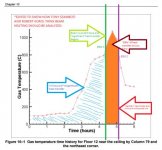
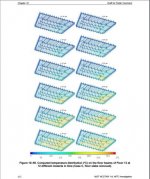
You claimed that both the Cardington studies and the NIST WTC 7 report supported Robert Korol's use of a 25-30 min heating time frame, which time frame you cited as your basis for opposing WAI's temperature model. You even baldly lied and claimed that Korol was correct because about 99% of heat transfer in a fire occurs in 25-30 min, a statistic you blatantly fabricated out of nothing to try to win an argument (which you later try to hand wave away by saying such a statistic was a "figure of speech"). The very quote you cited in the NIST report, however, referenced figure 9-9 thereof (you can find that chart here for reference), which clearly shows areas were heated for hours (see, e.g., the middle portion of the northern side of the building). Further, the deeper you dive into the NIST report, the more apparent your error becomes. NIST included as figure 10-1 to its WTC 7 report a very helpful graph of gas temperatures in a single location on floor 12 (see here for the plain chart), which was not even where they thought the worst fires were. To illustrate how obviously incorrect you are, I've marked up the figure 10-1 chart to overlay your ridiculous assumptions (mark-up also attached for reference).

The 25-30 min heating theory you espouse based on the NIST report is proven wrong based on that same report. It's right there in 10-1, staring you in the face. You and Korol assume that there is no heating of the beam during the first 4.5 hours of the simulation. Actually, you already did admit that assumption was at least partially wrong, but, as with your other statements, even that admission was lacking. You pulled 200 C out of thin air without any evidence or even a rudimentary back-of-the envelope calculation to back it up. Meanwhile, in reality, we know that NIST--which is your source on temperatures--did do an exacting calculation of how much beam pre-heating would occur based on the figure 10-1. They show, on page 452 of their report that, at 4:30, there was almost 400 C of pre-heating on that beam. Attached for reference is a copy of that page. All you have to the contrary are bald assertions about how that's contrary to your understanding of convection heating, with no math or other experimental source to back you up.

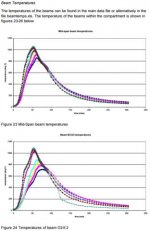
Moreover, you were wrong about the Cardington studies supporting the 25-30 min heating time. As I pointed out to you repeatedly, even in the Cardington studies' limited compartmental fire tests (which do not simulate the pre-heating that would be experienced in a traveling fire scenario, let alone a traveling fire scenario on the scale of the fires observed in WTC 7), there is no 25-30 min period when 99% of the heat transfer occurred. The Cardington study you cited to specifically (direct link to the report here) shows heating for over 50 minutes, and the Cardington temperature data is all public and so, if there were a 25-30 min period where 99% of the heat transfer occurred (the beam heating graphs from that study are on page 41 for reference), you could simply pop that data into excel and tell me exactly when such period begins and ends. But you can't. Further, you continue to ignore that another Cardington study has shown that, even without the pre-heating of a large traveling fire, a protected beam subjected to a compartmental fire could reach 700 C (See pg F47 of that Cardington study here). You continue to ignore this experimental finding because it alone shows how utterly incorrect and un-tethered to reality Korol's theoretical findings are.

In sum, you've proven you either have no idea what you are talking about when it comes to fire science or else you are just willing to blatantly lie and make things up. Korol's 25-30 min heat transfer model is indefensible and, in your ill-fated attempt to defend it, you have thrown away the small amount of credibility you had left. You cannot pretend to be interested in the truth if you are so willing to ignore reality--including the reality of the very sources you cited.
 

Attachments

  • NIST NCSTAR 1-9 pg 390 10-1 SZAMBOTI DELUSION.jpg
    NIST NCSTAR 1-9 pg 390 10-1 SZAMBOTI DELUSION.jpg
    33.2 KB · Views: 9
  • NIST NCSTAR 1-9 pg 452.jpg
    NIST NCSTAR 1-9 pg 452.jpg
    34.1 KB · Views: 4
  • Cardington Beam Temp.jpg
    Cardington Beam Temp.jpg
    20.7 KB · Views: 6
Last edited:
Don't forget compartmentalization. Got to keep that fire in one place and not let it fester for hours.

The paper he quoted is very clear on this.

I know, and we all know that carbon soot, wouldn't travel though a fire, land on a beam with insulation heated to 600C, the carbon soot then wouldn't combust at 1400C, Raising it to the 4th power, causing dirrect (conduction) though the insulating layer as well as cracking and degredation of the insulation.
We know that can't happen because The Great Tony says so!
So not only are NIST's studies wrong, but so are the Chinese studies, The Russian Navy studies, The German Studies, The Iranian Studies.

We need a new investigation the whole freaking world is in on this Conspiracy !:D
 
The NIST WTC 7 report has been shown to be invalid and non-explanatory. It is not proper to accept recommendations that are based on an invalid and non-explanatory analysis.

But the critique of the NIST report which resulted in your conclusion that NIST is invalid and non-explanatory is itself invalid and non-explanatory as it relies heavily on false starting assumptions which would invariably lead to false conclusions if not for the fact the conclusions are already founded heavily in assumption and assertion, largely devoid of supporting fact.

Because you say so doesn't cut it.

Therefore we are right back to where we started with NIST and the other reports, all of which differ in what are fundamentally unknowable details of collapse initiation (what broke first), but all of which absolutely agree that fire was the proximate cause.

Even if you could manage to do a proper job of managing to to prove NIST wrong over an unknowable detail, what difference does it make if it was Beam X or Girder Y that failed first when it comes to the fire safety recommendations that were the whole purpose of the report to begin with?

What changes?
 
We are talking about heat transfer mechanisms without reference to the use of sprinklers.

It is clear that you can't get into specifics because you have no case to make. You need to go away until you have some specifics to discuss.

FTFY.

Now, I'm no fire scientist, and I'm sure I'll be corrected if my completely out of my ass statement is incorrect, but:

Wouldn't heat transfer be more prevalent without fire suppression efforts? Including the inoperable sprinklers? If they were operable, there would be less heat transfer. Less heat transfer, better chance of the building surviving.

Make sense, or is that too nincompoopish?

Is there ANY room for critical thought in a truther's brain? Even a tiny bit?

Respond after your vacation.
 

ISF - Join now!

Every member here is approved by hand. No bots, no spam, just people who care about evidence and honest debate.

Membership is free!

Create your free account

Back
Top Bottom