OK, thanks for all that. Please allow me to sum this up and if I misstate anything, please correct.
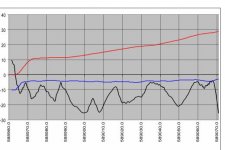
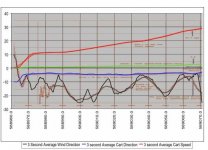
The raw data collected by the CV for the record run was published fully with no filtering. From this publicly available data, a chart was produced with 10 second averaging to smooth the data for legibility. The raw data is however still available where this came from of course.
When the CV is at a standstill, the wind direction data is random noise due to the GPS calculation of direction that is added to the CV offset. This random walk of the GPS direction is generally truly random for commercially available GPSs so no true wind direction can be inferred by this data from the CV at standstill but true shifts could be seen if the raw data from the wind direction transducer is available. (from Spork's comment.) In general when the CV is at a standstill the windspeed from the on-board anemometer would be accurate.
Once the CV is moving at any appreciable speed (say greater than 1fps) the GPS random walk is no longer an appreciable factor and the true wind is properly sampled on average by combining the relative data from the windvane on the CV (appropriately offset) and the GPS track data.
When the CV nears WS, there are errors in the two types of data (WS and direction). First, the wind direction data, close to WS is suspect, because it is below instrument accuracy speed limits and the small amount of turbulance makes it read erratically for direction due to low restoring force and other perturbations such as CV speed fluctuations (as can be seen with a streamer at WS ticking about lazily and randomly.). The speed at very near WS is also suspect as the anemometer slows to near zero and then increases again as WS is passed.
Finally, the measurements at anywhere reasonably above WS (say 1.2X) should be highly accurate from there throughout the record run.
The final assumption is that NALSA, with their record experience in general had no issues with any of this.
Let me know if I got it right or what I missed, please.
Thanks,
WindGrins