Merged DDWFTTW in a “Real” Wind

Status
Not open for further replies.
I was confused too!

A wingsail land yacht or ice yacht, if sailing 40 degrees off DDW, can happily get up to 4 or 5 times wind speed, and, by tacking, have a velocity made good ddw of 2 or 3 times wind speed. I think they can sail a bit closer than 40 degrees too.

If DDW, no more than 70% or so of wind speed, agreed.

I was a little confused about this also since I'm use to thinking relative wind on the sail/wing. I'm relatively confident that a really good wing should be able to sail within 20 degrees each side of a headwind (relative). I'm not exactly sure how this translates to going in the headwind for the true downwind reach.

I haven't done the vectors.

Regards,

WindGrins:D
 
A wingsail land yacht or ice yacht, if sailing 40 degrees off DDW, can happily get up to 4 or 5 times wind speed, and, by tacking, have a velocity made good ddw of 2 or 3 times wind speed. I think they can sail a bit closer than 40 degrees too.

If DDW, no more than 70% or so of wind speed, agreed.

I left off a bit of context in that post, which was "in a 10 MPH wind", they can't beat the wind closer than that in a 10 MPH wind.
 
I left off a bit of context in that post, which was "in a 10 MPH wind", they can't beat the wind closer than that in a 10 MPH wind.

I think you* previously posted a radial graph of wind sail performance that I found tremendously helpful on this particular point. If you have it at hand this may be a good spot to drop it in again.

*You or someone other carteer. I remember it was someone on the payroll, just not sure who.


ETA: Nevermind, it was you and you thought to add it again without my prodding. Thanks!
 
Last edited:
Shouldn't that read "more"?

I intended to say "less", as that's what actually happened during the test run, but maybe 20 degrees or less doesn't make much of a difference.

Certainly, only in the humberverse would winds more than 20 degrees off axis improve the performance of the cart.

The only support for the assertion that off axis winds helped that I've ever seen from humber is "The prop can act like a sail, so the prop can tack." Of course the assertion that a prop blade can act like a sail on a broad reach is wrong (according to humber) because it's "not in any textbook".
 
Last edited:
I intended to say "less", as that's what actually happened during the test run, but maybe 20 degrees or less doesn't make much of a difference.
but what you said was that winds less than 20 degrees off reduced the performance of the cart, that is not what the data shows. It shows the opposite.

Certainly, only in the humberverse would winds more than 20 degrees off axis improve the performance of the cart.

Exactly, but you, in effect, typed just that.
 
Very helpful!

I posted this before, but there is a velocity polar at the bottom of this page:

http://www.tspeer.com/landyachts/performance/Single.html

That illustrates the effect of wind speed on how close to the wind they can beat it.

I was searching around for a polar table like that and that is perfect!

The upwind polars say what we said-that you can sail about 20 degrees off the wind and the downwind (true polars) validate what you said-that in the range less than 40 degrees off the true wind, the speeds are practically zilch!

That is super helpful! That cleared it all up and I had personally not seen this before.

Thanks,

WindGrins:D

ETA: When you are sailing upwind at 20 degrees true, the relative wind will be at even a tighter angle (relative). (It has little relevance here-just interesting.) Man, I wish I could sail that tight!
 
Last edited:
I was searching around for a polar table like that and that is perfect!

The upwind polars say what we said-that you can sail about 20 degrees off the wind and the downwind (true polars) validate what you said-that in the range less than 40 degrees off the true wind, the speeds are practically zilch!

That is super helpful! That cleared it all up and I had personally not seen this before.

Thanks,

WindGrins:D
Bare in mind that the chart only considers the case where the airfoil is not stalled. In that case you have to fill in the downwind null zone with what bluff drag will get you.
 
Last edited:
OK, thanks for all that. Please allow me to sum this up and if I misstate anything, please correct.

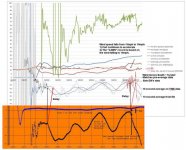
The raw data collected by the CV for the record run was published fully with no filtering. From this publicly available data, a chart was produced with 10 second averaging to smooth the data for legibility. The raw data is however still available where this came from of course.
No, it was not.
Bob Dill used the same true wind data as calculated by Spork, and then applied an arithmetic mean to the 10 seconds of the record run.
Spork applied the rolling average of 50 samples to produce the chart in the Observers report.

When the CV is at a standstill, the wind direction data is random noise due to the GPS calculation of direction that is added to the CV offset. This random walk of the GPS direction is generally truly random for commercially available GPSs so no true wind direction can be inferred by this data from the CV at standstill but true shifts could be seen if the raw data from the wind direction transducer is available. (from Spork's comment.) In general when the CV is at a standstill the windspeed from the on-board anemometer would be accurate.
The "wind direction relative to the CV" is that raw vane data.
The true wind calculation uses the GPS co-ordinates as part of the calculation. That produces the noise or chatter, that corrupts that data, until the CV reaches 9mph.
The charts I posted showing wind changes of 75 degrees ( there are more extensive cases than that) is the actual wind data as measured directly by the vane.
Perhaps Wingrins, the cart does not work. The initial boast, was that the cart could work in a windtunnel, steady-state. I Ratant's cart, beaten by the popcorn, and Spork's cart beaten by leaf, are evidence that it does not work.
In lieu of the initial claim, the cart is run in crosswinds, and a new and entirely bogus target of 10 seconds of not-so-near ddw is created to avoid obvious failure.


Once the CV is moving at any appreciable speed (say greater than 1fps) the GPS random walk is no longer an appreciable factor and the true wind is properly sampled on average by combining the relative data from the windvane on the CV (appropriately offset) and the GPS track data.
Can be 9mph.

When the CV nears WS, there are errors in the two types of data (WS and direction). First, the wind direction data, close to WS is suspect, because it is below instrument accuracy speed limits and the small amount of turbulance makes it read erratically for direction due to low restoring force and other perturbations such as CV speed fluctuations (as can be seen with a streamer at WS ticking about lazily and randomly.). The speed at very near WS is also suspect as the anemometer slows to near zero and then increases again as WS is passed.
That is reason enough not to use a vane isn't it? There are acoustic instruments that can read both horizontal and vertical winds, and pitot tubes. However, the small time is spends at WS is not that relevant, and in the record run, it was pushed to WS.

Finally, the measurements at anywhere reasonably above WS (say 1.2X) should be highly accurate from there throughout the record run.
The final assumption is that NALSA, with their record experience in general had no issues with any of this.
NALSA were expecting a "sophisticated instrument package" but got a land-based wind vane forced upon them. They have no experience in wind direction measurement. All other trials are landspeed, using GPS.
 
Good point!

Bare in mind that the chart only considers the case where the airfoil is not stalled. In that case you have to fill in the downwind null zone with what bluff drag will get you.

Good point but we all agree that they don't sail those carts like that so the polars make sense for practical purposes.

Regards,

WindGrins
 
but what you said was that winds less than 20 degrees off reduced the performance of the cart, that is not what the data shows. It shows the opposite.


Exactly, but you, in effect, typed just that.

Okay, I meant that wind less than 20 degrees or less off axis would reduce performance compared to a wind 0 degrees off axis. If the data does not support that, I stand corrected, but I suspect the problem is that I did not clearly state what I meant.
 
Last edited:
9 mph GPS errors?

No, it was not.

The "wind direction relative to the CV" is that raw vane data.
The true wind calculation uses the GPS co-ordinates as part of the calculation. That produces the noise or chatter, that corrupts that data, until the CV reaches 9mph.

Can be 9mph.

Humber, you haven't substantiated any of the other stuff but I'm interested in where you come up with this GPS data wrong up to 9mph. It's unsubstantiated also but I'm interested in how you came up with this.

No commercial GPS I've ever used had errors like this so where are you coming up with this?

WindGrins
 
No, it was not.
Bob Dill used the same true wind data as calculated by Spork, and then applied an arithmetic mean to the 10 seconds of the record run.
Spork applied the rolling average of 50 samples to produce the chart in the Observers report.


The "wind direction relative to the CV" is that raw vane data.
The true wind calculation uses the GPS co-ordinates as part of the calculation. That produces the noise or chatter, that corrupts that data, until the CV reaches 9mph.
The charts I posted showing wind changes of 75 degrees ( there are more extensive cases than that) is the actual wind data as measured directly by the vane.
Perhaps Wingrins, the cart does not work. The initial boast, was that the cart could work in a windtunnel, steady-state. I Ratant's cart, beaten by the popcorn, and Spork's cart beaten by leaf, are evidence that it does not work.
In lieu of the initial claim, the cart is run in crosswinds, and a new and entirely bogus target of 10 seconds of not-so-near ddw is created to avoid obvious failure.


Can be 9mph.


That is reason enough not to use a vane isn't it? There are acoustic instruments that can read both horizontal and vertical winds, and pitot tubes. However, the small time is spends at WS is not that relevant, and in the record run, it was pushed to WS.


NALSA were expecting a "sophisticated instrument package" but got a land-based wind vane forced upon them. They have no experience in wind direction measurement. All other trials are landspeed, using GPS.

STOP THE PRESSES! NEWS FLASH!

Humber still has nothing.
 
Okay, I meant that wind less than 20 degrees or less off axis would reduce performance compared to a wind 0 degrees off axis. If the data does not support that, I stand corrected, but I suspect the problem is that I did not clearly state what I meant.

Well the data is pretty ambiguous from 0 to 20 degrees off, the changes in performance due to wind speed and prop pitch changes "wash out" any changes caused by relative wind direction. However, in the second half of the record run, for which I posted a graph a month or two ago, the wind shifted further off to between 20 and 40 degrees of DDW, and the reduced performance is readily discerned.

I'll repost the graphs if anyone wants me to.
 

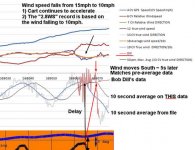
The vane data says you ran that cart in conditions that are not even close to acceptable. All over the place. The vane would have been constantly moving, with excursions to 100 degrees.
You did not even suggest that such winds would be there, and hid what you could.

The "true wind direction data" is incorrectly derived and misleading. An additional rolling average filtering was added to that, and prior to the chart being produced. Bob Dill did not use that average.

Somebody cooked the data to move the averaged data. When done right here, and now on the file data, the difference is clear.

And after that, claimed a 2.8WS record on the basis of wind that falls to 10mph. How does the cart keep accelerating, as the wind falls?
Well?


attachment.php


attachment.php
 

Attachments

  • jref_chart6.jpg
    jref_chart6.jpg
    48.6 KB · Views: 35
  • jref_chart7.jpg
    jref_chart7.jpg
    46.1 KB · Views: 36
Last edited:
Status
Not open for further replies.

ISF - Join now!

Every member here is approved by hand. No bots, no spam, just people who care about evidence and honest debate.

Membership is free!

Create your free account

Back
Top Bottom