
You are using an out of date browser. It may not display this or other websites correctly.
You should upgrade or use an alternative browser.
You should upgrade or use an alternative browser.
Merged DDWFTTW in a “Real” Wind
- Thread starter ynot
- Start date
- Status
- Not open for further replies.
by using the method as described over and over and over.The vane data says you ran that cart in conditions that are not even close to acceptable. All over the place. The vane would have been constantly moving, with excursions to 100 degrees.
You did not even suggest that such winds would be there, and hid what you could.
The "true wind direction data" is incorrectly derived and misleading. An additional rolling average filtering was added to that, and prior to the chart being produced. Bob Dill did not use that average.
Somebody cooked the data to move the averaged data. When done right here, and now on the file data, the difference is clear.
And after that, claimed a 2.8WS record on the basis of wind that falls to 10mph. How does the cart keep accelerating, as the wind falls?
Well?
According to humber, "done right" means putting the ten second average somewhere other than the middle of the 10 second period that is being averaged, namely, the end of it.[qimg]http://www.internationalskeptics.com/forums/attachment.php?attachmentid=22457&stc=1&d=1307130619[/qimg]
[qimg]http://www.internationalskeptics.com/forums/attachment.php?attachmentid=22458&stc=1&d=1307130950[/qimg]
Last edited:
Oh? Do tell. A 650lb cart, with rolling and aero losses you have wished away to nothing, can nearly maintain the speed that it gained from the 15mph wind prior to that, but how does it accelerate?by using the method as described over and over and over.
According to humber, "done right" means putting the ten second average somewhere other than the middle of the 10 second period that is being averaged, namely, the end of it.
The average that you can also perform on that chart data produces a different result from that posted in the Observer's report.
Explain.
Let's see what's happening in Humberland.
Ok first off a complete and utter lie, premeditated since he knows its a lie.
Hmmm let's see, more nonsense about wind changes outside of the test period. More nonsense about a non-ddw cart, and leaves which are evidence of nothing whatsoever except Humber's cluelessness. And some delusional talk about non-existent crosswinds which would Hinder the cart if present.
More silly and irrelevant nonsense.
Ridiculous sounding lies.
I guess the stupid hasn't stopped building up yet. A Vesuvius type eruption may be imminent.
No, it was not.
Bob Dill used the same true wind data as calculated by Spork, and then applied an arithmetic mean to the 10 seconds of the record run.
Spork applied the rolling average of 50 samples to produce the chart in the Observers report.
Ok first off a complete and utter lie, premeditated since he knows its a lie.
The "wind direction relative to the CV" is that raw vane data.
The true wind calculation uses the GPS co-ordinates as part of the calculation. That produces the noise or chatter, that corrupts that data, until the CV reaches 9mph.
The charts I posted showing wind changes of 75 degrees ( there are more extensive cases than that) is the actual wind data as measured directly by the vane.
Perhaps Wingrins, the cart does not work. The initial boast, was that the cart could work in a windtunnel, steady-state. I Ratant's cart, beaten by the popcorn, and Spork's cart beaten by leaf, are evidence that it does not work.
In lieu of the initial claim, the cart is run in crosswinds, and a new and entirely bogus target of 10 seconds of not-so-near ddw is created to avoid obvious failure.
Hmmm let's see, more nonsense about wind changes outside of the test period. More nonsense about a non-ddw cart, and leaves which are evidence of nothing whatsoever except Humber's cluelessness. And some delusional talk about non-existent crosswinds which would Hinder the cart if present.
Can be 9mph.
That is reason enough not to use a vane isn't it? There are acoustic instruments that can read both horizontal and vertical winds, and pitot tubes. However, the small time is spends at WS is not that relevant, and in the record run, it was pushed to WS.
More silly and irrelevant nonsense.
NALSA were expecting a "sophisticated instrument package" but got a land-based wind vane forced upon them. They have no experience in wind direction measurement.
Ridiculous sounding lies.
I guess the stupid hasn't stopped building up yet. A Vesuvius type eruption may be imminent.
Have to laugh at the idea of sailors having "no experience in wind direction measurement".
They don't. When you understand the apparent wiki you used to calculate the true wind, you will see assumptions made that do not apply to the cart. Can you see what they are?
Oh, it's ALL within the test run and the last 10 seconds. It's a pity the wind did not fall to 5mph, because then the "record" could be 5.6WSHmmm let's see, more nonsense about wind changes outside of the test period. More nonsense about a non-ddw cart, and leaves which are evidence of nothing whatsoever except Humber's cluelessness. And some delusional talk about non-existent crosswinds which would Hinder the cart if present.
As for the rest. Ha Ha Ha.
Will wonders never cease?!
Humber, Congratulations. You asked a reasonable question.
There is no reason to believe that if the cart has not reached its limit speed for 10 mph winds that it would not continue to accelerate as it does. With Winds higher than 10 mph the limit speed would be an even higher number and the cart might even accelerate even faster than it does.
Interestingly, this higher speed could be above the "VNE* speed" for the cart which could break it like the BUFC cart did.
To make this a reasonable objection, you will have to show that the cart is limited to less than 2.8X WS for a wind at 10mph. Otherwise we would expect the cart to continue to accelerate as it does just not quite as fast (rate of acceleration) if it had the 15mph wind driving it.
I'm amazed. This is a totally reasonable question.
*VNE-Velocity Never Exceed (for you non pilots!)
Regards,
WindGrins
How does the cart keep accelerating, as the wind falls?
Well?
Humber, Congratulations. You asked a reasonable question.
There is no reason to believe that if the cart has not reached its limit speed for 10 mph winds that it would not continue to accelerate as it does. With Winds higher than 10 mph the limit speed would be an even higher number and the cart might even accelerate even faster than it does.
Interestingly, this higher speed could be above the "VNE* speed" for the cart which could break it like the BUFC cart did.
To make this a reasonable objection, you will have to show that the cart is limited to less than 2.8X WS for a wind at 10mph. Otherwise we would expect the cart to continue to accelerate as it does just not quite as fast (rate of acceleration) if it had the 15mph wind driving it.
I'm amazed. This is a totally reasonable question.
*VNE-Velocity Never Exceed (for you non pilots!)
Regards,
WindGrins
The vane data says you ran that cart in conditions that are not even close to acceptable. All over the place. The vane would have been constantly moving, with excursions to 100 degrees.
You did not even suggest that such winds would be there, and hid what you could.
The "true wind direction data" is incorrectly derived and misleading. An additional rolling average filtering was added to that, and prior to the chart being produced. Bob Dill did not use that average.
Somebody cooked the data to move the averaged data. When done right here, and now on the file data, the difference is clear.
And after that, claimed a 2.8WS record on the basis of wind that falls to 10mph. How does the cart keep accelerating, as the wind falls?
Well?
What is amazing to me is the fact that the more lines he doesn't understand Humber adds to his charts the more impressive the cart's run actually looks. Again, congrats on the ddwfttw world record.
The wind falls 50%, but the cart still accelerates at the same rate prior to that. Explain that.Humber, Congratulations. You asked a reasonable question.
There is no reason to believe that if the cart has not reached its limit speed for 10 mph winds that it would not continue to accelerate as it does. With Winds higher than 10 mph the limit speed would be an even higher number and the cart might even accelerate even faster than it does.
And the time shift in the wind direction change.
Last edited:
It wasn't nearly maintaining, it was accelerating strongly before the wind dropped, and when the wind fell, so did the acceleration, it just didn't fall to zero, and it started climbing again when the wind increased again (within 2 degrees of DDW).Oh? Do tell. A 650lb cart, with rolling and aero losses you have wished away to nothing, can nearly maintain the speed that it gained from the 15mph wind prior to that, but how does it accelerate?
The average that you can also perform on that chart data produces a different result from that posted in the Observer's report.
Explain.
I just did, and I explained it to you no less than 6 times at TR, you got a "shifted" result because you shifted the time you put the average to the end of the period being averaged. The original chart put the average at the center of the time being averaged.
This was explained clearly in the report, and by me over and over.
Humber, Congratulations. You asked a reasonable question.
There is no reason to believe that if the cart has not reached its limit speed for 10 mph winds that it would not continue to accelerate as it does. With Winds higher than 10 mph the limit speed would be an even higher number and the cart might even accelerate even faster than it does.
Interestingly, this higher speed could be above the "VNE* speed" for the cart which could break it like the BUFC cart did.
To make this a reasonable objection, you will have to show that the cart is limited to less than 2.8X WS for a wind at 10mph. Otherwise we would expect the cart to continue to accelerate as it does just not quite as fast (rate of acceleration) if it had the 15mph wind driving it.
I'm amazed. This is a totally reasonable question.
I disagree. It is actually a completely unreasonable question. It would be a reasonable question if; A: he did not have the data, or B: if it were the first time he asked it and if any and all issues relevant to the question had not been patiently explained to him more than 30 times already.
The wind falls 50%, but the cart still accelerates at the same rate prior to that. Explain that.
And the time shift in the wind direction change.
Wrong.
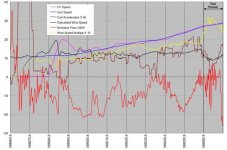
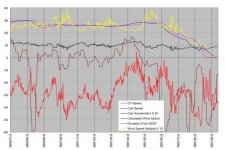
Okay, time for the charts with the acceleration shown: The brownish, steppy line is the acceleration.
First, up to the end of the test period:

Then afterwards, which clearly shows the reduced performance with winds over 20 degrees off:

First, up to the end of the test period:
Then afterwards, which clearly shows the reduced performance with winds over 20 degrees off:
Attachments
Last edited:
We'll need a TM test to be precise!
In spite of my "godlike" appearing powers, alas I am not Aeolus.
In looking at the charts you posted, the acceleration does look to be lower in the lower wind range to me and not at the same value as 15mph WS. If you take the derivative, of the acceleration graph, you could verify or dispute this. Just eyeballing your data, the rate looks lower.
The cart has substantial inertia and I don't have perfect insight into the dynamic behavior of the cart in wind changes. For this we would need an instrumented treadmill (big enough to support the BB) test capable of producing fast transients to fully characterize the carts response to transients.
I see no physics reason to doubt this data. Again, if you want controlled conditions we would have to go to a TM.
ETA: I see Llyricist has conveniently shown us the acceleration graphs in detail for us while I was writing!
Regards,
WindGrins
The wind falls 50%, but the cart still accelerates at the same rate prior to that. Explain that.
In spite of my "godlike" appearing powers, alas I am not Aeolus.
In looking at the charts you posted, the acceleration does look to be lower in the lower wind range to me and not at the same value as 15mph WS. If you take the derivative, of the acceleration graph, you could verify or dispute this. Just eyeballing your data, the rate looks lower.
The cart has substantial inertia and I don't have perfect insight into the dynamic behavior of the cart in wind changes. For this we would need an instrumented treadmill (big enough to support the BB) test capable of producing fast transients to fully characterize the carts response to transients.
I see no physics reason to doubt this data. Again, if you want controlled conditions we would have to go to a TM.
ETA: I see Llyricist has conveniently shown us the acceleration graphs in detail for us while I was writing!
Regards,
WindGrins
Last edited:
From the submissionIt wasn't nearly maintaining, it was accelerating strongly before the wind dropped, and when the wind fell, so did the acceleration, it just didn't fall to zero, and it started climbing again when the wind increased again (within 2 degrees of DDW).
Thrust = Vcart/Vprop*n*Fwheel
Initial state
Thrust = 28/13*n*Fwheel
When wind falls
Thrust = 28/18*n*Fwheel.
Thrust falls by 1- 1.55/2.15 = 27%, but F wheel remains the same.
The net force was 32N, and will be negative in the latter case.
I just did, and I explained it to you no less than 6 times at TR, you got a "shifted" result because you shifted the time you put the average to the end of the period being averaged. The original chart put the average at the center of the time being averaged.
This was explained clearly in the report, and by me over and over.
Your "explanation" is nonsense.
The 10 second average is applied over the entire run.
If the average is "centered" as you say, then the wind change just after the push, is also moved.
It was not explained in the report because Bod Dill did not use that average, Spork did.
Last edited:
From the submission
Thrust = Vcart/Vprop*n*Fwheel
Initial state
Thrust = 28/13*n*Fwheel
When wind falls
Thrust = 28/18*n*Fwheel.
Humber doesn't understand what he is looking at again.
Thrust falls by 13%, but F wheel remains the same.
The net force was 32N, and will be negative in the latter case.
Humber makes up numbers again.
Your "explanation" is nonsense.
The 10 second average is applied over the entire run.
It was not explained in the report because Bod Dill did not use that average, Spork did.
Humber is lying again.
I just did, and I explained it to you no less than 6 times at TR
I believe it would be over a hundred times if you included all poster's explanations, not just yours. I wish I could get someone to take the under 100 side for money before I check.
There is no reason to believe that if the cart has not reached its limit speed for 10 mph winds that it would not continue to accelerate as it does. With Winds higher than 10 mph the limit speed would be an even higher number and the cart might even accelerate even faster than it does.
Debunking humber's folksy notions once again?
Keep in mind it has variable pitch. So theoretically it is even possible that the acceleration rises while the true wind decreases, if the pitch is being optimized.
Your "explanation" is nonsense.
The 10 second average is applied over the entire run.
If the average is "centered" as you say, then the wind change just after the push, is also moved.
It was not explained in the report because Bod Dill did not use that average, Spork did.
Your (lack of) comprehension is what makes it nonsense. I said that each 10 second average is placed at the center of the 10 second period being averaged. That's exactly what the Observer's report explains, in detail. The fact that you still utterly fail to comprehend it is no-one else's problem.
You placed the average at the end of the time period being averaged, you got the exact same curve, shifted to the right by 5 seconds as a result.
Good while it lasted!
Yes, Believe it or not, he actually asked a somewhat reasonable question for a change! It didn't take long for it to go off the rails but it was enjoyable while it lasted. (1 post). He didn't even insult people too much during the post-wow!
Regards,
WindGrins
ETA: No I was wrong, he called the data cooked and everything wrong. I'm so use to ignoring it that I missed it!
Debunking humber's folksy notions once again?
Keep in mind it has variable pitch. So theoretically it is even possible that the acceleration rises while the true wind decreases, if the pitch is being optimized.
Yes, Believe it or not, he actually asked a somewhat reasonable question for a change! It didn't take long for it to go off the rails but it was enjoyable while it lasted. (1 post). He didn't even insult people too much during the post-wow!
Regards,
WindGrins
ETA: No I was wrong, he called the data cooked and everything wrong. I'm so use to ignoring it that I missed it!
Last edited:
- Status
- Not open for further replies.