Merged DDWFTTW in a “Real” Wind

Status
Not open for further replies.
Do you think that when the CV is stationary, the wind direction readings are meaningless? That the vane does not read the change in wind direction?

No, merely irrelevant.

Again;

Any chance of backing up your assertion that vector addition is not appropriate to determine the true wind direction and speed?
 
No, merely irrelevant.

Again;

Any chance of backing up your assertion that vector addition is not appropriate to determine the true wind direction and speed?

That is a complex matter, but this one is simple.

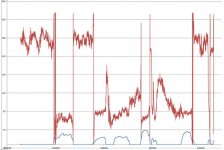
In between the periods when the CV is moving, the chart show the vane motion when the CV is stopped.

The absolute reading will change, because that depends on which direction the vehicle is parked, but the changes are real wind changes.
There is one period that shows 100 degrees of change.
Not "meaningless", but showing the real wind changes. Do you agree?

( the y axis extends to -10, so that it was clear the CV was at 0mph.)


attachment.php
 

Attachments

  • llyicist3.jpg
    llyicist3.jpg
    29.5 KB · Views: 81
Last edited:
That is a complex matter, but this one is simple.

In between the periods when the CV is moving, the chart show the vane motion when the CV is stopped.

The absolute reading will change, because that depends on which direction the vehicle is parked, but the changes are real wind changes.
There is one period that shows 100 degrees of change.
Not "meaningless", but showing the real wind changes. Do you agree?

( the y axis extends to -10, so that it was clear the CV was at 0mph.)


[qimg]http://www.internationalskeptics.com/forums/attachment.php?attachmentid=22448&stc=1&d=1307062206[/qimg]

so what?
 
No, merely irrelevant.

Again;

Any chance of backing up your assertion that vector addition is not appropriate to determine the true wind direction and speed?

That is a complex matter, but this one is simple.

In between the periods when the CV is moving, the chart show the vane motion when the CV is stopped.

The absolute reading will change, because that depends on which direction the vehicle is parked, but the changes are real wind changes.
There is one period that shows 100 degrees of change.
Not "meaningless", but showing the real wind changes. Do you agree?

( the y axis extends to -10, so that it was clear the CV was at 0mph.)


[qimg]http://www.internationalskeptics.com/forums/attachment.php?attachmentid=22448&stc=1&d=1307062206[/qimg]

I think the answer to Llyricist's question is "no".
 
No, merely irrelevant.

It seems to me that the wind indications from the chase vehicle are meaningless when the chase vehicle is not moving because we can't know the chase vehicle orientation in that case. Of course it's possible that we incorporated a memory that maintains the last CV orientation when it stops - I don't really recall. What's your thought?
 
It seems to me that the wind indications from the chase vehicle are meaningless when the chase vehicle is not moving because we can't know the chase vehicle orientation in that case. Of course it's possible that we incorporated a memory that maintains the last CV orientation when it stops - I don't really recall. What's your thought?

I have already said that the orientation is not known, but the changes are not affected by that.

So indeed, the stationary wind vane does show the true wind changes. The vane always points into the wind, no matter how which direction the CV is parked.

You did not notice the vane moving 100 degrees?
If zero is a direct tailwind, then 100 is a 10 degree headwind..or 80. So, when did you set the vane to read "ddw"? Each time the starting line was moved?
 
Last edited:
Let me know that you have this, RP.

@WG: So what extraordinary proof was presented (#7) to show IR's video was spurious?

For clarity:

7. A single exception can negate the entire argument unless you have rock solid evidence that the single exception is spurious.

RP, I don't think you understand this. I Ratant stated that his cart never could achieve DDWFTTW. That is not a problem per se. It just was a cart incapable of achieving the objective. Since it was incapable, Showing it doing anything as an example of what DDWFTTW capable carts can do, is the part that's spurious.

Again, if you substitute my winged brick (which of course is also a failed DDWFTTW cart.) It can't be used to say anything about carts that are DDWFTTW capable. That would be an obviously spurious example.

Am I missing something or is this a difficult concept to understand? I was under the impression that stating this once was a bit snarky simply because it is so obvious. It seems its been used several times since then to try to justify things however.

I've always contended that if I Ratant shows his cart can go up the TM, then it is proven to be a DDWFTTW cart and it can be used to illustrate principles with appropriate controls. I'm assuming everyone has this concept by this point.

Just so we are clear, as stated in my test, if the cart is shown to pass a vehicle which is at windspeed, and then packing peanuts pass it, its doing something that the carteers will have to explain (I'd personally be trying to figure out how the packing peanuts could go FTTW but that's another issue.)
I Ratant's video had no controls to show that the cart was traveling faster than the wind and in fact it wasn't. This obviously does not imply carts can't go faster than the wind, just that his didn't in that particular video.

RP, does this make sense or not yet?

WindGrins,:)
 
A question about how the Wind Direction was computed for CV.

It seems to me that the wind indications from the chase vehicle are meaningless when the chase vehicle is not moving because we can't know the chase vehicle orientation in that case. Of course it's possible that we incorporated a memory that maintains the last CV orientation when it stops - I don't really recall. What's your thought?

Spork,

I was under the impression from an earlier post that the published wind direction when the CV was stopped was determined by the assumption that the gps was producing a "heading" of the CV and then the WindVane direction was added to this to create a "true direction" of the wind.

For example, say the 360 degree index of the windvane was oriented to be facing directly in front of the truck. If the gps said the truck was going 90 degrees (true) and the windvane pointed, say, +45 degrees (relative), then the wind was from 90+45=135 degrees (true).

Was this the case or not?

If it was, the output is truly random (due to the gps standstill random directional walk error). If not you'll have to tell us how the Windvane direction was indexed. This method would work just fine if the CV is moving more than a crawl but won't tell you anything when stationary.

If you had the raw directional data from the windvane seperately, it wouldn't tell the true direction but it would give the deviations which seems to be the point of interest here.

It is worthy of note that this really has nothing to do with the tests when everything is moving but this seems to be a point of interest to some at the moment for some reason.

Regards,

WindGrins
 
Last edited:
It seems to me that the wind indications from the chase vehicle are meaningless when the chase vehicle is not moving because we can't know the chase vehicle orientation in that case. Of course it's possible that we incorporated a memory that maintains the last CV orientation when it stops - I don't really recall. What's your thought?

No, nothing like that was incorporated, but the wind vane measurements will give a good indication of changes in wind direction, if not the actual direction they indicate.

And humber found an instance where the wind shifted by about 100 degrees over a period of a couple minutes while the CV was stationary, and he thinks that invalidates the whole day's worth of data.
 
No, nothing like that was incorporated, but the wind vane measurements will give a good indication of changes in wind direction, if not the actual direction they indicate.
Right, so the vane indicates the changes, just like a fixed station does.

And humber found an instance where the wind shifted by about 100 degrees over a period of a couple minutes while the CV was stationary, and he thinks that invalidates the whole day's worth of data.

Not an instance but one of many. It is not correct to assume that the greater the change, the larger benefit to the cart.
The wind never stops changing by at least 40 degrees. It will be doing that for each run too, because the frequency of change is less than a run time.
 
Not an instance but one of many. It is not correct to assume that the greater the change, the larger benefit to the cart.
The wind never stops changing by at least 40 degrees. It will be doing that for each run too, because the frequency of change is less than a run time.

Humber discovers why the rules said "ten seconds", not "entire run".
 
Spork,

I was under the impression from an earlier post that the published wind direction when the CV was stopped was determined by the assumption that the gps was producing a "heading" of the CV and then the WindVane direction was added to this to create a "true direction" of the wind.

For example, say the 360 degree index of the windvane was oriented to be facing directly in front of the truck. If the gps said the truck was going 90 degrees (true) and the windvane pointed, say, +45 degrees (relative), then the wind was from 90+45=135 degrees (true).

Was this the case or not?

As near as I recall, the heading of the chase vehicle is determined by the GPS velocity vector. This means that the CV heading when it's sitting still will be randomly spinning around due to random GPS walk.

Since the indicated wind direction is given by the vane output plus the vehicle heading, the wind direction output will clearly be random when the vehicle sits still.

If you had the raw directional data from the windvane seperately, it wouldn't tell the true direction but it would give the deviations which seems to be the point of interest here.

Indeed, I'm sure I do have that output somewhere. Perhaps that's the data humber and Llyricist are talking about(?)

No, nothing like that was incorporated, but the wind vane measurements will give a good indication of changes in wind direction, if not the actual direction they indicate.

Perhaps windgrins has unraveled the puzzle. Are you talking about the raw wind instrument readings before vehicle heading correction?
 
As near as I recall, the heading of the chase vehicle is determined by the GPS velocity vector. This means that the CV heading when it's sitting still will be randomly spinning around due to random GPS walk.

Since the indicated wind direction is given by the vane output plus the vehicle heading, the wind direction output will clearly be random when the vehicle sits still.

Only true wind direction will be affected, not the relative direction. The vane shows true wind changes, as I said. A problem is that you can't say which direction ddw is. The offset is only the vane relative to the vehicle. The trial was conducted not only in constantly changing winds, but in a rather extreme case.
That was well hidden from Wired.

llyricist said:
humber said:
It never stops changing, let alone for 10 seconds.
wrong
No it does not, and if you are even a bit observant, you can see what the bits you think do, have in common.
 
Last edited:
The vane shows true wind changes, as I said.

Yes you did say -- and as usual, it's wrong.

A wind vane on a moving vehicle will itself only reflect relative wind changes not true wind changes.

But then we know you have a serious problem with all things relative.

JB
 
Status
Not open for further replies.

ISF - Join now!

Every member here is approved by hand. No bots, no spam, just people who care about evidence and honest debate.

Membership is free!

Create your free account

Back
Top Bottom