
Merged DDWFTTW in a “Real” Wind

Status
Not open for further replies.
Humber,

In my explanation to I Ratant, you seemed to ignore what I actually said in most of my comments and commented on things I never said. I disagree on all your points discussing my explanation but one definitional comment did jump out at me:

Your "Static Thrust" comment. Static Thrust means: thrust a prop produces when operating in a no wind condition, not when its not producing thrust. Clearly props do produce static thrust in no wind conditions or no airplanes could taxi when there is no wind. When the BB is at Windspeed-which clearly implies that the prop is in a no wind condition as described above, if it is turning, it is producing static thrust. This may not be the most efficient point to operate but it is certainly real thrust. If that real thrust exceeds overall retarding forces, the cart will accelerate.

When you produce your video, we'll have something else to talk about. Till then, I'll watch your comments.

Thanks for the feedback.
 
Then you are positing two things.

Entirely friction free travel ...
No. Wrong.

If you release a balloon travelling faster than windspeed, friction very rapidly slows it down to windspeed. You claimed it would slow to below windspeed. You are wrong, but have never explained why you think so.
And what turns the prop? The wheels? They generate power because they are turning? And that is not PM?

The wind pushes on the prop like a sail. The prop hub pushes on the mast... You know what - let's just pretend I explained why you are wrong yet again, and you didn't understand yet again. OK?
 
.
Go back to your response at the time, sweet cheeks.

Alrighty then -- I've done my homework:

This is the earliest location I could find that you posted that particular graphic.
http://www.internationalskeptics.com/forums/showpost.php?p=7073087&postcount=2286

Here's the truth, oh admirer of my cheeks -- I NEVER responded IN ANY WAY to your posting of that graphic. Zip, zero, zilch.

Now, you're welcome to find a post of mine "at that time" that I missed and produce it (at which time I will apologize for my just made mistake), but I suspect there will be no need for that apology as I have checked quite carefully.

So now you're left needing to make TWO explanations:

A: why you continue TODAY to contradict yourself regarding the thrust of the prop at WS

and

B: why you try to dodge your contrdiction by falsly claiming that I responded to the graphic when I in fact did not.

Time to put up -- produce the post that you claim I made in response to your graphic.

JB
 
When the balloon travels, it creates air motion in 3 dimensions, vortexes, stagnation points, intermittent laminar flow that changes the mass, striation, heat of friction, surface oscillation...

When the balloon moves at the same speed as the air around it, it is not travelling relative to the air.
 
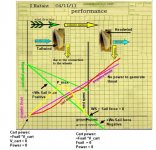
Discussion of your graph

.
Shurely.
No quantitative data, just a toss-up for discussion. Which never followed.

I Ratant,

HUH? What is it you want to discuss? I assume your green line is bluff body force? Is this correct? If so, why do you not extend it past WS. It is clearly acting as a negative there on the cart. Since I assume you made that graph up for illustration, what is it that you want quantified?

Help me out here.

Also, have you figured out how this works from the previous explanation?
 
Humber,

In my explanation to I Ratant, you seemed to ignore what I actually said in most of my comments and commented on things I never said. I disagree on all your points discussing my explanation but one definitional comment did jump out at me:

Your "Static Thrust" comment. Static Thrust means: thrust a prop produces when operating in a no wind condition, not when its not producing thrust.
Static thrust is when the prop is not in motion relative to the air.
It still produces only a small amount of power, whether fixed to a post, or because there is not air flow when in the air.
http://www.mh-aerotools.de/airfoils/prpstati.htm

Clearly props do produce static thrust in no wind conditions or no airplanes could taxi when there is no wind.
Contrary. If the prop is moving relative to the air thrust is not static.
Cessna's have an engine, and do not need the wind to produce thrust. The power to taxi is small. There is enough residual work to cover that.

Static thrust is measured by attaching a prop to a mounting, and using strain gauges to measure the force.
http://www.mh-aerotools.de/airfoils/propuls1.htm
http://aerade.cranfield.ac.uk/ara/1940/naca-report-684.pdf

When the BB is at Windspeed-which clearly implies that the prop is in a no wind condition as described above, if it is turning, it is producing static thrust. This may not be the most efficient point to operate but it is certainly real thrust. If that real thrust exceeds overall retarding forces, the cart will accelerate.
What turns the prop? It needs power. Where does that come from?
Don't say the wheels, Windgrins, because it has already been said the cart does not break the laws of conservation of energy, but to claim that the wheels do, is such a breach.

Maybe, Windgrins, you were at first skeptical, but kept an open-mind and took on board what TAD said. Perhaps you have now closed that mind, after stopping at the convenience store.
If the TM was "impossible" but now it is, that does not mean TAD got the explanation correct. All trial and error, not math.
 
No. Wrong.

If you release a balloon travelling faster than windspeed, friction very rapidly slows it down to windspeed. You claimed it would slow to below windspeed. You are wrong, but have never explained why you think so.
Cd =0
You lose. Again.

The wind pushes on the prop like a sail. The prop hub pushes on the mast... You know what - let's just pretend I explained why you are wrong yet again, and you didn't understand yet again. OK?
And the woman who swallowed a bird, to catch the spider, to catch the fly...
 
Humber


You stated: Contrary. If the prop is moving relative to the air thrust is not static.
Cessna's have an engine, and do not need the wind to produce thrust. The power to taxi is small. There is enough residual work to cover that.


I looked at that same website and agree: Props are generally not as efficient in a static thrust condition as at design speed.

However, All airplanes in no wind conditions have to start taxing from 0- a static thrust situation.

I have this personal experience so I can vouch for this: A small general aviation airplane at full power in a static thrust condition has enough thrust to overcome fully locked brakes-that's a lot of thrust.

This is why all pilots are taught to tie aircraft down when they are being hand propped for a start. Otherwise they have been known to crank and go skittering off on their own with locked brakes.:o

What turns the prop? It needs power. Where does that come from?
Don't say the wheels, Windgrins, because it has already been said the cart does not break the laws of conservation of energy, but to claim that the wheels do, is such a breach.


NOPE! wrong again. Of course it needs power. Clearly your argument is flawed since the prop on the cart is turning backwards from the way one would expect if it was "windmilling". If the wind is not turning the prop, then the only thing left to turn the prop is the wheels through the drivetrain. The wheels do turn the prop and this does not contradict COE. The power input is from the wind/ground differential. No magical power inputs and no power production by the cart. The power of the wind/ground differential which is a force on the body of the cart in the direction of travel is absorbed by the wheels which transfer it to the prop which transfers it back to the air. Thus slowing the air slower than its original differential velocity. It then has less energy than it started with so no COE violations!

Maybe, Windgrins, you were at first skeptical, but kept an open-mind and took on board what TAD said. Perhaps you have now closed that mind, after stopping at the convenience store.
If the TM was "impossible" but now it is, that does not mean TAD got the explanation correct. All trial and error, not math.[/QUOTE]


Still open minded but if someone tells me that airplanes can't fly, my response that one flew over my house this morning is mighty convincing to me! I may not understand it. I may even disagree with how most people say it works but I would tend to say there was a flaw in their argument when faced with this emperical evidence. And that's about all I have to say about this.
 
Last edited:
When the balloon moves at the same speed as the air around it, it is not travelling relative to the air.

Except that it can't do that. Do you really think that everyone else can't "imagine" your utterly banal claim?

LOL -- leave it to humber to assert that a balloon can't possibly sit 'still' in a room full of 'still' air. (ignoring brownian which is irrelevent to the question on the table).

JB
 
LOL -- leave it to humber to assert that a balloon can't possibly sit 'still' in a room full of 'still' air. (ignoring brownian which is irrelevent to the question on the table).

JB

The Balloon in the Room has no Kinetic Energy, and has not been accelerated to speed. That is not true of the balloon at WS. The hubris that allows you to think you can teach...
And don't give me that Relative KE line...I will burn your house down.
 
I Ratant,

HUH? What is it you want to discuss? I assume your green line is bluff body force? Is this correct? If so, why do you not extend it past WS. It is clearly acting as a negative there on the cart. Since I assume you made that graph up for illustration, what is it that you want quantified?

Help me out here.

Also, have you figured out how this works from the previous explanation?
.
Nothing to be quantified.
Just talking points.
What does what when.
The how can be added, but the how much not really germane.
That was in a response to TAD's(pbuhn) message above it.
You'll notice the response today contains just as much information and desire to inform...
I NEVER responded IN ANY WAY to your posting of that graphic. Zip, zero, zilch.
Not exactly encouraging for "friendly and lively" discourse.
 
Got it in one ... a cheering moment

We have two house guests, a couple we have known for decades. After dinner, while the girlies were away discussing the 'good ole days' or shoes or babies or makeup or something I chatted to Mike. He's a keen sailor of many years experience and has a degree in physics. His work for a long time was as video editor at the BBC where he invented some pretty serious ve techniques.

So I tried, over yet another glass and as gently as possible, to lead him into a discussion about DDWFTTW. Eventually I described the BB design etc etc. I asked him how fast it could go.

After a few seconds (:eye-poppi) thought he said "Well, there's no limit except as determined by the friction involved". Dazzled, I asked him to explain. He said "The machine can always exploit the relative speed of the wind over the ground, as long as it blows or until you run out of track". When I told him BB made 2.8 x windspeed he wasn't surprised.
So there we are. A meaningless anecdote I thought I'd share :)
 
Humber
I looked at that same website and agree. Props are generally not as efficient in a static thrust condition as at design speed.
Theoretically, it is zero, but in reality not. There are many formulas and opinions on how that anomaly should be handled.

I have this personal experience so I can vouch for this. A small general aviation airplane at full power in a static thrust condition has enough thrust to overcome fully locked brakes-that's a lot of thrust.
And a very big engine. Let's say the efficiency is low. 5% of a lot, is enough.
You will note that to overcome the brakes, the engine runs very fast.
It works, so the engine must be responsible somehow, Windgrins.

This is why all pilots are taught to tie aircraft down when they are being hand propped for a start. Otherwise they have been known to crank and go skittering off on their own with locked brakes.:o
Can do, but the work is small.
It is all irrelevant. The cart has no engine, so efficiency of that non-existent engine is moot.

What turns the prop? It needs power. Where does that come from?
Don't say the wheels, Windgrins, because it has already been said the cart does not break the laws of conservation of energy, but to claim that the wheels do, is such a breach.


NOPE! wrong again. the wheels do turn the prop and this does not contradict COE. The power input is from the wind/ground differential.

That is 100% TAD nonsense. The mother load.

It is a gimmick to say "differential" without saying where the source is. The source of energy is the wind, but at wind speed the cart and wind are at the same speed, so the cart can not gain energy from the wind. The force vectors from the wind, and from the ground are in opposite directions.

No magical power inputs and no power production by the cart. The power of the wind/ground differential which is a force on the body of the cart in the direction
The relative velocity of cart and wind is zero. No power!

of travel is absorbed by the wheels which transfer it to the prop which transfers it back to the air.
The wheels are in motion. There is an opposing force of rolling resistance upon the wheel. As I have said, there is no energy from the wind.

If the wheels also turn the prop, the energy to do that must come from somewhere, and that is the Kinetic Energy of the cart. The prop will lose energy to the air, the Kinetic Energy of the cart will fall, and the cart slows.

Thus slowing the air slower than its original differential velocity. It then has less energy than it started with so no COE violations!
Above wind speed, the cart is faster than the wind, so must push it out of the way. The air is accelerated, so gains Kinetic Energy. Again, the wind can't power itself to be faster than itself, so that energy comes from the cart's Kinetic Energy, and the cart slows.

Still open minded but if someone tells me that airplanes can't fly, my response that one flew over my house this morning is mighty convincing to me!
Perhaps, but why choose an example of something that is certainly known to be true?
How about a magician that saws a lady in half? Surely, you have seen that too, but I hope you don't believe it.
Perhaps this newclaim of ddwfftw, is not what it seems.

I would tend to say there was a flaw in their argument when faced with this emperical evidence. And that's about all I have to say about this.

But, if TAD make a TM that is false, an offer a theory that can't work, perhaps the trial is in the same wrapper.
It is odd that you will find no text book support for any of TAD's theories.

And this is closer to reality:
attachment.php
 

Attachments

  • I_ratant2.jpg
    I_ratant2.jpg
    52.4 KB · Views: 63
.
Nothing to be quantified.
Just talking points.
What does what when.
The how can be added, but the how much not really germane.
That was in a response to TAD's(pbuhn) message above it.
You'll notice the response today contains just as much information and desire to inform...

Not exactly encouraging for "friendly and lively" discourse.

OK,

I'm not getting in the middle of those issues.

Here's what does what when:

At zero speed, the cart, et al is a bluff body. The tailwind causes it to start moving downwind. As it moves the wheels start turning the prop through the drive train. As the the prop turns, it pretty quickly starts coming out of its stalled condition (the exact timing will depend upon prop shape, drive train gearing, etc but long before the cart reaches wind speed.) As soon as it unstalls, it starts producing considerable thrust because an unstalled airfoil is much more efficient than a stalled one.

From this point the prop produces more and more thrust the faster the cart goes. The only thing that changes is that from an aerodynamic drag perspective on the body of the cart, the force decreases until windspeed is reached and then increases as a retarding force until max velocity is reached. If the cart doesn't break, it is now traveling at some speed greater than the wind (assuming enough wind to make this work at all). This is max steady state velocity for the wind speed. The retarding forces at steady state are the drag forces on the prop (in the plane of the prop), aerodynamic drag on the cart body, and frictional losses-drive train loss, wheel friction, etc.

PS, remove Humber's yellow line on your graph above and the graph is roughly correct.

I think that's the whole story! Does this work for you?

Regards,
 
Last edited:
That is 100% TAD nonsense. The mother load.

It is a gimmick to say "differential" without saying where the source is. The source of energy is the wind, but at wind speed the cart and wind are at the same speed, so the cart can not gain energy from the wind. The force vectors from the wind, and from the ground are in opposite directions.

The relative velocity of cart and wind is zero. No power!

This sums up why I am back to believing Humber is a troll who is jusy having fun with everyone. No one could be as stupid as he is pretending to be here. He was just told it is the wind/ground speed differential which is being utilized but he immediately starts talking about the wind/cart speed differential which is irrelevant. He in fact knows that it is irrelevant. He has been told it is irrelevant thousands of times yet he has written the above again. I believe that by definition he is trolling now.
 
We have two house guests, a couple we have known for decades. After dinner, while the girlies were away discussing the 'good ole days' or shoes or babies or makeup or something I chatted to Mike. He's a keen sailor of many years experience and has a degree in physics. His work for a long time was as video editor at the BBC where he invented some pretty serious ve techniques.

So I tried, over yet another glass and as gently as possible, to lead him into a discussion about DDWFTTW. Eventually I described the BB design etc etc. I asked him how fast it could go.

After a few seconds (:eye-poppi) thought he said "Well, there's no limit except as determined by the friction involved". Dazzled, I asked him to explain. He said "The machine can always exploit the relative speed of the wind over the ground, as long as it blows or until you run out of track". When I told him BB made 2.8 x windspeed he wasn't surprised.

So there we are. A meaningless anecdote I thought I'd share :)

And the pilot employed by Mythbusters, didn't think the plane would take off,
and having physics degree means you are on the bottom rung on the way to becoming a physicist. A career in video editing is not a good indicator.
Show me the text books, supporting any of the claims.
 
Status
Not open for further replies.

ISF - Join now!

Every member here is approved by hand. No bots, no spam, just people who care about evidence and honest debate.

Membership is free!

Create your free account

Back
Top Bottom