Merged DDWFTTW in a “Real” Wind

Status
Not open for further replies.
The relative velocity of cart and wind is zero. No power!


[/qimg]

Humber,

Last attempt. The fundamental flaw in your argument is the part about the cart being at WS, that there is no wind to take the energy from. The flaw is that the prop, unlike the cart is never in a no wind condition at any point. The prop is always turning and is always harvesting the differential energy. This is not to be confused with "windmilling" since it is turning in the opposite direction than "windmilling".

To state it clearly. When the cart achieves Wind Speed-Zero Relative Velocity to the wind, the prop is far from Zero Wind Speed. The wind the prop blades "see" is not in plane of the prop rotation-Hence the confusion.
 
OK,

I'm not getting in the middle of those issues.

Here's what does what when:

At zero speed, the cart, et al is a bluff body. The tailwind causes it to start moving downwind. As it moves the wheels start turning the prop through the drive train. As the the prop turns, it pretty quickly starts coming out of its stalled condition (the exact timing will depend upon prop shape, drive train gearing, etc but long before the cart reaches wind speed.) As soon as it unstalls, it starts producing considerable thrust because an unstalled airfoil is much more efficient than a stalled one.

From this point the prop produces more and more thrust the faster the cart goes. The only thing that changes is that from an aerodynamic drag perspective on the body of the cart, the force decreases until windspeed is reached and then increases as a retarding force until max velocity is reached. If the cart doesn't break, it is now traveling at some speed greater than the wind (assuming enough wind to make this work at all). This is max steady state velocity for the wind speed. The retarding forces at steady state are the drag forces on the prop (in the plane of the prop), aerodynamic drag on the cart body, and frictional losses-drive train loss, wheel friction, etc.

PS, remove Humber's yellow line on your graph above and the graph is roughly correct.

I think that's the whole story! Does this work for you?

Regards,
.
That's the way I kinda think it works.
I started with a bare-ass cart.
Just the structure to hold the prop.
Your "bluff body".
In the available wind, it didn't move.
Adding the prop, but fixed for no rotation, the cart moves off downwind.
No thrust, just a fancy shaped sail.
Freeing the prop, it moves off downwind more spritely.
I've not seen anything that would indicate this square one stuff has been performed.
Adding (on another cart) the structure required to get the wheels and prop connected, the initial method chosen just has too much system friction in the bearings, and the tension needed to get the cord drive between the wheels axle and the propellor shaft for it move at all, except when the cord is disconnected. Then it goes off downwind just like the freewheeling prop version.
The latest version has almost an order of magnitude less system friction, and moves in the wind, self starting.
I have every reason to feel that when the winds straighten out and blow at a steady rate and direction, it will move just fine.
And I have the freewheeler to release at the same time, as a "which is faster" check, there being no practical to set up a speed trap downwind, without adding steering.
Don't wanna do that.
 
I Ratant,

Just ensure your gearbox has the 1:1 ratio or less (wheels turn as much or more than the prop does). Your prop looks a little small compared to the working models but it still may well work. Set your prop up correctly so that when the cart is rolling forward, the prop is pushing the cart with the ensuing rotation. Since you are an RC guy, you will know how to do this.

I don't know if you have a treadmill or access to one but if you set the TM for a speed and the cart climbs up the treadmill, you will know the WS necessary for your cart to go DDWFTTW. (minimum speed on the TM where this occurs.)

PS, I don't know if you are on one side or the other on this TM thing but I will assure you it is a valid test platform for the above. PPS. Since the treadmill is so repeatable, its a great place to test your DDWFTTW cart but your ungeared cart will always just roll off the back end.

You probably have all this but that's my discussion! :)
 
Last edited:
Yep -- humber's a hoot.

JB

KE = m*a*d.
K is for kinetic
E is for energy
m if for mass
a is for acceleration
d is for distance.

And yes, the Earth is moving and all that, but that is your nonsense.
How delightfully apt you have Spork as a tutor.
Enjoy the record while you can, but don't forget to keep looking over your shoulder.
 
Cd =0
You lose. Again.
What on earth do you think you are talking about? That non sequitur makes absolutely no sense whatsoever. If a moving, neutrally buoyant balloon is released in a body of air, its large drag and low inertia mean it will very quickly slow to a stop relative to the air. If that body of air is also moving relative to some other frame of reference (the ground for example) it doesn't matter, as it doesn't influence the balloon in any way.

But you claimed a balloon floating in the air magically knows which way the ground is moving relative to the air and magically accelerates in that direction. Would you care to defend that ridiculous assertion, or just try to evade it by pasting more irrelevant garbage about zero friction, as if that had anything to do with the matter?
 
OK,

I'm not getting in the middle of those issues.

Here's what does what when:

At zero speed, the cart, et al is a bluff body. The tailwind causes it to start moving downwind. As it moves the wheels start turning the prop through the drive train. As the the prop turns, it pretty quickly starts coming out of its stalled condition (the exact timing will depend upon prop shape, drive train gearing, etc but long before the cart reaches wind speed.) As soon as it unstalls, it starts producing considerable thrust because an unstalled airfoil is much more efficient than a stalled one.

From this point the prop produces more and more thrust the faster the cart goes. The only thing that changes is that from an aerodynamic drag perspective on the body of the cart, the force decreases until windspeed is reached and then increases as a retarding force until max velocity is reached. If the cart doesn't break, it is now traveling at some speed greater than the wind (assuming enough wind to make this work at all). This is max steady state velocity for the wind speed. The retarding forces at steady state are the drag forces on the prop (in the plane of the prop), aerodynamic drag on the cart body, and frictional losses-drive train loss, wheel friction, etc.

I think that's the whole story! Does this work for you?

Regards,
.
Yup.
60 some pages.. a short message and a pichur.
(note: the actual variations of the propellor values will be non-linear... due to vSqvareRoHalf, as my aero prof Max Munk would say at least once a class session. :) )
 

Attachments

  • SailEffect-04.jpg
    SailEffect-04.jpg
    147.2 KB · Views: 2
The source of energy is the wind, but at wind speed the cart and wind are at the same speed, so the cart can not gain energy from the wind.
Do you have any recollection of how many times you have been told that the wind pushes the propeller blades? Or the number of times you have responded with the irrelevant observation that the propeller hub is travelling at windspeed? Can't you think of any more cogent objection to how the cart works?
The relative velocity of cart and wind is zero. No power!
Well, no. It appears you can't.
 
Notes on I Ratant's diagram

I Ratant,

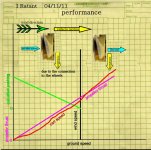
A short note on your diagram. I believe the magnitude of your green line would start at a much lower value as the force on the cart as a bluff body is pretty darn small. It would reduce to zero at WS and then would go negative as a function on WS**2 at speeds above WS.

Interestingly Humber sort of got some of that right with his diagram but as mentioned earlier, forget the yellow line. He is just making that up to match his beliefs but clearly the BB does not behave that way.

Regards,
 
So it's clear that I Ratant can't explain his direct contradictions made within just a few posts of each other.

Thrust or no thrust at WS? In spite of being told repeatedly and by numerous contributors what the answer is, I Ratant *still* can't figure out which it is.

JB
 
Probably been said before, but wouldn't this very idea violate thermodynamics?

Yes (been said). No violation.

But that fact that your thought is the first thought most folks have is what makes is such an interesting brainteaser.

JB
 
Humber,
Last attempt. The fundamental flaw in your argument is the part about the cart being at WS, that there is no wind to take the energy from.
That is correct. All texts will tell you that. Drela will tell you that.

The flaw is that the prop, unlike the cart is never in a no wind condition at any point.
Ah, but that's trick commonly employed by cranks, Windgrins; start in the middle.

If the prop is not turning at WS, because it is not connected to the wheels, then it can't be argued that power can be added to or taken from the wind when in that state. The prop won't spontaneously turn when in the still air of a room, nor take energy from it, so it won't now.( Will it, JB? )

When in the still air of a room, you need an engine if you hope to turn and power the prop, so you need one now. Remember that the prop is not connected, so the wheels are rolling along as expected... but wheels are not engines.
The claim is clearly exposed as hidden PM, with the wheel driving the prop, which drives the wheel...


The prop is always turning and is always harvesting the differential energy. This is not to be confused with "windmilling" since it is turning in the opposite direction than "windmilling".
The rotor does not "harvest" energy in some vague manner. To gain energy from the wind, momentum must be transferred to the rotor.
The cart is traveling faster than the wind, so will transfer energy to the wind. The direction of rotation does not determine the events, but is a consequence of applied forces.

To state it clearly. When the cart achieves Wind Speed-Zero Relative Velocity to the wind, the prop is far from Zero Wind Speed. The wind the prop blades "see" is not in plane of the prop rotation-Hence the confusion.
No confusion Windgrins. The wind is not a stick nor a string, nor does it "see".
It carries momentum, which is the product of velocity and mass, and that is transferred to the prop or sail.

The conditions at or above WS, mean that the transfer is from the cart to the wind. It is clear that the chassis is a source of drag, because it accelerates the slower air before it. The prop will do the same. The wind can't move itself out of the way - should it, there would be no means of taking energy from it.
The prop will displace the air before it, and accelerate it. That will happen no matter how some may like to "trick" it with angles and turning this or that.

The cart is out on a limb, with no text book support nor solid theory, and that is because TAD made it all up. The rest is a show and so forth.

 
Probably been said before, but wouldn't this very idea violate thermodynamics?

Would an ice yacht making ground into the wind by a factor of 5 x windspeed violate thermodynamics?
 
It works, so it doesn't. (violate thermodynamics.)
Not many things can.
 
Last edited:
All,

I think I reached my point of "Zero Information Content" passing between Humber and I.

I await his posting of the video of his cart which travels up the treadmill with the conditions stated earlier. Since this was his idea, I think it's fair game!

It's not really worth responding to his posts until something new arises. It's pretty clear where his arguments fall apart and I feel like I was polite and responded nicely but he really didn't give me quite the same courtesy. He spent a lot of time talking about "Show me a textbook with this in it" and when I did he dismissed a serious physics text by saying that he and his friend saw it as "somewhat mystical". The Symmetry of Sailing Text by Garrett is about as far from "mystical" as one can get. So far, his physics understanding seems pretty "mystical" to me so perhaps there is an interesting symmetry there after all.

I do think his fundamental lack of understanding comes from this point about not understanding that at 0 WS (wrt to the cart), the prop blades are experiencing a large relative "wind" to extract the power from. Everything else is just Obfuscation and tangential nonsense that don't apply except in name only. The rest is of course just tortured rationalization with painfully poor examples. If one can't understand the treadmill argument, I don't think one has much hope of understanding the more subtle aspects of this.

So, I'm going quite on Humber posts until something new comes along. Insults are definitely not worth responding to!

Respectfully,

WindGrins
 
Last edited:
I Ratant,

A short note on your diagram. I believe the magnitude of your green line would start at a much lower value as the force on the cart as a bluff body is pretty darn small. It would reduce to zero at WS and then would go negative as a function on WS**2 at speeds above WS.

Interestingly Humber sort of got some of that right with his diagram but as mentioned earlier, forget the yellow line. He is just making that up to match his beliefs but clearly the BB does not behave that way.

Regards,
.
The "bluff body" force has to include the unmoving prop's effect, which is large enough to move the cart. Ain't nuthin' else to do that.
The lines are not set in concrete, just talking points for the discussion.
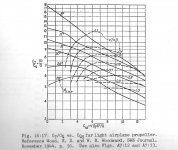
Going into propellor dynamics, I didn't want to when I had to and I certainly ain't goin' there now! :)
 

Attachments

  • PropellorCoefficients.jpg
    PropellorCoefficients.jpg
    127.1 KB · Views: 1
Last edited:
Status
Not open for further replies.

ISF - Join now!

Every member here is approved by hand. No bots, no spam, just people who care about evidence and honest debate.

Membership is free!

Create your free account

Back
Top Bottom