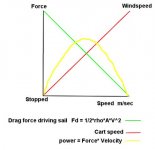
Yep -- we call this ratio the "speed ratio" (no real reason -- lack of better term) and if it's 1:1, the vehicle goes very near nowhere (the wheels and the 'turbine' tendency of the rotor battle to a tie).
If this ratio is less than 1, say the above prescribed .75, then it works DDW reasonably well (including self starting) in a variety of wind speeds. The lower that ratio, the slower the top speed but the faster the acceleration. The higher the ratio, the closer the theoretical top multiple of the wind gets to infinity and the more wind it takes to self start.
If this ratio is more than 1.0, the desire of the rotor to turbine wins out over the wheels desire to rotate the rotor as a propeller and the device simply backs up into the wind (an upwind vehicle in other words). Again, if this ratio was 1.00001, in theory it would move upwind freakin' fast but would be very unlikely to self start. If it were 1.5 it would fire right up but not advance very quickly.
As you can see, the theoretical speeds reach infinity from both sides (upwind and downwind) as you get closer to 1:1.
Your total system efficiency also has a great deal to do with how close one can place the ratio to 1:1. Use cheap (or no) bearings and a poorly matched propeller and you might want a .65 ratio to make it work. A higher end and more considered vehicle can utilize a .85 or more (we've done it) and rip along quite nicely (like say 3-4x WS).
Hope that helps.
JB



 Good Advice!

 )