William Parcher
Show me the monkey!

- Joined
- Jul 26, 2005
- Messages
- 27,680
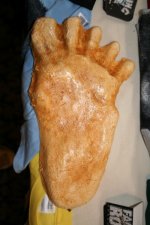
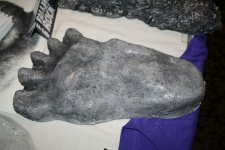
This is a plaster cast from this trackway, yes?

The toes look too narrow to be bear. They even look too narrow for human or "Bigfoot". These toes seem to get narrower towards the right (towards the "little toe"?). But bear prints (front foot and back) don't show much of a descending reduction in toe size as you go from "thumb-to-pinkie" or from "big toe-to-little toe". With a bear, the two outside toes are obviously different in size... but the three "center toes" are nearly identical. IOW, bears don't have a nice uniform reduction in digit size as you go from inside digits towards outside (front foot or back).
Besides that, this print shows strangely narrow toe impressions considering the foot had slid backwards through mud before finding a grip. Those individual toes should be compressed (widened) as the push into the mud to create the locomotive push-off. IOW, the foot and toes slid backwards until they found a "firmness" that could propel the mass of the animal forwards.
Look at the shape of your own bare toes suspended in mid-air. Now press them against a clear glass sheet, looking from the bottom. They "squish" and widen. To me, the toes in this casting look too narrow to realistically resemble a living bear, human or Bigfoot (whatever its toes may look like).