Bigfoot - The Patterson-Gimlin Film

Status
Not open for further replies.
That's because it just happens when you walk. You don't need to do anything special to duplicate it. You can get a midtarsal break and slide in your footprint with a flat bottomed shoe on.

Wrong sir or madame! The technology for a bending foot didn't exist in 1967. Feet in those ancient times tended to remain rigid during walking and climbing. What you are claiming is not possible. It's just not...

(runs from the room in tears - then returns)

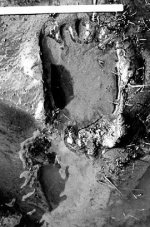
Sorry... I'm just emotional because I'm being beaten up my colleagues over at the BFF because I dared to suggest that the Meldrum print in the left photo might be similar to the bear track on the right.

I guess I'm suggesting that it might help to dispense with info that can be determined to be bogus whether we really, really like the guy that unearthed it or not. Just an idea I had once.

- Dfoot
 
From the A & E documantary narration:

Krantz:
"we have an awful lot of bits of information about the social relationship among the Sasquatches. The best view now is that they live in small groups of one male and 4 sometimes 5 females and that this is the breeding community. Then as they have offspring, the young females grow up and replace the adult females as they are dying. The young males are grown up and they are driven out of the group by the adult male which tolerates no competition. So then these young males, I call them rogue males, will just wander the countryside in suitable environments, growing up, getting stronger, looking for another social group where they can perhaps have a conflict or challenge the dominant male there, and hopefully take over. Now, as to the total population, I’ve worried about this a good many times and I’m making a flying guess that there is in the Pacific Northwest part of the U.S. and adjacent Canada, somewhere in the ball park of 200 of them."

Dr. John Crane, Zoologist:
"How does he <Krantz> know this? <laughing> I mean how does he know they have a social grouping? How does he know that they have anymore intelligence than a Grizzly Bear or any more intelligence than a coyote or any of the bears?"

Crane's response is exactly what a scientist should say to that silliness.
 
Meldrum's bear trackway. This is just a bear walking along and overlapping his feet as usual, imo.

002_1.jpg
 
Lu just can't stand the idea that Meldrum was fooled by bear tracks...

In this post:
http://www.bigfootforums.com/index.php?s=&showtopic=13887&view=findpost&p=294187


She writes:

.....with no apparent claw marks in the middle or at the ends of the toes, the feet are perfectly lined up and never mind overlaid bear tracks are extremely rare.

Well I'm sure Lu is right, and this Wildlife Biologist with a Ph.d is wrong..

http://www.spiritone.com/~brucem/bigfsec2.htm

Let's take a look at some bear tracks. Specifically, let's first look at a set of drawings -- all done by professional wildlife biologists in published science books -- of one aspect of bear tracks. That is, that bears, of different species in different parts of the world, commonly overstep their own tracks, or step in the same tracks made by other individual bears or by themselves.

Thanks to Starrman for the excellent link, that I should have checked out earlier..
 
I am trying to figure out this B&W version of the bearfoot print picture.

It appears to be sharper and I believe I can see a line from a claw above the center toe.

It looks like the rain has actually partially filled in the print with sediment. That would be why the claw marks have gone.
 

Attachments

  • untitled.JPG
    untitled.JPG
    32.9 KB · Views: 23
Last edited:
http://www.isubengal.com/news/2002/10/23/Life/Isu-Professor.On.Bigfoots.Trail-304928.shtml

Growing up in the Pacific Northwest, he was fascinated by the possible notion of Bigfoot roaming the mountains. But it was not until he was well into his career that he stumbled upon evidence that fueled the next six years of studies.

Meldrum was a believer all along. He did not just convert a few years ago.

Just outside of Walla Walla, Wash., Meldrum discovered fresh tracks across a muddy dirt road of what could only be assumed those of Sasquatch. The 14-inch tracks were believed to be mere hours old and possessed the common traits of previously discovered prints.

"As it sank in, the hair on the back of my neck stood up as my mind visualized what made the tracks," said Meldrum.

Fresh tracks, mere hours old, yet no pursuit. Again and again this scenario is repeated.

Meldrum took casts and photographs of the seven footprints he discovered.

Now it's only seven footprints? Wasn't it 40?
 
Limited examples of faint dermatoglyphics were apparent, but deteriorated rapidly under the wet weather conditions.

That one is from Meldrum's page. There could have been claw marks that deteriorated rapidly. Like before Meldrum got there.


Got to use that for Tube, who said he saw the cast, but did not see claw marks..

------------------

Tube are you there ?
 
Got to use that for Tube, who said he saw the cast, but did not see claw marks..

------------------

Tube are you there ?

Yes sir, present and accounted for. I suspect that if features as gross as claw marks had been washed out by rain, then the cast that I saw would have had much less detail than it did.
 
Yes sir, present and accounted for. I suspect that if features as gross as claw marks had been washed out by rain, then the cast that I saw would have had much less detail than it did.
But we have shown that claw marks are not always visible at all..

I see a couple of dimples that might correspond to claw marks, but they could be pebbles, or rain artifacts..

The print looks like a lot of verified bear tracks. The trackway looks like it was made by a bear..

002_1.jpg


Why imagine it is anything else?
 
Ok, here´s my take on some of the "bearbigfootprints" presented by Meldrum at http://www.isu.edu/~meldd/fxnlmorph.html, from where the pics were cropped.

bearfeet.jpg

(A)
(1) Rear foot imprint;
(2) Forward foot imprint, partially obscured by the later imprint of the rear foot;
(3) Mud splatered by the rear foot;
(4) Front foot claw marks, partilally obscured by mud splatter.

(B)
(5) Claw imprint (faint);
(6) Rear foot imprint;
(7) Forward foot imprint.
Cracks indicate the mud was probably partially dry when the bear walked over it.

(C)
(8) Claw marks, possibly created over very wet slippery mud.
Meldrum proposes the marks were created by bigfoot's fingers, when the forward part of the foot rotated about an axis (the mid-tarsal break). Anyone who played in the dirt or mud when he/she was a child will quickly understand why those most likely were not produced by fingers. Thrust your foot's fingers in mud. Rotate the foot backwards. Do the same with your hand's fingers. The results will nowhere be near what´s in the pic. What's in the pic can only be achieved by thrusting paralell narrow rigid blade-like objects (yeah, claws) in the mud. Just like a bear can do while walking on soft mud. Note that just below the arrow's point there's a divide, a change in thickness that may be where the claws join the fingers.

(D)
(9) This is supposed to be a "splattered finger", showing that the fingers are articulated and not just rigid wood carvings. Try moving your foot´s little finger to that position while walking... The result: OUCH!!!! But the footers will say that this is OK for bigfeet, since they have prehnsile feet. We'll touch this issue just a bit later.
(10) Check the position of this finger. Now look at the overall position of the fingers. Now compare this with the footprints at the bottom of the following pic, all taken as "bonna fide" bigfoot footprints:
midtarsalbreaks.jpg

One does not need to be an expert in anatomy, biology, primatology, etc. to see that FINGER MORPHOLOGY AND DISPOSITION DO NOT MATCH when we compare the feet (A), (B), (C) and (D) with the bigfoot footprints at the bottom of the pic!!!

Oh, yes, the "prehnsile feet" issue. The above pic also show some real prhensile feet, mid-tarsal breaks included. One does not need to be an expert in anatomy, biology, primatology, etc. to see that THERE IS NO MATCH BETWEEN THE REAL FEET WITH MID TARSAL BREAKS AND THE ALLEGED BIGFEET FOOTPRINTS!!!

Footers will then, as a last resort, appeal to Loren Coleman and his 9 species of unknown primates that live in North America (aquatic apes included), after of course, the standard complains about "close-minded scoffics", etc. etc. etc.

 
Footers will then, as a last resort, appeal to Loren Coleman and his 9 species of unknown primates that live in North America...

Coleman is the Living Patron Saint of all of those who believe that animals not living on Earth, are presently living on Earth. They call it Cryptozoology.
 
004.jpg


This is a crazy footprint to try to evaluate. It's like a big rectangular block with toes. It's not shaped like a single bear footprint, nor is it shaped like a single hominoid footprint. There is no visible tapering towards the heel. The left-side line is almost totally straight and parallel to the line of travel. What the hell is that stuff? It's as if it isn't bear, human, or Bigfoot!

Maybe overlapping prints would cause this. But, you have to wonder why is looks like a cinder block impression with toes, instead of any kind of known (or postulated) animal foot.
 
Yeah, it sure doesn't look like a sasquatch foot. Nothing like Patty's feet, for example. So why the big defense of it as a squatch footprint?

How do they reconcile the difference between this print, and the normal Bossburg footprint, for example, which looks exactly like an enlarged human footprint?

Squatch must have variable feet.

It looks closest to typical overlapping bear prints.

There is, of course, the possibility that a hoaxer found the bear prints and took advantage of the opportunity.
 
Perhaps I have an additional bias in this question having also examined, at length, two other Paul Freeman casts, namely the so called "Mill Creek" cast from 1982 which included human dermals and "Wrinkle Foot" which is also alleged to have dermal ridges.

The casts Freeman put forth seemed to have a certain "style" to them, much different than other alleged Sasquatch casts. I tend to interpret the cast made from the track seen in the photos here as similar to other Paul Freeman casts rather than a bear track.
 
Status
Not open for further replies.

ISF - Join now!

Every member here is approved by hand. No bots, no spam, just people who care about evidence and honest debate.

Membership is free!

Create your free account

Back
Top Bottom