Bigfoot - The Patterson-Gimlin Film

Status
Not open for further replies.
A qeustion for Huntster, or others familiar with trackways, which I hope is not taken as too loaded. I really am curious and do not know enough on this score.

When you speak of a trackway, I'm assuming that this is a fairly well established and beaten path on which animals of some sort habitually walk. I've certainly been on deer and other trackways, and one thing that's fairly obvious is that they go on for a fair length often, and contain very many tracks of the same animal. If a bear, for example, walked along 50 feet of muddy trail, it would leave quite a number of prints, which with a little effort at measuring, and perhaps estimating gait, could be identified as the tracks of the same bear. Try it yourself on a muddy or snowy trackway. How many good prints do you leave in 50 feet or so?

So my question is obviously: why so few good tracks from the bigfeet? I would expect that unless they are very casual about their paths, or coy about leaving tracks, bigfeet like other animals would at least occasionally leave a good long trail of tracks on a trackway, from which the best could be selected, and perhaps averaged, or the whole sequence photographed in order. I'm just surprised that a decent bigfoot cast would be so hard to come by from a bigfoot trackway, and so easily confused or palmed off by skeptics as a slid bear track or other anomaly.
 
Can you restate exactly what it is that "a 4 legged bear does all the time when it walks"?

No, I have had quite enough deliberate obtuseness from believers.

Not to mention that several of us have already begun to think it might not be a track at all, and posted those thoughts.
 
Last edited:
A qeustion for Huntster, or others familiar with trackways, which I hope is not taken as too loaded. I really am curious and do not know enough on this score.

When you speak of a trackway, I'm assuming that this is a fairly well established and beaten path on which animals of some sort habitually walk. I've certainly been on deer and other trackways, and one thing that's fairly obvious is that they go on for a fair length often, and contain very many tracks of the same animal. If a bear, for example, walked along 50 feet of muddy trail, it would leave quite a number of prints, which with a little effort at measuring, and perhaps estimating gait, could be identified as the tracks of the same bear. Try it yourself on a muddy or snowy trackway. How many good prints do you leave in 50 feet or so?

So my question is obviously: why so few good tracks from the bigfeet? I would expect that unless they are very casual about their paths, or coy about leaving tracks, bigfeet like other animals would at least occasionally leave a good long trail of tracks on a trackway, from which the best could be selected, and perhaps averaged, or the whole sequence photographed in order. I'm just surprised that a decent bigfoot cast would be so hard to come by from a bigfoot trackway, and so easily confused or palmed off by skeptics as a slid bear track or other anomaly.

Or simply put, they just don't exist.
 
Tune in tonight; I can hardly wait!

From the Coast to Coast AM website, Saturday Febuary 4 2006:


First Hour: Remote viewing teacher Major Ed Dames will discuss the revolutionary discovery his RV team made about 'Bigfoot.'


At last this entire debate may be settled.
 
...You claim that there are at least 6 other prints from that trackway (Which you seem to be implying, don't look like bear tracks.) ......

"Implying"?

I simply made the mention that there is much hullabaloo regarding that one photo, and the rest are ignored.

My actual "implication" is that some here are being rather selective with regard to their "analysis". I'll try to refrain from "implying" why they are doing that.

...How about instead of a bald assertion, you point us to some pictures of these other tracks? So we can see what they really look like...
EVALUATION OF ALLEGED SASQUATCH FOOTPRINTS
AND THEIR INFERRED FUNCTIONAL MORPHOLOGY


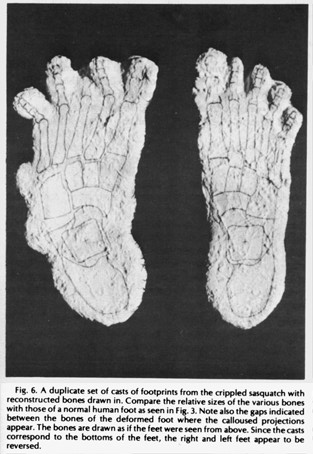
...Seven individual footprints were preserved as casts....

How about instead of making prejudiced statements regarding something you don't know anything about, you try to perform some research?

Hint:

Google is your friend.
 
A qeustion for Huntster, or others familiar with trackways, which I hope is not taken as too loaded. I really am curious and do not know enough on this score.

When you speak of a trackway, I'm assuming that this is a fairly well established and beaten path on which animals of some sort habitually walk....

Not necessarily. A trackway isn't a "trail", or even on a trail. It is a series of footprints made during a single walking event. It might be found on an established game trail, on the side of a road, on a riverbar, etc. It can amount to just two clear footprints, or it might yield many.

... I've certainly been on deer and other trackways, and one thing that's fairly obvious is that they go on for a fair length often, and contain very many tracks of the same animal. If a bear, for example, walked along 50 feet of muddy trail, it would leave quite a number of prints, which with a little effort at measuring, and perhaps estimating gait, could be identified as the tracks of the same bear. Try it yourself on a muddy or snowy trackway. How many good prints do you leave in 50 feet or so?....

Actually, unless there is lots of mud or on riverbar sand, very few footprints of passing creatures are left.

...So my question is obviously: why so few good tracks from the bigfeet?...

I believe it is because they are extremely rare and primarily inhabit remote areas.

...I would expect that unless they are very casual about their paths, or coy about leaving tracks, bigfeet like other animals would at least occasionally leave a good long trail of tracks on a trackway, from which the best could be selected, and perhaps averaged, or the whole sequence photographed in order....

That has, indeed, occurred. The Bossburg event comes to mind.
 
"Implying"?

I simply made the mention that there is much hullabaloo regarding that one photo, and the rest are ignored.

My actual "implication" is that some here are being rather selective with regard to their "analysis". I'll try to refrain from "implying" why they are doing that.


EVALUATION OF ALLEGED SASQUATCH FOOTPRINTS
AND THEIR INFERRED FUNCTIONAL MORPHOLOGY


How about instead of making prejudiced statements regarding something you don't know anything about, you try to perform some research?

Hint:

Google is your friend.

All of those tracks were made by a single creature?
 
Bruto, Ivan Marx, a well known hoaxer, is closely associated with Bossburg. This renders the whole incident quite suspect, imo, and useless to science.

http://www.bigfootencounters.com/articles/bossburg.htm

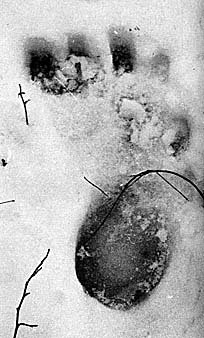
The supposed footprint, doesn't even match the supposed cast.

10_Bossburgsnow.jpg


footprint2.jpg
 
Last edited:
Bossburg is just another incident where the footers were supposedly within hours of a real live bigfoot. A crippled one yet. No pursuit was attempted for days. Once again, they presumably get very near their goal, and then stop. A habit that footers can't seem to break.

And they still were unable to find another trace of the beastie even when they finally did start looking. They even threw away some of the original footprints, and blamed it on science.

Some of the prints were lifted from the snow and kept in Marx's freezer for a while. They were eventually discarded when the hunters developed one of their periodic collective depressions, generally attributed to science's marked apathy towards their endeavors.

In the Skookum incident, footers claim to have been within just 5 or 6 hours, probably a lot less, of a bigfoot that actually sat down very near them and ate their bait. They made no attempt to pursue, and actually left the area the next morning. They had placed the bait somewhere around 3am, and were back at the site sometime around 9am, where they found the butt print.
 
Last edited:
Meldrum published what looks like a bear track and said it was a sasquatch print. You claim that there are at least 6 other prints from that trackway. (Which you seem to be implying, don't look like bear tracks.) How about instead of a bald assertion, you point us to some pictures of these other tracks? So we can see what they really look like.


The link to the article has been posted repeatedly, but here it is again:

http://www.isu.edu/~meldd/fxnlmorph.html

The trackway was found in a muddy farmer's field near Walla Walla, Wa. Meldrum examined 40 tracks in situ in this trackway.
 

Attachments

  • meldrum tracks 2.jpg
    meldrum tracks 2.jpg
    78 KB · Views: 11
Well, I'm not a doctor, but I have had medical training in nursing and also have had formal training in human anatomy and physiology. Perhaps my judgment will be of some use?

My understanding of muscles and muscle injuries is limited, but I do know that a basic muscle hernia, where the muscle tissue protrudes through the outlying fascia, causes a good amount of swelling and some pain/discomfort. However, it wouldn't look anywhere nearly as bad as the "hernia" claimed to be on Patty's thigh. What would cause something so disfiguring as that would be (to my limited knowledge) a rupture, where the muscle tissue protrudes much more through the outer fascia. Ruptures, however, cause intense pain, as the tough fascia actually cuts into the muscle tissue as it contracts and relaxes in normal movement. If Patty had a rupture in her quadricep, she would barely be able to crawl, let alone walk.

I can't see how a simple muscle hernia would cause such a nasty looking bulge in the leg like that. Especially not with the well-defined edges of it. Simple muscle hernias cause localized swelling with no defined edge (to my knowledge). If I had to make a call just looking at the leg itself, I'd say it was a serious rupture. And if it was a rupture, that animal should be down on the ground, not walking, not even with a "compliant gait."

I would suggest you ask some of the members here with more extensive training on the subjects of medicine or anatomy though -- I think Dr. Kitten is a practicing physician, and she would likely be able to give a more informed opinion.

My references for the information in this post are all classroom-related. I will cite my anatomy professor W. Sanderson, and one of my nursing assessment instructors, L. Luka.

...

My opinion? That's just an ill-fitting costume.


*edited for typos, and to clarify*

There's been a discussion on this here and on BFF. A poster there said he'd had such an injury (from skiing, I believe) and that it was only painful at first.
 
Regarding Meldrum's paper (http://www.isu.edu/~meldd/fxnlmorph.html), so often cited by some "footers" there's an important comment that must be made:

When people write a paper, the photographic record presented is supposed to be the best avaliable examples of the topic in question. So, regardless if the tracks were composed by 1 or 1000 individual fooprints, the pictures are most likely to be, in the writer's judgement, from the best footprints, those with the best preserved details, those that are supposed to have less chances of being mistaken with anything else.

So, among the "best examples" of bigfeet footprints are bear tracks and suspected hoaxes. Interesting, don't you think?
 
Patty does appear to show many problems that are normally only seen in creature suits and NEVER in live animals.

I'm open to the idea there are other species that have existed we are not aware of. Even this one. But I can't use fake footprints or a hoaxed film as evidence for what I'd love to find some type of hard evidence for.

The skin of an ape suit popping away from the thigh isn't a hernia and real gorillas or humans never detach at the back of the neck while attempting to look over their shoulders. Patty does this. Sometimes that happens when a person wears a gorilla suit made with 1940's methods.

Roger kept filming for too long. He should've stopped earlier before this frame.

- Dfoot:boxedin:

All this and more right here on this thread:

http://www.bigfootforums.com/index.php?showtopic=13887&st=40
 
A qeustion for Huntster, or others familiar with trackways, which I hope is not taken as too loaded. I really am curious and do not know enough on this score.

When you speak of a trackway, I'm assuming that this is a fairly well established and beaten path on which animals of some sort habitually walk. I've certainly been on deer and other trackways, and one thing that's fairly obvious is that they go on for a fair length often, and contain very many tracks of the same animal. If a bear, for example, walked along 50 feet of muddy trail, it would leave quite a number of prints, which with a little effort at measuring, and perhaps estimating gait, could be identified as the tracks of the same bear. Try it yourself on a muddy or snowy trackway. How many good prints do you leave in 50 feet or so?

So my question is obviously: why so few good tracks from the bigfeet? I would expect that unless they are very casual about their paths, or coy about leaving tracks, bigfeet like other animals would at least occasionally leave a good long trail of tracks on a trackway, from which the best could be selected, and perhaps averaged, or the whole sequence photographed in order. I'm just surprised that a decent bigfoot cast would be so hard to come by from a bigfoot trackway, and so easily confused or palmed off by skeptics as a slid bear track or other anomaly.

I think you're confusing "trackway" with "game trail". Deer tend to make game trails (to water, e.g., and follow them at times. Some animals, Chimps, e.g., seem aware of their foootprints and deliberately leave them for others in the troop to follow. More than one investigator has speculated Sasquatches tend to deliberatately leave tracks as territorial markers. I don't know about that, but it's hard to find tracks of anything in the PNW, unless the animal happens to be walking in snow, on a roadside or on a fresh skid road.

There have been many thousands of prints found. There are over 100 casts of some in Meldrum's collection at Idaho State. The double trackway north of Carson, Washington was followed for seven miles in snow and photographed by a crew from the Vancouver Columbian. The Skamania County Pioneer did a special issue on events around that time. (Ivan Marx didn't live in SW Washington in 1969, BTW.) Here's a trackway filmed last spring:

http://www.bigfootencounters.com/images/JimKarl.htm

From Pike's Peak (I posted a link to a discussion of tracks in this area on a bowhunter's site - not sure if this is the same incident):

http://www.bigfootencounters.com/sbs/tellercounty.htm

Ivan Marx is dead.

Many are found but few photographed. Might have something to do with people not always carrying cameras.
 
Status
Not open for further replies.

ISF - Join now!

Every member here is approved by hand. No bots, no spam, just people who care about evidence and honest debate.

Membership is free!

Create your free account

Back
Top Bottom