Bigfoot: The Patterson Gimlin Film - Part 2

Status
Not open for further replies.
Thats not really where I was going. ( altho it did appear that way)

My first point is that theres no way to be certain ( if the PGF is a hoax) that the site the prints were found at is in fact the actual site the film subject was filmed. Its been said to be and all that but there are questions ( and it may be) that doesnt matter for this purpose.
The film site has absolutely been located and confirmed. By many. This is a certainty. Locating it now is another matter.
 
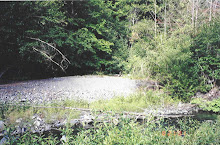
Right, the film site has probably changed in many ways. Even if you could figure out where Patterson was while filming - the elevation may have changed from accumulated or evacuated substrate. The Patty film theater is a dynamic creek wash. The flowing creek changes over time. We can see in the film that the creek is a sliver snaking through a wide wash.

There may be some recognizable things remaining. These would probably be larger living trees. They are going to be bigger 40+ years later, but achored in the same place.

Some folks have gone there and mentioned how different it looks now.


Bigfoot Information Project

"Near the P/G film site on Bluff Creek"
image034.jpg


Paul Vella: The film site itself looks very different to the way it looks in the film. The year prior to the film, a flood washed away nearly all the foliage and a large quantity of earth, sand, shale and trees. In October 1967, the area was covered with a fine layer of grey sand, but today is mostly shale.

It took a little while, but we eventually managed to work out where Patterson had been standing when he first saw ‘Patty’, and what struck me was that Patty was obviously on the other side of the stream. Where the film goes blurry, Patterson was running across the creek, and then climbed some 6-8 feet up the shale bank. It was no wonder the camera shook. The second thing that struck me was just how close Patterson must have been to the creature, and yet he continued to chase after her.


40th Anniversary of Patty (Henry May)

"Bluff Creek today"
Bluff+Creek.jpg


"Plaque To Be Placed at the P/G Movie Film Site" (Note misspelled name)
Plaque.jpg
 
The film site has absolutely been located and confirmed. By many. This is a certainty. Locating it now is another matter.

And it may be ( I'm not saying it isnt factually known) so lets assume it is located down to a 12 digit coordinate and the party makes it to literal dead center of ground zero.

Then, after 40 years of rain,floods,erosion, foliage and who knows what- trying to find locations?
 
Longtabber:

"What does matter is the camera placement, film subject placement, alleged path et al to get MEASUREMENTS in a location that has changed innumerable ways in 40 years of weathering. ( and thats assuming they literally are standing at ground zero) That would make finding a needle in a haystack seem like child's play."

Use an electromagnet and finding the needle isn't so hard. Properly applied terchnology can yield positive results.

Just a thought, since you love the "garbage in, garbage out" phrase, investigators (LE and private alike) do routinely look into garbage cans, trash cans, dumpsters and similar repositories of acknowledged "garbage" in search of clues and evidence that has true evidentiary value and isn't in fact "garbage" at all.

So while your hypothetical precautionary advice is welcomed, perhaps you should not prejudge the quality of evidence not yet collected, analysed, or presented for critical analysis.

We should also consider that perhaps you have your own blinders on, and have the foregone conclusion that there is no new evidence of merit anyone could possibly obtain and apply to the whole PG Film issue (you've stated as much on prior occasions, I believe), so you have ceased to actually examine the material in depth precisely because you have the foregone conclusion such effort would be wasted.

Would any good law enforcement officer or private investigator say "let's not bother looking in the garbage can, because we can assume there's nothing in it but garbage"? The ones who really want to gather all the best evidence do in fact re-evaluate the "garbage" with an open mind.

A thought.

Bill

Heres the thing Bill, I support your efforts and what you are trying to accomplish. ( and I wish you success) I just feel you might be fixing to walk in the proverbial minefield of "bigfoot science."

>>>Properly applied terchnology can yield positive results.

True but heres the caveat. The "information" ( actual or estimated) has to BE there to get in the first place and thats where the problem is.

I'm all for a crime scene investigation ( done quite a few) but if the goal is to go into a house, find blood, trace a bullet path etc and determine shooter/victim locations is the goal- then going back 40 years when the original house has been remodeled multiple times ( changing walls, flooring etc) is of little value. Possible? certainly- probable with the realistic hope of gaining useful information? highly unlikely.

In this case, the 'clues' are measurements for a PG examination of the film subject to determine "whatever" ( be they IM indexes, size of the film subject or any number of other things)

Given the close range of "Patty" to human norms ( estimates of her size range from 5-7 feet depending on who measured what) any information to accurately scale her ( it) would have to be both precise and accurate for any scientific validity. ( we have estimates now- I cant see more of the same making any "new" revelation)

I dont question the PG techniques,software, math etc. ( I use it, I do it- I know it works) It all goes back to the measurements plugged in. If I had the measurements, I could plug them in at work and tell anyone the size/dimension of everything in the film in about 10 minutes and could get the CAD operators to give me a 3d animation in a few hours.

I just have serious questions about the ability to get anything remotely considered as "accurate" baseline measurements to plug into the equation and without that, everything is just a SWAG.

Its the same trap Dr F's "footprint analysis" fell into, Meldrum's speculative anatomy, dermals and everything else.
 
O,

I think a camera distance at 352 of somewhere between 85-90 feet is probably closer to fact. Titmus stated 81 feet at frame 264 (Green 88’), Patterson moved forward and to the right after 264 finally settling down around 320ish. There is a ballpark -18.1% difference in object/clutter/tree/stump size (middle 3rd of image) between 264ish and 320ish, that is, 320ish has to be reduced ballpark 18.1% for the images to begin to line up correctly. The headache is just beginning, do we use Titmus at 81 feet or Green at 88, do we know for certain the gait distance during those frames, do we know the absolute fps, how can we accurately measure the distance from the film to subject as it moves through the plane? One thing is for certain we do not know the subjects relative height and without an accurate measure of distance that will remain a mystery.

I have no problem with trying different SWAG methods but when someone mentions scientific I have to chuckle a bit. The very first project in a scientific analysis would be a 4k scan (if 4k is even justified) followed by a grain analysis to verify the integrity of the film aka crop specs, enlargement numbers if any, method of process, optical vs. wet gate/contact dupe and possibly film generation. Unfortunately, none of that will ever give you the subject’s height or accurately measure the distance from the film to the subject.

The window is closed; the time for data collection was Oct. of 1967. There is one absolute though, they did a horrible job collecting data.

I must admit I’m pretty much with LT across the board on this one. It doesn't mean it wont be fun to look at.


m
 
LT:

"I just have serious questions about the ability to get anything remotely considered as "accurate" baseline measurements to plug into the equation and without that, everything is just a SWAG."

I share your concern for what would constitute an "accurate" measurement, and I have about 5 months to gather, examine, process and challenge all data which might be candidates to qualify as accurate.

As for what might be on a scene 40 years later, I guess real big trees (100 years old or older ) or their real big stumps, rock formations (which don't erode much in 40 years), and tree stumps which are well rooted don't tend to move around much, all might be candidates for locators.

Anyways, we won't really know until somebody really goes there and has a look. Good investigations never presume a circumstance will yield no reliable evidence. And the unknown isn't "solved" by sitting back and saying "it can't be solved". We try, we keep looking, and we set aside our pessimism, which of itself, can sometimes be the reason for a lack of a solution.

Bill
 
I do understand Bill but mangler pretty much summed it up- the window is closed.

In order to have any reasonable validity ( we can let the camera internals slide because we really dont need "micrometer" precision) you would need to literally pull a tape from where RP's feet were to where the film subjects feet were and have that frame for legitimate accuracy. ( or pull a tape to any object in the film and be able to accurately place the film subject to it)

If that cannot be done, "a miss is as good as a mile" as far as anything that can be considered accurate goes.
 
LT:

"the window is closed."

The pessimist would agree, The optimist would suggest we might try to open a door.

Bill
 
I'm all for optimism but I'm also a realist.

If the goal was to go back there and look for something physical ( such as the alleged dead Bigfoots from the MK massacre) with new ground penetrating radar and cadaver dogs- yeah because that technology might find them.
First, any claim of legitimate measurements that would meet any scientific or even legal ( the lower standard) criteria is stillborn because the baseline is NOT the factual ORIGINAL ( or a certified true copy) but lets assume it miraculously appears.

This effort is after a "measurement" ( an intangible) because thats what PG is based on. ( measurements and math) So these measurements MUST ( not should) be accurate and reliable or they are hold no weight whatsoever in regards to accuracy or legitimacy.

In order to get that accuracy, one will literally have to determine where his feet were in relation to a referenced frame and object in frame. Thats how it works. Thats the ONLY way it works. ( Imagine building a house to print when the carpenters cut all the boards to "around" a measurement)

I could say there would be a slim chance IF there was a second camera showing where RP was but thats the problem. Placing Patterson.
 
LT:

"I could say there would be a slim chance IF there was a second camera showing where RP was but thats the problem. Placing Patterson."

You are wrong. The problem is placing the camera, regardless of whether Roger is even in fact holding it.

And the camera, by virtue of taking the image, creates a spatial relationship between itself and with what it films. That spatial relationship can be determined with sufficient image data from multiple locations to allow photogrammetry triangulations. The question is whether the image data is sufficient, and obviously that issue is hotly debated, as we all know.

Bottom line, the weakest point of any proof is the measurements. Their degree of accuracy is the principle data in question. If you keep up with the whole "but we don't have the original film" thing, you can close your mind every time to any prospect of any solution. Nothing I do will pry it open.

For now, I'm done, unless you want the last word.

:)

Bill

True, iff* you use an uncropped version of the film, and you get a huge number of permanent reference points. Two or three won't do it.


*iff - that's not a typo, it means if and only if
 
“I'm all for optimism but I'm also a realist.” Perfect LT.

Bill, have at it, less talk more action, you opened the door to this now finish what you started, this is getting old real fast.


m
 
>>>You are wrong. The problem is placing the camera, regardless of whether Roger is even in fact holding it.

Well, "technically" in this case, they should be one and the same but if RP isnt the one holding it, the PGF has a much greater problem. LOL
 
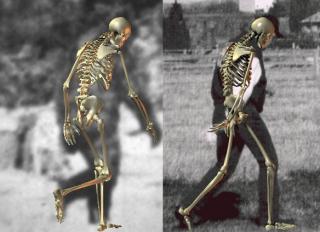
The flaw in Mangler's presentation occurs in the tibia. He's arrived at the tibia being the same length, actual as shown, and not relative in both Patty and Bob H. When the smaller illustration (being Patty) gets scaled up to being the same size as Bob leaning against his Corvette the tibias no longer match up while the rest of the bones (skull etc) become fairly well proportioned to scale against each other. Please note that Patty's right tibia is in a verticle position and should be perfectically scalable to Bob's verticle tibias. In other words Mangler had to scale down Patty to get the #7 poser skeleton to work with Bob H and have at least something measure up. If you don't see it or don't want to see it. Fine but Mangler made no case there.

When you mean scaling to the same size, are you talking about height? Why would I scale an image of a figure hunched forward to the same as someone standing up straight?

These look fine to me:


GooGooGaaGaa2.jpg
 
GT:

"True, iff* you use an uncropped version of the film, and you get a huge number of permanent reference points. Two or three won't do it."

I agree, 2 or 3 reference points won't do. I'd say somewhere between 8 and 13 would be better. I believe my photogrammetry references state 6 an minimum, but even more is better.


LT:

"(My quote)>>>You are wrong. The problem is placing the camera, regardless of whether Roger is even in fact holding it.

(LT's quote) Well, "technically" in this case,

Technically, you just introduced a + - 2% margin of error into your argument, based on photographing something 100' away, and guaging distance by a cameraman's feet location, when he could be holding a 16mm camera at arms length forward or backward from his feet, and assuming about a 2' arm's length. Now if you can live with a +-2% margin of error, we're cool.

Mangler:

"Bill, have at it, less talk more action, you opened the door to this now finish what you started, this is getting old real fast."

That's what I'm doing, the action. I agree, the arguments are getting real old.

Bill

added for Mangler:

"I think a camera distance at 352 of somewhere between 85-90 feet is probably closer to fact."

just curious, did you ever actually crunch the numbers into the basic optical formula (image height divided by lens length equals object height divided by camera to subject distance)?

In 352, if Patty is about 15% of true full frame height (0.292" I believe is 16mm spec) which is 0.044", and a 25mm lens is about 1", and you think Patty is about 90 feet from camera, doesn't her height solve to about 3.96' tall?

At 102 feet from camera, as estimated in Murphy's book, she should be 4.488' tall, with her height as seen in frame and a 25mm lens, according to the optics formula.

Is my math wrong, or is one of the numbers a bit off?

Bill
 
Last edited:
However Negros have pale palms and soles. Also this gorilla has light hands and a dark face. This gorilla suit has dark face and dark hands so I suppose we can exclude that style gorilla suit as a Patty candidate.

[qimg]http://www.internationalskeptics.com/forums/imagehosting/thum_187554942a5b130577.jpg[/qimg]

[qimg]http://www.internationalskeptics.com/forums/imagehosting/thum_187554942a63c2b1a8.jpg[/qimg]

Negro? Where would you like to be driven, Mrs. Daisy?

Here is an image of a black person's feet:

http://www.flickr.com/photos/eddiemackle/1458621009/

My best friend is black so I get to see his hands all the time. The problem with your reference to black people or those images you posted is that the difference is nothing like what we see with Patty. Fudge face, fudge boobs, white-out hands and feet.
 
Can you prove that Sweaty got his working photos from JREF? Since when is the JREF the only source for photos of the Paterson Gimlin film and its related characters? Virtually everything concerning the PGF is availanble from sources outside the JREF. For instance I've obtained photos relating to the the PGF via private sources I've met on various forums and websites.

Yet there are frames we do associate with regular posters. One that comes to mind is the finger flex frames that Sweaty often posts. Its even been commented that hes prone to posting it.

I also asked Mangler if he had any copywrights on his work to which there was no reply. Maybe Sweaty shouldn't ream Mangler concerning the use of public domain/available photos. However he certainly could ream him for having posted that miscaled dribble with the #7 poser.

Per my bolding:

1) Sweaty will tell you himself. I can search for the post where he got it from William but I don't see that it's necessary.

2) You are the one arguing for some sort of propietary claim for Sweaty and the Bob/Corvette image. It's fall down stupid. Not even Sweaty would go there.

3) Not maybe. Definitely.
 
Status
Not open for further replies.

ISF - Join now!

Every member here is approved by hand. No bots, no spam, just people who care about evidence and honest debate.

Membership is free!

Create your free account

Back
Top Bottom