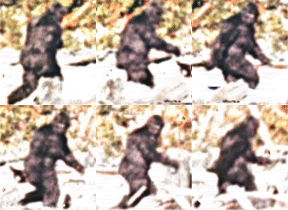
Condensed Version
Bill,
I guess I’ll start at the beginning. The formula seems to be in proper order M = F/f when M= blah, blah, blah.
How do we know that 15% is accurate, is that standing height or walking height, which walking height because it seems to vary, was the measurement taken from hardcopy or the film (Pixels or LPI), what generation etc.? The subject is behind debris in 352; we can’t see the substrate contour, what’s the elevation of the camera relative to the subject? Are we certain that the lens was a Kodak Cine Ektar?
How do you arrive at .292”? Image area is defined by aperture opening/angle/pitch (7.605 mm long pitch, 7.6mm short pitch, guesstimated) you will need the numbers from the specific model, but, that’s not the problem. The problem is we are not working with the master (ya, ya, I know, quit whining about the master) all we have are dupes so now we have to wonder about the specific optical printer (were any prints contact printed?) and it’s aperture opening, was it printed using an 1R or 2R optical, what about a second generation and the optical printer specs for that one? See what I’m getting at here, if we don’t have accurate information how can we come to an accurate conclusion? Do I even need to go into changing aspect ratios using an optical printer and how it could have been changed from one generation to the next without anyone really being the wiser, or, how frames could have been pulled without splicing?
To answer your question, yes I have run numbers, my conclusion, I don’t run numbers anymore.
O,
Tracking is do-able both manually as well as with BouJou. In Boujou I’ve found that keeping the reference points to a minimum helps considerably with the tracking, otherwise the tracker tends to interpret the spatial shifting incorrectly. I prefer doing it manually using old school/traditional point tracking, it takes a hell of a lot longer but I seem to understand/grasp what was actually happening in real time much better.
I haven’t absolutely/factually determined anything, nor do I intend to. It’s just a personal exercise in futility. BTW, like LT, I’m simply a realist.
My original sole intentions were to see (1. If an IM index within average human range could possibly fit into the subject (say around 72 +change). (2. To see if the subject could walk without some wild-ass gait. Everything else is byproduct and irrelevant to me, least of all the subjects actual height. I don’t really have an opinion as to whether the subject is human or some frickin freak of nature and I have a gut belief that regardless of the “scientific” analysis this film will never provide the answer to that question. My scientific method of analysis is, and always will be SWAG, actually SWAGS little brother SRWAG (Some Really Wild Ass Guessing).
Final conclusion, horrible data. All they (the "professional" bigfoot researchers) needed to do was provide detailed information for ten strides, length, impression, trail width etc. Provide detailed information on nine points from any good frame (three for each horizontal 3rd of the image) tree diameter, rock info, stump size etc.
Previous Map Guesstimate
I narrowed the location down to 3 possibilities. If anyone was paying attention when I posted the map I created (not sure if I had to pull it because of space requirements) I went with the 3rd possibility on that, the Titmus map actually lines up pretty good with it. The red line NW of the creek is an old trail/road that I found on a map from the 30’s, it goes to the site and beyond. There were actually structures there at one point in time and it was called Ferris Camp (FC is now a historical landmark). Note that the coordinates on the maps are decimal.


As far as I’m concerned that’s pretty much it. I’ve probably left important things out. I’m probably wrong about other things. Honestly, I don’t really care.
Later
m
Bill,
I guess I’ll start at the beginning. The formula seems to be in proper order M = F/f when M= blah, blah, blah.
How do we know that 15% is accurate, is that standing height or walking height, which walking height because it seems to vary, was the measurement taken from hardcopy or the film (Pixels or LPI), what generation etc.? The subject is behind debris in 352; we can’t see the substrate contour, what’s the elevation of the camera relative to the subject? Are we certain that the lens was a Kodak Cine Ektar?
How do you arrive at .292”? Image area is defined by aperture opening/angle/pitch (7.605 mm long pitch, 7.6mm short pitch, guesstimated) you will need the numbers from the specific model, but, that’s not the problem. The problem is we are not working with the master (ya, ya, I know, quit whining about the master) all we have are dupes so now we have to wonder about the specific optical printer (were any prints contact printed?) and it’s aperture opening, was it printed using an 1R or 2R optical, what about a second generation and the optical printer specs for that one? See what I’m getting at here, if we don’t have accurate information how can we come to an accurate conclusion? Do I even need to go into changing aspect ratios using an optical printer and how it could have been changed from one generation to the next without anyone really being the wiser, or, how frames could have been pulled without splicing?
To answer your question, yes I have run numbers, my conclusion, I don’t run numbers anymore.
O,
Tracking is do-able both manually as well as with BouJou. In Boujou I’ve found that keeping the reference points to a minimum helps considerably with the tracking, otherwise the tracker tends to interpret the spatial shifting incorrectly. I prefer doing it manually using old school/traditional point tracking, it takes a hell of a lot longer but I seem to understand/grasp what was actually happening in real time much better.
I haven’t absolutely/factually determined anything, nor do I intend to. It’s just a personal exercise in futility. BTW, like LT, I’m simply a realist.
My original sole intentions were to see (1. If an IM index within average human range could possibly fit into the subject (say around 72 +change). (2. To see if the subject could walk without some wild-ass gait. Everything else is byproduct and irrelevant to me, least of all the subjects actual height. I don’t really have an opinion as to whether the subject is human or some frickin freak of nature and I have a gut belief that regardless of the “scientific” analysis this film will never provide the answer to that question. My scientific method of analysis is, and always will be SWAG, actually SWAGS little brother SRWAG (Some Really Wild Ass Guessing).
Final conclusion, horrible data. All they (the "professional" bigfoot researchers) needed to do was provide detailed information for ten strides, length, impression, trail width etc. Provide detailed information on nine points from any good frame (three for each horizontal 3rd of the image) tree diameter, rock info, stump size etc.
Previous Map Guesstimate
I narrowed the location down to 3 possibilities. If anyone was paying attention when I posted the map I created (not sure if I had to pull it because of space requirements) I went with the 3rd possibility on that, the Titmus map actually lines up pretty good with it. The red line NW of the creek is an old trail/road that I found on a map from the 30’s, it goes to the site and beyond. There were actually structures there at one point in time and it was called Ferris Camp (FC is now a historical landmark). Note that the coordinates on the maps are decimal.
As far as I’m concerned that’s pretty much it. I’ve probably left important things out. I’m probably wrong about other things. Honestly, I don’t really care.
Later
m

 ...except for a big discrepancy.