Abenomics: medicine or poison for Japan?

Medicine or poison?

  • Medicine

    Votes: 12 27.3%
  • Poison

    Votes: 3 6.8%
  • Don't know

    Votes: 18 40.9%
  • Planet X

    Votes: 11 25.0%

  • Total voters
    44
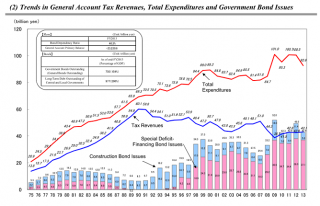
Since 1990 the expenditure trend has been rising at a slower pace (1990-2014 = +26.6 T ¥). However, revenue during the same period has been declining – not rising – so that we are, for example, looking at -10.1 T ¥ in revenue in 2014 compared to 1990.
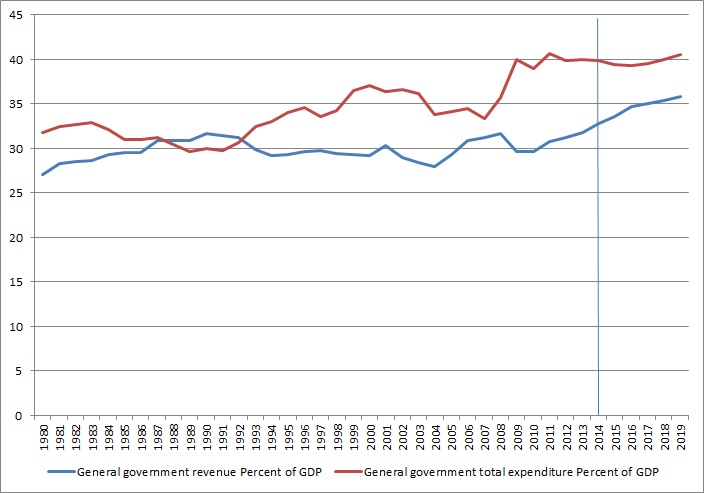
As a fraction of output the numbers do not reflect those trends. In any case the persistent gap is net fiscal stimulus (fiscal policy adds to GDP). Not all of it is automatic stabilisers either--Japan has legislated many supplementary budgets since 1992 (slide 11)

12746546b3cf894769.jpg


Source

Yet somehow you assume mere financing of that gap through bond issuance indicates the most expansionary fiscal policy the world has ever seen.
Correct. Non-expansionary fiscal policy would be to finance it via spending reductions / tax increases.

Simply looking at government debt/GDP will not give you a meaningful picture here.
Agree but I am not.
 
Compared to GDP? And when bad GDP growth is the problem under investigation…

Here's the gap i mentioned:

 
Last edited:
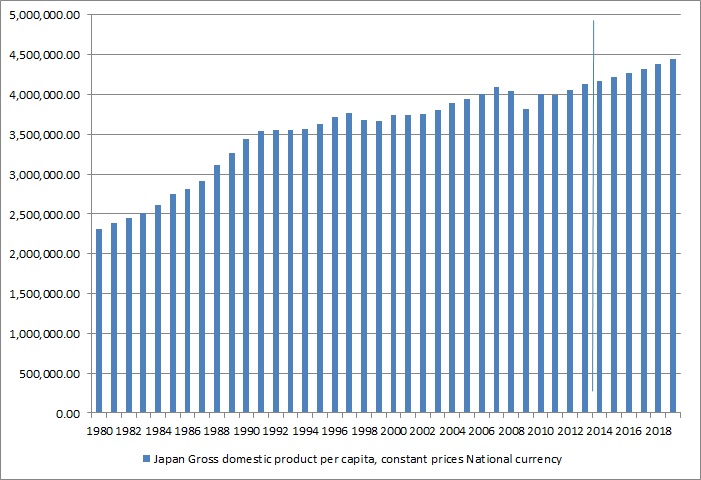
It's not actually so bad on a per-capita basis (population is shrinking)

12746546b46c356b41.jpg


(source IMF)

Anyway I am not saying anything about Japan should never have done fiscal stimulus. Only that it hardly wins hands down implying resounding success. It isn't clear that it is more efficacious than monetary policy. Plus of course there are various ways to expand fiscally--such as cutting taxes more and raising spending less, which can be done without messing with the progressiveness of the redistribution element of it if desired.
 
I also think that is an important point. They are still doing quite well, regardless of total GDP development.

Simply looking at what monetary policy can do in an almost zero-interest rate environment does not render monetary policy that impressive. You might say that about the fiscal side too. But since this is a balance sheet recession, where the pace of private sector deleveraging is apparently measured in decades rather than months or years in Japan's case, it seems rather clear that monetary policy is not up to the task once it has stabilized the financial turmoil. Some would argue that the same applies to the fiscal side as well (Richard Koo at Nomura for instance), i.e. normalizing monetary and fiscal policy will fail until the private sector is done deleveraging and adjusting its balance sheet. He, and you, could be correct?

But what we do know, is that when the private sector increases its saving and pushes further into surplus; the government must run a deficit (unless something extraordinary is happening in the foreign sector). In such a circumstance as Japan's, where interest rates are already close to zero, conventional fiscal policy is at least in principle still capable of impacting GDP growth upwards, whereas conventional monetary policy isn't. How would such a mechanism look like on the monetary side anyway? That's why I think fiscal policy wins hands down. (I have not considered the central bank buying up most of private debt so as to end deleveraging early on.)

And so we see these kinds of GDP fluctuations following some fiscal adjustment: e.g., a tax increase plummeting GDP growth the following periods, or increased investment spending lifting the pace of real GDP growth until investment spending is faded away.
 
Last edited:
... Japan ... unemployment rate is already quite low).

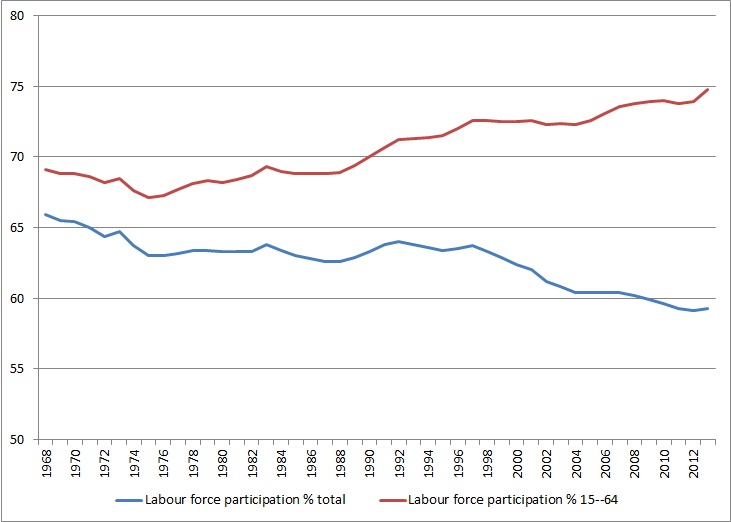
Only in nominal terms. J's labor participation rate has dropped significantly. Their real household income has dropped dramatically since abemonics. So it's no consolation that the job_openings:applicants ratio is at an all time high. Ppl choosing not to work and jobs no more attractive than current jobs is not economic strength.

The government deficit is a reaction to private sector saving. So why does the private sector need to save so much?

B/c the government has decided to burn off their past savings at 2% inflation per year while the major savings instrument, Jbond, yields 0.5% at 10yr and the exchange rate is dropping, making ppl feel very insecure about their retirement/savings/assets. Duh !
 
It's not actually so bad on a per-capita basis (population is shrinking)

Thanks for that graph, BTW.

Often comparisons are made without considering the fact that Japan has a shrinking population. I don't expect Japan to ever have very strong GDP growth again, but if it can manage to have growth on a per capita basis, even if the total size of the economy is flat or slightly shrinking, I think that wouldn't be such a disaster.
 
But what we do know, is that when the private sector increases its saving and pushes further into surplus; the government must run a deficit (unless something extraordinary is happening in the foreign sector).
Just because a balance sheet balances, it doesn't imply one thing always drives another. One could say that if the government runs a deficit then the non-government "must" save (excluding net exports and FX reserves). Ricardian equivalence and crowding out would probably argue that the causality is the opposite of what you suggest.

And so we see these kinds of GDP fluctuations following some fiscal adjustment: e.g., a tax increase plummeting GDP growth the following periods, or increased investment spending lifting the pace of real GDP growth
Years of structural "G-T" deficit followed by a small tax rise suggests the effect on total GDP is asymmetric (the negative of the tax rise is a lot larger than the positive of budget expansion). This is the point about fiscal policy not being particularly effective. In much of history one would not have expected/seen such a lopsided reaction.
 
stevea said:
Only in nominal terms. J's labor participation rate has dropped significantly

The drop is significant for people over 60, or to use BoJ:s terms: "From the structural perspective, the cohortbased analysis result suggests that population aging (age effect) accounts for a substantial part of the recent decline in labor participation rates for males." And yet the employment rate, measures according to OECD methods, is higher than OECD, EU, or U.S. average. Culturally, female participation has always been quite low, but it's rising now (except for the elderly). Needless to say, the unemployment rate is way below OECD etc. average as well; it's at the same level as before the recent financial crisis and below the Japan's own average for the past decade or so.

stevea said:
Their real household income has dropped dramatically since abemonics.
Hmm… data does not seem to support your assertion. Keep in mind we are talking about a trend from way back in the 1990s when the bubble burst and stagnation and deflation ensued. Abenomics (anno 2012) is not that relevant when looking at the whole picture, I think.

japan-disposable-personal-income.png


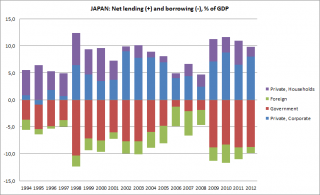
We have to keep in mind that the whole private sector surplus/saving boom started in the early 1990s, when, for instance, the corporate sector surplus, i.e., net borrowing (-) and lending (+), went through the roof: from about -12 % of GDP in 1991 to +8 % during the peak in 2001-2004. That's a huge deleveraging which is going to push the government sector into deficit no matter what. And that has nothing to do with government bond yields or inflation rate (which also plummeted by the way).

stevea said:
B/c the government has decided to burn off their past savings at 2% inflation per year while the major savings instrument, Jbond, yields 0.5% at 10yr and the exchange rate is dropping, making ppl feel very insecure about their retirement/savings/assets. Duh !

Japan went into the bust with a 2.71 % annual inflation rate in 1991. 2014 might be the first time over 2 % … That’s a time-span of over 20 years; half of that deflation rather than inflation! This saving culture is not a recent phenomenon. But yeah there's a great deal of saving for retirement due to the institutional setting.

 
Last edited:
[qimg]http://www.tradingeconomics.com/charts/japan-disposable-personal-income.png?s=japandisperinc&d1=19900101&d2=20141231[/qimg]

Seasonal adjustments would be nice. (Not blaming you, just "Trading Economics"). Even annual data would be better than monthly data if the data is not smoothed by making seasonal adjustments.
 
Seasonal adjustments would be nice. (Not blaming you, just "Trading Economics"). Even annual data would be better than monthly data if the data is not smoothed by making seasonal adjustments.

I know. Do you have it? I would be interested. ;)

OECD shows the growth rate of real household net disposable income.
 
Last edited:
Yeah, good stuff Francesca.

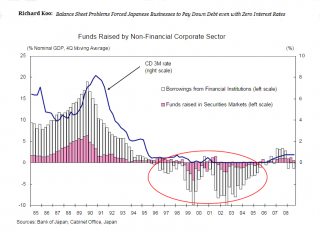
I took a look at one of Richards Koo's presentation, just to get a picture about the size of deleveraging – it has indeed been huge within the corporate sector. Exhibit 11 in particular is illuminating.


The most comprehensive survey of debt and deleveraging (public, financial, nonfinancial, household) is--I think--by McKinsey in 2010, updated a couple of times since.

The issue with this type of analysis is that, approximately, no country is really shrinking its "balance sheet", and no country ever has really done this either, except during output contractions. All that total debt (as a fraction of output) ever does is increase (Exhibit 1 page 2, 2MB).

If it was a requirement that non-government had to deleverage completely, or even half way for some kind of normal outcome, then everywhere would be looking at public debt ratios of 150-300% of output (Exhibit E4 page 6)

Japan's history (probably in more informative units than the Koo chart in previous post) is Exhibit 16. Japan's nonfinancial debt ratio is lower than most of Europe's. Same for household debt which is lower than that of the US. Public debt hasn't just offset that it has more than offset it. (And real GDP still does not grow)
 
Last edited:
Yes, I did read the McKinsey report when it came out.

Not sure what "more than offset" really means in this regard. I don't think there's any proportion that is correct (unless we want ideology to kick in). Until the private sector changes its "surplus-habit", there's really no realistic way for the public sector to compensate for that fully in terms of GDP growth.

A quick sectoral breakdown for Japan using OECD stats:
 
Last edited:
It means total borrowing in the Japanese economy continued to grow. In other worlds more leveraging.

That does not seem to matter as long as it is declining for the private sector (and the government increasingly issuing new debt just to service maturing debt). The "total leveraging" impact on the real economy is going to be limited.

fredgraph.png


fredgraph.png
 
Last edited:
I believe you are mistaken to focus on non-government leverage and discard government leverage as not mattering.

That does explain why you appear to unconditionally favour fiscal expansion though.
 
It is simply about recognizing that the private sector is in the driver's seat. The government deficit (or leverage) is to a great deal a consequence of such dynamics. Remember: (S – I) = (G – T) + (X – M)

Kind of what James Tobin already explained many decades ago:
Tobin 1963 said:
The moral is inescapable, if startling. If you would like the federal deficit to be smaller, the deficits of business must be bigger. Would you like the federal government to run a surplus and reduce its debt? Then the business deficits must be big enough to absorb that surplus as well as the funds available from households and financial institutions.
 

ISF - Join now!

Every member here is approved by hand. No bots, no spam, just people who care about evidence and honest debate.

Membership is free!

Create your free account

Back
Top Bottom