Abenomics: medicine or poison for Japan?

Medicine or poison?

  • Medicine

    Votes: 12 27.3%
  • Poison

    Votes: 3 6.8%
  • Don't know

    Votes: 18 40.9%
  • Planet X

    Votes: 11 25.0%

  • Total voters
    44
See above, viz:
Just because a balance sheet balances, it doesn't imply one thing always drives another. One could say that if the government runs a deficit then the non-government "must" save (excluding net exports and FX reserves). Ricardian equivalence and crowding out would probably argue that the causality is the opposite of what you suggest.

James Tobin is not the last word on financial balance dynamics (and wasn't the first). And your quotation does not actually back the quite strong causality implied by your use of "driver's seat".

I find a more symmetric view desirable. Plus see my several hints above (perhaps they were too mild) that the rate of GDP growth in Japan does not need to be very high.
 
Not sure if I can embed this, so I'll just leave a link, but the following graph shows the population of Japan vs. the working age population. I made it an index of 100 rather than millions of people because FRED puts one unit in "persons" and the other in "millions of persons". Although you can change the units, you cannot multiply or divide by a million.

http://bit.ly/1xEPSPS

Anyway, what it shows is that although Japan's population peaked some time in the mid 2000s, the population of people aged 15-64 peaked sometime in the 1990s and has been declining much more rapidly since then. You can deduce from that that the population of people 65 and older has been growing. Really, any growth at all would be amazing under those circumstances, and even just staying flat would be pretty darn good.
 
Francesca R said:
Just because a balance sheet balances, it doesn't imply one thing always drives another. One could say that if the government runs a deficit then the non-government "must" save (excluding net exports and FX reserves). Ricardian equivalence and crowding out would probably argue that the causality is the opposite of what you suggest.

Well yes, we should be careful with causality, especially with the "always" part. But simply looking at GDP formation gives a sense of rudimentary proportion: consumption expenditures being over 80 % of GDP and the private sector taking a 75-80 % share of that (as compared to the government's 20-25 % share). The relationship is not that much different in terms of capital formation. So we are looking at a 4:1 relationship on that measure alone.

Francesca R said:
James Tobin is not the last word on financial balance dynamics (and wasn't the first). And your quotation does not actually back the quite strong causality implied by your use of "driver's seat".

I find a more symmetric view desirable. Plus see my several hints above (perhaps they were too mild) that the rate of GDP growth in Japan does not need to be very high.

At least he understood that to any surplus there has to be a deficit somewhere else. I think I agree with the notion about Japan not necessarily needing high GDP growth.


**********
As a side question: do you, for example, consider it plausible that it was mainly the government who pushed the private sector into surplus during the last financial crisis?

fredgraph.png
 
[ . . . ] the following graph shows the population of Japan vs. the working age population. I made it an index of 100 rather than millions of people because FRED puts one unit in "persons" and the other in "millions of persons".

The below shows total population, 15-64 population and labour force (employed and unemployed)

15834644952_b87fbe04ed_o.jpg


https://www.flickr.com/gp/francesca_rizzi/7Q5fnV

Sources are SBJ (a-1 and b-1) and UN-DESA

the population of people aged 15-64 peaked sometime in the 1990s and has been declining much more rapidly since then.
Yes--although the labour force hasn't declined so quick (see post 368). The history is not to be credited to "Abenomics" but the future trajectory of this is contingent on "arrow three"
 
consumption expenditures being over 80 % of GDP and the private sector taking a 75-80 % share of that (as compared to the government's 20-25 % share). The relationship is not that much different in terms of capital formation. So we are looking at a 4:1 relationship on that measure alone.
Correct but the government can surely punch above its (consumption / investment) weight in the realm of borrowing--in Japan and most everywhere else.

As a side question: do you, for example, consider it plausible that it was mainly the government who pushed the private sector into surplus during the last financial crisis?

I believe the BOJ did much of that

15647866597_99c4f37f04_o.jpg


https://www.flickr.com/gp/francesca_rizzi/206qu0
 
Francesca R said:
Correct but the government can surely punch above its (consumption / investment) weight in the realm of borrowing--in Japan and most everywhere else.

It can, and during recessions, it should. But in such circumstances the government sector would still be pushing against a larger economic body.

Francesca R said:
I believe the BOJ did much of that

Interesting. So what about the U.S.?

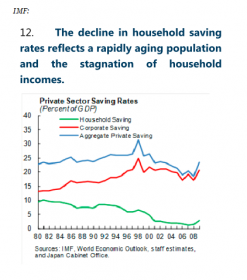
Not sure how you factor in declining rates? Even though aggregate private saving has been quite high, the household saving rate has dropped significantly: from over 20 % in the 1970s to very low 2-3 % in recent years (8 % and declining since the 1991 bust). That leaves the private corporate sector as the major surplus category, a significant reason for recurrent high total private sector saving levels in Japan. So how do you think rates explain that; lower interest payments contributing to higher retained earnings – deferred domestic investments for investments abroad?
 
But in such circumstances the government sector would still be pushing against a larger economic body.
The government's ability to borrow and spend (dis-save) is nonetheless greater than that of the entire non-government economy (setting aside sovereign insolvency concerns). That is why it is borrower/spender of last resort and not the other way round. The relative size of consumption/investment is a red herring.
 
The government's ability to borrow and spend (dis-save) is nonetheless greater than that of the entire non-government economy (setting aside sovereign insolvency concerns). That is why it is borrower/spender of last resort and not the other way round. The relative size of consumption/investment is a red herring.

But do you really think it's the government that's doing the "pushing"?

Japan? U.S.? Euro zone?
 
Hmm… data does not seem to support your assertion.

Particularly when you choose the wrong data, fail to distinguish real household income from personal disposable income.
==

Regardless, ee can either call this the "third lost decade", else the "new normal", and I'm in favor of the latter.
 
Last edited:
Particularly when you choose the wrong data, fail to distinguish real household income from personal disposable income.
==

Regardless, ee can either call this the "third lost decade", else the "new normal", and I'm in favor of the latter.

Yeah, ok. But you still need to explain why household saving rates have plummeted for the past decades (net savings; % of disposable income). They were slightly elevated directly after the financial crisis 2009 (2.4 %), although dropped after Abenomcis started: 1.3 % in 2012, 0.9 % in 2013, and 0.6 % in 2014. It's the corporations that have been saving excessively.


Just an update from a "typical salaryman" on the ground here. I've been looking at my pay stubs and it seems that the amount of money they are taking out of my salary has increased quite a bit since last year. Even though my before-tax pay increased this April by a small amount, around $70/month, my taxes, social security contributions, etc. increased by about twice that, leaving me with less take-home money. Under these circumstances it seems hard to expect consumers to spend more, since our take-home pay is actually less than it had been before. (I'm not even considering the effect of the higher consumption tax here; I have less money before I even start to spend it.) Of course, I'm just one person, but I expect that many more are in the same situation.
 
You live in japan ? I can't tell from context.

Yes I do. I'm an American living in Japan. Been living here since 2001 actually. Prior to that I was stationed here for 3 years back in the 90s and also spent a year studying abroad here. And I work for a Japanese company.

At least in my own industry (translation), which may not be representative of the larger economy, I have yet to see any evidence of an end to the "deflationary mindset".
 
Well GDP data for Q1 was decent, but I'm not quite ready to declare the recovery is finally here based on one good quarter.

Japan's economy grows at fastest pace in a year

Japan's economy grew at its fastest pace in a year in January-March on modest increases in consumption and capital expenditure, adding to evidence the country is steadily emerging from last year's recession.

The world's third-largest economy expanded an annualized 2.4 percent in the first three months of this year, more than a median market forecast for a 1.5 percent increase and following a revised 1.1 percent expansion in October-December, data from the Cabinet Office showed.
 
Well GDP data for Q1 was decent, but I'm not quite ready to declare the recovery is finally here based on one good quarter.

Japan's economy grows at fastest pace in a year

And the first revision to that data makes it even better. Still, it's just one quarter and these things can be choppy.

http://www.bloomberg.com/news/artic...grows-more-than-estimated-on-investment-gains

Japan’s economy grew at a faster pace than initially estimated in the first quarter, on a stronger pickup in business investment and inventory buildup.

Gross domestic product expanded an annualized 3.9 percent, more than a preliminary 2.4 percent, according to revised data from the Cabinet Office. The median forecast of 26 economists surveyed by Bloomberg was for 2.8 percent growth.

“Japan is in on a trajectory for a recovery,” said Taro Saito, an economist at NLI Research Institute. “The Bank of Japan must be relieved with today’s report, as it signals there’s no need for them to do more now.”
 
Once again, Japan's economy is taking a turn for the worse. The BoJ was expected to make a decision today on whether to increase monetary easing.

Japan’s Inflation Is Still Near Zero Ahead of BOJ Decision Today

Japan’s economy ended 2015 with a bust, as everything from household spending to industrial production and exports tumbled in December, escalating pressure on the Bank of Japan to add to its stimulus program as soon as Friday.

Output from the nation’s industries slid 1.4 percent last month from November, worse than any of the forecasts in a Bloomberg survey, a government report showed. Spending among households, when compared with a year earlier, fell the most in nine months. Exports last month dropped the most since 2012. A core gauge of consumer prices remained far from the BOJ’s target.

The weakening came before this month’s global financial turmoil and worries about China’s slowdown, which threaten to unsettle Japanese businesses’ plans for investment and spending. Both the Bank of Japan and the Abe administration have been pressing companies -- flush with record profits from years of enjoying a cheap yen -- to deploy their cash and fuel reflation.

“The state of the economy and financial markets warn that no one should be
surprised by further BOJ easing today,” said Yoshiki Shinke, chief economist at Dai-Ichi Life Research Institute in Tokyo. “The outlook for a pickup in inflation is diminishing and there is little indication that the economy is gaining momentum this quarter.”

Instead, it seems they have decided to adopt a negative interest rate policy:

Bank of Japan Adopts Negative Rates, Keeps Asset-Buying Target

Governor Haruhiko Kuroda strengthened his reputation for surprising markets as the Bank of Japan adopted a negative interest rate policy while maintaining its record asset-purchase plan. The yen weakened.

The board was split 5-4 on the decision to set an interest rate of minus 0.1 percent on a portion of the current accounts held by financial institutions at the central bank. The change takes effect on Feb. 16, the central bank said Friday at the conclusion of a two-day policy meeting.

“This is a scary, dramatic move, and we may see the more negative yields will be, the better the economy gets,”said Hideo Kumano, chief economist at Dai-ichi Life Research Institute. “I thought they had ruled them out due to the risk of side effects. ”

Hajime Takata at Mizuho Research Institute was the only economist surveyed by Bloomberg who predicted a cut at this meeting, but even he didn’t foresee a negative rate.

Kuroda’s task in achieving his goal of sustainable inflation remains difficult amid subdued wage growth and a renewed decline in oil prices, which has led a growing number of economists to predict additional stimulus later this year. His resolve to do “whatever it takes” to meet the price target -- a phrase he has repeated in speeches in recent months -- will be tested if inflation and growth prospects worsen further.

The BOJ pledged to keep increasing the monetary base at an annual pace of 80 trillion yen ($666 billion), primarily by continuing to purchase Japanese government bonds, exchange-traded funds and real estate investment trusts.

Nikkei is currently up 1.36% on the day.

Remains to be seen what effect negative rates will have.
 
As a 'wrap' on the original Abenomics. Many sources have declared that original Abenomic a failure in the past 4 months or so and my interpretation of the new negative interest rate is that the Japanese government agrees. Particularly the attempt to increase workforce by gaining more female employment have failed. I personally don't think the other two "arrows" had a chance.

~2.7 years ago I suggested to lomiller that this policy would not create the growth he expected, and I predicted the obvious - that the yen would devalue.

...
So you believe this policy will result in Japanese growth.
I'll suggest that you take the Nikkae225 index as your proxy.
...
I believe that we will see yen devaluation, and I'll take
YCS (ProShares UltraShort Yen ETF) as a proxy.
..
Both converted to any common currency for comparison.
Let's say we start 4/15/2013 /?

The nikkae went from 13316 to 17518 yen ($136.40->$144.57) up 31.56% in nominal yen terms [+6% in dollar terms] . The YCS went from $65.35 to $88.66 which converts to(6380 -> 10743 yen) or a gain of 68.4% as yen [35.7% as dollars] by betting against the yen. This *suggests* that growth not real.
---

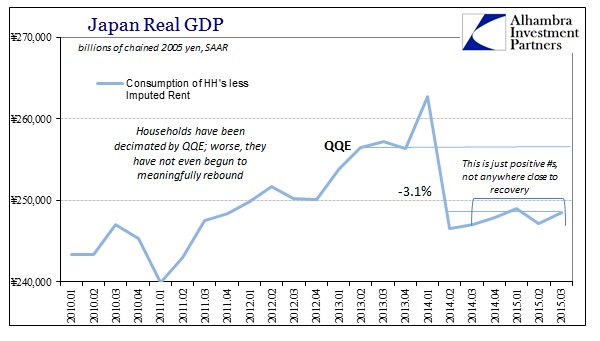
That 37% delta result is no doubt exaggerated (the yen/$ shifted 24%), but it appears that REAL growth in Japan was nearly nil, and inflation had a nice bump in 2014, but has evaporated - not close to the 2% target.

ABOOK-Nov-2015-Japan-GDP-HH-Cons-less-Rent.jpg


I'd take a victory lap, but there is nothing plesant about this outcome.
--

Negative interest rate is will certainly assist the currency decline but other policy will be needed to generate growth. What is the qty of commercial lending in Japan ? What are commercial rates like ?
 
Seems like the Bank of Japan is effectively doing exchange rate policy under the banner of inflation targeting.

China just devalued and switched to a currency basket peg. Japan countered with negative rates (bringing down the yen and a downward pressure on the whole yield curve).
 

ISF - Join now!

Every member here is approved by hand. No bots, no spam, just people who care about evidence and honest debate.

Membership is free!

Create your free account

Back
Top Bottom