Richard Gage Blueprint for Truth Rebuttals on YouTube by Chris Mohr

Status
Not open for further replies.
Approximately constant distance (or with a negligible percent in variation, as in the case of the Dan Rather viewpoint) results in negligible need for correction.
Agreed. The correction is of lower magnitude than the error resulting from defining building scaling metric on the Dan Rather footage, so it's a bit pointless.

With that 3D info it would then be possible to perform full perspective correction.
I could use SynthEyes to resolve the 3D motion using multiple "shots", but the problem with that (automated route AND manual as you're describing) is the significant increase in noise.

I'm interested in the shape of the curve for the first moments.
Not a problem.

There's little N-S movement at that point. I haven't compared the height of the windows near the bottom with that near the top; that can also give an idea of the influence of perspective.
It's fairly small, but not negligible.
 
I could use SynthEyes to resolve the 3D motion using multiple "shots", but the problem with that (automated route AND manual as you're describing) is the significant increase in noise.
The aim I had in mind is not to use a 3D trace for graphing, only for estimating distance to the camera over time for perspective correction. I expect that a heavily smoothed version of the 3D trace would suffice for that purpose. Microscale movements have negligible influence in the perspective correction. It would just be an additional refinement to the vertical position data.


[Influence of perspective is] fairly small, but not negligible.
Mostly agreed. That's why I've suggested using the camera position for the correction; the distance between the windows can serve as a secondary check, and also to have an initial idea before going into the more complex calculations.
 
Use your words. A YT link does not answer your assertions about NIST and Chandler.
Chandler explains what he did and what the software did. You ask for things you know don't exist and do not need to be known in an attempt to claim that NIST and Chandler don't know what they are talking about when they said WTC 7 fell at free fall for ~100'.

Then you'll have no issue adding a ~ prefix to your "FFA" every time you state it then.
Only deniers would do that. Chandler said "indistinguishable from free fall acceleration" and NIST said "at free fall"

NIST measured to within 1/10th of 1%. The difference is negligible - to small to be considered. As long as you keep using sophistry to deny the fact that WTC 7 fell at free fall acceleration for about 100' and claiming that NIST and Chandler don't know what they are talking about I will continue to post these facts.

A while since I've been called a "denier". Denying what ?
No-one is denying a period of ~FFA.

It's the ~ that's important there.
Double talk. Your implication in using ~ is that it is not FFA, correct? You can't have it both ways.

What caused early motion of the building, as-in...the building was in motion long before it started to drop. What caused that motion ?
Irrelevant to the period of FFA.


C7 said:
Draw the line that shows your interpretation.
http://img515.imageshack.us/img515/2535/femr5e.jpg
On the velocity graph. :rolleyes:

I just moved the line up to show how it fits the data before the moment of >g [which is probably a slight movement in the camera several miles away].

femr5ee.jpg


.
 
Last edited:
Chandler explains what he did and what the software did.
Yet you are unable to type them. Big surprise.

You ask for things you know don't exist
Incorrect. I've told you the answers several times within this very thread. It seems you're simply too dense to even notice.

and do not need to be known
When you repeatedly say stupid things like...
The programs NIST and Chandler used were designed to calculate acceleration.
...whilst freely admitting, when asked what "programs" they use. that...
[you] don't know.

That's just dumb.

Again, I've TOLD you numerous times...
You don't know what "programs" were used, because you simply don't understand. I've told you what I use:

a) SynthEyes - Professional feature tracking system, which I use to extract motion data from video with high precision. I've used many similar systems and SynthEyes has by far the most accurate tracking engine.

b) OriginPro - Professional data analysis and math environment, which I use to perform Savitzky-Golay smoothed derivation of raw data.

c) Excel - Which I use to translate from pixel units to real-world units, and generate the many lovely graphs I post.


Now then...

NIST placed "dots" on video by hand. So did Chandler. Awful.
Chandler may have redone his trace with Tracker, but likely did not use it's primitive tracking facilities.

NIST derived data using simple central difference approximation, probably with Excel or Matlab, though a piece of paper would do. Chandler's freebies "Physics Toolkit/Tracker" performed a similar symmetric difference derivation.


Yet you STILL don't know. Yet you still keep saying the "programs" they used "were designed to measure velocity and acceleration". Bizarre.

So, comprehension test...have a go at answering my questions again.

in an attempt to claim that NIST and Chandler don't know what they are talking about
As I already said to you, YOU don't even understand what they ARE saying. I've repeatedly told you that it's not about them not knowing what they are talking about, simply that their analyses use low fidelity data, and their results are inaccurate. What part of that do you not understand ?

when they said WTC 7 fell at free fall for ~100'.
Firstly, NIST don't say that. With local context...

...NIST say their estimation of approximate and average acceleration is equivalent to the acceleration of gravity during that period.

Only deniers would do that.
lol.

Chandler said "indistinguishable from free fall acceleration"
~FFA.

and NIST said "at free fall"
Nah...

NIST say their estimation of approximate and average acceleration is equivalent to the acceleration of gravity during that period.

As long as you keep using sophistry to deny the fact that WTC 7 fell at free fall acceleration for about 100'
What is wrong with you ?

No-one is denying ~FFA for a period of time, indeed I am ADDING a period >FFA.

What part of that are you having a problem with ?

and claiming that NIST and Chandler don't know what they are talking about
Where do I claim such ? I highlight problems with their data and studies, absolutely, as those issues are all real.

I will continue to post these facts.
You're not posting "facts". You're posting "crap". You know you're posting crap. Transparent. Obvious.

Double talk. Your implication in using ~ is that it is not FFA, correct?
Jebus. What does "~" mean ?

You can't have it both ways.
lol.

Irrelevant to the period of FFA.
~FFA. ffs.

On the velocity graph
The line indicating ~FFA is already on the graph son.

I just moved the line up to show how it fits the data
It doesn't fit. You don't know what you're doing. Stop it.
 
Firstly, NIST don't say that. With local context...

...NIST say their estimation of approximate and average acceleration is equivalent to the acceleration of gravity during that period.
You hang you hat on the qualifiers and ignore the scientific conclusion.
"the north face descended at gravitational acceleration"

~FFA. FFA
The difference is so tiny that it is not worth considering. Only a devout denier would try to imply that it is not FFA.

C7 said:
claiming that NIST and Chandler don't know what they are talking about
Where do I claim such ? I highlight problems with their data and studies, absolutely, as those issues are all real.
You just did. :rolleyes:

What does "~" mean ?
That was the question. When you use ~ does that mean that it was NOT FFA?

The line indicating ~FFA is already on the graph.
Non answer. You say there is .5s of >g. Where? draw lines to indicate where it is.

It doesn't fit.
Yes it does. It fits as well as the 1.8s of g. The data points are not perfect because they are taken from a video. You have acknowledged that.

In any case, the first 0.7s are at or greater than FFA. i.e. NO RESISTANCE!
 
And C7 will argue forever and a day about sub-pixel levels of accuracy in video analysis while blithely ignoring the absence of the 000's of explosions required to support his weird theory.

"Straining at gnats" is a good expression, and sums him up well.
 
And C7 will argue forever and a day about sub-pixel levels of accuracy in video analysis while blithely ignoring the absence of the 000's of explosions required to support his weird theory.

"Straining at gnats" is a good expression, and sums him up well.
You would almost expect Chris7 to post page after page of traces of buildings destroyed by controlled demolition falling at "free fall", but, he does not.

Why is this Chris7? This is a "classic sign" of controlled demolition, right?

:rolleyes:
 
You hang you hat on the qualifiers and ignore the scientific conclusion.
Incorrect.

Incorrect.

The difference is so tiny that it is not worth considering.
Incorrect.

Only a devout denier would try to imply that it is not FFA.
Incorrect.

You just did. :rolleyes:
Incorrect.

That was the question. When you use ~ does that mean that it was NOT FFA?
Really ? :jaw-dropp "~" = "approximately".

Non answer.
Incorrect.

You say there is .5s of >g
Incorrect. ~0.5s.

Where? draw lines to indicate where it is.
No need. Use the acceleration graph. Anything below ~-32.2ft/s2 is >g.

Yes it does.
Incorrect.

It fits as well as the 1.8s of g.
Incorrect.

The data points are not perfect because they are taken from a video.
Partially correct.

You have acknowledged that.
Correct !

In any case, the first 0.7s are at or greater than FFA
Incorrect.

i.e. NO RESISTANCE!
Incorrect.

11 Incorrect.
1 Correct.
3 Middlin'


You do not win a prize.

Try harder next time.
 
Last edited:
C7 said:
That was the question. When you use ~ does that mean that it was NOT FFA?
Really ? :jaw-dropp "~" = "approximately".
Non answer. When you use ~/approximately do you mean it was not FFA ?

C7 said:
Where? draw lines to indicate where it is.
No need. Use the acceleration graph. Anything below ~-32.2ft/s2 is >g.
Cop-out. I have shown that your velocity graph shows:
ETC: FFA for ~0.4s, then >g for ~0.3s. then FFA for 1.8s.
femr5c.jpg

You cannot refute this so you refuse to answer directly. We could quibble about 0.2s of >g but that's not the point.

Your velocity graph shows FFA or greater. There is NO <g until 14.9s - 85'.


Just saying incorrect without saying why is worthless.
 
Last edited:
...
No, the data points [dots] are inaccurate due to the fact they are taken from a video. Some are more inaccurate than others. That's why the program has a feature that computes the average and draws the line.
...

C7, do you have Chandler's data points in tabulated form? As a list of pairs of numerical values "time|drop distance"? This as opposed to "dots" or "lines" drawn in a chart.

Thanks
 
Non answer.
Incorrect.

When you use ~/approximately do you mean it was not FFA ?
The inclusion of the approximate qualifier is non-optional, and means just that...approximate. You, as you are clearly a bit dim, might want to think of some other words, like equivalent, estimation, average...things like that.

Stick a ~ in front of "FFA" when you write it, and I'll give you a lot less grief. Oh, but make sure you don't state ridiculous incorrect ~FFA periods suggesting my data supports your nonsense, as it doesn't. Being very generous you could say my data suggests ~1.75s of ~FFA. More than that and I'll be on your case.

I have shown that your velocity graph shows
You really haven't.

You cannot refute this so you refuse to answer directly.
ROFL. My graph shows there are Klingons on the starboard bow. You cannot refute this so you must now sit in the corner wearing the blue dunce hat. Refute what ? You pulling faeces out of thin air ? I've tried to tell you many times. The time to simply point and laugh instead is approaching rapidly I'm afraid.

We could quibble about 0.2s of >g but that's not the point.
No, the point is that your severe lack of understanding, in combination with your willful refusal to learn from (or even admit) (or, ffs, even recognise) your mistakes, in conjunction to your blind desire to see what you want to see...renders your dialogue totally pointless, repetative and really, really boring.

Without your problems above, you could have simply improved your understanding a long time ago, and be discussing the correct details, rather than waste my time going round in circles with the REALLY simplest of friggin things imaginable.

Just saying incorrect without saying why is worthless.
Saves me time. It's not like you're ever going to learn anything. You just don't want to.
 
Last edited:
in an attempt to claim that NIST and Chandler don't know what they are talking about when they said WTC 7 fell at free fall for ~100'.

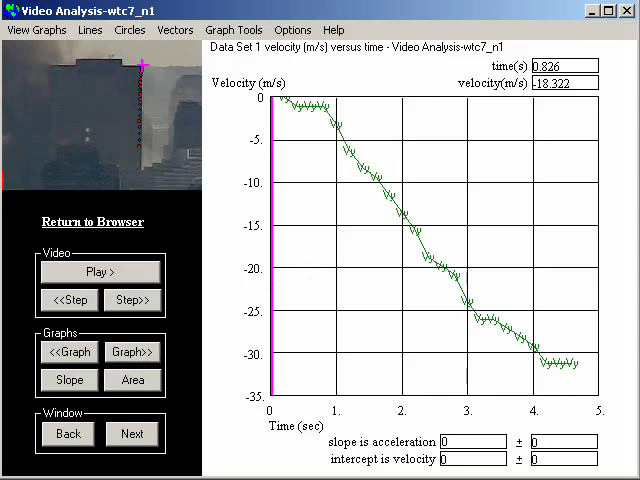
Here's Chandler's "re-done" WTC7 velocity plot...

117268871.png


In your own words, please explain how the **** you get from that remarkably non-linear (aka wiggly) line, which, of course you understand cannot imply a constant acceleration, "FFA" or not, to saying "indistinguishable from freefall" ?

Chandler said "indistinguishable from free fall acceleration"
Correct. He really shouldn't have, should he.
 
Here's Chandler's "re-done" WTC7 velocity plot...

http://femr2.ucoz.com/_ph/7/117268871.png

In your own words, please explain how the **** you get from that remarkably non-linear (aka wiggly) line, which, of course you understand cannot imply a constant acceleration, "FFA" or not, to saying "indistinguishable from freefall" ?
The wiggly line assumes that the data points are accurate. Chandler explains that the data points are not perfectly accurate because they are taken from a grainy video. The deviation from free fall line is that inaccuracy, not a variation in the acceleration.

This is basic high school physics that most high school aged people can understand.
 
The wiggly line assumes that the data points are accurate. Chandler explains that the data points are not perfectly accurate because they are taken from a grainy video. The deviation from free fall line is that inaccuracy, not a variation in the acceleration.

This is basic high school physics that most high school aged people can understand.

Chandler versus femr2 ???

My money is on femr2.

...even us older folk understand physics. But we weren't "taught" by Chandler. ;)
 
The wiggly line assumes that the data points are accurate.
The "wiggly line" is not sentient, and assumes nothing.

The line simply connects the actual data-points.

The RESULT is a "wiggly line".

Chandler explains that the data points are not perfectly accurate because they are taken from a grainy video.
There is certainly an amount of error introduced by extracting the data from video, however, you do not create new accuracy that was not there in the first place by placing a straight line over the top of a wiggly one.

All you achieve is an average, an estimation, an approximate result that is easier to "read".

The question you must ask, is how you KNOW that variation is "noise" and not "real" ?

The answer, as I know you'll fluff it, is that you don't know.

There are ways of "cutting through noise", but a linear fit is FAR from the best or most accurate way to do that.

The deviation from free fall line is that inaccuracy, not a variation in the acceleration.
Utterly, obviously, simply incorrect...in this case, as we DO have more accurate data available, mine.

My data shows that some of that variation is indeed "real".

My acceleration profile is much closer to actual, and reveals detail not presented by either Chandler nor NIST.

You should update your position.

It's not wildly different from your previous position, as it's still valid to suggest ~1.75s of ~FFA during which the NW corner descends ~83ft.

Being more specific than that, or omitting any of the approximate qualifiers is not supported by my data, let alone the lower quality and inferior data from either Chandler or NIST.

This is basic high school physics that most high school aged people can understand.
It is indeed. So why are you having so much difficulty with it ? Are you pre-high-school in learning ?

If so, then why are you trying to defend your eronious position ?

If not, then why are you trying to defend your eronious position ?

 
Chandler explains what he did and what the software did. You ask for things you know don't exist and do not need to be known in an attempt to claim that NIST and Chandler don't know what they are talking about when they said WTC 7 fell at free fall for ~100'.

Only deniers would do that. Chandler said "indistinguishable from free fall acceleration" and NIST said "at free fall"

NIST measured to within 1/10th of 1%. The difference is negligible - to small to be considered. As long as you keep using sophistry to deny the fact that WTC 7 fell at free fall acceleration for about 100' and claiming that NIST and Chandler don't know what they are talking about I will continue to post these facts.

Double talk. Your implication in using ~ is that it is not FFA, correct? You can't have it both ways.

Irrelevant to the period of FFA.


On the velocity graph. :rolleyes:

I just moved the line up to show how it fits the data before the moment of >g [which is probably a slight movement in the camera several miles away].

[qimg]http://img37.imageshack.us/img37/7076/femr5ee.jpg[/qimg]

.

Christopher? We're talking about 2.25 seconds. No more than about 25% of the total collapse! You're obsessing over minutaie. Contrary to what you might think, the whole world doesn't hang on that 2.25 seconds!

Breathe! Chill out!
 
The wiggly line assumes that the data points are accurate. Chandler explains that the data points are not perfectly accurate because they are taken from a grainy video. The deviation from free fall line is that inaccuracy, not a variation in the acceleration.

This is basic high school physics that most high school aged people can understand.

Bollocks. Basic high school physics says that, unless you've analysed and understood the measurement error of the individual points, you can't tell what level of detail in the data is a genuine measurement and what part is that inaccuracy. As usual, C7 is starting from a conclusion and reasoning backwards to an unfounded interpretation of the data. If he weren't, he'd be able to state the width of the error bar on each point, which he won't because he can't.

Dave
 
There is certainly an amount of error introduced by extracting the data from video, however, you do not create new accuracy that was not there in the first place by placing a straight line over the top of a wiggly one.
The software computes the average and draws the line. It is designed to compute the velocity of objects in a video and that's the way it's done.

In the debate, Dave acknowledged "there was a 2 er 1 3/4 second period of FFA of this outer shell". He's probably referring to your graph and he understands that it confirms at least 1.75s of FFA. Your data points are closer to the free fall line than Chandlers or NIST's. Nice work. Since data taken from a video is imprecise, a straight line thru the average of the data points is the logical scientific conclusion. That is the accepted way it is done.

Your interpretation that WTC 7 was varying around FFA is wrong.
 
My acceleration profile is much closer to actual, and reveals detail not presented by either Chandler nor NIST.
You used the same data for your acceleration and velocity graphs but got completely different results.

If you wish to claim that I am wrong, point to where I am wrong.

On your acceleration graph, you have
~0.8s of acceleration from zero to FFA
Then ~1 s of >g.
Then 0.5s of g or >g ???
Then <g
femr4ec.jpg

But on your velocity graph you have
~0.1s to 0.2s of acceleration from zero to FFA
Then ~0.4s of FFA
Then ~0.3s of >g
Then ~1.75s of g
Then <g
femr5ec.jpg
 
Last edited:
Status
Not open for further replies.

Back
Top Bottom