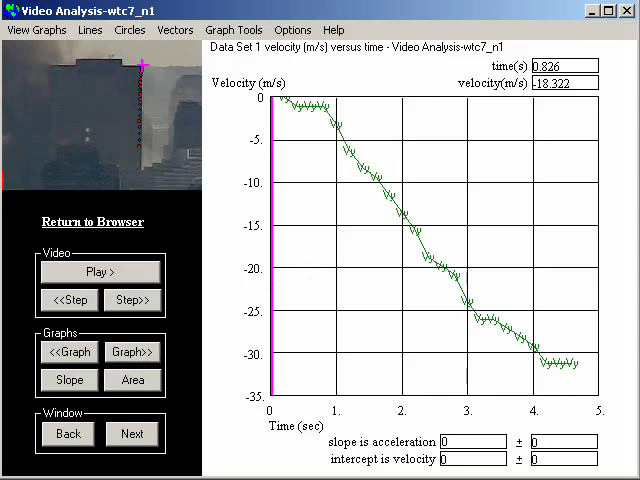
The wiggly line assumes that the data points are accurate.
The "wiggly line" is not sentient, and assumes nothing.
The line simply connects the actual data-points.
The RESULT is a "wiggly line".
Chandler explains that the data points are not perfectly accurate because they are taken from a grainy video.
There is certainly an amount of error introduced by extracting the data from video, however, you do not
create new accuracy that was not there in the first place by placing a straight line over the top of a wiggly one.
All you achieve is an average, an estimation, an approximate result that is easier to "read".
The question you must ask, is how you KNOW that variation is "noise" and not "real" ?
The answer, as I know you'll fluff it, is that you don't know.
There are ways of "cutting through noise", but a linear fit is FAR from the best or most accurate way to do that.
The deviation from free fall line is that inaccuracy, not a variation in the acceleration.
Utterly, obviously, simply incorrect...in this case, as we DO have more accurate data available, mine.
My data shows that some of that variation is indeed "real".
My acceleration profile is much closer to actual, and reveals detail not presented by either Chandler nor NIST.
You should update your position.
It's not wildly different from your previous position, as it's still valid to suggest ~1.75s of ~FFA during which the NW corner descends ~83ft.
Being more specific than that, or omitting any of the approximate qualifiers is not supported by my data, let alone the lower quality and inferior data from either Chandler or NIST.
This is basic high school physics that most high school aged people can understand.
It is indeed. So why are you having so much difficulty with it ? Are you pre-high-school in learning ?
If so, then why are you trying to defend your eronious position ?
If not, then why are you trying to defend your eronious position ?



 "~" = "approximately".